Introduction
From climate change and biodiversity collapse to social inequality and geopolitical unrest, these are just a few of the many social and ecological crises we face. These crises do not exist in isolation, but are symptoms of a deeper issue: we are in ecological overshoot.
Ecological overshoot means we deplete resources faster than they regenerate, produce more waste than the earth can absorb, and destroy ecosystems in the process. We have already transgressed 6 out of 9 planetary boundaries that make up our planet’s life support system. If ecological overshoot is the root problem, then the root cause is our modern, industrial, colonial way of living, based on expansion and extractive capitalism. We cannot pursue endless economic growth on a finite planet. Solutions such as incremental progress, green growth and technological fixes often perpetuate this root cause and fail to offer a true alternative.
Bioregioning offers a different path. It is a meaningful response to our social and ecological issues that combines deep ecology with a place-based approach. For most of human history, people were native to their place. Bioregioning asks us to learn from this and asks the question: How can we once again live as an integral part of our ecosystem?
It starts with the bioregion: a region defined by natural boundaries such as watersheds and mountain ridges, instead of arbitrary political lines. A bioregion is a coherent and whole ecosystem that includes the unique human culture and local knowledge of that place. It is the largest unit we can still connect to- the largest place we can still call ‘our home’. The bioregion is the linking pin between global earth science and our local place, allowing us to think global and act local.
Bioregioning supports and aligns with regeneration: the intrinsic drive of living systems to continuously heal, adapt and self-organize into resilient, diverse and vibrant ecosystems. It is the work of belonging: a practice of coming home to our landscape, contributing to the local web of life and improving the socio-ecological conditions of our life-place.
The Bioregional Participatory Action Research (BPAR) framework offers a way to take action for bioregional regeneration. The BPAR framework adds ‘Bioregioning’ to ‘Participatory Action Research’ and describes the minimal elements required to do Action Research: “Execute 4 steps that ensure 12 outcomes while applying the 4 principles”. This makes the BPAR framework easy to remember and easy to use. For a deeper understanding and more information on every step, read the full BPAR guide after you read the BPAR framework.
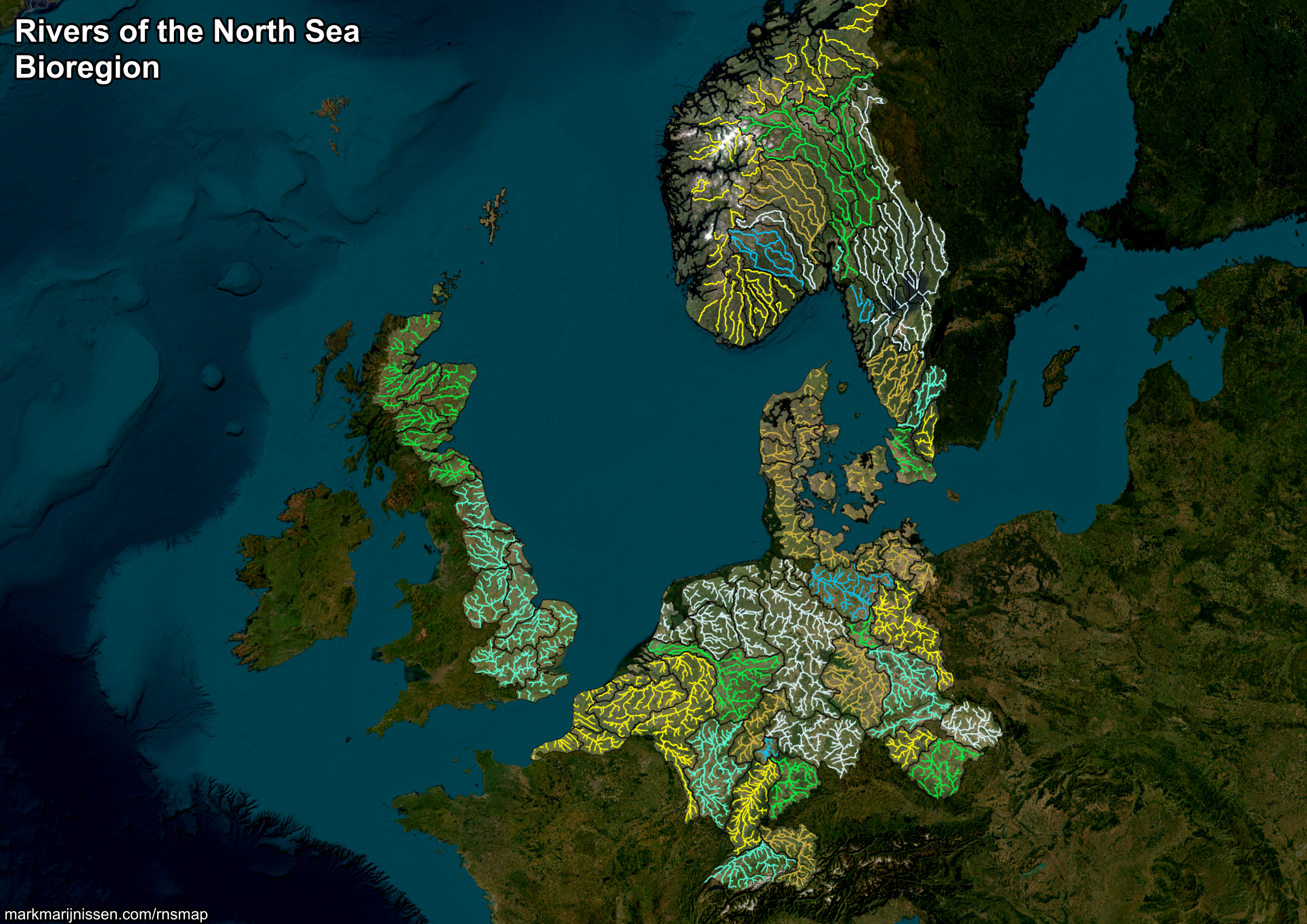 Rivers of the North Sea Bioregion. Depicted are the watersheds of the rivers, instead of the nation-states of West Europe.
Intended use
BPAR is applicable when you have a problem, question or challenge where there is no best practice to follow and you need to discover what works. If a proven method already exists, we recommend using that method instead. BPAR gives a sense of orientation and direction: Where am I and what should I do?
The framework can be used fully from start to finish, in which writing a research article helps structure your initiative. It can also be used incidentally, alongside other frameworks, to reflect on your current situation and determine the next action or improve your strategy. Finally, the framework offers various frames, narratives and concepts to explain how you are regenerating a bioregion to others.
The framework is deliberately minimal and is meant to be adapted and extended to fit your local bioregional context. Use what works, discard what does not and add what is missing.
Steps and outcome: What to do
Execute four steps (bold) to answer the key question (italic) and ensure twelve outcomes (underlined and numbered). When using this framework from start to finish, write these outcomes in a research paper (blue headings) to share with others.
Step 1) find Direction: a Calling Enquiry
Introduction
Key question: Where are you heading?
- Formulate a Research question (1) and
- limit scope (2) geographically, relationally and conceptually.
Step 2) do Research: Connect & Explore
Initial exploration and literature review
Key question: Where are you now?
- Explore the landscape (3),
- Connect with stakeholders (4) and
- Perform a literature review (5).
Step 3) take Action: Collaborate & Experiment
Methods
Key question: “What can you do?”
Run experiment to test hypothesis:
- “Will Action (6) lead to
- Intended Outcome (7)?"
- Collaborate: Design for participation (8),
- Make sure to collect data and observations (9).
Step 4) harvest Wisdom: Community Evaluation
Results
Key question: How did it go?
- Analyse data and observations to validate hypothesis (10).
Conclusion and discussion
- Answer research question (11) and
- Determine next step (12) - a new BPAR cycle.
 The steps can be remembered as DRAW: Direction, Research, Action and Wisdom, in which you Enquire, Explore, Experiment and Evaluate (EEEE). Also note the four C’s of participation: Call, Connect, Collaborate & Community - they are depicted as yellow figures.
Principles: How to do it
The steps tell you what to do and the principles tell you how to do it. These principles can be applied at every step to infuse them with the spirit of BPAR. As BPAR is a minimal framework, use these principles to guide your decisions in adapting and extending the framework for your local context. There are four principles that are based on the name: BPAR.
Every principle is formulated as a question and a value statement: “We value X over Y”. Which means that while Y might be useful at times, we prefer X when faced with a dilemma.
The Bioregional Principle
How are you listening or regenerating the Bioregion?
We value a deep ecological view over an anthropocentric view (Bio-)
We value a place-based view over a global view (-regional)
In order to add Bioregioning to Participatory Action Research, we must introduce a few key terms:
- Ecology: The study of the web of life - the relationships between organisms and their environment.
- Deep Ecology: Valuing all life on earth as inherently valuable. Recognizing our interdependence, human beings are viewed as part of nature - not separate or superior. Deep ecology cares for the wellbeing of all living things, including more-than-human life.
- Anthropocentric: Exclusively focusing on human needs, interests, values and constructs (such as the economy) while ignoring or dismissing the needs of more-than-human life, biophysical laws and the environment.
- Place-based: Taking the unique characteristics of a particular place into account, recognizing them as significant for effective action.
- Bioregion: A place defined by natural boundaries such as watersheds and mountain ridges, instead of arbitrary political lines. It is a coherent and whole ecosystem that includes the unique human culture and local knowledge of that place, and the largest place we can still meaningfully call ‘our home’.
- Regeneration: The innate and active drive of living systems to heal from disruption, adapt to new conditions, and continuously self-organize into more intricate and resilient patterns of existence.
- To regenerate: Working with nature – rather than against it – to actively restore the health, resilience and self-organizing capacity of the whole socio-ecological system.**
The Participatory Principle
How are you inviting people to Participate?
We value sharing over retaining (of information, decisions, resources, work, power)
As outlined in the introduction, our modern, industrial and colonial way of living is driving social inequality. To prevent power and wealth from accumulating and concentrating in a select few, we practice participation to share our information, decision, resources, work and power. Examples of applying the Participatory Principle are stewarding a commons or using sociocratic decision making.
The Action Principle
How are you taking Action for bioregional regeneration?
We value action for bioregional regeneration over thinking and talking.
Insight without action is nothing more than a good story. The Action principle invites you to explicitly formulate a theory of change: How will your actions lead to certain outcomes that in turn will contribute to bioregional regeneration? What data and observations can you collect to show progress?
The Research Principle
How are you Researching?
We value discovery and learning over delivery and performing.
The Research principle is based on the fact that discovery and learning are vital to navigate complex challenges. And complex challenges we have: Never before have we breached so many planetary boundaries, risked so many tipping points, or have been so deep in ecological overshoot. The socio-ecological crises we are facing today are unseen in magnitude, depth and complexity. We are in a situation that is novel, complex and quickly changing. Nobody has definitive answers and we cannot rely on what has worked in the past. Therefore, we must learn by discovering what works in the present.
The Research principle is most visible when you write a research article to structure your initiative from start to finish. However, even when you do not write a research article, the attitude of research is present in every step: staying curious, open-minded, listening and learning.
Too much focus on delivery and performance might lead to simplistic solutions that are ineffective or have unintended consequences. It can be an attempt to control nature rather than work with nature. Remember when we sprayed broad-spectrum pesticides like DDT to control pest insects, which unintentionally decimated bird populations and poisoned waterways?
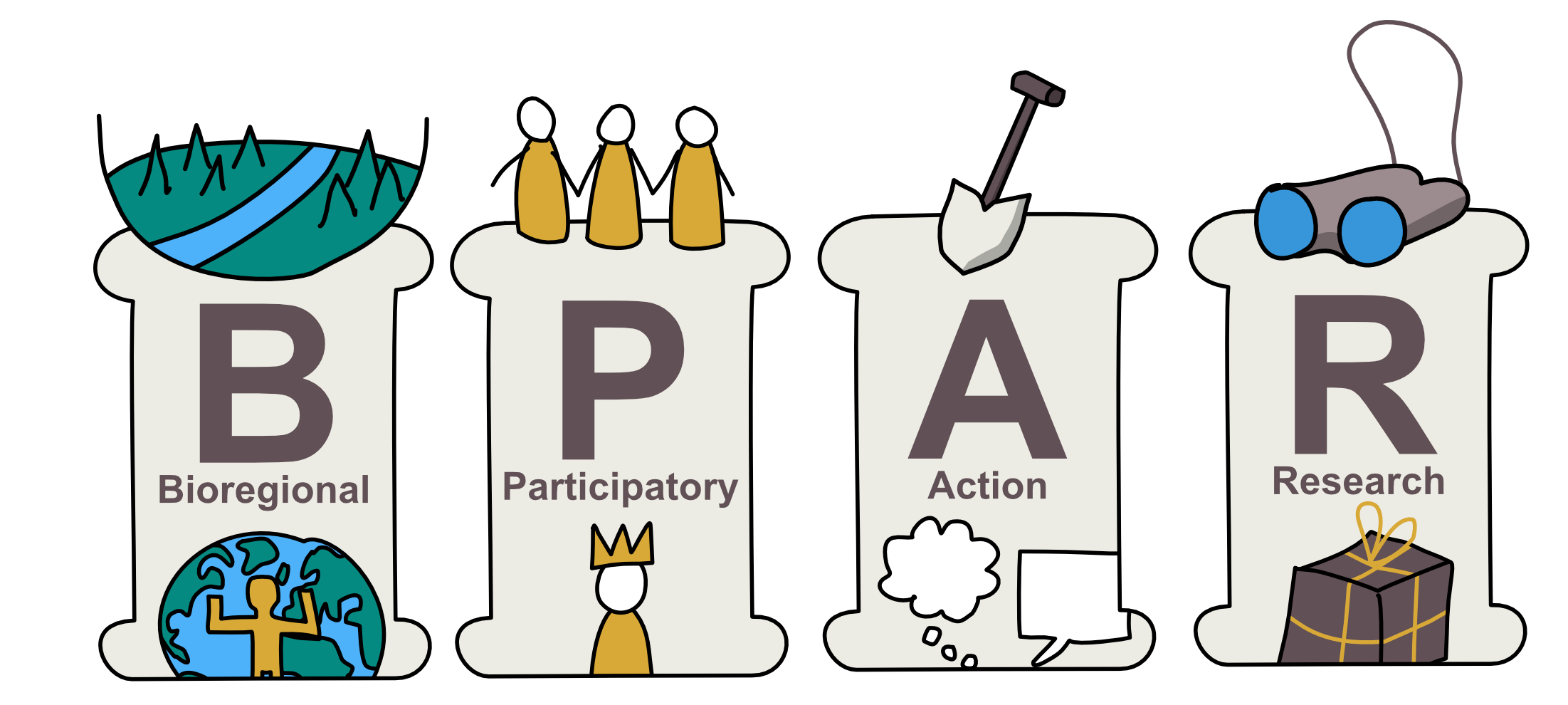 These pillars visualize the value statement of ‘X’ over ‘Y’
- Bioregional: Bioregional over Anthropocentric & Global.
- Participatory: Sharing over Retaining.
- Action: Action over Thinking and Talking.
- Research: Discovery over Delivery.
How to apply the BPAR-principles at every DRAW-step
In the table below, you see how the principles can be applied at every step:
DRAW-steps →
BPAR-principles ↓
Step 1: find Direction
Step 2: do Research
Step 3: take Action
Step 4: harvest Wisdom
Bioregional Principle:
How are you listening and regenerating the bioregion?
Listen to ecological and cultural needs; limit scope to your bioregion.
Explore the landscape and connect with stakeholders involved.
Link your actions and indended outcomes to the ecological and social regeneration of your bioregion.
Harvest the results and learnings and share them with the community for broader bioregional impact.
Participatory Principle (CCCC):
How are you inviting people to participate?
Call (people in)
Connect (with stakeholders)
Collaborate (with your team)
Community (harvest)
Action Principle (EEEE):
How are you taking action for bioregional regeneration?
Enquire: Where are you heading?
Explore: Where are you now?
Experiment: What can you do?
Evaluatie: How did it go?
Research Principle:
How are you researching? (The twelve outcomes help structure the research paper)
Introduction
(1) Research Question
(2) Limit Scope
Initial Exploration
(3) Landscape observations
(4) Stakeholders
(5) Literature review
Methods
(6) Action
(7) Intended outcome
(8) Participation Design
(9) Data Collection
Results
(10) Validate hypothesis
Conclusion & Discussion
(11) Answer research question
(12) Determine next steps
Optional elements to include in the paper:
Background & Context
Refine Research Question
Data Analysis, Ethics
Reflection on the DRAW-steps and BPAR-principles
Next steps
Use the framework
Use BPAR to
- …find the next best action in an existing initiative.
- …structure an initiative from start to finish.
- …as a frame to explain to others what you are doing.
- …improve your strategy.
Read the BPAR guide to learn how.
Learn more about Bioregional Participatory Action Research
Read the BPAR guide and learn more:
- An introduction to Bioregoning and Participatory Action Research.
- A deep dive into the DRAW-steps and BPAR-principles.
- Additional models and methods to extend and adapt the framework.
- Further reading and resources to continue learning.
Get support
Get professional and/or volunteer support in using this framework.
Remix this framework to fit your needs
Use the CC BY-SA 4.0 license, which requires you to attribute the authors and share under the same license.
]]>The BPAR guide is in a beta-version.
- Do you want to take action for bioregional regeneration?
- Are you trying to determine the next best action?
- Do you want to structure an initiative from start to finish?
- Are you looking to explain bioregioning to others?
- Or wanting to improve your strategy?
Please read the framework and guide and apply it to your situation. We are looking for case studies and feedback from users to improve this guide. Contact us.
Contribute to the BPAR guide
We hope BPAR supports you in taking action for bioregional regeneration. We use a participatory approach for the framework and guide: let’s apply BPAR on real-world cases and use our experiences to improve this work, together.
You can share feedback, propose changes and share case studies. We value feedback from using the framework above all. We also appreciate feedback from deep expertise.
We will review and include your contribution when it improves this guide.
]]>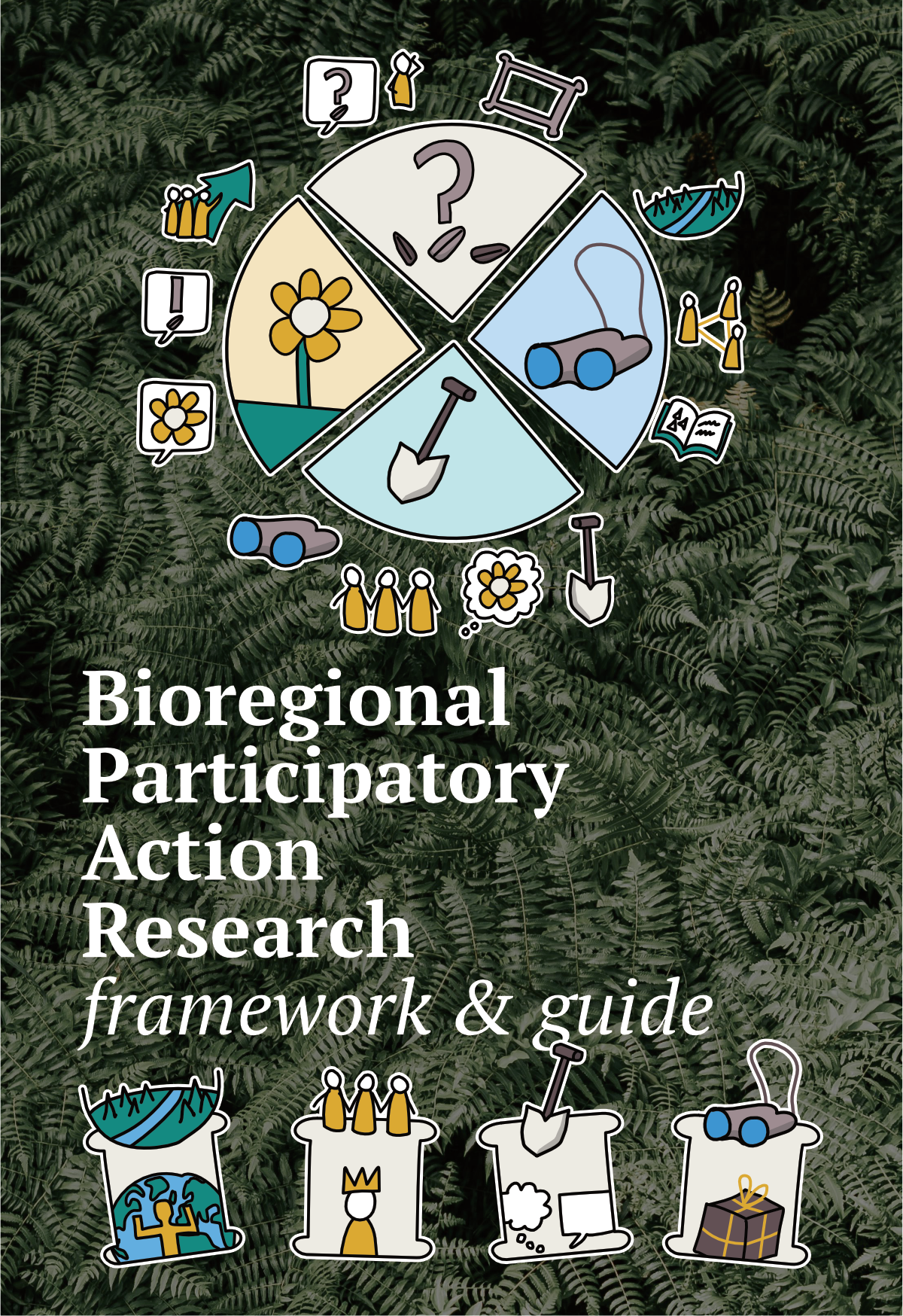
Contents of the book
Learn more about Bioregional Participatory Action Research:
- The BPAR minimal viable framework.
- A deep dive into the DRAW-steps and BPAR-principles.
- An introduction to Bioregioning and Participatory Action Research.
- Additional models and methods to extend and adapt the framework.
- Further reading and resources to continue learning.
Learn how to use BPAR to:
- …find the next best action in an existing initiative.
- …structure an initiative from start to finish.
- …as a frame to explain to others what you are doing.
- …improve your strategy.
Read the book
Last version: 0.9, 26 june 2025. First manuscript.
The book is currently being rewritten based on the feedback. Send a message if you want to read the work in progress.
Supporting materials
- Research Paper Template (to do)
- Canvas (to do)
- Illustrations (to do)
- Presentation (to do)
Contribute to the guide
This book is a participatory effort:
]]>Ineens viel het kwartje: Ik weet hoe je moet opgavegericht werken voor een leefbare aarde!
Toen ik een jaar geleden begon met FORLEA (FOR a Liveable EArth) wist ik het grondprobleem, de grondoorzaak en de oplossingsrichting.
In het kort:
- Het grondprobleem is dat we 6 van de 9 planetaire grenzen hebben overschreden; we zijn in ecologische overshoot.
- De grondoorzaak is een economie gebaseerd op eindeloze groei: we privatiseren de winsten en externaliseren de ecologische en sociale kosten.
- De oplossingsrichting? Niet méér consumeren (groene groei) of hopen op wonderen (techno-fixes) maar leren leven binnen de grenzen van de aarde. Herstel ecosystemen, schep veerkachtige gemeenschappen die behoeften kunnen vervullen zonder winstoogmerk, en stimuleer ecologisch bewustzijn.
Dat is helder - maar wat ga ik nu concreet doen?
Het antwoord lag achteraf zó voor de hand dat ik mij verbaas dat ik het niet eerder heb gezien.
Ik zat zo vreselijk te puzzelen: Hoe combineer ik organisatieontwikkeling en teambegeleiding voor opgaveteams die willen innoveren op maatschappelijke vraagstukken met mijn ambitie om van betekenis te zijn voor een leefbare aarde?
- Opgavetrekker voor een opgaveteam rondom duurzaamheid?
- Organisatieontwikkeling voor duurzame organisaties?
- Leiderschap training, maar dan ecologisch of regeneratief?
En toen opeens klikte het: Bioregionaal Participatief Actie Onderzoek!
- Bioregionaal betekent kijken met een ecologisch perspectief (bio-) en vanuit het landschap (-regionaal).
- Participatief betekent dat je in co-creatie met alle betrokkenen aan de slag gaat.
- Actie betekent richten op impact voor de ecologie en de maatschappij
- Onderzoek betekent een lerende, experimenterende aanpak die geschikt is voor complexe vraagstukken.
(Participatief) Actieonderzoek is een methode om maatschappelijke verandering teweeg te brengen door actie en onderzoek te combineren, het liefst mét de mensen (participatief).
Dit past goed bij andere methodieken die ik ken: Theory U is een vorm van actieonderzoek. Ook gaan ideeën uit Design Thinking, Lean Startup en Agile passen goedsamen met actieonderzoek: onderzoeken wat werkt door te luisteren naar de betrokken mensen, en dat iteratief en kort-cyclisch.
Het bioregionalisme is een stroming die mij veel houvast geeft in hoe je kunt zorgen voor een leefbare aarde.
Voeg dat samen en je krijgt: Bioregionaal Participatief Actie Onderzoek!
Wat ik dus doe: Een proces begeleiden waarmee je impact kunt maken op ecologische en maatschappelijke vraagstukken.
Opgavegericht werken voor een leefbare aarde, dus.
(En ik kan ook de mensen, teams en organsatie ontwikkelen zodat zij zélf dit proces goed kunnen beleiden)
Om te beginnen heb ik een minimaal raamwerk geschreven. De essentiële elementen voor Bioregionaal Participatief Actieonderzoek (zie foto). Maar daarover later meer!

This is my reply:
It’s a combination from what I am good at (change agent) with what the world needs (a liveable earth).
Underneath ‘for a liveable earth’ are a few key beliefs and ideas, which I can briefly outline as follows:
- The root problem isn’t climate change or carbon (CO2) - it is ecological overshoot: we have crossed 6 out of 9 planetary boundaries. Ecological overshoot deserves some explanation: when a species consumes more resources than its environment can generate, the resources will run out and this will cause the population to collapse, as it cannot sustain itself any longer. This means that humans, too, will face a collapse.
- The root cause is capitalism; profit maximization is made possible by externalizing harm to others elsewhere (by expansion and extraction) or to the future (by drawing down resources that cannot be used in the future).
Therefore, solutions within a profit-maximizing system might reduce harm or alleviate suffering, but will not contribute to the systemic shift that needs to happen. By the way: The system will not shift - it will break down, while other new systems emerge.
I have come to the conclusion that there are few good things to do:
3) Restore ecosysems (e.g. reduce pollution, increase health, resilience and biodiversity of landscapes, etc).
4) Reduce inequality (e.g. counteract the capatalistic machine).
5) Increase eco-centric thinking and ecological awareness.
Currently, I am advocating bioregionalism by co-facilitating my bioregion: the “Rivers of the North Sea” (e.g. North-West Europe) in the Design School for Regenerating Earth. They just started a learning journey, and if interested you can still join!
Also, I lead change initiatieves that help governments and muncipalities to work in a way that prioritizes making impact on the issues (“opgaven”) our society is facing. This requires new ways of thinking, working and organizing that build on (a) navigation complexity and (b) a radical shift in perspective from inside-out to outside-in.
In my toolbox are various methods that build empathy and navigate complexity, like participatory action research, theory u, agile, scrum, design thinking, art of hosting, etc. Of course, the change initiative itself isn’t a blueprint, but a participatory proces in which we practice being a learning organization, responding to change, doing what is needed to make an impact on what matters most.
]]>
Co-create this map on the Design School for Regenerating Earth. More information here.
]]>Say what now? Bioregions? Rivers of the North Sea? Regenerating Earth? A School?
Let me explain.
Bioregions: Imagine if you define countries not by the geopolitical boundaries of nation states, but by the ecological and cultural features. Then I would not live in the Netherlands, but in the watershed of the Rhine, near the Waal. The people living here used to be fruit growers, and they lived with the eb and flow of the river. The river gave fertile ground for growing apples and pears, but it also took ground when it flooded.
Acknowledging both the ecological features as well as the cultural history of the place I live allows me to reconnect to the land I live on. As we have currently crossed 6 out of 9 planetary boundaries, we must learn how to live within planatary boundaries and regenerate the earth.
However, the scale of the entire earth is paralyzing and crippling. At what scale do we, humans, need to learn to live within planatery boundaries? At the bioregional scale! If we learn to live on a bioregional scale, and live within the bioregional boundaries, then our local efforts (e.g. permaculture garden, regenerative farm) scale up to a cohesive society; a ‘country’ based on ecological and cultural features! And just like nation-states have provinces, muncipalities and properties, so we can have multiple scales within a bioregion.
Rivers of the North Sea is a bioregion defined, more of less, by the watersheds of rivers that drain into the North Sea. Rivers like the Schelde, Rhine, Elbe, Meuse, Ems, Thames and more. It is a different way of looking at North-West Europe. Connected to those rivers are ecosystems, languages, countries and much more. Like those fruit growers in my town.
The Design School for Regenerating Earth is a community and school led by Joe Brewer andPenny L. Heiple. It is an amazing community and school for a number of reasons.
First, they acknowledge the severity of our predicament; we are in an ecological overshoot and collapse situation. This means no techno-fixes, green growth or greenwashing here.
Second, this community is not doom-and-gloom but positive and empowering: by practicing a bioregionaling, we practice a response to our predicament that serves all life on earth. We make the best of a bad situation.
Third, the school covers both the inner work (e.g. dealing with climate anxiety) as well as the outer work, and they prioritize on-the-ground action over on-the-internet talking.
Fourth, the Design School dreams BIG; they offer a vision for the entire earth, and connect this to a local effort. I personally have struggled with local effort (what is the point) as well as planetary thinking (too big, abstract, unactionable). The Design School finds a way to connect those.
]]>Herken je dat? Als je de wereld bekijkt met een ander uitgangspunt, kun je vanzelfsprekendheden in twijfel trekken. Dat wat iedereen logisch vind, klinkt gek in je oren. Ben jij dan gek of is de wereld gek? Als je niet oppast ga je ook nog aan jezelf twijfelen.
Bijvoorbeeld:
- Vanwaar die obsessie met CO2? Hoe zit dat dan met biodiversiteit, landgebruik, waterkwaliteit, luchtvervuiling, stikstofproblemen, mestoverschot?
- Vanwaar het reduceren tot problemen zoals biodiversiteit, landgebruik, waterkwaliteit en meer? Het gaat toch om het herstellen van ecosystemen die we leeg geplunderd hebben zodat de aarde weer gezond wordt en ons van voedsel, grondstoffen en veiligheid kan voorzien?
- Hoezo netto nul? Dat is alsof je iemand in zijn gezicht spuugt en het daarna met een doekje schoonmaakt zodat je ‘netto’ geen impact maakt.
- Groene groei? Als iedereen leeft zoals in Nederland, hebben we 4 keer de aarde nodig. En dan nog verder groeien?
- Een mooi net grasveldje? Ik zie het tegenhouden van ecologische successie met veel arbeid (en soms ook bestrijdingsmiddelen) waardoor insecten en planten geen kans krijgen om te leven.
- Een fijn bosje bloemen? Ik zie stervende planten vol met gif waarvan een bloemist in Frankrijk laatst gelijk kreeg: dat de leukemie waaraan zij haar dochter verloor inderdaad kwam doordat ze teveel bloemengif kreeg via haar werk.
En zo kan ik we even verder gaan. Het probleem gaat nog verder, van veel ons werken binnen een kader dat beschouwd wordt als gegeven. Hierdoor denkt niemand na over de fundamentele uitgangspunten. Daardoor verzinnen we oplossingen die het probleem erger maken.
In denk dat het waardevol is om een ecologisch wereldbeeld te leren, omdat je hiermee tot wezenlijk andere oplossingen komt. Ook ontmantel je hiermee het denken van uit extractie, expansie, kapitalisme, reductionisme en individualisme dat diepgeworteld ons steeds verder en opnieuw in de problemen brengt.
Dat begint met je kaders niet voor lief te nemen. Dat begint met het bevragen van wat jij ziet als gegeven. Alleen door dit te bevragen wordt een ecologisch wereldbeeld méér dan een leuke filosofie, maar kun je het ook werkelijk toe gaan passen in het werk.
Daar nemen we vaak de tijd niet voor. Of we weten niet hoe het moet. Of de waan van de dag houdt ons bezig. Of het systeem biedt ons geen ruimte om buiten het narratief en kaders te gaan die gesteld zijn. Lastig werk dus!
Ik geloof overigens dat je voor een ecologisch wereldbeeld geen ecoloog hoeft te zijn. Het gaat namelijk niet om de feitelijke kennis over ecosystemen, maar over begrijpen, ervaren en voelen hoe ecologie werkt. Het herkennen van uitgangspunten en patronen. Van individualisme naar verwevenheid. Van reductionisme naar complexiteit. Van ontworpen naar emergentie. Van extractie naar regeneratie. En zo voort.
]]>Dit zijn de drie pijlers:
- Herstel ecosystemen
- Samenredzaamheid
- Ecobewustzijn
Herstel ecosystemen

- Zorgt het voor meer leven op aarde?
- Is het een goed idee als iedereen het zou doen? Met andere woorden: is het echte duurzaamheid?
Echte duurzaamheid betekent:
- Neem niet meer dan je krijgt
- Maak het niet kapot - of herstel meer vóórdat je iets kapot maakt: geen landschapsdegradatie of uitbuiten van mensen.
- Dump niet meer afval dan de aarde kan verwerken
Zodat je ecologische overshoot vermindert en binnen planetaire grenzen blijft.
Samenredzaamheid

- Vermindert het ongelijkheid? (Robin Hood principe: steel van de rijken, geef aan de armen)
- Vervult het levensbehoeften zonder winstoogmerk? (b.v. door decommodificatie, de commons)
- Zorgt het voor een meer veerkrachtige gemeenschap?
Ecobewustzijn

- Ecocentrisch? Denken we vanuit planetaire grenzen in plaats vanuit menselijke wensen?
- Eerlijk verhaal? Erkent het de ernst van de situatie, in plaats van valse hoop? (Hopium)
- Compassievol door doem? Helpt het mensen niet naar doem als eindpunt, maar door doem als tussenstap voor acceptatie en actie?
Dus geen: techno-optimisme, groene groei, incrementalisme of eco-modernisme.
]]>
I.
In 2019 las ik een essay van Charles Eisenstein. Hij beklaagde zich dat klimaatverandering werd gereduceerd tot één nummer, CO2, en pleitte dat het véél meer was dan dat. Ik vond het maar gezeur. Het is toch juist goed dat we een doel hebben? Het is toch goed dat we iets proberen te doen? Dat moeten we juist aanmoedigen, niet bekritiseren.
Ik was nog een optimist. Ik geloofde dat technologie ons kon redden. Ja, we deden wel écht te weinig, maar als de urgentie eenmaal doordringt dan komt het wel goed allemaal. Ik was een eco-modernist die geloofde in technofixes en groene groei.
II.
Later las ik in de volkskrant dat de insecten dood gaan. Het stond ergens in de zaterdag editie bij wetenschap. Het klonk ernstig. Toch hoorde ik er later niks meer over. Waarom horen we niet meer over het verlies van insecten? Waarom praat niemand hier over? We kunnen dit toch niet zomaar negeren? Misschien dat het toch wel meevalt als niemand er over schrijft.
III.
In 2020 las ik een tweet: “Als ik echt depressief wil zijn, lees ik @climateben”. Hij schreef over 8 feiten (vertaald):
“1. De oceanen gaan dood.
2. De bossen zullen spoedig niet meer zijn.
3. Vruchtbare grond is aan het verdwijnen.
4. Megafauna staat op uitsterven.
5. De insecten gaan weg.
6. Climaat chaos is onvermijdelijk.
7. Het uitsterven gebeurt - nu.
8. Er zit plastic in ons bloed.
En niets daarvan komt in het nieuws”
Bomen gaan dood? Plastic in ons bloed? Kom op zeg! Dat kan toch niet waar zijn. Tegelijkertijd stond er een hele rits artikelen van betrouwbare bronnen (science, guardian, etc) die dit allemaal beweerden. Zo las ik dat bomen inderdaad dood kunnen gaan door te veel droogte of juist teveel regen. Ik begreep dat de situatie ernstiger was dan ik dacht, maar ik vond sommige punten toch écht ongeloofwaardig. Plastic in ons bloed! Dat klinkt als een complottheorie. We hebben toch gezondheidsvoorschriften die tenminste dit soort dingen zullen voorkomen?
Het koste mij tijd om de informatie tot mij te nemen en een plek te geven. Ik wissel af tussen zorgen en hoop. Ik wil niet meer ellende lezen dan ik kan verwerken. Tegelijkertijd kunnen we niet veroorloven om dit te negeren - we móeten hierover leren als we wat zinnigs willen doen.
IV.
Het wordt me duidelijk dat de problemen dieper zijn en meer verweven dan ik dacht. Ik leer over de planetary boundaries, over duurzaamheid, over colonisme en kapitalisme, over onze geschiedenis als mens. Enkele highlights:
- Nate Hagens met de Great Simplification vertelt dat we in een uitzonderlijke tijd leven: We hebben in de afgelopen 150 jaar olie opgepompt dat zich in miljarden jaren heeft gevormd. Zijn podcast bevat interviews me experts en wetenschappers die van alles vertellen over de aarde en de toestand waarin we verkeren.
- Joe Brewer’s boek “The Design Pathway for Regenerating Earth” schetst niet alleen de ernst van de situatie, maar biedt ook visie over wat ons te doen staat.
- Michael Dowd vertelt dat het fundamentele probleem ecologische overshoot is. en dat alle voortgang gepaard gaat met ongekende ecologische destructie.
- Vanessa Machado de Oliveira legt in Hospicing Modernity hoe diep onze manier van denken is geworteld in extractie en colonisme.
Ik was gewaarschuwd: Dit is heftige kost. En toch heb ik het onderschat. Mijn zorgen groeien, alsmede het gevoel van machteloosheid. Maar ook mijn geloof wankelt. Ik geloofde in vooruitgang, technologie en wetenschap. Ik geloofde dat we veilig waren en goed bezig. Ik geloofde dat de economie en maatschappij gezond was. Bijvoorbeeld dat we het voorzorgsbeginsel toepassen en eerst goed testen of een gif veilig was voordat we het gebruiken op ons voedsel. Maar kijk naar het verleden en zie hoe lood en asbest werden gebruikt. Tegenwoordig krijgen we parkinson van landbouwgif, sterven onze insecten en zit er PFAS in ons bloed (RIVM). Tegelijkertijd laat Zwarte Piet, Me Too, groningen en de toeslagenaffaire zien hoe goed ik beschermd ben geweest door mijn privileges (wit, man, hoog opgeleid, etc) tegen ellende zoals rasisme (zwarte piet), seksueel geweld (me too), systeemfouten (toeslagenaffaire) of winstbejag (groningen). Waar zijn we mee bezig?
V.
Ik zit in de trein naar Amsterdam. Ik rijd langs de Zuidas terwijl ik luister naar een samenvatting van het boek “Tech No Fix: Why technology won’t save us or the environment”.
Windmolens, zo wordt vertelt, bestaan uit gigantische metalen bladen op een betonnen paal. Het metaal smelten vraagt hoge temperaturen en dat kan niet zonder fossiele brandstoffen. Het beton maken kan niet zonder fossiele brandstoffen. De windmolen vervoeren naar locatie en opbouwen: kan niet zonder fossiele brandstoffen. Daarnaast vraagt de generator zeldzame mineralen en metalen. En als alles dan eenmaal staat, is het na 20-30 jaar op. Dan kunnen we de hele infrastructuur weer opnieuw bouwen. De afgedankte windmolenonderdelen zijn zeer lastig om te recyclen. Dus het is waanzin om onze energieproductie te vervangen door windmodels. We denken hier gewoon écht niet genoeg over na. We denken dat we eindeloos veel energie hebben, en we verspillen het zonder dat we ons van kwaad bewust zijn. We zijn zó onwetend.
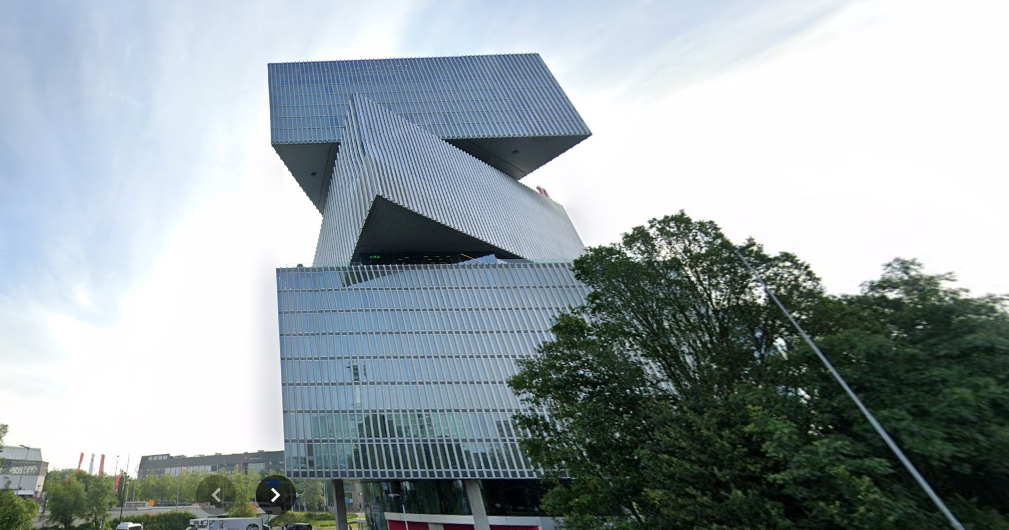
Ik zie een gebouw. Een architect heeft bedacht dat het leuk is als de punten uitsteken. Ook hij heeft géén idee hoeveel energie het heeft gekost. Onze kostbare, zeldzame energie die zoveel ecologische destructie veroorzaakt wordt gewoon achteloos verspilt. Alsof het niks is!
Mijn wereldbeeld en waarden zijn veranderd, en plots leef ik in een wereld die mij vreemd is. Ik voel me hopeloos, letterlijk: zonder hoop. Michael Dowd vertelt over Hopium, een comfortabele visie over de toekomst de de wetten van natuurkunde, biologie en ecologie breekt. Ik kijk om mij heen en iedereen zit aan de Hopium. De mensen zeggen er ís geen probleem. En áls er een probleem is, dan fixen we het wel. Maar ik geloof meer in natuurwetten dan in economische wetten. Mijn geloof is zó anders geworden dan het gangbare verhaal. Ik voel me ver verwijderd en onbegrepen. Ben ik geradicaliseerd tot eco-gekkie?
Ik kom aan op mijn werk. Alles heeft zijn betekenis verloren. Wat doe ik hier? Wat heeft het voor zin? Waarom doe ik mee in deze wereld? Als een robot ga ik door mijn werk. Ik voel me lethargisch, lamgeslagen, leeg.
Mijn klimaatzorgen worden nu écht een klimaatdepressie. Karen Perry biedt troost met 15 voordelen van collapse acceptance.
VI.
De beste remedie tegen klimaatdepressie is actie, zeggen ze. Alsmede praten met anderen wordt geadviseerd, maar dat doe ik niet zo graag. Wat valt er te vertellen als de situatie zo hopeloos is?
Ik agendeer duurzaamheid op mijn werk. Voor sommige is duurzaamheid een belangrijke motivatie, maar voor de meeste niet. Ik word gesteund in mijn ambitie: als duurzaamheid belangrijk voor mij is, dan gaan we er toch mee aan de slag? Bij welke organisaties gaan we het verschil maken? Wat is het grootste probleem?
Goedbedoeld allemaal, maar het doet extra pijn om nét niet begrepen te worden. Een probleem kun je oplossen. Deze toestand is onoplosbaar. We blijven niet eeuwig vooruit gaan, het kantelpunt is geweest waarop we achteruitgaan. Ineenstorting van deze manier van leven is onvermijdelijk. Het zal niet één gebeurtenis zijn, maar een serie van kleine onmerkbare stapjes en grote impactvolle gebeurtenissen. Met horten en stoten. Technologie gaat ons niet redden, maar draagt eerder bij aan toenemende extractie, destructie en consumptie. We hebben een existiëntele crisis en onze manier van denken is op fundamentele en diepgaande manieren problematisch - en dit moet fundamenteel veranderen.
Tsja, als je dan aankomt met de energietransitie en “kom we gaan windmolens plaatsen” dan haak ik af. Ik wil eco-gekkies om mij heen.
VII.
De beste remedie tegen klimaatdepressie is actie, zeggen ze.
In een fulltime baan heb ik geld, maar geen tijd.
Dus ik zeg mijn baan op om forlea te beginnen. Nu kan ik er letterlijk werk van maken.
Nu heb ik tijd, maar geen geld. De financiële onzekerheid zorgt dat ik even geen tijd heb voor klimaatdepressie. Ik moet zorgen dat we rondkomen. Inderdaad, klimaatdepressie is een privilege voor de welvarenden.
Ik vind al snel wat opdrachten die zorgen voor een financiële basis.
Nu heb ik tijd én geld.
Waar zullen we beginnen?
Door uit te sluiten wat niet werkt kunnen we de oplossingsruimte verkleinen. Zo kunnen we het idee om fossiele brandstof te vervangen door windmolens wegstrepen. Het is veel belangrijker om energieconsumptie verminderen. Uiteindelijk kom ik op drie pijlers waarvan ik zeker weet dat ze nuttig en goed zijn:
- Herstel van ecosystemen: leer leven binnen planetaire grenzen en zorg voor meer leven op aarde.
- Meer samenredzaamheid: schep veerkrachtige gemeenschappen die behoeften vervullen zonder winstoogmerk. Verminder ongelijkheid en de eindeloze economische groei.
- Meer eco-bewustzijn: we hebben een ecologische manier van denken en samen-leven nodig. De reis van onwetend dóór klimaatangst naar acceptatie en actie. Van menselijk wensdenken (dit wil ik) maar planetair grensdenken (dit krijg ik).
Dit is mijn kompas voor een leefbare aarde.
Wat is jouw reis geweest?
Als je net begint te leren over de toestand waarin we verkeren, ga dan alsjeblieft niet te hard en gun jezelf wat tijd. Zoek steun en stuur me een bericht als je wilt.
Als je ook ‘collapse-aware’ bent, laat het dan weten. Het voelt goed om niet alleen te zijn en wie weet kunnen we samen iets doen wat nuttig en betekenisvol is.
]]>- We have crossed 6 out of 9 planetary boundaries, and crossing one of them is enough.
- The climate system has tipping points, which, once tipped, create positive feedback loops that reinforce climate change.
- There are biophysical constraints to the metabolism of our civilization: We extract resources faster than the earth can renew them, and we produce more waste than earth can proces, and we degrade our habitat (see fssd sustainability principles).
- Our ecological footprint is larger than one earth (Earth day), therefore, we are in ecological overshoot and collapse.
- History: All earlier civilizations have followed a boom and bust cycle.
We must conclude the following:
- Technology will not save us (because Jevons paradox, Maximum Power Principle, energy requirements, material usage and the brittleness of our global supply chain)
- Clean energy is unfeasible with our current energy demand (also because wind and solar still require fossil fuels for construction and transportation, and too much rare earth metals such as Lithium).
- Decoupling of energy usage and economic activity is only possible when energy costs are externalized to another place.
- Therefore, globally, economy (GDP) and energy usage are tightly coupled.
- Therefore, green growth is not an option.
If we take it a step further, we can also conclude:
- We’re already 30-50 years into collapse of our biosphere - unstoppable runaway climate change.
- Our current institutions and systems will not change, they will break down either by force or by perhaps more gracefully by our own efforts.
- Therefore, and also by studying the history of previous civilisations, the civilisation as we know it is self-terminating.
- The breakdown of our civilisation, together with our global supply chains, together with the effects of climate change on food production, will cause mass migration and food insecurity. Given that we are in ecological overshoot, it will be hard to sustain our current population.
- Taken even further, extinction is a real possibility.
When green growth and systemic change of our current institutions are not an option, we are left with the following strategy.
- Degrowth - we must degrow our economy and reduce our consumption consciously, or it will be forced upon us.
- Commons - public luxury and private necessity to maximize what we can do with less resources.
- Hospice the old - we must slow down and break down extractive institutions, organizations and economies. Some will argue this is wasted energy as the old institutions will break sooner or later anyway.
- New institutions - we must design and build a new economy and new institutions. Joe Brewer argues they must be bioregional, instead of nation states.
- Invest in climate adaptation, to improve our quality of life.
- Invest in climate mitigation and regeneration, for the health of our biosphere.
- Invest collapse readiness and resilience.