


Why Computer Vision is critical for businesses today
Across industries, vision is often the bottleneck to scale. Manual tasks like defect detection, scan interpretation, or inventory tracking are slow and subjective. Computer Vision automates these processes using deep learning models to see, detect, classify, and act in real time with high accuracy and zero fatigue.
3x
improved accuracy in defect detection
70%
faster triage in medical image processing
2x
diagnostic throughput
What you can do with Computer Vision
From diagnostics to operations, Computer Vision helps organizations automate observation, detect patterns, and act faster—wherever visual data lives.
Healthcare
- Detect abnormalities, perform segmentation and classify medical images for treatment planning with radiology scan analysis.
- Prioritize critical cases by analyzing DICOM scans, improving patient outcomes.
- Improve treatment efficiency and safety with AI-assisted summarization of medical images and videos.
Industrial
- Strengthen quality control with precise and consistent defect detection.
- Accelerate assembly verification by spotting defects, missing components, or misplacements instantly.
- Enhance safety compliance by monitoring PPE use and issuing real-time alerts for hazardous behavior.
Life Sciences
- Process large-scale cell images with accurate segmentation and classification.
- Automate microscope scans for tasks like cell-counting and high-throughput analysis.
- Streamline research with automated labeling of complex biological datasets.
Logistics
- Boost supply chain efficiency with automated label reading, damage detection, sorting and dimensioning.
- Ensure compliance with barcode capture, decoding and validation against preset parameters.
- Detect anomalies in operations, like stopped vehicles or security breaches, through camera-based monitoring.
Technical Capabilities

Image classification and object detection

Real-time video stream processing and event triggers

Edge-developed CV models with low latency inference

Mobile-first vision inference (ONMX, CoreML, TFLite)

Integration with hardware sensors and CCTV feeds

Custom training pipelines for domain-specific datasets
How Computer Vision drives business outcomes
Automate tasks
Increase efficiency by automating manual visual inspection and counting tasks to reduce time and overhead.
Accelerate decision-making
Stay ahead with proactive decision-making with real-time visual intelligence.
Reduce human error
By automating repetitive tasks, reduce human error in quality control, safety, and compliance.
Efficiency in healthcare and life sciences
Accelerate diagnostic and analytical workflows for better patient outcomes.
Actional insights
Unlock operation insights from video, camera and sensor feeds
From concept to deployment
Our delivery approach
Opportunity mapping
Identify where Computer Vision can deliver the highest ROI.
Data curation
Label, clean, and augment your visual data for automation.
Model development
Train, validate, and tune custom Computer Vision models for your use case.
Deployment
Deploy responsively across cloud, edge, mobile or ERP-integrated workflows.
Monitoring
Continue monitoring with ongoing tracking, feedback loops and drift correction.
Real-world outcomes with Computer Vision
Faster workflows
Reduce manual review in labs and speed decisions for quality and safety-critical processes

Augmented teams
Enhance accuracy in verification and assembly with mobile vision systems while cutting training time

Lower overhead
Eliminate hours of repetitive annotation in research pipelines to focus on high-value discovery work

Trusted decision-making
Improve planning, population estimates and parcel tracking with data-driven insight from live camera feeds

Secure environments
Strengthen safety, compliance and check-ins workflows in sensitive environments with face recognition

Resources
Expert insights to make you future-ready
-

Blog
8 min readZoho One for Construction & Real Estate: The Complete Business Platform Guide
Read MoreConstruction and real estate businesses depend on efficient coordination across CRM, project management, procurement, finance, workforce management, and site operations. When these systems operate independently, businesses often face challenges such as delayed approvals, duplicate data entry, missed customer follow-ups, and project cost overruns. Many organizations still rely on spreadsheets, messaging platforms, and disconnected software tools,…
 : Zoho One for Construction & Real Estate: The Complete Business Platform Guide
 -

Blog
7 min readSAP vs ERPNext: Which ERP Should Modern Businesses Choose in 2026
Read MoreThe ERP Decision That Can Save Your Business MillionsChoosing an ERP system is no longer just about accounting or inventory. Today, an ERP becomes the digital backbone of every organization. Modern ERP platforms connect core business functions including Sales, CRM, Procurement, Manufacturing, HR, Finance, Warehousing, Customer Portals, Mobile Apps, AI solutions, IoT devices, and Business…
: SAP vs ERPNext: Which ERP Should Modern Businesses Choose in 2026 -

Blog
6 min readHow Disconnected Systems Cost eCommerce Businesses Revenue
Read MoreYour eCommerce business may be generating orders every day, but hidden operational gaps could be silently reducing revenue. Many businesses focus heavily on increasing traffic and customer acquisition while overlooking what happens after customers enter the sales journey. A customer adds products to their cart and moves toward checkout. Then something fails behind the scenes.…
: How Disconnected Systems Cost eCommerce Businesses Revenue -
Blog
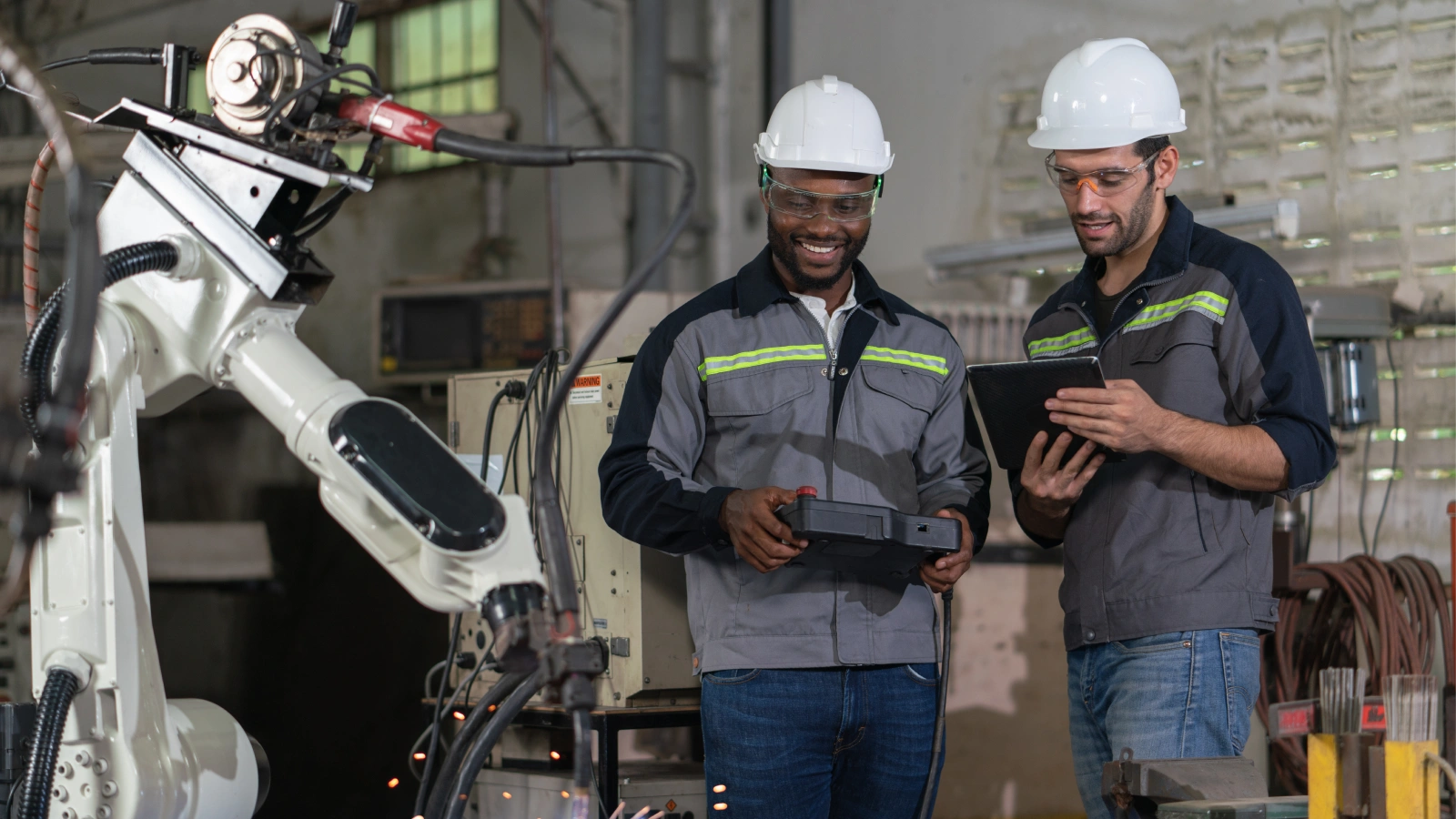
9 min readIndustry 5.0 vs Industry 4.0: Why AI-Human Collaboration is the Next Frontier
Read MoreWhat is Industry 5.0 and how does it differ from Industry 4.0? Industry 5.0 prioritizes human-AI collaboration where machines handle data processing and pattern detection while humans focus on judgment, creativity, and strategy. Industry 4.0 automated production through connectivity and data. Industry 5.0 augments humans using that data. The shift emphasizes worker resilience, sustainability, and…
: Industry 5.0 vs Industry 4.0: Why AI-Human Collaboration is the Next Frontier -
Blog
11 min readHow AI-Powered Predictive Maintenance Reduces Unplanned Downtime by 40%
Read MoreAI-powered predictive maintenance reduces unplanned downtime by up to 40% by connecting IoT monitoring sensors to machine learning models that detect equipment failure before it happens. Industrial businesses that deploy predictive maintenance AI report 25–30% lower maintenance costs and 70–75% fewer unplanned breakdowns compared to traditional scheduled maintenance programs. What Is AI-Powered Predictive Maintenance? Predictive…
: How AI-Powered Predictive Maintenance Reduces Unplanned Downtime by 40% -

Blog
7 min readBuilding Vendor & Approval Systems on Zoho Creator
Read MoreVendor management is a significant yet highly complex aspect of business operations. From onboarding suppliers to ensuring compliance, companies often struggle with fragmented vendor-based processes. This leads to operational delays, errors & inefficiencies that directly impact business performance. An effective vendor approval system acts as the backbone of vendor management. It ensures that suppliers go…
: Building Vendor & Approval Systems on Zoho Creator -

Blog
13 min readWhat is the EU AI Act and what does it require from German companies?
Read MoreBuilding compliant agentic AI systems for industrial growth.
: What is the EU AI Act and what does it require from German companies? -

Blog
8 min readHow Zoho Creator Transforms Internal Operations Beyond CRM?
Read MoreAutomate, Integrate, and Scale Operations with Zoho Creator
: How Zoho Creator Transforms Internal Operations Beyond CRM? -

Blog
12 min read

How we’ve transformed operations with computer vision
Visual lab QA automation
60%
faster chemical tracer counting in diagnostic labs through camera-based CV workflows
 Read Case StudyLink
Assembly verification
17%
boost in production efficiency and fewer errors with real-time glove and part detection
See how we did itLink
Cell segmentation in microscopy scans
85%
time saved in annotating and reviewing microscope image datasets using AI-enabled pipelines
Read Case StudyLink
Traffic flow analysis for Smart City planning
Got questions?
Find your answers here.
Can your Computer Vision models adapt to changing environments (e.g., new lighting, layouts, camera angles)?

Yes. We incorporate data augmentation and adaptive learning techniques to ensure robustness. Additionally, we offer drift detection and retraining workflows to maintain accuracy over time as conditions evolve.
Can the solution work in low-bandwidth or offline environments?
Yes. We support edge deployment using Nvidia Jetson, OpenVINO, or mobile devices. This is especially useful in factory floors, remote logistics hubs, or field environments with poor connectivity.
How long does it take to implement a Computer Vision solution?
Implementation depends on data availability and use case complexity. However, using our prebuilt accelerators, we typically deliver a working MVP within 4–6 weeks, followed by refinement and deployment.
What types of integrations are supported?
We integrate seamlessly with:
- Healthcare systems (PACS, DICOM)
- Industrial systems (MES, SCADA)
- Logistics tools (ERP, WMS)
- Mobile apps and cloud dashboards via REST APIs
What if our visual data isn’t labeled or well-organized?
We help you structure your data pipeline from scratch—whether that means building annotation interfaces, conducting initial labeling, or using transfer learning to reduce the amount of labeled data needed to get started.
