


Why Machine Learning is Non-Negotiable Today
In fast-moving markets, reactive systems fall short. Machine Learning enables real-time insight, predictive foresight and adaptive execution, boosting efficiency and enabling agile, data-driven strategies. This isn’t just data science—it’s business intelligence in motion.
44%
of businesses say ML improves decision
making
60%
of leaders call ML critical for competitive
advantage
20-50%
increase in forecasting accuracy by ML adoption
What You Can Do with Machine Learning
Discover high-impact ML use cases tailored to your business goals, mapped by function, refined by data and designed to drive efficiency.
Healthcare
- Analyze large-scale medical datasets to detect early disease patterns before symptoms appear.
- Improve clinical decision-making through patient data analysis, enhancing diagnosis, treatment accuracy and outcomes.
Operations
- Forecast with greater accuracy by uncovering complex patterns across historical data and multiple variables.
- Optimize inventory using ML to minimize stockouts and overages.
Manufacturing
- Predict equipment failures using sensor and IoT data to enable proactive maintenance and reduce downtime.
- Detect anomalies and defects in products or processes, to improve quality, reduce waste and minimize cost.
Technical Capabilities

Cloud ML Platforms: AWS SageMaker, Google Vertex AI, Azure ML

Model Types: Supervised (classification, regression), Unsupervised (clustering, dimensionality reduction), Reinforcement Learning

Forecasting & Anomaly Detection: Time-series models (ARIMA, Prophet), LSTM, Isolation Forest

ModelOps & Monitoring: MLflow, SageMaker Pipelines, custom drift detection

Integration Ready: REST APIs, Snowflake, Databricks
Rethink What Your Business Can Do with ML
Improve predictability
Identify patterns across large datasets, enabling early trend detection and generating real-time, predictive insights.
Automate tasks
Increase operational efficiency and reduce overhead by automating repetitive and cognitive processes with ML-driven workflows.
Reduce risk
Stay ahead of potential issues by using ML models to detect anomalies and uncover hidden patterns, allowing for proactive risk mitigation.
Enhance personalization
Deliver personalization at scale by analyzing user behaviors and preferences, enabling more tailored experiences across touchpoints.
From Idea to Impact
A ML Process That Delivers
Business-first assessment
Identify high-impact use cases where ML can deliver tangible value
Data Strategy & Modeling
Clean, structure and prepare data for training, aligning with business context and real-world variability
Model Development & Validation
Build and validate models for accuracy, explainability and bias handling
Deployment & Monitoring
Deploy responsibly with continuous monitoring, drift detection and retraining pipelines that keeps models effective overtime
Business outcomes, not just algorithms

Predictive Maintenance
Reduce factory downtime by up to 40% by proactively identifying equipment issues before failure.

Detect anomalies
Cut fraud by 30% through real-time anomaly detection across transactions and user behavior.

Reduce manual processing
Improve efficiency by automating repetitive workflows and cutting manual effort by 25%.
Predict churn rate
Increase customer retention by 30% by identifying early signs of churn and enabling timely action.

Resources
Expert insights to make you future-ready
-

Blog
8 min readZoho One for Construction & Real Estate: The Complete Business Platform Guide
Read MoreConstruction and real estate businesses depend on efficient coordination across CRM, project management, procurement, finance, workforce management, and site operations. When these systems operate independently, businesses often face challenges such as delayed approvals, duplicate data entry, missed customer follow-ups, and project cost overruns. Many organizations still rely on spreadsheets, messaging platforms, and disconnected software tools,…
 : Zoho One for Construction & Real Estate: The Complete Business Platform Guide
 -

Blog
7 min readSAP vs ERPNext: Which ERP Should Modern Businesses Choose in 2026
Read MoreThe ERP Decision That Can Save Your Business MillionsChoosing an ERP system is no longer just about accounting or inventory. Today, an ERP becomes the digital backbone of every organization. Modern ERP platforms connect core business functions including Sales, CRM, Procurement, Manufacturing, HR, Finance, Warehousing, Customer Portals, Mobile Apps, AI solutions, IoT devices, and Business…
: SAP vs ERPNext: Which ERP Should Modern Businesses Choose in 2026 -

Blog
6 min readHow Disconnected Systems Cost eCommerce Businesses Revenue
Read MoreYour eCommerce business may be generating orders every day, but hidden operational gaps could be silently reducing revenue. Many businesses focus heavily on increasing traffic and customer acquisition while overlooking what happens after customers enter the sales journey. A customer adds products to their cart and moves toward checkout. Then something fails behind the scenes.…
: How Disconnected Systems Cost eCommerce Businesses Revenue -
Blog
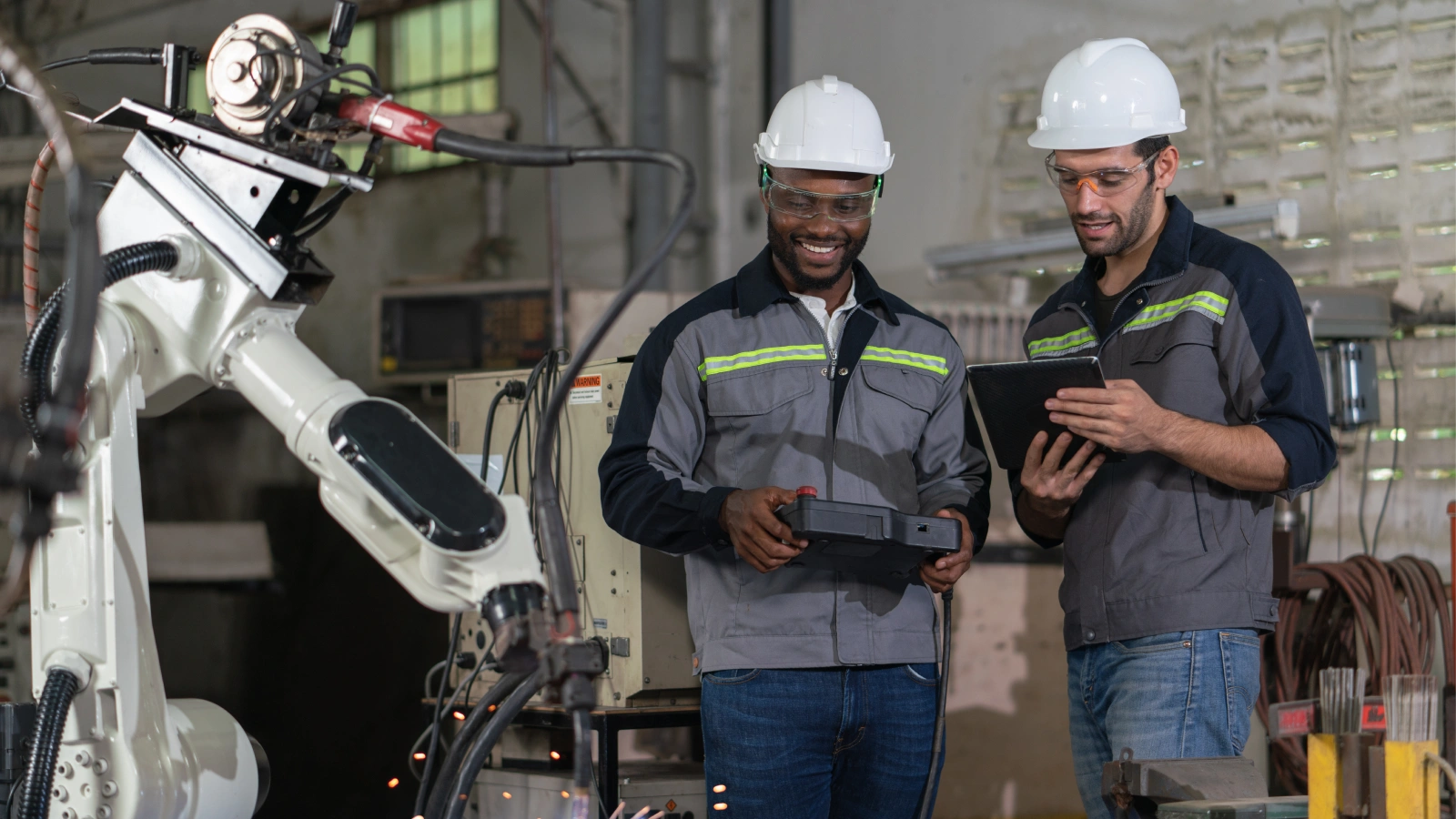
9 min readIndustry 5.0 vs Industry 4.0: Why AI-Human Collaboration is the Next Frontier
Read MoreWhat is Industry 5.0 and how does it differ from Industry 4.0? Industry 5.0 prioritizes human-AI collaboration where machines handle data processing and pattern detection while humans focus on judgment, creativity, and strategy. Industry 4.0 automated production through connectivity and data. Industry 5.0 augments humans using that data. The shift emphasizes worker resilience, sustainability, and…
: Industry 5.0 vs Industry 4.0: Why AI-Human Collaboration is the Next Frontier -

Blog
11 min readHow AI-Powered Predictive Maintenance Reduces Unplanned Downtime by 40%
Read MoreAI-powered predictive maintenance reduces unplanned downtime by up to 40% by connecting IoT monitoring sensors to machine learning models that detect equipment failure before it happens. Industrial businesses that deploy predictive maintenance AI report 25–30% lower maintenance costs and 70–75% fewer unplanned breakdowns compared to traditional scheduled maintenance programs. What Is AI-Powered Predictive Maintenance? Predictive…
: How AI-Powered Predictive Maintenance Reduces Unplanned Downtime by 40% -

Blog
7 min readBuilding Vendor & Approval Systems on Zoho Creator
Read MoreVendor management is a significant yet highly complex aspect of business operations. From onboarding suppliers to ensuring compliance, companies often struggle with fragmented vendor-based processes. This leads to operational delays, errors & inefficiencies that directly impact business performance. An effective vendor approval system acts as the backbone of vendor management. It ensures that suppliers go…
: Building Vendor & Approval Systems on Zoho Creator -

Blog
13 min readWhat is the EU AI Act and what does it require from German companies?
Read MoreBuilding compliant agentic AI systems for industrial growth.
: What is the EU AI Act and what does it require from German companies? -

Blog
8 min readHow Zoho Creator Transforms Internal Operations Beyond CRM?
Read MoreAutomate, Integrate, and Scale Operations with Zoho Creator
: How Zoho Creator Transforms Internal Operations Beyond CRM? -

Blog
12 min read

Learn From Real Deployments
Predictive quality control for manufacturing

ML-powered logistics routing
Clinical trial forecasting for life sciences
Time-series forecasting for inventory planning
Got questions?
Find your answers here.
What’s the difference between ML and AI?

AI is the broader discipline of building systems that mimic human intelligence. Machine Learning (ML) is a subset of AI focused on enabling systems to learn from data and improve over time without explicit programming.
Think of AI as the umbrella, and ML as one of its core engines.
Do I need large volumes of data to benefit from ML?
Not always. While more data often improves accuracy, effective strategies exist for working with limited datasets such as:
- Transfer learning
- Data augmentation
- Synthetic data generation
- Pretrained models and AutoML frameworks
We’ll assess your use case and recommend the best approach based on available data.
How long does it take to deploy an ML model?
Typical timeframes:
- Proof of concept: 4 weeks
- Production-ready ML: 6–12 months
This includes data preparation, model development, validation, deployment, and testing. With accelerators (e.g., prebuilt models from our library), deployment can be significantly faster.
Can you integrate ML with our ERP/CRM systems?
Yes. We’ve integrated ML solutions into platforms like:
- Zoho CRM
- ERPNext
- Custom CRMs and ERPs
Whether it’s embedding predictive models into dashboards, triggering alerts, or automating workflows based on real-time insights, we offer:
- API-based integration
- Webhook-triggered workflows
- Embedded ML insights within your existing tools
