Log inSign up
Andrew Lampinen
2,964 posts
Image
user avatar
Andrew Lampinen
@AndrewLampinen
Interested in cognition and artificial intelligence. MTS at @AnthropicAI. Previously @DeepMind, cognitive science @StanfordPsych. Tweets are mine.
lampinen.github.io
Joined November 2019
1,734
Following
12.3K
Followers
  • Pinned
    user avatar
    Andrew Lampinen
    @AndrewLampinen
    Dec 16, 2025
    Why isn’t modern AI built around principles from cognitive science or neuroscience? Starting a new substack (link below) by writing down my thoughts on that question: as part of a first series of posts giving my current thoughts on the relation between these fields. 1/3
    Image
    41K
  • user avatar
    Andrew Lampinen
    @AndrewLampinen
    Feb 11, 2023
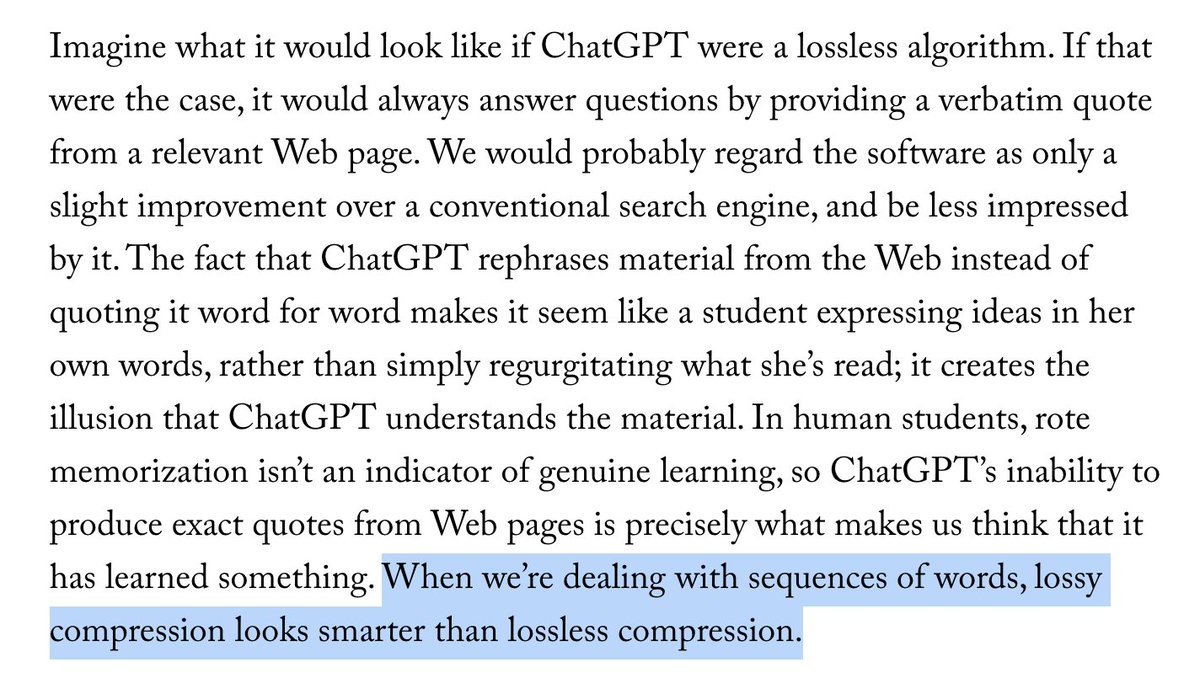
    Ted Chiang is a great writer, but this is not a great take and I'm disappointed to see it getting heavily praised. It's not in keeping with our scientific understanding of LMs or deep learning more generally. Thread: 1/n
    user avatar
    John Burn-Murdoch
    @jburnmurdoch
    Feb 11, 2023
    Ted Chiang’s piece on ChatGPT and large language models is as good as everyone says. The fact that the outputs are rephrasings rather than direct quotes makes them seem game-changingly smart — even sentient — but they’re just very straightforwardly not. newyorker.com/tech/annals-of…
    Imagine what it would look like if ChatGPT were a lossless algorithm. If that were the case, it would always answer questions by providing a verbatim quote from a relevant Web page. We would probably regard the software as only a slight improvement over a conventional search engine, and be less impressed by it. The fact that ChatGPT rephrases material from the Web instead of quoting it word for word makes it seem like a student expressing ideas in her own words, rather than simply regurgitating what she’s read; it creates the illusion that ChatGPT understands the material. In human students, rote memorization isn’t an indicator of genuine learning, so ChatGPT’s inability to produce exact quotes from Web pages is precisely what makes us think that it has learned something. When we’re dealing with sequences of words, lossy compression looks smarter than lossless compression.
    743K
  • user avatar
    Andrew Lampinen
    @AndrewLampinen
    May 2, 2025
    How do language models generalize from information they learn in-context vs. via finetuning? We show that in-context learning can generalize more flexibly, illustrating key differences in the inductive biases of these modes of learning — and ways to improve finetuning. Thread: 1/
    On the generalization of language models
from in-context learning and finetuning: a
controlled study
Andrew K. Lampinen*,1, Arslan Chaudhry*,1, Stephanie C.Y. Chan*,1, Cody Wild1, Diane Wan
1
, Alex Ku1, Jörg Bornschein1, Razvan Pascanu1, Murray Shanahan1 and James L. McClelland1,2
*Equal contributions,
1Google DeepMind,
2Stanford University
    103K
  • user avatar
    Andrew Lampinen
    @AndrewLampinen
    Jul 2, 2020
    Officially done with my PhD! My dissertation is now online (purl.stanford.edu/xj689nb3522), if you fancy reading way too many pages about flexibility and transfer in humans and deep learning models.
  • user avatar
    Andrew Lampinen
    @AndrewLampinen
    Jul 21, 2025
    Quick thread on the recent IMO results and the relationship between symbol manipulation, reasoning, and intelligence in machines and humans:
    98K
  • user avatar
    Andrew Lampinen
    @AndrewLampinen
    Sep 22, 2025
    Why does AI sometimes fail to generalize, and what might help? In a new paper, we highlight the latent learning gap — which unifies findings from language model weaknesses to agent navigation — and suggest that episodic memory complements parametric learning to bridge it. Thread:
    Latent learning: episodic memory complements parametric learning by enabling flexible reuse of experiences Andrew Kyle Lampinen , Martin Engelcke , Yuxuan Li , Arslan Chaudhry and James L. McClelland; Google DeepMind
    88K
  • user avatar
    Andrew Lampinen
    @AndrewLampinen
    Feb 25, 2023
    What is emergence, and why is it of recent interest in AI, and long-standing interest in cognitive science? And why is this an exciting time for considering emergence across these fields? A thread: 1/
    121K
  • user avatar
    Andrew Lampinen
    @AndrewLampinen
    Jun 3, 2023
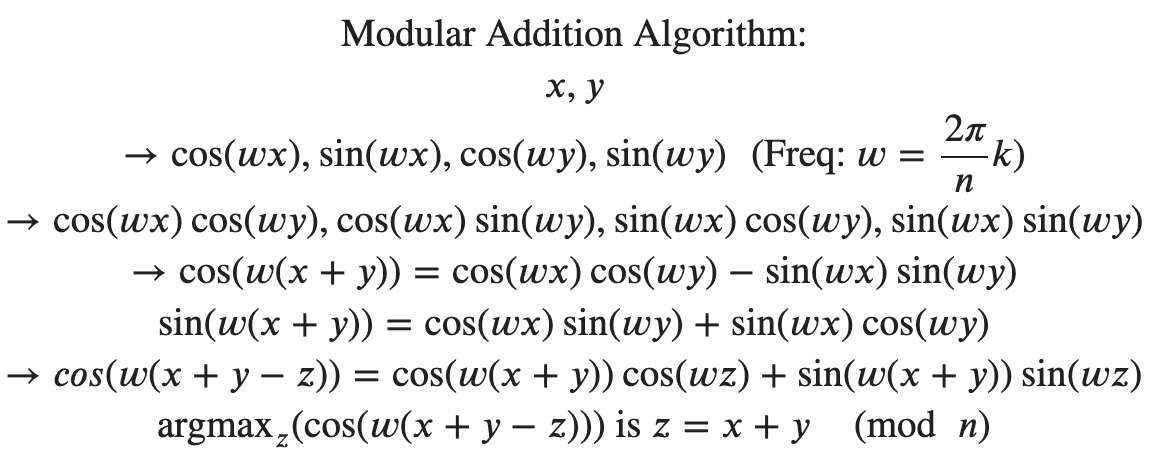
    Computational physicists doing most their operations (e.g. derivatives) via an FFT because it's more efficient
    https://knowyourmeme.com/memes/awkward-look-monkey-puppet
    Image
    user avatar
    Rob Miles
    @robertskmiles
    May 30, 2023
    Replying to @robertskmiles
    Their results are bizarre and inhuman. @NeelNanda5 trained a tiny transformer to do addition, then spent weeks figuring out what it was doing - one of the only times in history someone has understood how a transformer works. This is the algorithm it created. To *add two numbers*!
    103K
  • user avatar
    Andrew Lampinen
    @AndrewLampinen
    Dec 22, 2023
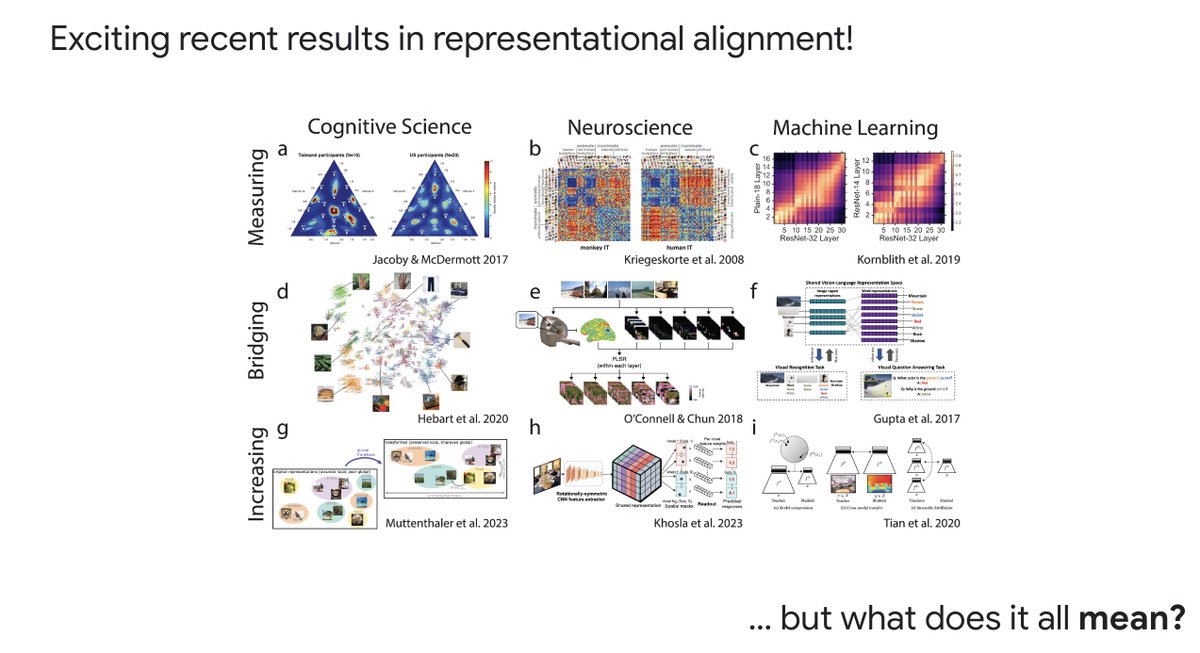
    Research in mechanistic interpretability and neuroscience often relies on interpreting internal representations to understand systems, or manipulating representations to improve models. I gave a talk at @unireps at NeurIPS on a few challenges for this area, summary thread: 1/
    Slide: exciting recent results in representational alignment... but what does it all *mean*?
Illustration: Figure from a recent survey paper: https://arxiv.org/abs/2310.13018 showing a 3 x 3 grid of illustrations from papers in cognitive science, neuroscience, and machine learning that used methods of measuring, bridging, or increasing representational alignment between different systems.
    52K
  • user avatar
    Andrew Lampinen
    @AndrewLampinen
    May 26, 2023
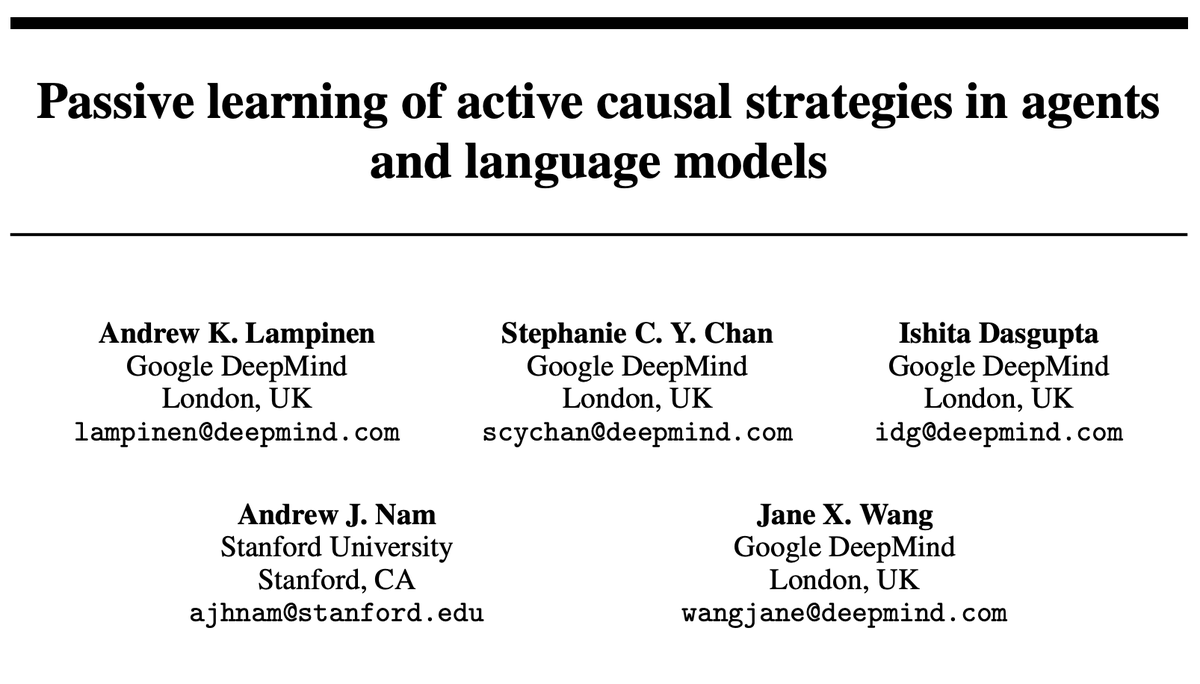
    What can be learned about causality and experimentation from passive data? What could language models learn from simply passively imitating text? We explore these questions in our new paper: “Passive learning of active causal strategies in agents and language models” Thread: 1/
    Paper title and authors:
Passive learning of active causal strategies in agents
and language models
Andrew Kyle Lampinen, Stephanie C Y Chan, Ishita Dasgupta, Andrew J Nam, Jane X Wang
    107K
  • user avatar
    Andrew Lampinen
    @AndrewLampinen
    Sep 13, 2024
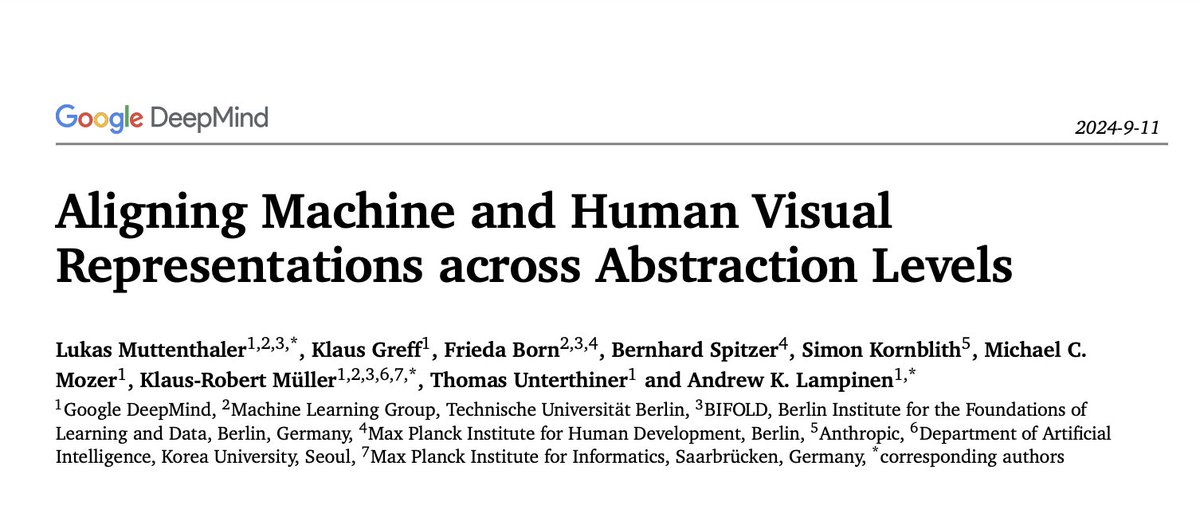
    What aspects of human knowledge are vision models missing, and can we align them with human knowledge to improve their performance and robustness on cognitive and ML tasks? Excited to share this new work led by @lukas_mut! 1/10
    Paper title: Aligning Machine and Human Visual Representations across Abstraction Levels
    62K
  • user avatar
    Andrew Lampinen
    @AndrewLampinen
    Sep 29, 2022
    I'm not a scaling maximalist, but it's surprising to me how many people are 1) interested in differences between human and artificial intelligence and 2) think scaling to improve performance means deep learning is doing something fundamentally wrong. 1/n
  • user avatar
    Andrew Lampinen
    @AndrewLampinen
    Dec 10, 2024
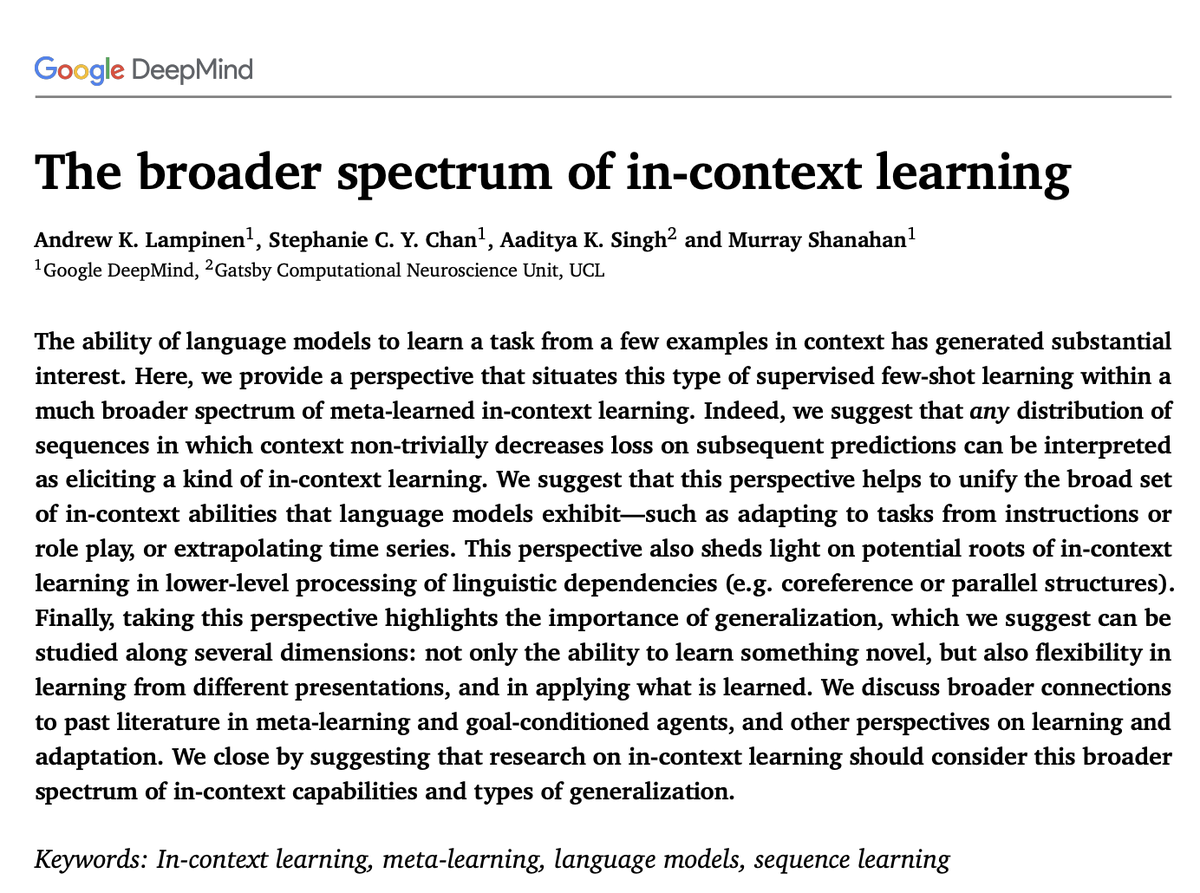
    What counts as in-context learning (ICL)? Typically, you might think of it as learning a task from a few examples. However, we’ve written a perspective that suggests interpreting a much broader spectrum of contextual behaviors as ICL! Summary thread: 1/8
    The broader spectrum of in-context learning

Andrew K. Lampinen , Stephanie C. Y. Chan , Aaditya K. Singh and Murray Shanahan

Abstract:
The ability of language models to learn a task from a few examples in context has generated substantial interest. Here, we provide a perspective that situates this type of supervised few-shot learning within a much broader spectrum of meta-learned in-context learning. Indeed, we suggest that any distribution of sequences in which context non-trivially decreases loss on subsequent predictions can be interpreted as eliciting a kind of in-context learning. We suggest that this perspective helps to unify the broad set of in-context abilities that language models exhibit—such as adapting to tasks from instructions or role play, or extrapolating time series. This perspective also sheds light on potential roots of in-context learning in lower-level processing of linguistic dependencies (e.g. coreference or parallel structures). Finally, taking this perspecti
    47K
  • user avatar
    Andrew Lampinen
    @AndrewLampinen
    Jul 15, 2022
    Abstract reasoning is ideally independent of content. Language models do not achieve this standard, but neither do humans. In a new paper (arxiv.org/abs/2207.07051 co-led by Ishita Dasgupta) we show that LMs in fact mirror classic human patterns of content effects on reasoning. 1/
    arXiv logo
    arxiv.org
    Language models show human-like content effects on reasoning tasks
    Reasoning is a key ability for an intelligent system. Large language models (LMs) achieve above-chance performance on abstract reasoning tasks, but exhibit many imperfections. However, human...

New to X?

Sign up now to get your own personalized timeline!

Create account

By signing up, you agree to the Terms of Service and Privacy Policy, including Cookie Use.

Terms·Privacy·Cookies·Accessibility·Ads Info·© 2026 X Corp.
Don't miss what's happening
People on X are the first to know.
Log inSign up
Advertisement
Advertisement