This section offers a set of practical tools and guides designed to empower journalists, activists, advocates, academics, educators, content creators, artists, humanitarian workers and policymakers with the resources needed to effectively communicate about Palestine. From identifying and countering common propaganda and logical fallacies, to mastering the ethical use of terminology and visuals, these tools provide practical guidance for shaping impactful communication on Palestine.
A master checklist summarising key tips and takeaways from the guide.
Click on each to be directed to the relevant section with more detailed insights and guidance.

Context is not just about presenting facts, it is about exposing structural oppression beyond isolated incidents of colonial violence. Not doing so would run the risk of spreading misinformation, distorting reality and perpetuating harmful narratives.
Frame military occupation, apartheid, genocide and ethnic cleansing as tools of the broader century-long settler-colonial project against the Palestinian people.
Colonial violence should not only be highlighted when it appears in visible, brutal forms like killings, torture, and bombardment; it must also include the less apparent, yet destructive policies that fracture families, erode communal bonds, impose generational trauma, and stifle economic development. Capturing this full spectrum is essential for portraying Palestine.
From refugees denied return in Lebanon, to Bedouins under settler violence in the West Bank, to communities under siege in Gaza, to “unrecognised” villages facing ethnic cleansing in 1948 Palestine—colonial oppression targets Palestinians everywhere. Fragmentation is itself a deliberate strategy to entrench it.
Colonial practices differ by geography and severity but remain systemic and interconnected, driven by one goal: to empty the land of its people and deny their collective right to self-determination.
The strongest narratives balance lived experience with systemic injustice and collective struggle. Overemphasising stories risks reducing these struggles to isolated, depoliticised anecdotes, while overemphasising structures risks erasing the human element, turning Palestinians into statistics and abstractions.
Resistance under occupation is not only an enshrined right but a way of survival and dignity. Associating “violence” with Palestinians blames the oppressed for their suffering.
Highlight the diverse ways Palestinians have resisted over the past century instead of overwhelmingly communicating only when armed struggle is involved. This includes protests, strikes, political organising, legal and advocacy work, boycotts, working the land and community-building, all of which have been repressed or criminalised.
Dismantle the myth of symmetrical power. One side possesses vast military capacity and receives extensive financial and military backing from powerful allies. The other is a colonised people under siege and occupation, stripped of basic rights, and often delegitimised internationally.
In contexts of systemic injustice, “neutrality” is siding with the oppressor. Name the deep power imbalance and dynamics, focus on root causes, and centre those whose rights are systematically denied.
Counter the claim that an occupier has the right to brutalise, torture and murder those whose land they steal under the guise of “self-defence”. This is not only morally indefensible but also lacks legal standing under international law.
Euphemisms soften or obscure harm—call injustice what it is. Name the perpetrator and avoid passive language. Ensure all language situates events within their broader colonial context, and avoid reductionist or sanitised terms that downplay systemic violence and international crimes.
Avoid repeating harmful tropes, even when opposing them—repetition reinforces familiarity. Instead, reframe them on your own terms, centring facts, dignity and justice. (e.g. say Palestinians are resisting colonial domination instead of Palestinians are not terrorists).
Recognise the Palestinian struggle as part of a broader global movement against imperialism, racism and oppression. Draw parallels with other liberation struggles to emphasise shared experiences of resistance.
From Gaza, to the West Bank, Jerusalem, 1948 Palestine, or in exile—all 15 million Palestinians fight the same liberation struggle. Unity does not mean uniformity, but acknowledging the collective identity and struggle.
Ensure equitable portrayal across ages, genders, social classes, religions, cultural norms, geographies, backgrounds, political affiliations and professions. Avoid overemphasising certain groups—such as women or children—to elicit sympathy.
Palestinians embody a wide range of human experience and emotion—strength and vulnerability, joy and suffering. The same person who celebrates a wedding with friends at night might still return to a home threatened with demolition, with a relative in prison.
Reject selective empathy and recognise that all Palestinians, regardless of appearances, background, or values, deserve representation and coverage. Recognise that even the most flawed Palestinian deserves freedom.
Beyond oppression and the relationship to Israeli colonial violence, Palestinians have a rich culture and identity that should not be erased.
Don’t shift focus to what the victim ‘should have done’—centre harm and its context. Language that implies blame reinforces injustice and erases power dynamics.
Portray people as agents—highlight their dignity, steadfastness, resistance and analysis, not just their suffering. Avoid language that reduces them to their trauma: let them define their own story.
Avoid portraying Palestinians solely as heroic figures of steadfastness, or romantic symbols of resistance. When highlighting Palestinian steadfastness, it is crucial to show the costs and trauma behind it, rather than portraying it as an optional or effortless trait. Highlight how Palestinians can show strength while also experiencing vulnerability.
Avoid portrayals that reduce Palestinian men to violent and threatening stereotypes. Show men in their full humanity—capable of care, joy, vulnerability, creativity and resistance.
Highlight the stories of Palestinians who engage in resistance born of necessity and oppression.
Avoid exoticising or simplifying Palestinian culture and identity—don’t reduce people to symbols, stereotypes or scenery. Let individuals speak in their full complexity, rooted in their lived realities, not in Western imagination.
Recognise that Palestinians are best positioned to narrate their realities from personal experiences to in-depth analysis. Palestinians should be at the centre of all discussions and communications about Palestine. Always ask: where are the Palestinians in this conversation?
Palestinians must be the primary agents to decisions, processes and plans related to their lives and futures. This means genuine and inclusive participation at every stage—from planning and design to decision-making and implementation.
Inclusion should not be about fulfilling quotas or diversity checkboxes. Palestinians must have genuine space, authority, and influence in shaping conversations, narratives and decisions on their struggle.
Representation must reflect the breadth of Palestinian society—survivors, organisers, experts, fighters, and people across political parties, geographies, generations and social classes.
Share and promote Palestinian analysis, research, and expertise without needing external validation from Israeli or Western sources. Value Palestinian work without intermediaries, mediation, mirroring or a Western voice to please the audience.
Truly centring Palestinians means respecting when they choose not to speak, engage or be represented. When they do choose to engage, ensure that it is on their own terms and that the space is grounded in ethical conditions. Do not instrumentalise people for visibility, and do not reduce Palestinian stories to performances of suffering or tools to elicit sympathy.
Approach conversations with the intent to listen, understand and learn—not to interrogate or discredit. Check your approach against any fallacies. Avoid provocative or leading questions, false binaries or oversimplified framings. Ensure questions are transparent in intent and free of hidden agendas.
Clearly communicate the purpose, format and conditions of the engagement in advance. Provide all relevant details—including topic scope, duration, whether the conversation is live or recorded, the duration, other participants and expected audience. Obtain informed consent and give participants the opportunity to review how their contributions will be presented, especially in written or recorded formats.
Respect people’s boundaries, particularly grieving families, families of prisoners or people in vulnerable positions. Do not rush them into public appearances or ask dehumanising questions. Let them tell their stories on their own terms, with dignity and care.
Do not ask individuals to speak outside their area of knowledge. If you invite a Palestinian to give their testimony on their day-to-day reality, don’t ask them to analyse the geopolitical reality. Similarly if you invite an expert on environmental issues, don’t question them on topics they don’t necessarily master. Do not pair Palestinian testimony voices with experts in a way that sidelines them.
Assess potential risks to Palestinian participants—legal, emotional or physical—before involving them in conversations. Do not place them alongside others who may compromise their safety or dignity.
Ensure discussions on Palestine are grounded in historical and political context. Give Palestinian participants time to provide context and speak without interruption, and do not pressure them into reductive messaging. Interview set-ups must ensure responsible sequencing of speakers, accurate paired or background footage, and framing that reflects context rather than distorts it.
Palestinians should not be asked to be put as opposite to their oppressor. When conversations or initiatives do not challenge the structures of oppression—or worse, include those who represent and uphold them, or those paying lip-service to “peace” but benefitting from the oppressive system—they become part of the problem.
Be mindful of the power dynamics in the act of visual representation and the impact this has on the lives and realities of the people depicted.
Use techniques to shift power in the visual process and centre the agency of the person represented.
Tell the full context and story and avoid stereotypes in order to portray people and stories ethically in their broader environment.
Do not portray Palestinians as primitive, poor, frozen in time, exotic, inherently violent” or other harmful tropes. Acknowledge how visual representations can reinforce racist, patriarchal and colonial perceptions.
Emphasise Palestinians as active agents. Capture Palestinian resistance, sumoud (steadfastness) and creativity without romanticising people or falling into victim exploitation.
Avoid visuals that portray Palestinians as subservient, submissive or in need of saving. Such portrayals bolster pity rather than solidarity. Instead, focus on visuals that capture agency, dignity and collective resistance.
Capture the complexity of Palestinian life beyond moments of Israeli oppression, including everyday routines, culture, heritage and community bonds. Reject the tendency to portray Palestinians solely in moments of hardship or as one-dimensional.
Capture Palestinians in their full diversity, reflecting all genders, social classes, religions, cultural norms, geographic location, backgrounds and roles. This includes showcasing men, women, children and elders as students, parents, workers, artists, community leaders, freedom fighters and many others who together form the rich social fabric of Palestinian society.
Be mindful that constant representations of destruction, ruins, or heroic figures can unintentionally reaffirm colonial power and romanticise both oppressive structures and people. Use visuals that resist turning destruction or steadfastness into symbols, and instead affirm the lived complexity of Palestinian life.
Avoid commodifying symbols of resistance for profit or Palestinian suffering as a marketing tool.
Clearly define why you want to capture a particular image or video. What message, emotion or action do you hope to evoke? Are you genuinely trying to share Palestinian stories and voices, or is the goal to frame yourself as a hero or promote your organisation’s work?
Recognise the power imbalance inherent in your role as a photographer, filmmaker or documenter.
Research or ask about the context and stories from the community you are capturing.
Refrain from capturing Palestinians in vulnerable situations, such as when injured, when chasing a humanitarian aid truck, or when gathering belongings in distress as a home is demolished.
Ensure consent and avoid intrusive photography that disregards local customs and traditions, or that could expose Palestinians to reputational harm.
Avoid turning Palestinians' existential struggle into your edgy social media content. Do not position yourself as the hero in Palestinian stories.
When capturing Palestinians resisting, protesting or in any context where they may be at risk of Israeli retaliation, prioritise their safety by using creative angles and silhouettes that protect their identity.
Include captions, descriptions, direct quotes and additional resources that capture the full story and provide context on the place, moment and actors involved.
Ensure that visuals accompanying interviews, films, social media content or reports do not undermine or distract from the message or story.
Avoid manipulating images, footage or sound in ways that could mislead viewers or misrepresent the depicted.
Avoid publishing images that could put Palestinians at risk of arrest, surveillance or retaliation. Use protective techniques if need be, such as pixelation, blurring, anonymity or cropping.
Consider how and where your work is shared and how this might affect the safety, agency and privacy of the people represented.
Stand firm in your resistance and solidarity. Your voice is essential, and the struggle for justice must not be quelled.
Remain authentic in communicating the realities of colonial oppression and be strategic in how you deliver your message.
Hold media outlets, academic institutions, donor agencies, and social media companies accountable when they censor Palestinian and solidarity voices. When relevant, publicly expose censorship, file complaints, and amplify the voices that institutions try to silence.
Ensure those leading smear campaigns are held accountable. Demand public inquiries and investigations into how these attacks violate freedoms of expression, media and academia.
Reach out to organisations like Palestine Legal, the European Legal Support Centre, and your union for legal support. Know your rights and understand how to navigate the increasingly repressive environment.
Stay informed about the digital and physical security tools and practices to protect your identity and work.
Resist the normalisation of horror. Palestinian suffering does not pause, not even for mourning.
Avoid sporadic attention and mobilisation that spikes only during destructive violence. Inconsistency risks feeding apathy, which normalises oppression and erases the urgency of Palestinian liberation.
Protecting yourself is part of sustaining the struggle. Prioritise rest, care, reflection, and supportive relationships.
Acknowledge compassion fatigue, but not as an excuse for apathy. Make space for care while remaining politically engaged.
Isolation and emotional exhaustion are real, but remember you are not alone in this fight—collective power is your greatest resource. Connect with global solidarity networks and build alliances across movements and communities.
Remember that the global fight for justice is interconnected, and your voice is part of a larger struggle for justice and dignity against systems of imperialism and racism.
Stop silencing, excluding, erasing, stereotyping, defaming, or dehumanising Palestinians or their narratives. These practices are textbook examples of anti-Palestinian racism.
Disinformation is embedded in the Israeli regime’s tactics. Always assume information about Palestinians and their allies coming from these sources is in bad faith and has malevolent objectives.
Reject smear campaigns and lobbying efforts aimed at imposing repressive laws, policies, or measures against Palestinians and their allies advocating for rights and justice.
Repeal all legislation and policies that criminalise Palestinian advocacy and enforce protections against the targeting or stigmatisation of people based on their views on Palestine.
Distinguish clearly between antisemitism and criticism of Israel or Zionism. Oppose the misuse of laws and definitions—such as the IHRA definition—that silence legitimate advocacy for Palestinian rights. Delinking Zionism from Judaism is crucial, but Palestinians should not be burdened with having to make this distinction in every word or action they take.
Uphold fundamental rights such as freedom of speech, protest, academia and press, and the right to boycott for all. Confront the hypocrisy of preaching universal human rights and democratic values while simultaneously silencing dissent and criminalising those who challenge Israeli policies.
Ensure that Palestinians and allies can publish, teach and speak freely without fear of censorship, retaliation or institutional interference. Establish clear, transparent guidelines and mechanisms that prevent decision-makers or external actors from imposing censorship.
Eliminate all policies and practices that enable biased reporting and suppress accurate, contextually grounded framing across the entire media cycle—from the selection and sourcing of Palestinian voices, to editorial filtering, and style guides that prohibit accurate language. Commit to principles of independence, fairness, and accountability in reporting, in line with the Global Charter of Ethics for Journalists.
Improve accuracy and nuance in reporting by appointing Palestinians and others with firsthand experience of Palestine to editorial, production, and leadership roles.
Publicly disclose editorial policies, style guides, internal memos and other institutional guidelines that shape coverage and decision-making on Palestine.
Respond and rectify instances of unjust censorship and repression, and publicly communicate actions taken.
Recognise how funding mechanisms can reproduce dependency and colonial relationships.
End conditional funding and stop imposing restrictive conditions that dictate Palestinian civil society groups’ strategies and engagements with people and communities. This should include respecting and acknowledging the Palestinian people’s legitimate national anti-colonial struggle, and their right to resist, as well as empowering Palestinian groups to define their priorities, strategies and narratives.
Palestinian advocacy, community empowerment, grassroots organising, journalism, arts, and legal work are inherently political. Forcing it into siloed frameworks like humanitarian, human rights, gender or youth empowerment—void of political context—fails to accurately analyse the situation and find appropriate responses.
Flawed, illogical or deceptive arguments—known as fallacies—are often used to undermine Palestinian narratives and distort discussions about their struggle for freedom. These tactics can appear in a wide range of communication spaces, including media interviews, policy, diplomatic and solidarity events, and social media discussions. They often appear as loaded questions or distorted arguments, imposing false binaries, misrepresenting arguments, attacking the speaker, or using decontextualised, irrelevant, reductionist or triggering arguments.
Fallacies are not intended to foster genuine dialogue, but to discredit the speaker, suppress Palestinian narratives, manipulate public perception and reinforce harmful stereotypes. They are designed to distract and corner Palestinian speakers into defensive positions. They deflect attention from the structural violence of colonialism and occupation, shifting blame from the oppressor to the oppressed.
Whether you are a media spokesperson, an activist, an advocate in policy and diplomatic spaces, or anyone speaking about Palestine, it is crucial to recognise these tactics so you can avoid being cornered, stay focused on your original message, and effectively challenge attempts to distort your position.
This question is a classic example of how logical fallacies are used to undermine Palestinian narratives and distort discussions about the struggle for freedom. It has been widely employed by journalists, policymakers, and public figures, particularly since the ongoing genocide against Palestinians and allies.
At its core, this tactic relies on two common fallacies:
The question itself is not designed to invite genuine dialogue but to trap the respondent in a defensive posture. It forces Palestinians to either disavow their legitimate struggle for freedom—whether it be articulating their narratives, a stone thrown at a military tank, or armed resistance—or risk being portrayed as extremists.
If the person speaking “passes” this obfuscating standard, they may be portrayed as a credible (or balanced/unbiased) source. Failing to provide the responses that media outlets or policymakers expect frames the speaker as a villain or proponent of extremism and “terrorism”. This shifts the blame from the oppressor to the oppressed, absolving Israel of responsibility.
It is therefore essential to reject the false premise of such questions altogether. Instead, call out the fallacy and refocus the conversation on the core issues: the ongoing genocide, occupation and the systematic denial of Palestinian rights.
Browse some of the most common fallacies encountered when communicating about Palestine, along with their definitions, examples and tips for challenging them.

Definition:
A form of deflection where someone responds to a criticism by shifting the focus to a different issue, often by pointing out perceived hypocrisy or unrelated wrongdoing by the opponent. This tactic usually takes the form of "What about X?" and implies that the original critique is invalid because others are also guilty, and that the critic is therefore a hypocrite.
Person A: "Israel should be held accountable for war crimes and human rights violations in Palestine."
Person B: "But what about the Palestinian Authority's human rights record and its undemocratic practices?"

Tip:
Avoid engaging directly with the deflecting argument, even if you acknowledge it might have merit. Instead, call out the fallacy and firmly redirect the conversation back to the original point.
Definition:
A distraction that introduces an irrelevant topic to divert attention from the main argument. Unlike whatabout-ism, it doesn't necessarily imply hypocrisy or counter-criticism, but aims to mislead or sidetrack the discussion to an unrelated matter.
Person A: "Israel should be held accountable for war crimes and human rights violations in Palestine."
Person B: "But Israel is the only democracy in the Middle East, and has a vibrant LGBTQ+ community with strong legal protections."
Tip:
Acknowledge the unrelated comment, deconstruct it if needed, but clearly refocus the discussion to the original point.
Definition:
Attempts to discredit an argument by attacking or insulting the character or motives of the person making an argument, rather than focusing on the substance of the argument. The aim of this fallacy is to discredit the messenger as a way to discredit the message.
Person A: “Palestinians have the right to resist the military occupation of their land.”
Person B: “You say that because you support violence and terrorism.”
Tip:
Avoid focusing on the person deploying the fallacy and engaging in a personal attack. Instead, call out the fallacy and its racist and dehumanising undertone and then redirect the conversation back to the original topic.
Definition:
Misrepresenting or simplifying someone else's argument to make it easier to attack and distorting their position in order to weaken their stance. Unlike ad hominem attacks, which target the person making the argument, straw man fallacies focus on creating a misleading version of the argument itself, making it easier to dismiss or refute.
Person A: “Palestine will be free, from the river to the sea”.
Person B: “This is antisemitic. You are basically calling for the end of Jewish safety and self-determination.”
Tip:
Firmly reject this tactic by calling out the distortion. Clearly restate your original message, emphasising that if calls for freedom are interpreted as threats or acts of racism, this says more about the biases and assumptions of the listener than the intentions of the speaker.
Definition:
Presenting a choice between two mutually exclusive options, with the implication that these are the only two available options.
Person A: "Palestinian refugees should return to their homeland and properties."
Person B: "You are effectively calling for the destruction of the state of Israel."
Tip:
Call out the false binary, outlining the reductionist options presented. Emphasise that if calls for rights are interpreted as threats, this says more about the biases and assumptions of the listener than the intentions of the speaker. Once you've dismantled the fallacy, firmly steer the conversation back to your main point.
Definition:
Draws a direct comparison between two things that are not comparable, treating them as though they have the same moral, legal or practical weight despite significant differences in context, power, or scale.
Person A: "Israel is committing a genocide and bombarding Palestinian children."
Person B: "But why do terrorists throw rockets? "There are two sides to every story"
Tip:
Clearly expose the power imbalance and context that the fallacy attempts to obscure. Challenge the dangerous narrative that equates the actions of the coloniser and the colonised, emphasising the structural, historical and political realities that make such comparisons fundamentally flawed. Once you've dismantled the fallacy, firmly steer the conversation back to your main point.
Definition:
Oversimplifying an issue by reducing it to a single angle or explanation, ignoring the broader context, the full scope of experiences and power dynamics involved, and the diverse perspectives that shape the reality being discussed.
Person A: "We have the right to resist military occupation."
Person B: "But all I see are violent riots. Peace will only come when you stop fighting each other."
Tip:
Push back against this oversimplification by exposing the broader context in which events occur. Clearly articulate the full scope of the struggle, including the systemic violence, colonialism and military occupation, and denial of rights that drive resistance.
Definition:
Attempting to shut down a conversation by claiming it is too complicated or cannot be solved as a way to avoid addressing the substance of the argument.
Person A: "Palestinians deserve freedom and justice."
Person B: "It's not that simple. This is a very complex issue. Will it ever end?"
Tip:
Reject attempts to dismiss the conversation by claiming it is too "complicated." While achieving freedom may be difficult, discussing what is happening remains simple. There is no PhD required to call an unjust occupation just that. Overintellectualising implies that the difficulty in achieving something makes the pursuit of it, and the conversations around it, pointless. This is nonsense. We continuously strive to make society better, even if a perfectly fair society is unattainable.
Definition:
Drawing sweeping conclusions about a group, issue or subject based on limited personal experience or insufficient data or evidence. It oversimplifies complex issues by assuming that one example or a small set of experiences can accurately represent an entire group or situation.
Example: "I have been to Palestine once and spoke to a few people and from what I saw, Palestinians are very religious."
Tip:
Highlight that conclusions drawn from personal anecdotes or limited data are not representative of the broader reality. Such reasoning contributes to stereotyping and can lead to reductive narratives that oversimplify realities.
Definition:
Assuming that because an event follows another event, it must be caused by it; assuming there are no other possible factors or explanations.
Person A: "The Israeli blockade on Gaza has turned it into an uninhabitable place."
Person B: "That blockade only started because Palestinians elected Hamas. If Hamas hadn’t won, Gaza would be fine."
Tip:
Push back against this faulty cause-and-effect reasoning by exposing the broader context and multiple factors involved. This argument not only misrepresents the reality of the blockade but also implicitly blames an entire people for their own oppression, erasing decades of colonialism, occupation and collective punishment.
Definition:
Claiming something must be true simply because it hasn’t been proven false, or vice versa. In this fallacy, the arguer does not provide evidence to support their claim. Instead, they shift the burden of proof to the other party, implying that a lack of proof to the contrary means their claim must be true.
Person A: "Israeli occupying forces have extrajudicially killed five Palestinians in their car. Eyewitnesses have described the horrific assassination."
Person B: "But I have not seen footage or any concrete evidence, and the Israeli government has denied it. So we can’t assume they were responsible."
Tip:
Tip: Reject this fallacy by pointing out that the absence of widely available evidence is not proof that something didn’t happen, especially when the accused party controls the narrative, spreads disinformation, and has a long, documented history of war crimes.
This section will offer concise responses to common propaganda claims about Palestine, equipping advocates and educators with evidence-based arguments to counter disinformation with dignity and effectiveness.
This tool offers an alphabetical glossary of problematic terms commonly used in international media, politics, academia, the arts, advocacy, and development contexts when discussing Palestine. We provide more accurate, ethical alternatives. While multiple replacements are suggested for each term, not all will be appropriate in every context. Many of these terms and their replacements can also be applied when communicating about other oppressed peoples and struggles for justice. This tool is not exhaustive and will be regularly updated with relevant contributions.


See also: Conflict; Israeli-Palestinian Conflict; Israel-Hamas War
See also: Gazans
See also: Explosion
Barrier is commonly preceded by security or separation
See also: Wall; Fence
Commonly used in the humanitarian sector, “beneficiaries” frames people as passive recipients of aid and reinforces hierarchies between “givers” and “receivers”.
See also: Voiceless
Be precise about who is involved to avoid implying symmetry and false parity.
See also: Conflict; Arab-Israeli Conflict; Israeli-Palestinian Conflict; Israel-Hamas War
Avoid isolating women as a separate category when reporting Palestinian victims, unless contextually relevant. Doing so can strip them of political agency and frame them only as passive victims.
“Civil strife” is often used when settler violence escalates against Palestinians with Israeli citizenship within 48 Palestine. It reduces the colonial reality to an ethnic or religious issue.
”Civilian” is usually used when reporting people killed and distinguishing how many were “civilians” as opposed to fighters. This implies that there is a "war" between two symmetric parties, when Israel is illegally occupying Palestine in the first place.
See also: Both sides
See also: Skirmishes
See also: Arab-Israeli Conflict; Israeli-Palestinian Conflict; Israel-Hamas War
See also: Disputed Territory
”Crisis” implies a temporary disruption of a normal situation and is usually used to describe the reality in Palestine, sanatising systematic oppression and genocide.
See also: Conflict
See also: Disperse
See also: Crowd-control
See also: Contested land
See also: Evictions
See also: Holy Basin
See also: Targeted killing; Liquidation; Neutralisation
See also: Dispute (real estate/property)
See also: Airstrike
”Extremist” is often used to describe acts of violence by Israeli individuals. This exceptionalises the issue and frames systemic Israeli settler colonial violence as isolated incidents.
See also: Hunger
"Fence” is commonly preceded by security or separation
See also: Barrier; Wall
Fugitive” implies criminality of Palestinian freedom fighters hiding from being assassinated or imprisoned
See also: Wanted
Variants such as “West Bankers” or “48ers” are also used. These labels imply that Palestinian identity is shaped by the fragmentation status imposed on them, and assumes that all Palestinians currently living in a certain geography originate from there, omitting the fact that most Palestinians are refugees from other parts of Palestine.
See also: Arab-Israelis; Arab Minority
See also: East Jerusalem
See also: Famine
”Illegal” can be used to stress international law findings, but the systematic use of the adjectives creates a false notion that some policies and acts of Israeli colonialism are legal or legitimate.
Even if the word “war” is used, it should portray that there is a genocidal / aggression war on Palestinians, but not a two-sided war.
See also: War Conflict; Arab-Israeli Conflict; Israeli-Palestinian Conflict
Israel has never declared its border, to allow for ongoing colonial expansion.
See also: Tzahal
See also: Conflict; Israel-Hamas War
See also: Promised Land
See also: Promised Land; Judea and Samaria
See also: Explosion; airstrike
See also: Targeted killing; neutralisation; elimination
Often used to describe the period of British colonial control of Palestine.
"Middle East” is a colonial term that places Europe at the centre and everything else in relation to it. It flattens widely diverse nations in one bloc.
See also: Near East; Orient
”Near East” is a 19th century British term used to distinguish between the “Far East” (East Asia) indicating how far they are from London and has nothing to do with the people or culture.
See also: Middle East; Orient
”Jewish neighbourhoods” is often used to refer to settlements in Jerusalem, implying legitimacy while they are built on annexed and occupied land.
See also: Outpost
See also: Targeted killing; liquidation; elimination
”Orient” was popularised in the colonial era to refer to all that is east of Europe and is rooted in Orientalism: a worldview that dehumanised Arabs, Asians and Muslims.
See also: Middle East; Near East
See also: Neighbourhoods
Opposing “Pro–Israel” vs. “Pro-Palestine” reinforces bothsides-ism, making it an ethnic/racial issue rather than a political and colonial one.
See also: Land of Israel
See also: Evictions
See also: Unrest
See also: Clashes
See also: Liquidation; neutralisation; elimination
The entire “terrorism” term and narrative should not be used. The term is political, has no legal basis and is weaponised against oppressed and marginalised people. Use the alternatives above based on the sentence context.
See also: IDF
See also: Riot
See also: Beneficiaries
”Wall” is commonly preceded by security or separation
See also: Barrier; Fence
”Wanted” implies criminality of Palestinian freedom fighters hiding from being assassinated or imprisoned
See also: Fugitive
Even if the word “war” is used, it should portray that there is a genocidal / aggression war on Palestinians, but not a two-sided war.
See also: Conflict; Arab-Israeli Conflict; Israeli-Palestinian Conflict; Israel-Hamas War/Israeli-Gaza War
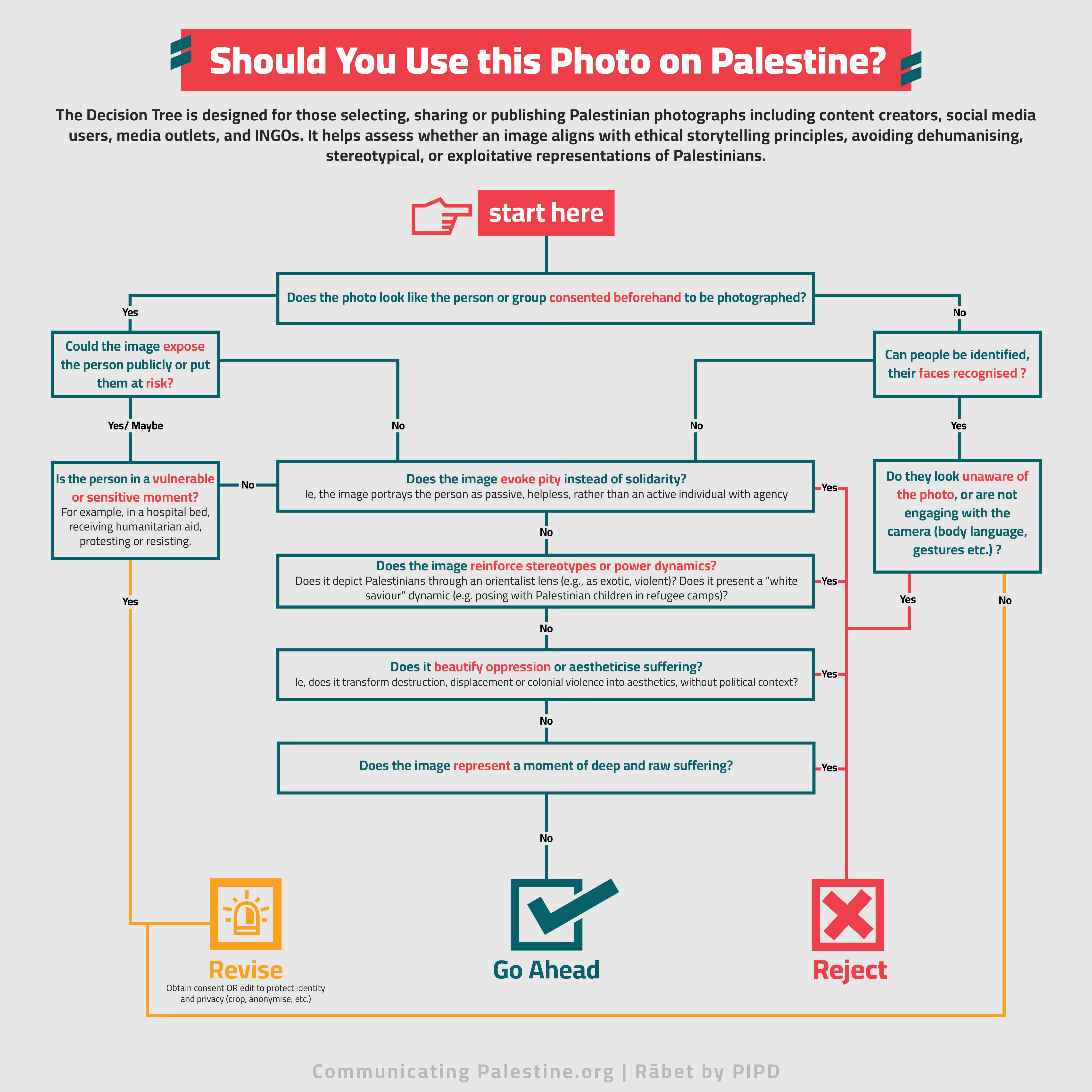
Looking for reliable resources, apps and courses to deepen your understanding of Palestine’s history and current realities? Want tools for challenging disinformation? Looking for digital security resources to protect your online presence or legal support for navigating repression? Looking for further guidance on visual ethics to ensure empowering representation?
We have compiled tools from our partners to empower your communication and advocacy
We all carry unconscious biases—shaped by the media we consume, the knowledge we’re taught and the systems we live in. These short, interactive quizzes help us reflect on how those biases might show up in our work as journalists, artists, organisers or other communicators.
Think of it as a mirror, not a test—No grades, just a chance to pause and learn. The quizzes will take you to relevant sections of the guide to deepen your understanding and strengthen your practice.
All selected pictures, headlines and examples within the quizzes are taken from real-life examples and are not AI-generated.



.png)





.png)
.avif)
.png)