Amazon Conservation Association
Over 25 Years of Conservation Impact
Mission
We unite science, innovation, and people to protect the Amazon—the greatest wild forest on earth.
Ruling year
2000
President
John Beavers
Main address
1025 Connecticut Ave NW STE 415
Washington, DC 20036 USA
EIN
52-2211305
NTEE code
Natural Resource Conservation and Protection (C30)
IRS filing requirement
This organization is required to file an IRS Form 990 or 990-EZ.
Sign in or create an account to view Form(s) 990 for 2024, 2023 and 2022.
Register now
Communication




Programs and results
What we aim to solve
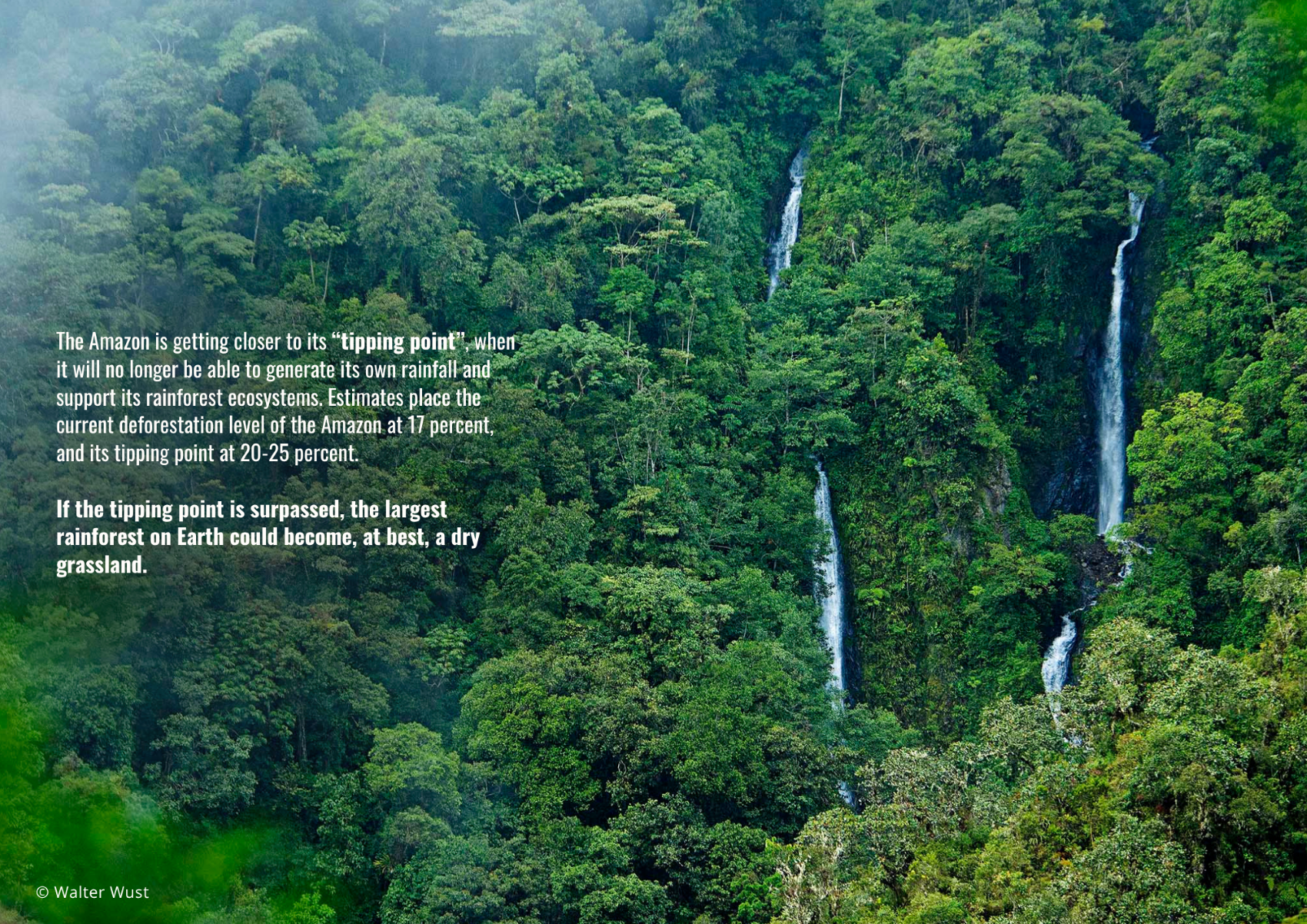
The Amazon has already lost 17% of its forests, and scientists warn that at 20–25% it will reach a tipping point, turning into a dry savanna incapable of sustaining its biodiversity or regulating global climate. The main driver is deforestation, caused by human activity such as gold mining, logging, fires, unsustainable agriculture, and poorly planned infrastructure. Indigenous and local communities are most affected, facing threats to their livelihoods and ancestral lands. To prevent irreversible loss, we need urgent, science-driven action to halt illegal deforestation, strengthen Indigenous stewardship, expand protected areas, foster sustainable forest economies, and scale conservation solutions across the entire Amazon Basin. That can only be achieved through improved collaboration between organizations, communities, and governments, as well as increased investments and support from caring individuals and eco-conscious institutions and companies everywhere.
Our programs
What are the organization's current programs, how do they measure success, and who do the programs serve?
Overview of Amazon Conservation's Work
The holistic approach that guides our conservation programs includes: 𝗣𝗿𝗼𝘁𝗲𝗰𝘁𝗶𝗻𝗴 𝗪𝗶𝗹𝗱 𝗣𝗹𝗮𝗰𝗲𝘀 - Safeguarding over 14.6M acres of forest by creating and supporting a network of public and private lands to keep vital habitats connected, using this area’s biodiversity as a living laboratory to study effects of climate change. 𝗘𝗺𝗽𝗼𝘄𝗲𝗿𝗶𝗻𝗴 𝗣𝗲𝗼𝗽𝗹𝗲 - Working hand-in-hand with communities, governments, and Indigenous peoples, we provide technical support and innovative tools to support enduring conservation solutions; help communities implement sustainable, forest-friendly businesses; and train the next generation of conservationists at our research stations and beyond. 𝗣𝘂𝘁𝘁𝗶𝗻𝗴 𝗦𝗰𝗶𝗲𝗻𝗰𝗲 & 𝗧𝗲𝗰𝗵𝗻𝗼𝗹𝗼𝗴𝘆 𝘁𝗼 𝗪𝗼𝗿𝗸 𝗳𝗼𝗿 𝗖𝗼𝗻𝘀𝗲𝗿𝘃𝗮𝘁𝗶𝗼𝗻 - Harnessing the power of satellite and drone technology to detect and stop deforestation across the Amazon Basin, giving governments and communities the science they need to take action.
Halting Illegal Deforestation
Illegal gold mining, logging, fires, and land conversion continue to advance deeper into the Amazon, often in remote areas where enforcement capacity is limited due to the forest's continental scale. Through initiatives such as the Monitoring of the Andes Amazon Program (MAAP), Amazon Mining Watch, and Amazon Mining Policy Score Board, we combine satellite imagery, AI-supported monitoring, drones, and geospatial analysis to detect illegal deforestation activities across the Amazon in real time. But our work goes beyond monitoring. We help governments, Indigenous organizations, journalists, and local partners transform data into rapid response, accountability, and enforcement action on the ground.
Protecting the Core of the Amazon
More than half of the Amazon Basin is made up of protected areas and Indigenous territories that help stabilize the climate, store carbon, and maintain biodiversity across the region. Amazon Conservation works alongside Indigenous peoples, governments, and local partners to establish, strengthen, and connect these critical landscapes. This includes supporting protected areas, territorial governance, biodiversity monitoring, landscape connectivity, and science-based conservation efforts across Peru and Bolivia, while helping scale a broader Amazon-wide perspective on conservation and climate resilience.
Building a Forest-Based Economy
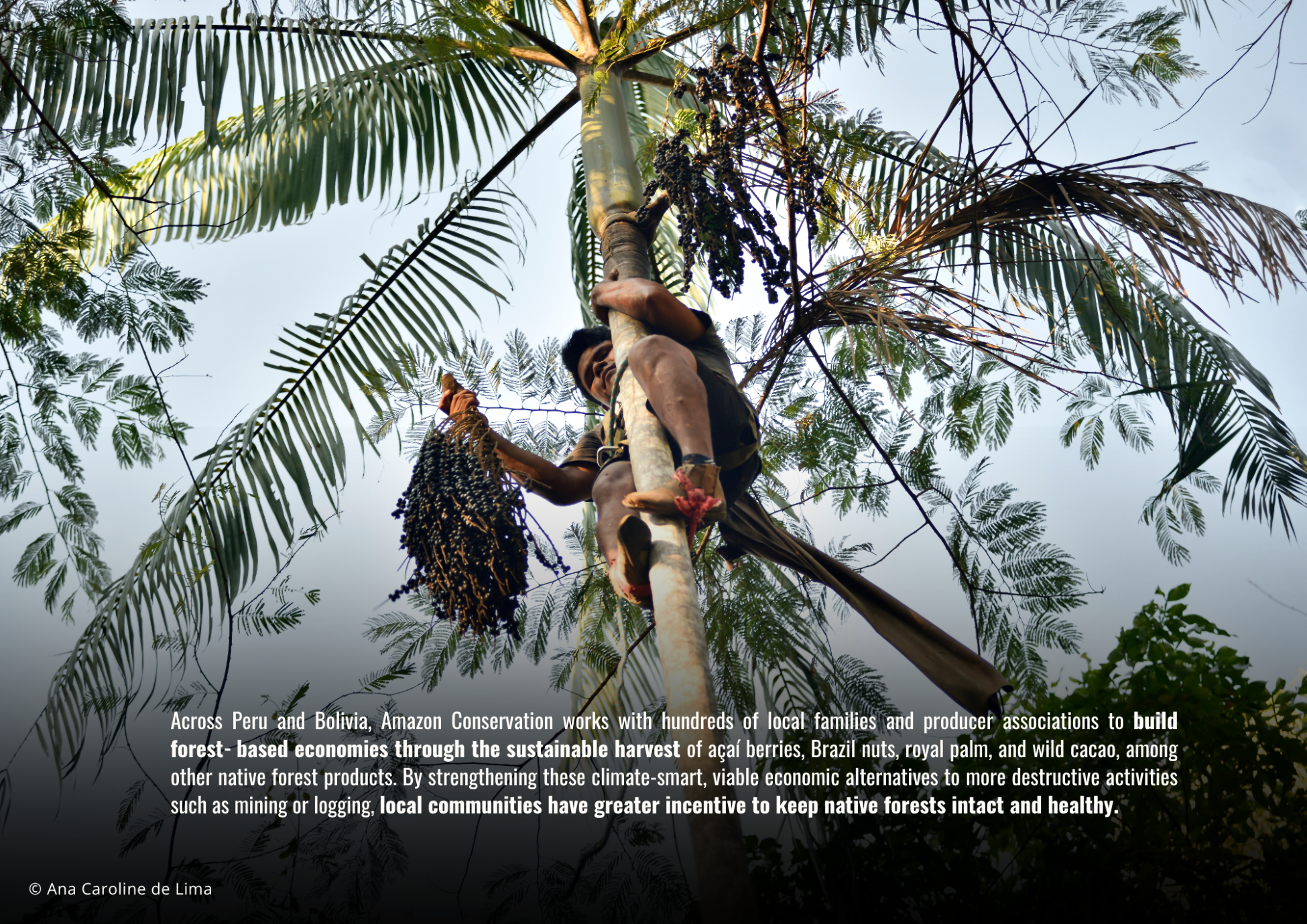
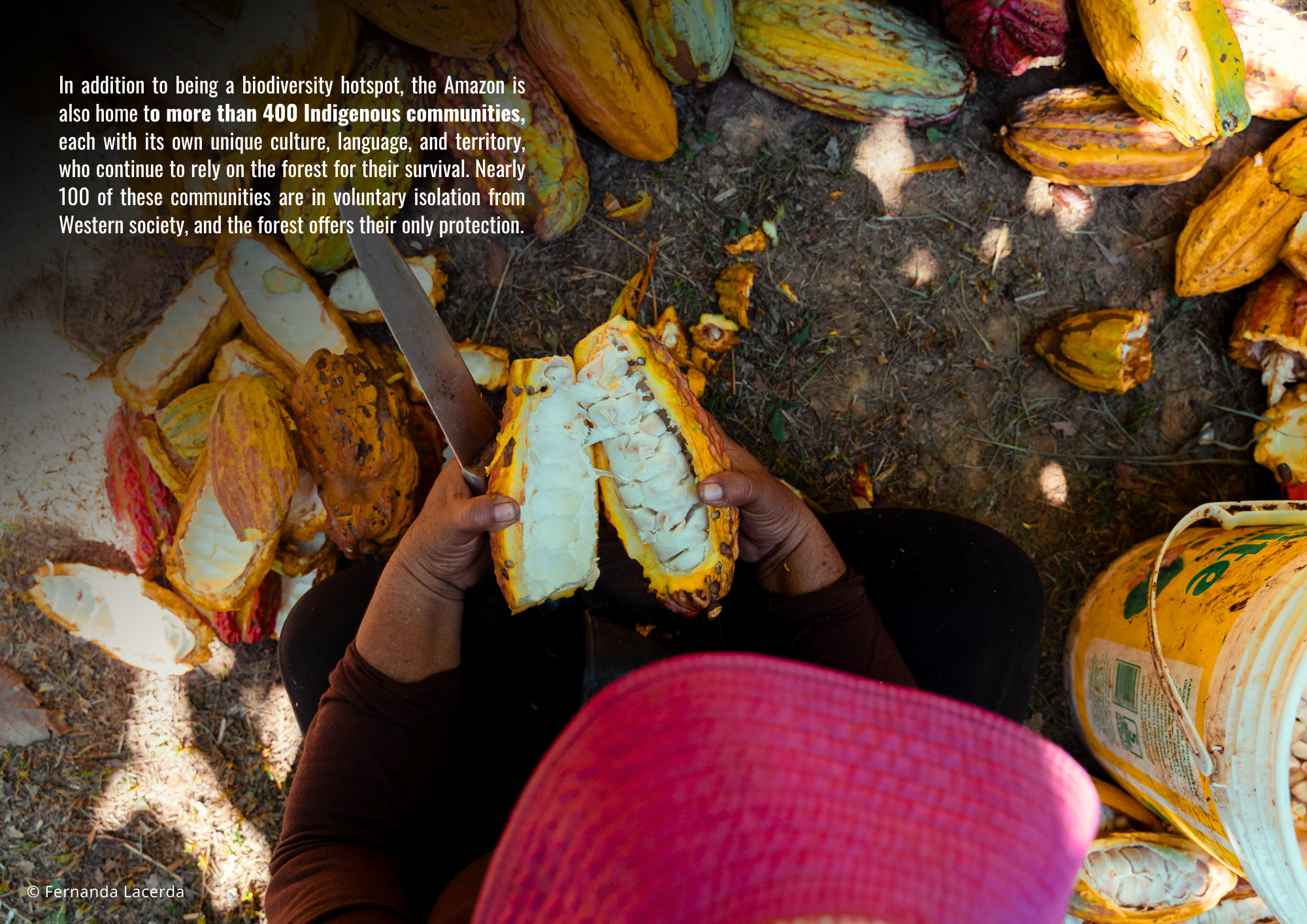
Long-term conservation depends on making standing forests more valuable than destroyed forests. Amazon Conservation supports sustainable forest economies across more than 42 million acres in Peru and Bolivia by strengthening climate-smart production of products such as Brazil nuts, açaí, aguaje, and wild cacao. By supporting community enterprises, improving market access, strengthening supply chains, and helping communities adapt to climate change, we help create long-term economic alternatives that keep forests standing while improving livelihoods.
Where we work
-
Amazon Basin (region in Brazil)
-
Amazonas (Peru)
-
Bolivia
-
Brazil
-
Colombia
-
Ecuador
-
French Guiana
-
Guyana
-
Peru
-
South America
-
Suriname
-
Venezuela
Awards
Platinum Seal of Transparency 2025
Candid
Top-Rated Badge 2022
GreatNonprofits
4-Star Charity (100% Rating) 2025
Charity Navigator
4-Star Charity (99% Rating) 2024
Charity Navigator
Leadership & Adaptability Beacon 2020
Charity Navigator
Photos

Videos
Our results
How does this organization measure their results? It's a hard question but an important one.
Number of native trees planted
This metric is no longer tracked.Totals By Year
Related Program
Overview of Amazon Conservation's Work
Type of Metric
Other - describing something else
Context Notes
Total number of native trees planted to date to help restore and regenerate damaged habitats and rebuild healthy forest ecosystems.
Number of partner organizations
This metric is no longer tracked.Totals By Year
Related Program
Overview of Amazon Conservation's Work
Type of Metric
Other - describing something else
Context Notes
Total number of partner organizations in Amazon Conservation's network per year (including other conservation nonprofit organizations, Indigenous groups, local communities, producer associations, advocacy groups, technology companies, etc.) working together to expand our collective conservation impact across the Amazon basin.
Number of reports exposing illegal deforestation
This metric is no longer tracked.Totals By Year
Related Program
Halting Illegal Deforestation
Type of Metric
Other - describing something else
Context Notes
Cumulative number of reports exposing deforestation events (as evidenced via satellite analysis) published publicly or confidentially by Amazon Conservation.
Acres we monitor for illegal deforestation
This metric is no longer tracked.Totals By Year
Related Program
Halting Illegal Deforestation
Type of Metric
Other - describing something else
Context Notes
Total number of acres of the Amazon basin monitored per year for illegal deforestation activity using satellite data through our Monitoring of the Andes Amazon Program (MAAP).
Acreage of of protected areas and Indigenous territories we helped to establish
This metric is no longer tracked.Totals By Year
Related Program
Protecting the Core of the Amazon
Type of Metric
Other - describing something else
Context Notes
Total number of acres of protected areas and Indigenous territories Amazon Conservation has helped establish to date and which we currently manage with local partners. Support in establishing protected areas and Indigenous territories may include technical expertise or assistance, data collection, and conservation and land management planning.
Acres of land we actively conserve
This metric is no longer tracked.Totals By Year
Related Program
Protecting the Core of the Amazon
Type of Metric
Other - describing something else
Context Notes
Total number of acres Amazon Conservation supports through sustainable land management, creation of protected areas, territorial defense, and other conservation efforts with local partners.
Volume of forest goods sustainably produced and harvested per year (kg)
This metric is no longer tracked.Totals By Year
Related Program
Building a Forest-Based Economy
Type of Metric
Other - describing something else
Context Notes
Total volume of forest goods (such as Brazil nuts, açaí berries, and wild cacao) sustainably harvested and/or produced per year by local communities with logistical and operational support from Amazon Conservation, such as trainings and certifications, funding, and administrative services.
Acres sustainably used and managed per year
This metric is no longer tracked.Totals By Year
Related Program
Building a Forest-Based Economy
Type of Metric
Other - describing something else
Context Notes
Total number of acres sustainably used, managed, and protected per year through our forest-based economy efforts.
Our Sustainable Development Goals


Learn more about Sustainable Development Goals.
Goals & Strategy
Learn about the organization's key goals, strategies, capabilities, and progress.
Charting impact
Four powerful questions that require reflection about what really matters - results.
What is the organization aiming to accomplish?
Our vision is simple: we work toward creating a thriving and resilient Amazon that sustains the full diversity of life. We apply a holistic approach to our work, based on three pillars: protect wild places, empower people, and put science and technology to work for conservation. Through this approach, we strengthen our conservation efforts through building partnerships that center people, nature, and innovation to create enduring climate-smart solutions that protect this vital place for all of humanity.
What are the organization's key strategies for making this happen?
All of Amazon Conservation’s conservation solutions are centered around three interconnected strategic initiatives that together enable us to address the region’s complex problems and achieve a resilient, thriving Amazon:
𝟭. 𝗣𝗿𝗼𝘁𝗲𝗰𝘁𝗶𝗻𝗴 𝘁𝗵𝗲 𝗖𝗼𝗿𝗲 𝗼𝗳 𝘁𝗵𝗲 𝗔𝗺𝗮𝘇𝗼𝗻: More than half of the Amazon basin is made up of protected areas and Indigenous territories that help stabilize the climate, store carbon, and maintain biodiversity across the region. We work alongside Indigenous peoples, governments, and local partners to establish, strengthen, and connect these critical landscapes. This includes supporting protected areas, territorial governance, biodiversity monitoring, landscape connectivity, and science-based conservation efforts across Peru and Bolivia, while helping scale a broader Amazon-wide perspective on conservation and climate resilience.
𝟮. 𝗛𝗮𝗹𝘁𝗶𝗻𝗴 𝗜𝗹𝗹𝗲𝗴𝗮𝗹 𝗗𝗲𝗳𝗼𝗿𝗲𝘀𝘁𝗮𝘁𝗶𝗼𝗻: Illegal gold mining, logging, fires, and land conversion continue to advance deeper into the Amazon, often in remote areas where enforcement capacity is limited due to the forest's continental scale. Through initiatives such as the Monitoring of the Andes Amazon Program (MAAP), Amazon Mining Watch, and Amazon Mining Policy Score Board, we combine satellite imagery, AI-supported monitoring, drones, and geospatial analysis to detect illegal deforestation activities across the Amazon in real time. But our work goes beyond monitoring. We help governments, Indigenous organizations, journalists, and local partners transform data into rapid response, accountability, and enforcement action on the ground.
𝟯. 𝗕𝘂𝗶𝗹𝗱𝗶𝗻𝗴 𝗮 𝗙𝗼𝗿𝗲𝘀𝘁-𝗕𝗮𝘀𝗲𝗱 𝗘𝗰𝗼𝗻𝗼𝗺𝘆: Long-term conservation depends on making standing forests more valuable than destroyed forests. Amazon Conservation supports sustainable forest economies across more than 42 million acres in Peru and Bolivia by strengthening climate-smart production of products such as Brazil nuts, açaí, aguaje, and wild cacao. By supporting community enterprises, improving market access, strengthening supply chains, and helping communities adapt to climate change, we help create long-term economic alternatives that keep forests standing while improving livelihoods.
Amazon Conservation turns science, field experience, and regional monitoring into advocacy that supports stronger environmental governance and more coordinated action across borders. Through collaboration with Indigenous organizations, governments, journalists, researchers, and civil society partners, we help elevate science-based solutions and strengthen accountability around the drivers of deforestation across the Amazon.
How we listen
Seeking feedback from people served makes programs more responsive and effective. Here’s how this organization is listening.
-
How is your organization using feedback from the people you serve?
To identify and remedy poor client service experiences, To identify bright spots and enhance positive service experiences, To make fundamental changes to our programs and/or operations, To inform the development of new programs/projects, To strengthen relationships with the people we serve, To understand people’s needs and how we can help them achieve their goals, To identify where we are less inclusive or equitable across demographic groups,
-
Which of the following feedback practices does your organization routinely carry out?
We take steps to get feedback from marginalized or under-represented people, We aim to collect feedback from as many people we serve as possible, We take steps to ensure people feel comfortable being honest with us, We look for patterns in feedback based on people’s interactions with us (e.g., site, frequency of service, etc.), We engage the people who provide feedback in looking for ways we can improve in response, We act on the feedback we receive, We tell the people who gave us feedback how we acted on their feedback, We ask the people who gave us feedback how well they think we responded, We collect feedback from the people we serve at least annually, We look for patterns in feedback based on demographics (e.g., race, age, gender, etc.),
-
What challenges does the organization face when collecting feedback?
It is difficult to find the ongoing funding to support feedback collection, Staff find it hard to prioritize feedback collection and review due to lack of time, It is difficult to get the people we serve to respond to requests for feedback,
Financials
Unlock nonprofit financial insights that will help you make more informed decisions. Try our monthly plan today.
- Analyze a variety of pre-calculated financial metrics
- Access beautifully interactive analysis and comparison tools
- Compare nonprofit financials to similar organizations
Want to see how you can enhance your nonprofit research and unlock more insights?
Learn more
about GuideStar Pro.
Operations
The people, governance practices, and partners that make the organization tick.
Connect with nonprofit leaders
SubscribeBuild relationships with key people who manage and lead nonprofit organizations with GuideStar Pro. Try a low commitment monthly plan today.
- Analyze a variety of pre-calculated financial metrics
- Access beautifully interactive analysis and comparison tools
- Compare nonprofit financials to similar organizations
Want to see how you can enhance your nonprofit research and unlock more insights? Learn More about GuideStar Pro.
Connect with nonprofit leaders
SubscribeBuild relationships with key people who manage and lead nonprofit organizations with GuideStar Pro. Try a low commitment monthly plan today.
- Analyze a variety of pre-calculated financial metrics
- Access beautifully interactive analysis and comparison tools
- Compare nonprofit financials to similar organizations
Want to see how you can enhance your nonprofit research and unlock more insights? Learn More about GuideStar Pro.
Amazon Conservation Association
Board of directorsas of 06/05/2026
Douglas Sarno
Forum Facilitation Group, The Participation Company
Eduardo Forno
Conservation International (Bolivia)
Andrew Beck DIRECTOR (START 2/23)
Beyond Good
Andrew Wilcox
Unilever
Carlos Wiese
Asociación Latinoamericana de Instituciones Financieras para el Desarrollo (ALIDE)
Carolyn Hendricks
Maryland Oncology Hematology
Douglas Sarno
Forum Facilitation Group, The Participation Company
Eduardo Forno
Conservation International (Bolivia)
James Brumm
John Nassikas
Arnold & Porter
Katherine Petty
Steven Kahle Architects
Kathleen Goodin
Manuel Pulgar-Vidal DIRECTOR
Nature International, World Wild Fund
Marie Arana DIRECTOR (START 12/23)
Simon & Schuster
Ryan Bailey
Bailey Equipment & Intralogistics
Stephen Voorhees
Teichos Energy
Walter Vergara
World Resources Institute
William Sheehan
American Bird Conservancy
Board leadership practices
GuideStar worked with BoardSource, the national leader in nonprofit board leadership and governance, to create this section.
-
Board orientation and education
Does the board conduct a formal orientation for new board members and require all board members to sign a written agreement regarding their roles, responsibilities, and expectations? yes -
CEO oversight
Has the board conducted a formal, written assessment of the chief executive within the past year ? yes -
Ethics and transparency
Have the board and senior staff reviewed the conflict-of-interest policy and completed and signed disclosure statements in the past year? yes -
Board composition
Does the board ensure an inclusive board member recruitment process that results in diversity of thought and leadership? yes -
Board performance
Has the board conducted a formal, written self-assessment of its performance within the past three years? no
Organizational demographics
Who works and leads organizations that serve our diverse communities? Candid partnered with CHANGE Philanthropy on this demographic section.
Leadership
The organization's leader identifies as:
Race & ethnicity
Gender identity
Transgender Identity
Sexual orientation
Disability
We do not display disability information for organizations with fewer than 15 staff.


Thanks for signing up!
An email has been sent to the address you provided. Click on the link in that email to get more GuideStar Nonprofit Profile data today!
(Don't see an email in your inbox? Click here to resend it.)
GuideStar Pro Reports

Report successfully added to your cart!
Want more data?
A GuideStar Pro report containing the following information is available for this organization:
- Email contact information
- Financial trends metrics for five most recent years 2024, 2023, 2022, 2021, 2020*
- Financial statements for 2024, 2023, 2022, 2021, 2020
- Letter of Determination
- Officer and/or Employee data for 2024, 2023, 2022, 2021, 2020
- Contractor and/or Paid Preparer data for 2024, 2023, 2022
- Board of Directors data for 2026
- *with the ability to download the data for 2024, 2023, 2022, 2021, 2020
Download it now for $125.
Need the ability to download nonprofit data and more advanced search options?Consider a Pro Search subscription.
