
Abstract
Objective:
Changes in cerebrovascular hemodynamics associated with head position may be important in the pathogenesis of periventricular-intraventricular hemorrhage (PIVH) in premature infants. This study evaluated the effect of elevated midline head positioning on cardiopulmonary function and the incidence of PIVH.
Study design:
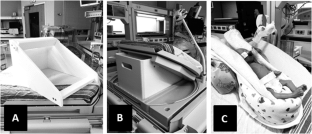
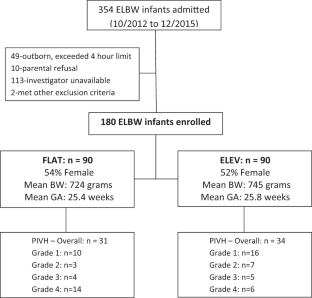
ELBW infants were randomized to FLAT (flat, supine) or ELEV (supine, bed elevated 30 degrees) for 96 h. Cardiopulmonary function, complications of prematurity, and the occurrence of PIVH were documented.
Results:
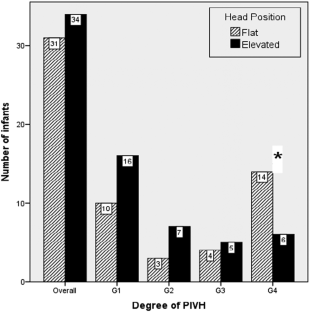
Infants were randomized into FLAT (n = 90) and ELEV groups (n = 90). No significant differences were seen in the incidence of BPD or other respiratory complications. The ELEV group developed significantly fewer grade 4 hemorrhages (p = 0.036) and survival to discharge was significantly higher in the ELEV group (p = 0.037).
Conclusions:
Managing ELBW infants in an elevated midline head position for the first 4 days of life appears safe and may decrease the likelihood of severe PIVH and improve survival.
This is a preview of subscription content, access via your institution
Access options
Subscribe to this journal
Receive 12 print issues and online access
$259.00 per year
only $21.58 per issue
Buy this article
- Purchase on SpringerLink
- Instant access to the full article PDF.
USD 39.95
Prices may be subject to local taxes which are calculated during checkout
References
Volpe JJ. Intracranial hemorrhage: Germinal matrix-intraventricular hemorrhage of the premature infant. In: Neurology of the Newborn (5th edition). Philadelphia, PA: Saunders Elsevier, 2008, pp 517–88.
Ballabh P. Intraventricular hemorrhage in premature infants: mechanism of disease. Pediatr Res. 2010;67:1–8.
Gilmore MM, Stone BS, Shepard JA, Czosnyka M, Easley RB, Brady KM. Relationship between cerebrovascular dysautoregulation and arterial blood pressure in the premature infant. J Perinatol. 2011;31:722–9.
Limperopoulos C, Gauvreau KK, O’Leary H, Moore M, Bassan H, Eichenwald EC, Soul JS, Ringer SA, Di Salvo DN, du Plessis A. Cerebral hemodynamic changes during intensive care of preterm infants. Pediatrics. 2008;122:e1006–13.
Bembich S, Oretti C, Travan L, Clarici A, Massaccesi S, Demarini S. Effect of prone and supine position on cerebral blood flow in preterm infants. J Pediatr. 2012;160:162–4.
Pichler G, Urlesberger B, Schmolzer G, Muller W. Effect of tilting on cerebral haemodynamics in preterm infants with periventricular leucencephalomalacia. Acta Paediatr. 2004;93:70–75.
Pellicer A, Gaya F, Madero R, Quero J, Cabanas F. Noninvasive continuous monitoring of the effects of the head position on brain hemodynamics in ventilated infants. Pediatrics. 2002;109:434–40.
Ancora G, Maranella E, Aceti A, Pierantoni L, Grandi S, Corvaglia L, et al. Effect on posture on brain hemodynamics in preterm newborns not mechanically ventilated. Neonatology. 2010;97:212–7.
Cowan F, Thoresen M. Changes in superior sagittal sinus blood velocities due to postural alterations and pressure on the head of the newborn infant. Pediatrics. 1985;75:1038–47.
Emery JR, Peabody JL. Head position affects intracranial pressure in newborn infants. Pediatrics. 1983;103:950–3.
Goldberg RN, Joshi A, Moscoso P, Castillo T. The effect of head position on intracranial pressure. Crit Care Med. 1983;11:428–30.
Dellagrammaticas HD, Kapetenakis J, Papadimitriou M, Kourakis G. Effect of body tilting on physiological functions in stable very low birthweight neonates. Arch Dis Child. 1991;66:429–32.
Jenni OG, von Siebenthal K, Wolf M, Keel M, Duc G, Bucher HU. Effect of nursing in the head elevated tilt position (15o) on the incidence of bradycardic and hypoxemic episodes in preterm infants. Pediatrics. 1997;100:622–5.
Carteaux P, Cohen H, Check J, George J, McKinley P, Lewis W, et al. Evaluation and development of potentially better practices for the prevention of brain hemorrhage and ischemic brain injury in very low birth weight infants. Pediatrics. 2003;111:e489–96.
Malusky S, Donze A. Neutral head positioning in premature infants for intraventricular hemorrhage prevention: an evidence-based review. Neonatal Netw. 2011;30:381–96.
Thoresen M, Cowan F, Walloe L. Cardiovascular responses to tilting in healthy newborns babies. Early Human Dev. 1991;26:213–22.
Schrod L, Walter J. Effect of head-up body tilt position on autonomic function and cerebral oxygenation in preterm infants. Biol Neonate. 2002;81:255–25.
Ma M, Noori S, Maarek J-M, Holschneider DP, Rubinstein EH, Seri I. Prone positioning decreases cardiac output and increases systemic vascular resistance in neonates. J Perinatol. 2015;35:424–7.
Jobe A, Bancalari E. Bronchopulmonary dysplasia. Am J Respir Crit Care Med. 2001;163:1723–9.
Watkins AMC, West CR, Cooke RWI. Blood pressure and cerebral hemorrhage and ischemia in very low birth weight infants. Early Hum Dev. 1989;19:103–10.
Stoll BJ, Hansen NI, Bell EF, Shankaran S, Laptook AR, Walsh MC, et al. Neonatal outcomes of extremely preterm infants from the NICHD Neonatal Research Network. Pediatrics. 2010;126:443–55.
Polin RA, Denson S, Brady MT. and the Committee on the Fetus and Newborn and the Committee on Infectious Disease. Clinical report: strategies for prevention of health care-associated infections in the NICU. Pediatrics. 2012;149:e1085–93.
Garland JS. Ventilator-associated pneumonia in neonates: an update. NeoReviews. 2014;15:225–35.
Kuban K, Leviton A, Pagano M, Fenton T, Strassfield R, Wolff M. Maternal toxemia is associated with reduced incidence of germinal matrix hemorrhage in premature infants. J Child Neurol. 1992;7:70–76.
Acknowledgements
The authors thank the excellent, dedicated nursing staff and the respiratory therapy staff of the Children’s Hospital of The King’s Daughters Neonatal Intensive Care Unit for their support and assistance.
Author information
Authors and Affiliations
Corresponding author
Ethics declarations
Conflict of interest
The authors declare that they have no conflict of interest.
Rights and permissions
About this article

Cite this article
Kochan, M., Leonardi, B., Firestine, A. et al. Elevated midline head positioning of extremely low birth weight infants: effects on cardiopulmonary function and the incidence of periventricular-intraventricular hemorrhage. J Perinatol 39, 54–62 (2019). https://doi.org/10.1038/s41372-018-0261-1
Received:
Revised:
Accepted:
Published:
Version of record:
Issue date:
DOI: https://doi.org/10.1038/s41372-018-0261-1

