Log inSign up
NOAA
20.9K posts
Image
user avatar
NOAA
@NOAA
NOAA provides science, service and stewardship to protect life, property & Earth's natural resources. An agency of @CommerceGov. Join us on Instagram & Facebook
USA (Formerly @usNOAAgov)
noaa.gov
Joined April 2008
158
Following
1.3M
Followers
  • Pinned
    user avatar
    NOAA
    @NOAA
    Jan 7
    Rain, sleet, snow? Be in the know. For 24/7 weather forecasts, watches and warnings, follow NOAA's National Weather Service here at: @NWS and @NWSWPC -- and bookmark weather.gov to view a national advisories, watches and warnings map + get your local forecast by
    90K
  • NOAA reposted
    user avatar
    National Weather Service
    @NWS
    Jun 26
    Dangerous fire weather conditions are forecast across portions of the Great Basin and Southwest today as a robust fire weather pattern begins for an expansive portion of the Intermountain West.
    user avatar
    NWS Storm Prediction Center
    @NWSSPC
    Jun 26
    Here are our Key Messages for Friday (6/26).
    Image
    30K
  • NOAA reposted
    user avatar
    National Weather Service
    @NWS
    Jun 26
    Scattered severe thunderstorm development is possible today, particularly this afternoon into tonight across parts of the Ozark Plateau into lower Ohio Valley and across parts of the northern High Plains to the Black Hills vicinity. weather.gov
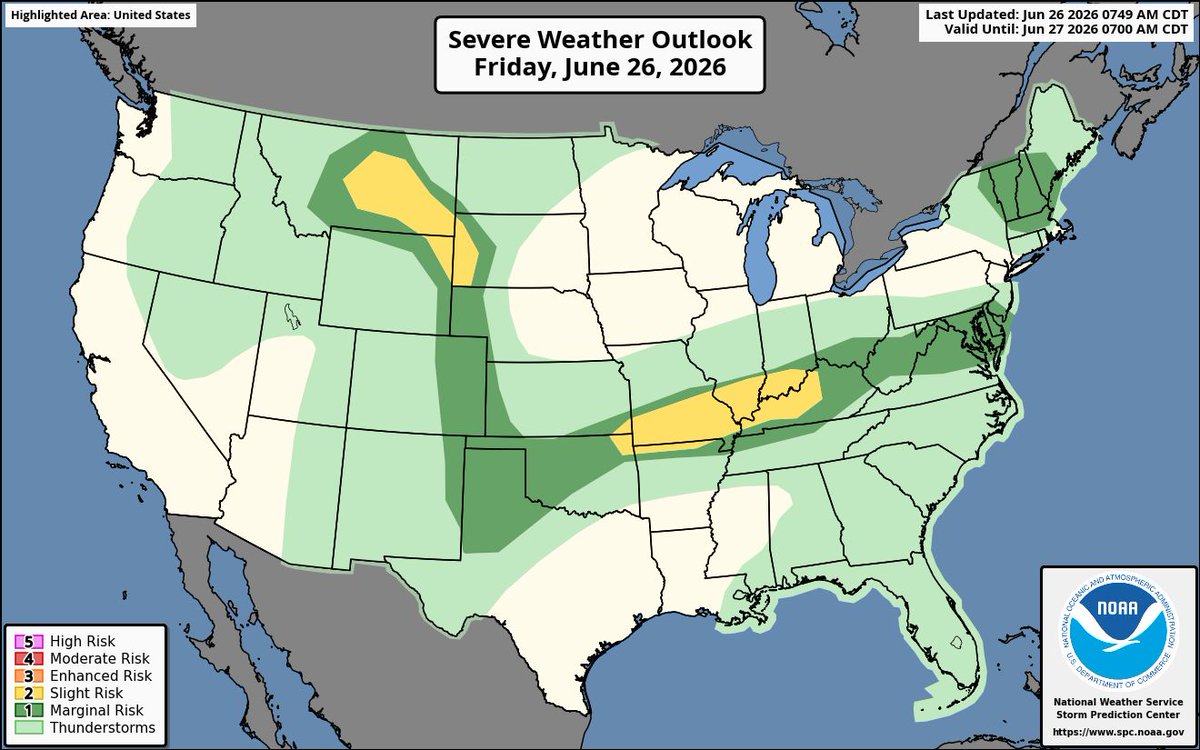
    National Weather Service Severe Weather Outlook map for Friday, June 26, 2026, highlighting areas across the United States with potential thunderstorms and severe weather risk. Two Slight Risk (yellow) areas are shown: one centered over parts of western Montana into northern Wyoming, and another stretching from eastern Kansas and Missouri into southern Illinois and western Kentucky. Broader Marginal Risk (dark green) areas surround these regions, extending across much of the central Plains, Rockies, Mid-Mississippi Valley, and Ohio Valley. General thunderstorm potential (light green) covers large portions of the western U.S., central U.S., Gulf Coast, Southeast, Mid-Atlantic, and Northeast, including northern New England. No enhanced, moderate, or high risk areas are indicated. The map suggests scattered thunderstorms capable of isolated severe weather, with the greatest concern focused in parts of the northern Rockies and lower Midwest.
    31K
  • NOAA reposted
    user avatar
    National Weather Service
    @NWS
    Jun 26
    Weather has its own rulebook. Know the calls! 🟨 Watch = Get ready. Dangerous weather is possible. 🟥 Warning = Take action now! Dangerous weather is happening. Knowing the difference can save your life.
    Weather has its own rulebook. Know the calls. WATCH means dangerous weather is possible. WARNING means dangerous weather is happening now or about to happen!
    28K
  • NOAA reposted
    user avatar
    National Weather Service
    @NWS
    Jun 25
    Dangerous fire weather conditions are expected across portions of the Great Basin and Southwest on Friday. Dry and windy conditions will allow any new or existing wildfires to spread rapidly. Stay alert to the forecast at weather.gov and follow instructions from
    Fire Weather Outlook for Friday June 26th from the Storm Prediction Center. Extremely Critical fire weather conditions are forecast for Utah and portions of southeastern Nevada and northwestern Arizona.
    Red Flag Warning infographic. A Red Flag Warning is issued when critical fire weather conditions are happening or about to happen. It does not necessarily mean there is a fire, but that conditions will be very dry and windy. If a fire is present, it can become extreme! Avoid activities that could spark a wildfire. Take action: make your wildfire plan with at least 2 evacuation routes, maintain your go kit, follow fire prevention tips and regulations, and listen to local officials for updates and evacuation orders.
    28K
  • NOAA reposted
    user avatar
    NWS Weather Prediction Center
    @NWSWPC
    Jun 26
    Extremely Critical Fire Weather risk over parts of the central Great Basin and Southwest Friday; fire weather conditions continue this weekend wpc.ncep.noaa.gov/discussions/hp…
    12K
  • NOAA reposted
    user avatar
    NWS Weather Prediction Center
    @NWSWPC
    Jun 26
    Heat starts to build across the Southern U.S. by Saturday, while below normal temperatures spread from the West into the Northern Plains and Rockies wpc.ncep.noaa.gov/discussions/hp…
    12K
  • NOAA reposted
    user avatar
    NWS Weather Prediction Center
    @NWSWPC
    Jun 26
    Heavy rainfall and severe storms continue across portions of the Central U.S. the next few days; with expansion across Eastern U.S by Saturday wpc.ncep.noaa.gov/discussions/hp…
    14K
  • NOAA reposted
    user avatar
    National Weather Service
    @NWS
    Jun 25
    A robust fire weather pattern is expected across an expansive portion of the Intermountain West through the middle of next week. Dry thunderstorms on Wednesday/Thursday will be followed by multiple days of exceptionally dry and breezy conditions will promote significant fire
    Wildfires can escalate quickly. Wildfire growth can be terrifyingly sudden and deadly. Prepare ahead of time so you'll be ready. Clear brush away from your home to create defensible space. Use fire-resistant landscaping. Know your potential evacuation routes. Have an emergency supply kit ready to go.
    22K
  • NOAA reposted
    user avatar
    National Weather Service
    @NWS
    Jun 25
    Scattered severe thunderstorms should develop today across parts of the southern/central Plains, with large hail and severe/damaging winds possible. A more focused corridor of tornado potential should exist this afternoon/evening across northern Oklahoma and southern Kansas,
    NOAA Storm Prediction Center severe weather outlook for Thursday, June 25, 2026, showing thunderstorm risk areas across portions of the United States. A slight risk (level 2 of 5) stretches across parts of the central and southern Plains, including eastern Colorado, western and central Kansas, western Oklahoma, and eastern New Mexico, where severe thunderstorms may produce damaging winds, large hail, and isolated tornadoes. Surrounding marginal risk (level 1) areas extend more broadly across the Rockies, central Plains, Midwest, lower Mississippi Valley, Great Lakes, and parts of the Gulf Coast. Additional marginal thunderstorm risk areas are highlighted over parts of the Northeast, Ohio Valley, Florida, and the Intermountain West, including Idaho and western Montana. The greatest organized severe storm potential is expected over the central Plains during the afternoon and evening hours.
    31K
  • NOAA reposted
    user avatar
    NIDIS Drought.gov
    @NOAADrought
    Jun 25
    Next week looks relatively dry for the Great Basin region in the West and part of the Southeast, especially the Carolinas. Temps: Cooler than normal for the Far West and warmer than normal for the Plains to the East, w/ extreme heat in parts. drought.gov/forecasts @NOAA @NWS
    A NOAA 6–10 day precipitation outlook map for June 30 to July 4, 2026, shows above-normal precipitation is favored in parts of the Pacific Northwest, Upper Midwest, Northeast, and Southwest, while below-normal precipitation is predicted for parts of the Great Basin and the Southeast.
     A NOAA 6–10 day temperature outlook map for June 30 to July 4, 2026, shows above-normal temperatures are strongly favored for the eastern two-thirds of the country and Hawaii, while below-normal temperatures are predicted for the West Coast and Alaska.
    6.2K
  • NOAA reposted
    user avatar
    NIDIS Drought.gov
    @NOAADrought
    Jun 25
    Spotlight on North Carolina, which is dealing w/ its worst drought since 2008. 100% is in drought, including 45.2% in Extreme/Exceptional Drought (D3/D4). Extreme heat and below-normal precip is expected next week. Drought may worsen. drought.gov/states/north-c… @NOAA @NCSCO
    The June 23 U.S. Drought Monitor shows 100% of North Carolina in drought including 45.2% in Extreme or Exceptional Drought (D3/D4).
    The 6–10 Day Precipitation Outlook map for North Carolina, valid from June 30 to July 4, 2026 indicates a high probability of below-normal precipitation
    A U.S. weather hazard map outlines a large risk zone for extreme heat from July 2 to July 8. The impacted high risk area areas spans a broad corridor from the Midwest and Great Lakes regions down through the Southeast and Mid-Atlantic states.
    7.3K
  • NOAA reposted
    user avatar
    NIDIS Drought.gov
    @NOAADrought
    Jun 25
    #DroughtMonitor 6/23: Heavy rain improved large areas from the Plains to the East, especially the South/Southeast. Heat and dry weather out West led to worsening drought and increasing wildfire risk. #Drought2026's Footprint: 43.7% of the USA drought.gov @NOAA
    The June 23 U.S. Drought Monitor shows 43.7% of the United States + Puerto Rico in drought. Extreme or Exceptional Drought (D3/D4) is present in Oregon, Idaho, Nevada, Montana, Wyoming, Utah, Colorado, New Mexico, Texas, Oklahoma, Kansas, Nebraska, Arkansas, Mississippi, Louisiana, as well as in each state on the Atlantic Coast from Florida to New Jersey except Georgia.
    5K

New to X?

Sign up now to get your own personalized timeline!

Create account

By signing up, you agree to the Terms of Service and Privacy Policy, including Cookie Use.

Terms·Privacy·Cookies·Accessibility·Ads Info·© 2026 X Corp.
Don't miss what's happening
People on X are the first to know.
Log inSign up
Advertisement
Advertisement