Our updated mobile app allows you to generate AND detect deepfakes in seconds.
Create, verify, and explore AI-generated content all in one place.
Try BitMind's AI Detector & Creator app here: bitmind.ai/mobile
The New York Times recently highlighted a challenge that affects everyone online: proving what's real in an era of increasingly convincing AI-generated content.
As synthetic media improves, trust can no longer rely on intuition alone.
Verification is becoming a necessity.
We're excited to announce our partnership with It's AI to advance text deepfake detection capabilities and strengthen our detection systems to include text.
We're working toward a shared goal: making trust and verification more resilient in the age of generative AI.
The future
We're excited to announce our partnership with It's AI to advance text deepfake detection capabilities and strengthen our detection systems to include text.
We're working toward a shared goal: making trust and verification more resilient in the age of generative AI.
The future
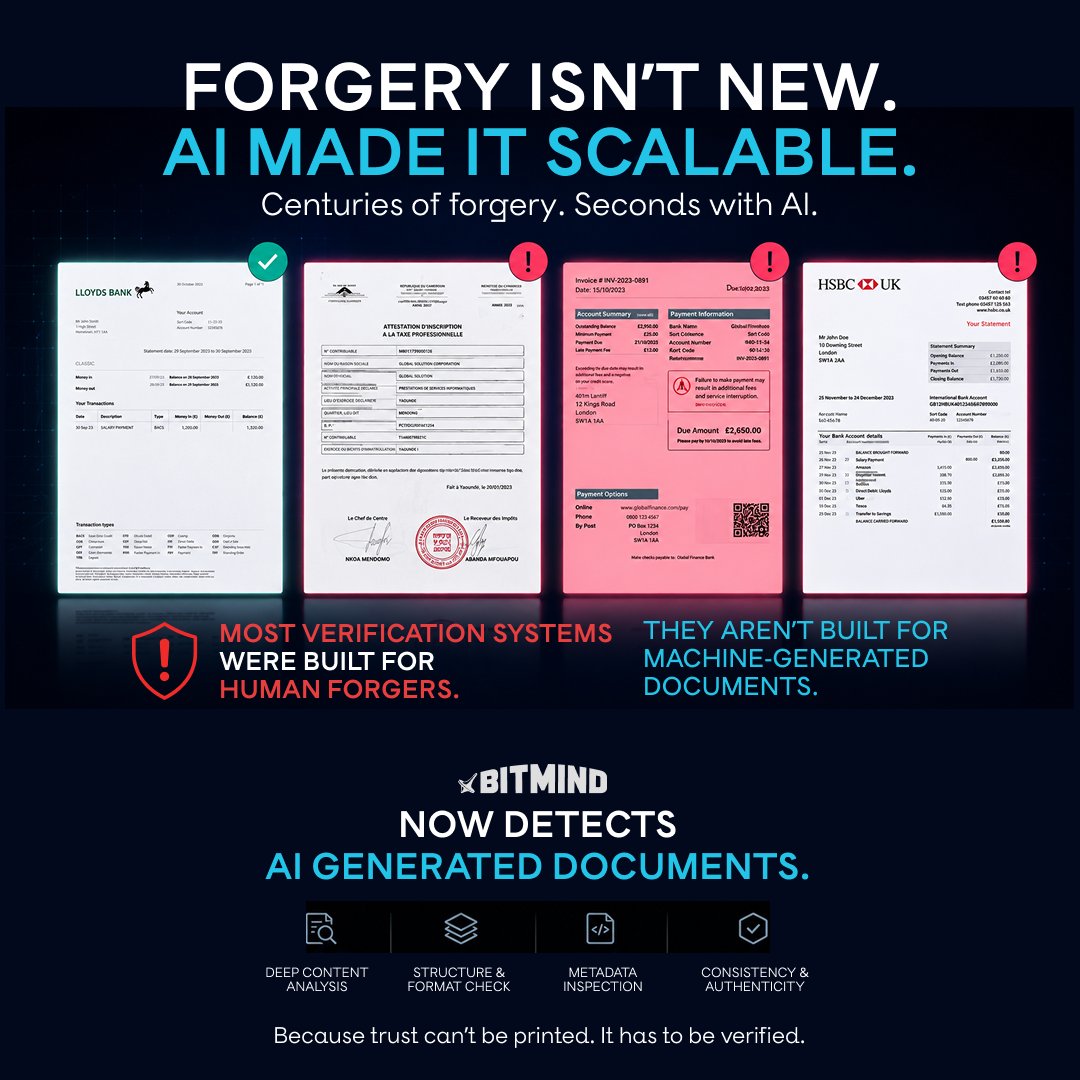
Forgery isn't new.
What's new is how quickly AI can create convincing documents at scale.
Most verification systems were built to catch human forgers. The next challenge is detecting machine-generated documents.
BitMind now detects AI-generated documents.
Most AI detection benchmarks measure performance against known generators. Real-world environments are different.
We evaluated our models against 300,000 images, including adversarial content specifically designed to evade detection. The goal was not to achieve a benchmark
Modern influence operations are increasingly optimized for attention, emotion, and belief rather than technical compromise.
AI is accelerating this shift.
When persuasive synthetic content can be generated at near-zero cost, the attack surface expands from systems and networks
Today we're locking 100% of our owner emissions. No selling, no taking value off the table. It's the clearest signal we can send about where we stand, so we want to explain the thinking behind it.
We've spent 2.5+ years building in the Bittensor ecosystem. That's a long time in
The frontier of AI has been generative, but we think the next unlock is different. Representation and embedding models are how detection moves forward, and they're the key to unlocking the next wave of physical AI use cases.
Here's why it matters now. The world is automating
Most people think detection is about classifiers.
It's not. It's about representation, how a model sees an image before it makes any decision at all. Get the representation right and detection, generation, and embodied AI all get better downstream.
It's where our research team is
AI-edited photos of "damaged" deliveries. Generated images of missing items. Doctored receipts. Refund fraud is bleeding gig economy platforms. Users upload fake proof, the platform pays out, multiply by millions of orders. DoorDash, Uber Eats, Instacart all wear the cost. Image
We've spent the last several months rebuilding our detection stack around what our customers actually face in production: face swaps, synthetic identities, and human-likeness attacks aimed at verification and trust flows. Human-centric detection. Shipping now.
We’ve assembled a lineup of individual Subnet Keynotes from some of the most exciting teams building on Bittensor.
Each keynote will spotlight a different part of the subnet economy:
@micaelabazo, @metanova_labs — decentralised AI for pharma and drug discovery.
@0xcarro,