◦ Security rich
◦ Built to spec
What is a managed private cloud?
A managed private cloud is a cloud hosting solution that combines the control and security of a private cloud with the convenience of managed hosting services. It’s a dedicated cloud environment—where resources are not shared with other organizations—and expert support to manage and maintain the infrastructure.
A managed private cloud ensures that organizations retain full control over their data and files, while the hosting provider takes care of the day-to-day management, monitoring, and maintenance. It’s perfect for businesses that need to prioritize security, privacy, and performance but don’t have the resources or the desire to manage hosting IT in-house.
What is a private cloud?
A private cloud is a cloud hosting architecture that provides a single organization with exclusive access to a set of computing resources. They are ideal for industries that need tight security for data and compliance.
That makes private clouds popular in industries like finance or healthcare. A private cloud also allows for greater customization, so businesses can tailor the cloud environment to specific workloads.
What is managed hosting?
Managed hosting is a hosting service wherein the provider takes care of the technical tasks of maintaining the server infrastructure—including updates, monitoring, backups, and troubleshooting. Unlike self-managed hosting, where the client is responsible for server management, managed hosting allows business teams to focus on their core operations.
Managed hosting generally improves uptimes and enhances security. It also gives organizations access to technical hosting expertise. It’s perfect for businesses that need reliable hosting, without the complexity of managing their own servers.
How a managed private cloud works
Managed private cloud technology functions like any other private cloud. It’s built on virtualization technology, where multiple virtual machines (VMs) can run on a single physical server. What sets it apart is the layer of managed services added on top.
Virtualization
Virtualization is technology that abstracts virtual machines (VMs) from the underlying physical resources necessary to operate them. The physical components of the hosts, such as the CPU, memory, storage, and network, are presented to the VMs and computing workloads as virtualized resources.
At its simplest, virtualization technology allows one physical server to host many virtual machines. This architecture is a common example of virtualized computing, and is used to silo the computing resources on one part of a physical server for one specific client or organization.
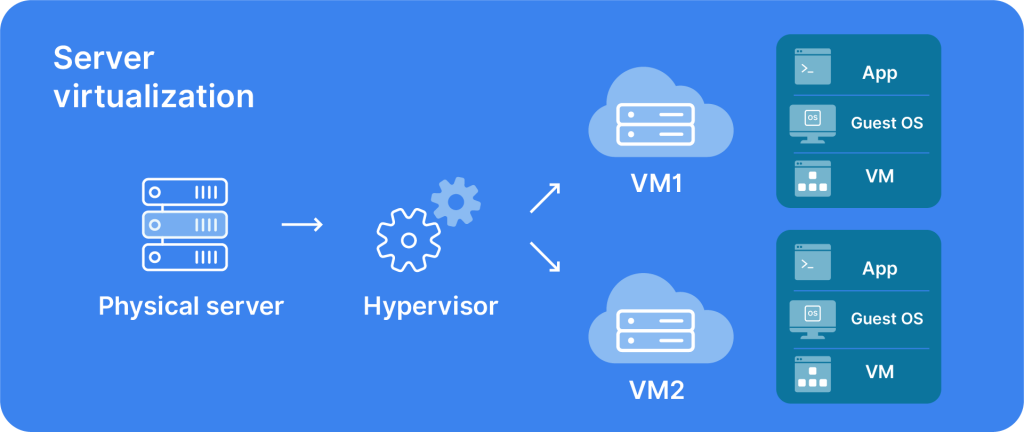
Virtualization makes a private server architecture more affordable, easier to manage, easier to ensure high availability, and it provides the flexibility to scale resources up or down as needed.
Virtualization makes a private server architecture more affordable, easier to manage, easier to ensure high availability, and it provides the flexibility to scale resources up or down as needed.
Virtualization makes a private server architecture more affordable, easier to manage, easier to ensure high availability, and it provides the flexibility to scale resources up or down as needed.
Support
Support is the cornerstone of managed hosting. In a managed private cloud, the hosting provider offers a range of services to ensure that everything runs smoothly. This can include 24/7 monitoring, performance optimization, and quick troubleshooting of any issues that arise.
Managed hosting providers may also offer enhanced security measures like DDoS protection, and disaster recovery plans, giving businesses peace of mind that their cloud environment is in good hands.
Each provider’s support services may differ, so compare details and ask questions if you’re considering a managed hosting solution.
Automation
Automation is another key feature of a managed private cloud. Hosting providers often use automation tools to streamline routine tasks, ensuring that their cloud environments run smoothly and efficiently.
Cloud automation also reduces the risk of human error. Automation enables the cloud to quickly adapt to changes in demand, ensuring that resources are allocated where they’re needed most, without delay. For businesses, this means a more responsive and reliable infrastructure.
Other types of private clouds
While managed private clouds offer a blend of convenience and control, they’re not the only option. Depending on the business’s needs, other private cloud setups may be more appropriate.
Self-hosted private cloud
A self-hosted, or unmanaged, private cloud is where a business takes care of its own private cloud infrastructure. While this offers complete control and customization, it also requires internal IT staff and expertise.
A self-hosted private cloud is ideal for businesses with highly specialized needs and the ability to maintain the entire environment themselves.
Some organizations may prefer a self-hosted private cloud for niche applications or to meet specific regulatory or compliance requirements. However, without managed services, this option can be more complex and time-consuming.
On-premises private cloud
An on-premises private cloud refers to infrastructure hosted at the company’s physical location rather than a remote data center. While on-premises is not technically a “cloud” environment, it often gets called that because it uses cloud-like technology for resource allocation and management.
On-premises servers are preferred by businesses that need to retain physical control of their hardware, often for regulatory or security reasons. However, this option requires a significant initial investment, and it lacks the scalability and convenience of true cloud hosting, making it less flexible for businesses looking to grow.
Other cloud architectures
Beyond private clouds, there are several other cloud hosting options that cater to different business needs.
Public cloud
A public cloud is a shared environment where multiple customers use the same infrastructure, managed by a third-party provider. Public clouds are known for their affordability and scalability, making them ideal for businesses that don’t have strict data privacy or performance requirements.
Hybrid cloud
A hybrid cloud combines elements of both public and private clouds, allowing businesses to use a mix of both environments. This offers flexibility, as businesses can keep sensitive workloads in a private cloud while using a public cloud for less-critical applications.
Hybrid clouds are a great solution for businesses with diverse workloads, providing the ability to optimize performance and costs.
Managed private cloud FAQs
Getting started with a private cloud
If what you need is a private cloud environment, or a virtual private server, for hosting a website, dev environment, or application, Liquid Web is the perfect solution. Our VPS solutions are the perfect intersection of security, speed, and affordability. And our custom private cloud solutions deliver huge performance wins over the competition.
Click below to explore dedicated server options or start a chat with one of our experts to learn more.
Ready to get started?
Liquid Web is known for providing high-performance dedicated server hosting solutions. Choose from bare metal or a fully manage dedicated server, and get 99.999% uptime, rich security features, and much more.
Additional resources
What is a dedicated server? →
Benefits, use cases, and how to get started
Best dedicated server hosting Europe: Top 7 choices →
This guide aims to simplify your decision-making process by presenting a comprehensive analysis of the top seven dedicated server hosting providers in Europe.
Fully managed dedicated hosting →
What it means and what fully managed services cover on dedicated hosting

Liquid Web’s Product Innovation & Marketing Manager Ken Wallace got his tech start in college by building websites. He soon entered the world of web development and has spent the last twenty-two years working in the tech industry.Previously, Ken was the GM of WP Sandbox, a Stellar brand brought into the Liquid Web Family of Brands with the Events Calendar acquisition. In his current role, Ken is part of two teams at Liquid Web: Product and Marketing.
