StopTheMadness Pro by indie developer Jeff Johnson is a web browser extension that stops website annoyances and privacy violations. A one-time universal purchase in the App Store, StopTheMadness Pro supports Safari on iOS, Safari, Chrome, and Firefox on macOS.

StopTheMadness Pro is not an ad blocker but rather a one of a kind web browser extension, with a huge number of unique features. Its main purpose is to force websites to behave as you expect and intend, by stopping them from sneakily subverting your web browser’s built-in functionality. For example, websites can block your copy and paste, block your contextual menu, block your keyboard shortcuts, play videos without your permission, hide the native video controls, and hijack your link clicks for tracking purposes. StopTheMadness Pro stops all that madness!

You can also customize your web browsing experience in several ways with StopTheMadness Pro. Set the video playback speed on websites, redirect URLs to alternative websites (or to alternative web browsers in macOS Safari), force links to open in the same tab or to open in new tabs, substitute fonts on websites, and add your own CSS and JavaScript to websites.

Beloved for years by users, widely praised by the Apple news media, StopTheMadness Pro is the essential companion to your web browser.

Jeff Johnson:

As an App Store developer myself, I’ve stubbornly resisted the trend, perhaps to my financial detriment, though I’m currently doing ok with upfront paid apps. One thing that drives me nuts about the In-App Purchase business model is that it creates massive customer confusion. How do you know in advance exactly how much the app costs, what exactly you’re getting for the price, and what functionality, if any, is free? And if you’re confused about any of these things, then how can you possibly comparison shop between various apps in the App Store?

Johnson mentions several ways, but I have one more complaint: Apple utterly buries this information on individual app listings. To get even a vague idea of how much an app is going to cost, a user must scroll all the way past screenshots, the app’s description, ratings and reviews, the changelog, the privacy card, and the accessibility features — all the way down to a boring-looking table that contains the seller, the app’s size, the category, the compatibility, supported languages, the age rating, and only then is there a listing for “In-App Purchases”. And, if they exist, a user must still tap on the cell to find the list of options and their associated cost.

This is almost at the very bottom of the app’s listing. The only things on the page after the In-App Purchases section are the copyright string, links to the developer’s website and privacy policy, and then the recommendations section. Apple thinks the cost of an up-front purchase is so important it replaces the text in the “get” button with the price. But for freemium apps? The possible costs are tucked away in a place I bet many users never look.

(For full disclosure: Johnson’s StopTheMadness Pro is sponsoring Pixel Envy this week, but he has not asked me to post this, and I would have linked to it regardless.)

Ilya Gridneff and Myles McCormick, in a Financial Times article with the headline “Trump Officials Met Group Pushing Alberta Independence From Canada”:

Leaders of the Alberta Prosperity Project, a group of far-right separatists who want the western province to become independent, met US state department officials in Washington three times since April last year, according to people familiar with the talks.

A worrisome paragraph if I have ever read one. The separatists’ behaviour has understandably been interpreted as treasonous, and the possible interference of the U.S. is a question of national sovereignty.

But — and maybe I am being naïve — I think this article is less of a description of reality, and more like a marketing stunt by these traitors. Here are the next two paragraphs:

They are seeking another meeting next month with state and Treasury officials to ask for a $500bn credit facility to help bankroll the province if an independence referendum — yet to be called — is passed.

“The US is extremely enthusiastic about a free and independent Alberta,” Jeff Rath, APP legal counsel, who attended the meetings, told the FT.

And later in the article:

Rath declined to say who the APP spoke to in Washington. “We’re meeting very, very senior people leaving our meetings to go directly to the Oval Office,” he claimed.

I would like to believe the Times has better sourcing than trusting the word of a ding-dong like Rath, but I have my doubts. The Times has previously relied on self-aggrandizing leaks for news stories, and this sounds like more of the same. These meetings surely happened — which is scary enough — but Rath could have leaked this in order to pressure State Department officials ahead of another meeting next month.

This is very dangerous, of course. These jokers are inviting meddling and laundering it through the respectable and staid pages of the Financial Times. If these guys so badly want to live in the U.S., they are capable of moving there. But they should not drag the rest of us into their braindead plan, nor should the U.S. government encourage or support them.

The one thing giving me hope is that, according to Ipsos polling, 28% of Albertans would vote to separate, and only 56% of that segment are actually committed. This is nowhere near the kind of public support as, for example, Brexit. On the other hand, that committed group still represents one in six Albertans who want to ruin the lives of the rest of us because, again according to Ipsos, they feel we have been “historically mistreated within Canada”. These people are fools — but we often fail to take seriously the power of very foolish people.

Andrew Deck and Hanaa’ Tameez, NiemanLab:

“A lot of these AI businesses are looking for readily available, structured databases of content,” he [the Guardian’s Robert Hahn] said. “The Internet Archive’s API would have been an obvious place to plug their own machines into and suck out the IP.” (He admits the Wayback Machine itself is “less risky,” since the data is not as well-structured.)

As news publishers try to safeguard their contents from AI companies, the Internet Archive is also getting caught in the crosshairs. The Financial Times, for example, blocks any bot that tries to scrape its paywalled content, including bots from OpenAI, Anthropic, Perplexity, and the Internet Archive. The majority of FT stories are paywalled, according to director of global public policy and platform strategy Matt Rogerson. As a result, usually only unpaywalled FT stories appear in the Wayback Machine because those are meant to be available to the wider public anyway.

Hahn may find the Wayback Machine “less risky” than the official API, but that was the reason Reddit cited when it blocked the Internet Archive last year. I feared this likely outcome. Publishers’ understandable desire to control the use of their work is going to make the Internet Archive less useful because neither A.I. scrapers nor the Internet Archive matches the robots.txt rules at the original domain with their policies on archival websites.

Wired this week published an extraordinary story sourced from a forced scammer inside a compound in Laos. The premise of being lured into running romance scams is a well-known one; if you have heard about “pig butchering”, you are likely familiar with it. But the granularity of information shared by this source with Andy Greenberg is staggering: internal chats among leadership, video recordings inside the compound, and guides to teach these imprisoned people how to do crime.

In a companion article, Greenberg writes about the source:

Over the next days, with little in the way of orientation, he was pulled into the machinery of the scamming organization he’d come to know as the Boshang compound: He was trained to create fake profiles, given scam scripts, and then set to work on a nocturnal schedule, manually spamming out hundreds of introductory messages every night to lure new victims. At the end of his shifts, he would return to the top bunk of his six-man dorm room — little bigger than the hotel room he’d occupied those first nights — with a toilet in the corner.

Yet from the very beginning, he says, he was determined to again defy his circumstances. It struck him that he knew more about computers than most of his coworkers, or even his bosses, who seemed to understand only how to use social media, AI tools, and crypto currency. Within days, he began daydreaming of using his technical skills to quietly gather information on the compound and, somehow, expose it.

Brave.

Romance scams are not new. The reason this particular type of scam is so novel is because the technologies that enable it are brand new: cryptocurrencies, ChatGPT to spit out convincing scripts, generative image tools for producing “photographs”, and even deepfake software for video calls.

You know how I have been banging on about the lack of a good Mac client for Bluesky? Like, for years? Well, I stopped complaining in October because I started using a terrific Bluesky app for MacOS.

Aeronaut is that app. It is native Mac software, not a wrapper around a Chromium instance, and it behaves like a proper Mac app, too. It feels, in the best possible way, like a throwback to the days of great indie software: clever name, beautifully designed, resource-light, and respectful. $3 per month or $20 per year.

Terry Godier, in an article nominally about RSS readers, but applicable for any app that sends notifications of any kind:

An interface that shows you an unread count is making an argument: that reading is something to be counted, that progress is something to be measured, that your relationship to this content is one of obligation.

We should be more conscious of which arguments we’re immersing ourselves in, hour after hour, day after day.

This is the kind of essay that has gotten me to rethink my own habits. I am the kind of sicko who enables badges on most types of communication apps, and it is often unnecessary. I do not actually think of reading my feeds as a task list, so why do I enable features to create that implication? It is madness, and it is my own fault.

Casey Newton is not very impressed by the recently published study the effect of screen time on over 25,000 Manchester-area youth, the same one I linked to last week. Newton is especially dubious of the conclusions drawn by two of the researchers in an article for the Conversation:

Here the researchers extend their conclusions beyond what their data can support. On one hand, I believe them when they suggest that banning social media for under-16s will not instantly improve the median teen’s mental health. On the other, though, blanket bans do offer a simple solution to any number of ongoing problems on these platforms: the ease with which they connect predators to children; addictive mechanics like “streaks” and notifications that roil classrooms and wreck sleep; predictive algorithms that introduce young girls to disordered eating and related harms; and the unsettled feeling that comes from staring way too long at a feed you had only intended to look at for a minute.

Though Newton links to Mike Masnick’s coverage of two studies, Newton only dissects the one that is not behind a paywall. I get it; the other study is $45 USD, and I only read free Platformer articles. But it would behoove him to try to find both for a more comprehensive article. For example, the Australian researchers found usage of under two hours a day was not correlated with negative outcomes, but a good retort is that teens are spending an average of nearly five hours across seven social media apps per day. I would say get a friend in academia, or see if your local public library has access to JAMA Pediatrics, Newton.

Anyway, one thing you will notice about Newton’s list of harms is that only one of them is actually child-specific: assuming a blanket ban is entirely effective, predators would indeed find few-to-no children on these platforms.

The rest of the list contains problems without any age limit. I have plenty of friends in their thirties and forties — and older — who bemoan the time-sucking quality of social media apps, and the forced engagement mechanics they employ, though not in those words. We have decreasing control over our experience on these platforms. I can use whatever newsreader I want, but if I want see my friends’ Instagram pictures, I have to wade through a jumbled-up mess in my feed of posts from accounts I do not follow that could be several days old. I have little control over this because Meta thinks it knows what I want better than I do.

Jonathan Haidt and Zach Rausch — Newton links to this article approvingly — write of finding “mountains of evidence” in Meta’s research into the damaging effects of its own products. Over thirty studies which, they are careful to note, span a gamut of ages. Nevertheless, they conclude that “social media is not safe for children and adolescents”. If there are legitimate questions of product safety that also impact adults, perhaps a mere age check is insufficient. Newton says “there are no 13-year-olds in casinos because we know that the environment is designed to exploit them”, which is true enough, but if we are all carrying a little slot machine in our pocket, maybe that is a different problem.

Newton is right: age-gating is a “simple solution” compared to writing regulations that could limit these gambling-adjacent features and withstand inevitable legal challenges. But if the risks are as grave as portrayed by Newton, and Haidt and his collaborators, perhaps this is not an issue of carding every user.

Brent Simmons:

NetNewsWire 7.0 for Mac is now shipping!

The big change from 6.2.1 is that it adopts the Liquid Glass UI and it requires macOS 26.

(Note to people who aren’t on macOS 26: we fixed a lot of bugs in 6.2 and 6.2.1 knowing that many people might skip, or at least delay, installing macOS 26. Also note that there’s a page where you can get old versions of NetNewsWire.)

This is a rather tasteful implementation of Apple’s new visual design language, as is the still-in-beta iOS version, but if you are a hard no on Liquid Glass, I doubt it will change your mind.

The good news is that this particular genre of software is built on open standards: as Simmons writes, older versions of NetNewsWire. Or, if that is still not enough, other RSS readers like (previous site sponsor) Unread are available. You can even use different readers on different devices if you use a syncing service like Feedbin. Imagine that.

Jason Anthony Guy:

Dr. King was a radical. Yes, he spoke of peace and nonviolence, and also advocated for dramatic social change and economic justice. Dr. King didn’t encourage passivity, he endorsed disruption. […]

Guy posted this on 20 January, the day after Martin Luther King Jr. Day in the United States, and just days before Alex Pretti was murdered and Tim Cook attended a screening of ‘Melania’. I had been meaning to link to it since then, and last week’s events made it all the more pressing. Guy quotes King’s “Letter from Birmingham Jail”, though I have chosen some additional context:

[…] First, I must confess that over the past few years I have been gravely disappointed with the white moderate. I have almost reached the regrettable conclusion that the Negro’s great stumbling block in his stride toward freedom is not the White Citizen’s Counciler or the Ku Klux Klanner, but the white moderate, who is more devoted to “order” than to justice; who prefers a negative peace which is the absence of tension to a positive peace which is the presence of justice; who constantly says: “I agree with you in the goal you seek, but I cannot agree with your methods of direct action” […]

Cook is, at best, the kind of white moderate who would disappoint King: someone who, optimistically, agrees with the goals of those protesting the horrific turn this second administration has taken but disagrees with their methods. Cook’s legacy used to be carrying Apple in the post-Jobs era to new financial heights. Now it is gold trophies and authoritarian appeasement.

Regular readers may have observed I have tried to be careful with how much I write about the rise of fascism in the United States. It is not because I do not notice or care — quite the opposite — but because I think the correct viewpoint for me is of an outside observer: what is most relevant about this administration from a Canadian perspective. And, also, because I assume many of you are already getting your fill of truly awful news. Some things are just so obviously bad that it seems almost perfunctory for me, of all people, to say anything. However.

Tessa Stuart, Rolling Stone:

On Saturday, the same day that an ICE agent shot and killed ICU nurse Alex Pretti as he was restrained, face first on ground in Minneapolis, a few dozen VIPs — including Apple CEO Tim Cook, Queen Rania of Jordan, and former heavy-weight champion Mike Tyson — gathered at the White House for a lavish party, complete with custom-made popcorn buckets and gift boxes emblazoned with the first lady’s portrait, to celebrate the forthcoming documentary Melania: Twenty Days to History.

Andy Jassy and Mike Hopkins, both of Amazon, were also in attendance, but that is partly explained by the company’s $40 million bid for the rights to film part of the brief period between the election and inauguration. $28 million of that went straight into Melania Trump’s bank account. Apparently, this is not a bribe or unduly coercive in any way. Imagine that.

Cook, though? He was there because he wanted to be. This was on the same day that, as Stuart writes, agents of the U.S. government murdered a second citizen in Minneapolis in three weeks, and then lied about it. Renée Good and Alex Pretti both embodied courage. Cook chose fealty and, ultimately, cowardice.

The U.S. Federal Trade Commission:

Today, the Federal Trade Commission filed a notice that it will appeal the U.S. District Court for the District of Columbia’s November 2025 ruling in favor of Meta Platforms, Inc. (“Meta”) in the FTC’s monopolization case against Meta. The appeal will be heard by the U.S. Court of Appeals for the District of Columbia.

I wonder if Adam Kovacevich, CEO of the Chamber of Progress, will continue referring to it as “one of Lina Khan’s most prominent anti-big tech cases”, despite its origins in the first Trump administration and this appeal landing in the second one.

StopTheMadness Pro is a Safari extension for iOS and macOS that stops website annoyances and privacy violations. When websites try to block your copy and paste, block your contextual menu, block your keyboard shortcuts, play videos without your permission, or track your link clicks, just stop the madness!

Made by indie developer Jeff Johnson, StopTheMadness Pro is a one of a kind Safari extension with a huge number of unique features, too many to list them all! Here are a few more:

  • Show Safari’s native video controls, including Picture-in-Picture.

  • Set video playback speed on websites.

  • Redirect URLs to alternative websites. In macOS Safari, redirect URLs to alternative web browsers.

  • Force links to open in the same tab, or force links to open in new tabs.

  • Customize fonts on websites.

  • Add your own CSS and JavaScript to websites.

In addition to Safari on iOS and macOS, StopTheMadness Pro supports Firefox and Google Chrome on macOS.

StopTheMadness Pro is a one-time universal purchase for iOS and macOS in the App Store.

Last month, Marcin Wichary began publishing updates to Unsung, a new blog about “software craft and quality”. Contra “backseat software”; among the posts published so far is a list of well-made apps and websites.

I disagree with some of the choices, but one thing you will notice is that there are very few examples from the world’s biggest vendors. Most are indie projects. That says a lot to me about the kinds of software with which people develop a connection.

Mike Swanson:

And yet, this is how a lot of modern software behaves. Not because it’s broken, but because we’ve normalized an interruption model that would be unacceptable almost anywhere else.

I’ve started to think of this as backseat software: the slow shift from software as a tool you operate to software as a channel that operates on you. Once a product learns it can talk back, it’s remarkably hard to keep it quiet.

You have heard about this stuff before, but Swanson’s piece is not mere repetition. There is history, and reasonable suggestions on how to correct the current oft-miserable state of software.

The TikTok deal announced in December is done. There is now a U.S.-specific version of the app running the same recommendations algorithm as the rest-of-the-world version but trained only on a bald eagle-approved data set. The U.S. app is owned by a bunch of friends of the family who bought it at a suspiciously low price. Oh, and users now have a more invasive privacy policy to contend with.

Reece Rogers, Wired:

Now that it’s under US-based ownership, TikTok potentially collects more detailed information about its users, including precise location data. A spokesperson for TikTok USDS declined to comment.

Whether this represents an actual change in the data collected or merely a difference in description is something it seems Rogers cannot answer. However, it is a good reminder that lawmakers’ opposition to TikTok’s data collection was never based on a principled stance on user privacy.

This may be U.S.-only for now, but I am deeply concerned about the precedent it sets for the rest of the world. There is nothing I can see that limits the scope of the new U.S. app to only U.S.-based users. In the near term, I bet a few other countries could be pressured into switching to TikTok U.S.; farther into the future, what this looks like is an acknowledgement that the U.S. will take what it needs with whatever justification it wishes.

Update: Lily Jamali, BBC News:

Precise location sharing hasn’t yet been enabled in the US, where it is expected to be optional and turned off by default so users will be asked to opt in with a pop-up message. TikTok has not said when the update is due to reach American users.

TikTok already collects similar data from users in the UK and Europe as part of a new “Nearby Feed” feature that lets users find events and businesses near them.

Via Jason Anthony Guy.

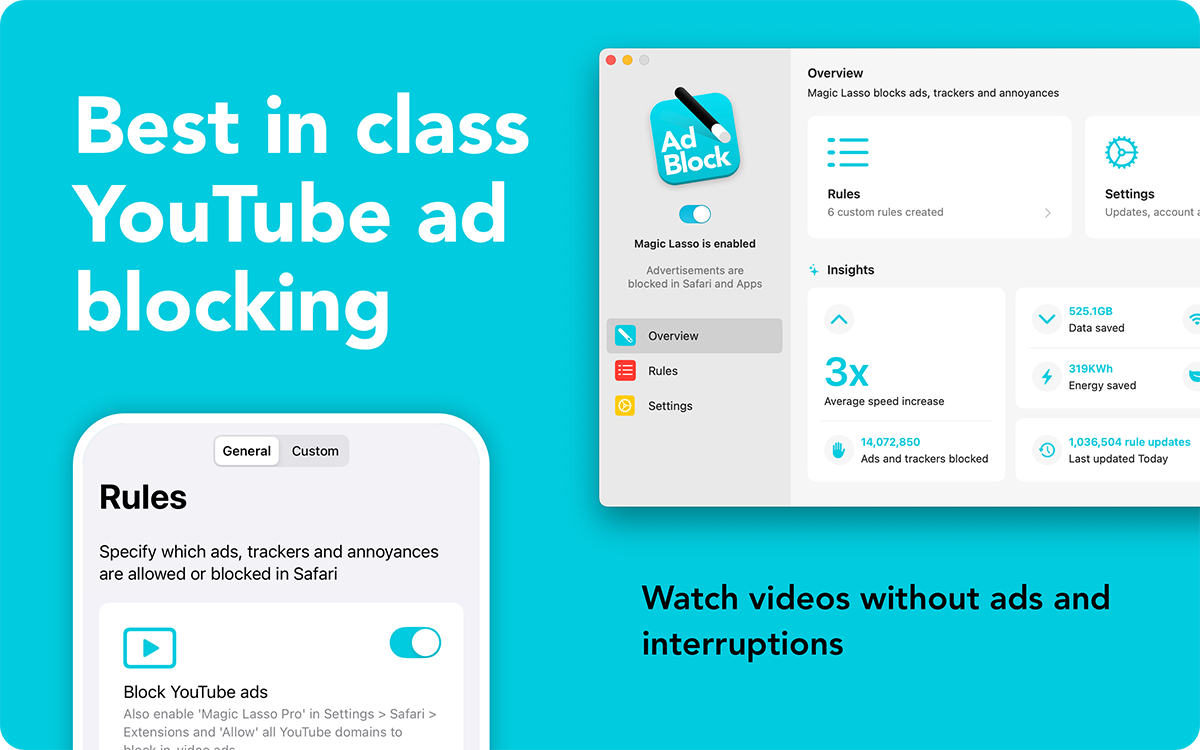
Do you want to block all YouTube ads in Safari on your iPhone, iPad, and Mac?

Then download Magic Lasso Adblock – the ad blocker designed for you.

As an efficient, high performance and native Safari ad blocker, Magic Lasso blocks all intrusive ads, trackers, and annoyances – delivering a faster, cleaner, and more secure web browsing experience.

Best in class YouTube ad blocking

Magic Lasso Adblock is easy to setup, doubles the speed at which Safari loads, and also blocks all YouTube ads — including all:

  • video ads

  • pop up banner ads

  • search ads

  • plus many more

With over 5,000 five star reviews, it’s simply the best ad blocker for your iPhone, iPad, and Mac.

And unlike some other ad blockers, Magic Lasso Adblock respects your privacy, doesn’t accept payment from advertisers, and is 100% supported by its community of users.

So, join over 350,000 users and download Magic Lasso Adblock today.

Mike Masnick, Techdirt:

For years now, we’ve been repeatedly pointing out that the “social media is destroying kids” narrative, popularized by Jonathan Haidt and others, has been built on a foundation of shaky, often contradictory research. We’ve noted that the actual data is far more nuanced than the moral panic suggests, and that policy responses built on that panic might end up causing more harm than they prevent.

Well, here come two massive new studies — one from Australia, one from the UK—that land like a sledgehammer on Haidt’s narrative — and, perhaps more importantly, on Australia’s much-celebrated social media ban for kids under 16.

The Australian study is sprawling, with over 100,000 youth participating over several years, though it should be noted it uses self-reported data only from weekdays and only for three hours after school. The study’s authors say that this “may not fully reflect total daily or habitual use”. (Also, they seem to have excluded nonbinary youth.) Still, the findings support a reasonable conclusion that children who spend a “moderate” amount of time using social media — about two hours daily or less — tend to have better outcomes, and it depends what they are doing.

The British study, on the other hand, found “distinguishing between active and passive use of social media played a limited role in our overall findings” suggesting “the distinction may be overly broad and does not sufficiently predict mental health”. So even the supposed quality of screen time might not have as much of an effect as we imagine.

The Australian government may have banned providing access to social media for people under sixteen, affecting millions, but these studies indicate it is an over-broad response to a complex topic. In explaining the limitations and caveats, the Australian researchers pointed out “[h]igher after-school social media use may also indicate fewer extracurricular or social opportunities” including those that may result from too much time spent on homework. That is not to say it would instead make more sense to me to ban homework, but it seems banning social media is both a red herring response to our built environment and has the potential to limit the actual socialization that takes place in these apps.

Canada is one of several countries working on a similar ban. Marie Woolf, Globe and Mail:

Prof. [Taylor Owen, of McGill University] warned that without a regulator, when a child hits the age when social media is allowed, they could “jump right into a social-media ecosystem that has no protections in it whatsoever.”

He said there is a need to address problems on platforms, which include certain kinds of content, “the incentives within them, the way the algorithms boost that content, the lack of guardrails, the lack of accountability, lack of safety teams and measures.” He added that a teen social-media ban would not resolve these problems on its own.

I am not knee-jerk opposed to considering the many harms created or exacerbated by online platforms; I think Owen is right in arguing for a more comprehensive vision. But if we are looking at correcting for failures in platform accountability, social media use by youth seems somewhat less important. The problem is that trying to make platforms in any way responsible for user-generated material will break the internet. It is much more straightforward — in theory — to add an age gate.

There is plenty of blame to go around, however, for our agency over our attachment to our devices, and I have no problem doling some out to platforms. “Time spent” is a bullshit metric that has nothing to do with user satisfaction, and encourages aggressive strategies like autoplaying the next video after one finishes and suggesting an endless scroll of entertainment. These features might not have an outsized effect on young people. But we should consider that the operators of these platforms are not building their apps with the happiness of people in mind. They are adding and continuously refining this functionality because it increases the time people spend using their thing instead of the competitor’s thing, thus making it more valuable.

Then again, perhaps we ought to limit social media use by age. Not for children, though: anyone over 55 gets read-only access to a maximum of six verified accounts, akin to broadcast television.
David Ljunggren, Reuters:

Canada’s federal court on Wednesday overturned a government order to close TikTok’s Canadian operations, allowing the short-video app to keep operating for now, and told Ottawa to review the case.

When the ban was enacted in November 2024, I noted the inconsistencies in the government’s position. The judge in this case, Russel Zinn, did not comment on why the ban was overturned, according to this Reuters story, and it looks like this decision will result in a new security review.

Hartley Charlton, MacRumors (I am linking to them instead of the actual source link because Bloomberg is expensive):

In yesterday’s report detailing Apple’s plans to turn Siri into a chatbot in iOS 27, [Mark] Gurman said that the company is in discussions with Google about hosting the forthcoming Siri chatbot on Google-owned servers powered by Tensor Processing Units (TPUs), a class of custom chips designed specifically for large-scale artificial intelligence workloads. The arrangement would mark a major departure from Apple’s emphasis on processing user requests either directly on-device or through its own tightly controlled Private Cloud Compute infrastructure.

Note that the press release last week regarding certain Apple Intelligence features set to be powered by Google’s Gemini specifically says “Apple Intelligence will continue to run on Apple devices and Private Cloud Compute”. Siri will have Apple Intelligence features but, in the company’s unique structure, it itself is not part of Apple Intelligence. Also note that Google in November announced Private A.I. Compute, which should be useful.