≡ Menu

Nozick on Intellectual Property

Related

Nozick was bad on IP: he was confused and weakly in favor of some form of patent law; very diletanttish reasoning, as often is the case for Nozick. See William Fisher, “Theories of Intellectual Property” (2), in Stephen Munzer, ed., New Essays in the Legal and Political Theory of Property (Cambridge University Press, 2001), text at n.5. Also Robert Nozick, Anarchy, State, and Utopia (Oxford: Basil Blackwell, 1974), p. 182: “independent inventors, upon whom the burden of proving independent discovery may rest, should not be excluded from utilizing their own invention as they wish (including selling it to others).” On Nozick’s dilettantism and “razzle-dazzle,” see Kinsella, Afterword to Hoppe’s The Great Fiction, Second Expanded Edition, and Hoppe, Murray N. Rothbard and the Ethics of Liberty.

See also Otto Lehto, “A point so fundamental: Nozick on intellectual property,” Critical Review of International Social and Political Philosophy (11 Feb 2026); Lehto’s tweet.

Abstract:

In Anarchy, State and Utopia, Nozick defends a libertarian theory of property rights under a minimal state. Whether libertarian theory supports or excludes intellectual property (IP) rights remains controversial. This paper shows that, although Nozick only mentions intellectual property (IP) a few times in the book, these discussions turn out to be surprisingly pivotal for his arguments. Indeed, Nozick calls IP rights a ‘fundamental’ issue for libertarian theory. So, it is important to analyse the structural, methodological, and substantive implications of what Nozick says (and does not say) about IP rights. I will show that in Part 1 of ASU, IP rights illustrate the non-ideal problem of persistent disagreement, which shows that the minimal state cannot simply administer justice; it must also tackle disagreements about the content of justice. In Part 2 of ASU, Nozick discusses patents to illustrate the limits of the Lockean Proviso. His embrace of counterfactual reasoning opens the surprising possibility that even property rights in physical resources may be up for time limitations, inheritance laws, or other proviso-motivated regulations. Overall, Nozick’s discussion of IP rights illuminates the somewhat neglected role of non-ideal libertarian theory, epistemic indeterminacy, counterfactual reasoning, and pragmatic, ‘rule-of-thumb’ remedies in ASU. In the final analysis, Nozick does not develop a fully coherent picture of IP rights, and his proposed solution, putting time limits on patents, seems somewhat ad hoc. Although IP rights play an underappreciated role in the book, his discussion raises more questions than it answers. The epistemically humble libertarian (or liberal) should approach the regulation of IP rights, and other thorny issues of real-world property-ownership, with an open mind.

What is interesting here about Lehto’s paper (admirably published online!)1 is that it shows how Nozick’s half-based support for IP undermines his case for normal property rights. Again quoting the abstract:

This paper shows that, although Nozick only mentions intellectual property (IP) a few times in the book, these discussions turn out to be surprisingly pivotal for his arguments. Indeed, Nozick calls IP rights a ‘fundamental’ issue for libertarian theory. … In Part 2 of ASU, Nozick discusses patents to illustrate the limits of the Lockean Proviso. His embrace of counterfactual reasoning opens the surprising possibility that even property rights in physical resources may be up for time limitations, inheritance laws, or other proviso-motivated regulations.

In other words, Nozick’s mistake and weak views on IP—making the mistake of treating IP as “another type of” property right2 —cannot help but undermine property rights—something Tom Bell has also suggested.3 Instead of saying that natural property rights last forever, so IP rights must too4—in other words, like things must be treated alike—his support of IP has to imply that just as IP rights must be time limited, so should regular property rights.

Overall, Nozick’s discussion of IP rights illuminates the somewhat neglected role of non-ideal libertarian theory, epistemic indeterminacy, counterfactual reasoning, and pragmatic, ‘rule-of-thumb’ remedies in ASU. In the final analysis, Nozick does not develop a fully coherent picture of IP rights, and his proposed solution, putting time limits on patents, seems somewhat ad hoc.

Since Nozick, like Rand,5 viewed IP rights as a “fundamental” issue for libertarian theory, it is important to get this right and not be half-assed or ad hoc about it! Otherwise you undermine the case for property rights, the most fundamental aspect of libertarian theory!6

  1. Authors: Don’t Make the Buddy Holly MistakeOn Leading by Example and the Power of Attraction (Open Source Publishing, Creative Commons, Public Domain Publishing)The Academic Publishing Paywall Copyright Subsidized RacketTucker, The Magic of Open-Source PublishingKulldorff, The Rise and Fall of Scientific Journals and a Way ForwardAcademic publishers have become the enemies of science: yet more real piracyTucker, The Magic of Open-Source Publishing; Tucker, “Authors: Beware of Copyright,” in Bourbon for Breakfast (Mises Institute, 2010). []
  2. Richard Epstein on “The Structural Unity of Real and Intellectual Property”; Yet more disanalogies between copyright and real property; Classifying Patent and Copyright Law as “Property”: So What?; IP Answer Man: “All property is fundamentally intellectual.” []
  3. Tom Bell: Copyright Erodes Property? []
  4. Like the more insane and “consistent” IP advocates do, e.g. Molinari, Schulman, Spooner, some Randians, Galambos, Yarros, Bastiat, Robert “Wenzel” (or whatever his real name is; he also claims Rothbard, who was confused on IP, also did)—those who say the IP term should be infinite or perpetual, just as real property rights are; see The Problem with Intellectual Property, n.6; Defamation as a Type of Intellectual Property, n.22; Transcript: Debate with Robert Wenzel on Intellectual Property; Molinari (and Tucker, and Mutualists) on IP; Classical Liberals, Libertarians, Anarchists and Others on Intellectual Property; Esplugas, The Monopoly of Ideas: Against Intellectual Property Rate; . []
  5. Yaron Brook on the Appropriate Copyright Term; Ideas are Free: The Case Against Intellectual Property: or, How Libertarians Went Wrong; IP Answer Man: “All property is fundamentally intellectual.”; IP: The Objectivists Strike Back!Letter on Intellectual Property Rights, IOS Journal (June 1995); Inventors are Like Unto …GODS… ; Regret: The Glory of State Law. []
  6. The Universal Principles of Liberty. []
Share
{ 1 comment }

Fuzz: The Permissionless Patronage Protocol

The author recently sent me this.

Fuzz: The Permissionless Patronage Protocol

Abstract: We propose a permissionless patronage protocol. A publisher shares a work and a public address. A subscriber contributes to the publisher through a distributor. The contribution is recorded and can be verified in a trust-minimized way. The cost for both the subscriber and the publisher to switch between distributors is zero.

Full post below. [continue reading…]

Share
{ 0 comments }

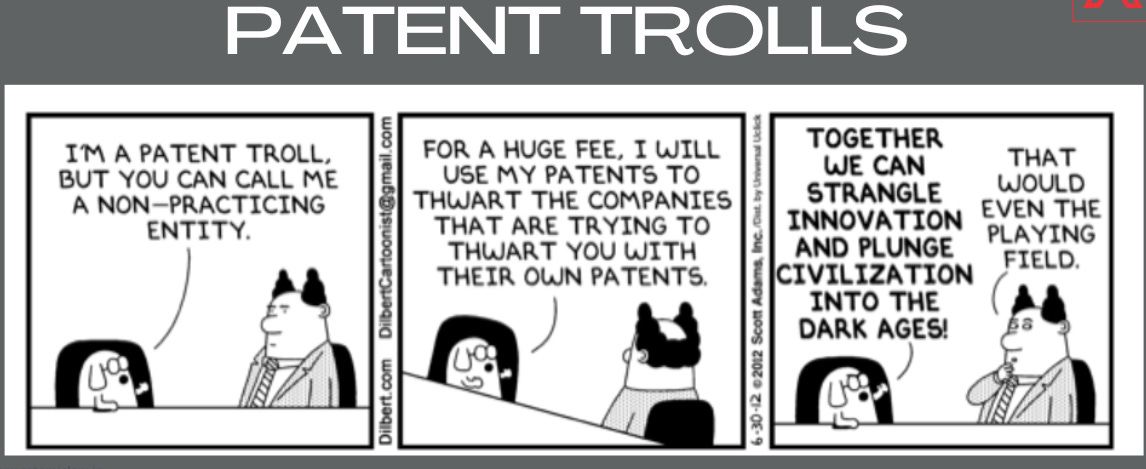
Patent Troll Leigh Rothschild vs. Valve

Related:

Gemini summary from the Asmongold video: [continue reading…]

Share
{ 0 comments }

From Bitcoin magazine. I like his term “legacy fiat intellectual property rights”.

The clash between Malikie Innovations and Bitcoin miners exemplifies a classic conflict between open innovation and legacy fiat intellectual property rights.

[continue reading…]

Share
{ 0 comments }

From Patently-O. Typical. The state protects its contractors from patent infringement liability and its only liability is to pay compensation. It cannot be enjoined. See 28 U.S. Code § 1498. Of course the whole thing makes no sense: the FedGov grants patents to applicants; this impedes innovation and drives up prices for consumers; and if the patentee sues the FedGov it harms the taxpayers again by printing money and giving it to the patentee.

Patent Suit Over NASA’s Mars Helicopter Blocked by Government Contractor Immunity

by Dennis Crouch

The War Industry (formerly Defense) heavily invests in new technology and patents. But, we see very few patent infringement lawsuits. A key reason is 28 U.S.C. § 1498. That statute channels patent infringement claims involving government-authorized work away from private defendants and into the U.S. Court of Federal Claims, with the United States as the sole defendant (and a reasonable royalty as the only remedy). For government contractors and subcontractors, § 1498 operates as a powerful shield: if the infringing activity was performed “for the Government” and “with the authorization or consent of the Government,” the patent holder’s only remedy is a compensation action against the United States. The contractor walks free. This design reflects a deliberate policy choice. The government pays heavily for technology development with taxpayer dollars and, in exchange, retains control as the key point person – and it allows the administration to resolve patent disputes as it sees fit.

Image

In Arlton v. AeroVironment, Inc., No. 2021-2049 (Fed. Cir. Feb. 2026) (nonprecedential), the Federal Circuit affirmed su

Read more>>

Share
{ 0 comments }

Related:

Fritz Machlup”Review of Monopolies and Patents, A Study of the History and Future of thePatent Monopoly. by Harold G. Fox,” The Journal of Economic History, Vol. 8, No. 2 (Nov., 1948), pp. 215–217.

Of course, not online. I would say ironically, but unforunately it’s not ironic anymore; it’s routine and pathetic: a paper by a patent skeptic reviewing the work of an IP promoter, but paywalled and hidden away due to copyright. Copyright is censorship at work–and preventing the spread of criticism of copyright and patent! Grok’s summary: [continue reading…]

Share
{ 0 comments }

Kant on Intellectual Property

See Marcus Willaschek, “‘This Is Mine’: On Intellectual and Other Property,” in Kant: A Revolution in Thinking, Peter Lewis, trans. (Cambridge, Massachusetts and London, England: The Belknap Press of Harvard University Press, 2025) (sample; Scribd).

Note the opening quote to ch. 12: “The value of money is . . . only indirect. One cannot enjoy money itself or make immediate use of it in any way. Yet it is still a means which, among all things, has the greatest usefulness.”1

I guess Ayn Rand should have liked him after all 🙂

Anyway, this speaks poorly of him in two ways. First, lack of integrity. Even if he thought it was in his own interest, this does not mean it’s justified. After all I started opposing IP around 1994, right when I passed the patent bar. But I guess there is some truth to Upton Sinclair’s quip “It is difficult to get a man to understand something, when his salary depends on his not understanding it.” But of course, he was wrong even about this. IP harms almost everyone, even those who think it benefits them.2

Second, besides mistakenly thinking copyright was in his financial interest, his arguments for IP were not the hallmark of the genius he is heralded to be, but the same simpleminded mistake that other classical liberals and libertarians make. They are basically all confused about the source of wealth and the nature of homesteading. They all accepted Locke’s labor theory of property and, to some extent, the related labor theory of value of Adam Smith, Ricardo, and Marx.3 I am actually not sure if Locke himself did, since even he did not believe his own natural right theory supported copyright; he supported it only on instrumental grounds but never thought of it as a natural right (contra dishonest misrepresentations by IP-socialist libertarians and Randians).4 But they are all confused: Marxists, labor theory proponents such as the anti-IP Benjamin Tucker and the pro-IP Spooner5 The empiricists and utilitarians, the sweat-of-the-brow dessert theorists, natural rights Objectivists, Galambosians, libertarian sci-fi authors like L. Neil Smith, J. Neil Schulman, John C. Wright, Hegelians with their vague and incomprehensible “personality” theory of IP.6 All of them. You would think Kant would think of something more sophisticated; nope.

Anyway here is a taste of his humdrum “reasoning” in favor of IP. From Willaschek, pp. 126-127:

As an author, Kant was an astute businessman who set great store by being properly recompensed for his efforts. This was, however, difficult to achieve in the eighteenth century, since there was no safeguarding of intellectual property at that time. Although the publishers of a book usually paid the author a fee at the time of publication, as soon as the work came on the market everyone was free to reprint it. Even where statutory provisions were in place concerning the reprinting of books, they were not effectively enforced. Accordingly, almost all of Kant’s works after the Critique of Pure Reason were reprinted by publishers throughout Germany without Kant receiving any benefit.

Except the spread of his ideas. And truth. And justice. And fame. Other than that…

Furthermore, collections of his minor works appeared without his authorization and with no remuneration forthcoming. Of course, this piracy

Piracy? Loaded, pejorative, inaccurate. Copying is not theft, stealing, plagiarism, or “piracy.” Piracy is, you know, a boat on the high seas literally boarding and robbing your vessel.7

affected not just Kant but all authors at that time. Aside from the financial losses incurred, a further problem was that the unauthorized editions often contained errors.

Oh now, these IP socialists really just care about the readers! The ones they want to force to pay more for their books! I mean if you outlaw unauthorized books, maybe they will be sort of underground and shoddy. You know, sort of how black market illegal drugs are less safe and more expensive and risky than they would be if they were legal?

Readers were not in a position to appreciate that these errors were not the fault of the author but of the publisher.5

So IP is really for the benefit of the poor, stupid consumers. It’s just a lucky side benefit that it just so happens to financially benefit authors.

It therefore comes as no surprise that Kant went public to highlight the problem of pirate editions and to argue that they should be outlawed. In 1785, just around the time his sales began to boom, Kant published an essay entitled “On the Wrongfulness of Unauthorized Publication of Books,” the main arguments of which he summarized again in the Doctrine of Right of 1797.68 In this essay, Kant distinguishes between the book as a material object, which a person is free to buy and sell as a chattel, and the “speech” it contains—in other words, the content aimed at a readership.7 The content of a book, Kant elaborated, was not a work (opus) but an action (opera)—an address by an author to his public. The publisher does not speak directly to the public through the book, but instead claims to have been tasked by the author with conveying his or her ideas. Thus, a pirate printer deceives those who purchase the book and infringes the rights of the lawful publisher who was engaged by the author.

Ah, so it’s deception! Even the poor consumer who intentionally buys a cheaper unauthorized work is just too stupid to understand he’s being “deceived.” Sort of how we need “freebanks” to be able to engage in fractional-reserve banking to inflate the money supply in response to changes in the demand for money because wages can’t adjust downwards fast enough; they are sticky downwards, because you know consumers are too stupid to understand the difference between purchasing power and nominal prices.

While the pirate publisher can, Kant concedes, become the owner of a copy of the book (as a material object), this does not, however, give him the right to disseminate the “speech” contained within it.

Actually this sounds a bit like the mistake Rothbard made. See The Problem with Intellectual Property, text at n.76.

Even though this reading of things did not make it onto the statute book, in airing it Kant became a pioneer of the law of intellectual property—a concept which, after some tentative first steps in England (1710) and then in France (1791), established itself as part of the legislative framework in Germany and many other countries only during the nineteenth century.8

In the Doctrine of Right Kant’s concept of copyright is embedded in his general theory of private property, with which he positioned himself in one of the key debates within political philosophy during the eighteenth century. Ever since the 1600s, an increasing number of philosophers and jurists had been searching for a legal rationale for ruling that certain parts of the Earth, plus the immovable property on them as well as other, movable objects, should be exempted from general use and set aside for individual people or groups.

Thanks, Locke. Too bad you had to intermix this with the labor-ownership assumption.9 My pet theory is that Locke overly complicated and contaminated his argument partly to appease the religious views of the time; so he claimed we are self-owners because God gave the earth to us, and so on.10

One widespread proposal was based on the idea of initial appropriation: according to this, every person was free to take possession of a piece of land or an object that was not already someone else’s property. After all, they did not belong to anyone who could be harmed by such an action.

This is actually a good point. (The reason one has the right to occupy, use, and homestead unowned resources is precisely because they are per assumption unowned, so that no one can object.)11 Too bad he did not stop there, but then tried to apply it to IP.12

Grok summary of ch. 12:

Summary of Chapter 12: “This Is Mine”: On Intellectual and Other Property [continue reading…]

  1. [“In the case of Kant’s principal work, the Critique of Pure Reason, following the common practice in the literature on Kant, references are given in the form “A . . . ,” “B . . . ,” and “A . . . / B . . .” (e.g., A xii; B406; A365/B390). Here, “A” refers to the page numbers of the first edition of the Critique, published in 1781, while “B” references the second edition, of 1787.”] Ak. 6:287, The Metaphysics of Morals (1797), in Kant, Practical Philosophy, ed. and trans. Mary J. Gregor, CWK [The Cambridge Edition of the Works of Immanuel Kant in Translation, 16 vols., Paul Guyer and Allen W. Wood, general eds. (Cambridge: Cambridge University Press, 1992–2016)] (1996), 435. []
  2. Examples of Ways Content Creators Can Profit Without Intellectual Property; Do Business Without Intellectual Property. []
  3. Rothbard on the Main Fallacy of our Time: Marx’s Labor Theory of Value; KOL037 | Locke’s Big Mistake: How the Labor Theory of Property Ruined Political Theory; Libertarian and Lockean Creationism: Creation As a Source of Wealth, not Property Rights; Hayek’s “Fund of Experience”; the Distinction Between Scarce Means and Knowledge as Guides to ActionObjectivist Law Prof Mossoff on Copyright; or, the Misuse of Labor, Value, and Creation Metaphors; “Hume on Intellectual Property and the Problematic “Labor” Metaphor”; Locke, Smith, Marx; the Labor Theory of Property and the Labor Theory of Value; and Rothbard, Gordon, and Intellectual Property; “Thoughts on Intellectual Property, Scarcity, Labor-ownership, Metaphors, and Lockean Homesteading”; Isaiah Berlin on Locke, Karl Marx and the Labor Theory of Value. []
  4.  Locke on IP; Mises, Rothbard, and Rand on Creation, Production, and “Rearranging”. []
  5. Classical Liberals, Libertarians, Anarchists and Others on Intellectual Property. []
  6. The Problem with Intellectual Property, n.27. []
  7.  Copying, Patent Infringement, Copyright Infringement are not “Theft”, Stealing, Piracy, Plagiarism, Knocking Off, Ripping OffStop calling patent and copyright “property”; stop calling copying “theft” and “piracy” []
  8.   Ak. 8:77–87, On the Wrongfulness of Unauthorized Publication of Books (1785), in Kant, Practical Philosophy, ed. and trans. Mary J. Gregor, CWK (1996), 23–36. []
  9. KOL037 | Locke’s Big Mistake: How the Labor Theory of Property Ruined Political Theory. []
  10. Hume on Intellectual Property and the Problematic “Labor” Metaphor; Cordato and Kirzner on Intellectual Property. []
  11.  Review of Anthony de Jasay, Against Politics: On Government, Anarchy, and Order, text at n.55. []
  12. The Structural Unity of Real and Intellectual PropertyA Recurring Fallacy: “IP is a Purer Form of Property than Material Resources”The “Ontology” Mistake of Libertarian Creationists. []
Share
{ 1 comment }

Zeidman, Why Libertarians Should Support a Strong Patent System

This tweet rattled my cage. I listened to enough of it to see it’s just another pro-IP engineer repeating the standard bogus arguments. Ayn Rand Fan Club 99: Bob Zeidman on Forensics, IP, AI, Election Fraud & Poker

(I appeared previously on this podcast: KOL470 | Intellectual Property & Rights: Ayn Rand Fan Club 92 with Scott Schiff.) Zeidman tweeted a link to his older pro-article that he mentioned during the discussion: Bob Zeidman & Eashan Gupta, “Why Libertarians Should Support a Strong Patent System,” IPWatchdog.com (Jan. 5, 2016). That it was published on the site of IPWatchdog.com, the site run by patent shill and blowhard-buffoon Gene Quinn1, does not augur well, but is not a surprise.

My tweeted response:

[continue reading…]

  1.  Desperate Patent Troll’s Plan to get Trump to Unblock his old patent applications to replace tariff games. []
Share
{ 0 comments }

Copyright is not a Verb; A Work is not “Copyrighted”

[From my Webnote series]

Related:

Okay, maybe linguistically it has become verbicized, even though this practice gives rise to false implications (such as hypocrisy: Kinsella, if you don’t believe in copyright, why did you copyright your book?1 Answer: I don’t, as much as possible (see the CC-BY or CC0 notices on my websites and most publications), nor was Against Intellectual Property “copyrighted” by the Mises Institute [nor would it by hypocritical if it were]).2

From a Grok conversation:

Prompt: Are you sure it’s correct to use copyright as a verb as you did? It’s not as if the JB “is copyrighted” by the translator or publisher, like an invention is patented because the inventor filed a patent application. Don’t such works automatically receive copyright protection? [continue reading…]

  1. KOL470 | Intellectual Property & Rights: Ayn Rand Fan Club 92 with Scott Schiff (“This is my book. It came out two years ago. This has all my arguments in it. Legal Foundations. You said it’s not copyrighted. Well, it’s copyrighted because all copyright is automatic, but I have a Creative Commons Zero license on there. So, I’ve made it public domain as much as the law will allow me to make it. Yeah, I’ve had three or four smartasses say things like, “This is you, there’s so many bad arguments for IP.” They’ll say, “Oh, well, Kinsella.” First, I get the hypocrisy argument. “Oh, you’re a practicing patent lawyer, so you’re a hypocrite.” I’m like, well, so basically, the only people you want to complain about IP law are people who don’t know anything about it?”); Let’s Make Copyright Opt-OUT; Copyright is very sticky!; Are anti-IP patent attorneys hypocrites?; “Oh yeah? How would like it if I copy and publish your book under my name?!”: On IP Hypocrisy and Calling the Smartasses’ Bluffs; “The Death Throes of Pro-IP Libertarianism” (Mises Daily 2010) (from Darcy: “Communism and opposition to property rights is hardly a new idea.

    The Mises Institute copyrights its material, and so it is itself a proponent of IP demonstrated in action.”); Authors: Don’t Make the Buddy Holly Mistake (from Stranger: “a CC license is still a copyright – the Mises Institute will use force on those who copy their books without making a reference to the Mises Institute. … The Mises Institute did not have to include an attribution clause in its copyright notice.”); Mises Institute: Do As They Say, Not As They Do? (Robert Wenzel). []

  2. See the copyright page of the PDF, and also the note on the page for Against Intellectual Property:

    N.b.: The copyright notice printed on this edition of my work is factually and legally incorrect: the copyright is held by me, not by the Mises Institute. And the copyright is 2001, the year the article was first published, not 2008. To be clear, and as indicated already in the footer to my Stephankinsella.com website, which hosts this work:

    CC0To the extent possible under law, N. Stephan Kinsella has waived all copyright and related or neighboring rights to “Against Intellectual Property,” first published in the Journal of Libertarian Studies 15, no. 2 (Spring 2001). This work is published from: United States.

    If this CC0 grant fails to be legally enforceable for any reason [see “Copyright is very sticky!”], I hereby grant a Creative Commons Attribution 4.0 International license (Image, or CC BY 4.0) as a fallback.

    As a second fallback I hereby estop myself and any legal heirs from asserting copyright in this work.

    So I don’t want to hear from any legally illiterate, disingenuous smartasses  saying “Oh yeah? If you are against copyright, why did you copyright your article? See “Oh yeah? How would like it if I copy and publish your book under my name?!”: On IP Hypocrisy and Calling the Smartasses’ Bluffs.”

    And as I explained previously,

    they [Mises Institute] didn’t copyright it. they put a copyright notice on it that was false. they said they have copyright; they do not, since it was not a work for hire and I never assigned it in writing. I have the copyright, and all my work it on stephankinsella.com with CC-BY applied to try to liberate it as much as the state will let me. It’s bizarre for pro-copyrgiht people to blame me for having copyright that their system imposes on me against my will. It’s like telling a black guy that he has no right to be against affirmative action or anti-discrimination laws since he is eligible to use these laws if he wants. why is it his fault if statist impose laws on society?”

    From I am Stephan Kinsella, a patent attorney and Austrian economics and anarchist libertarian writer who thinks patent and copyright should be abolished. AMA. []

Share
{ 0 comments }

Related:

Adam Haman of Haman Nature: None of us hate patent trolls nearly enough. In fact, all of IP has serious flaws that need fixing – or abolishing.

Jan. 26, 2026

Image

I used to think Intellectual Property (IP) was valid. Why wouldn’t I? After all, my business school insisted patents were vitally necessary to incentivize production and innovation. Even Ayn Rand, my gateway to libertarianism, insisted IP was a moral necessity, saying:

“Patents and copyrights are the legal implementation of the base of all property rights: a man’s right to the product of his mind.”

[continue reading…]

Share
{ 1 comment }

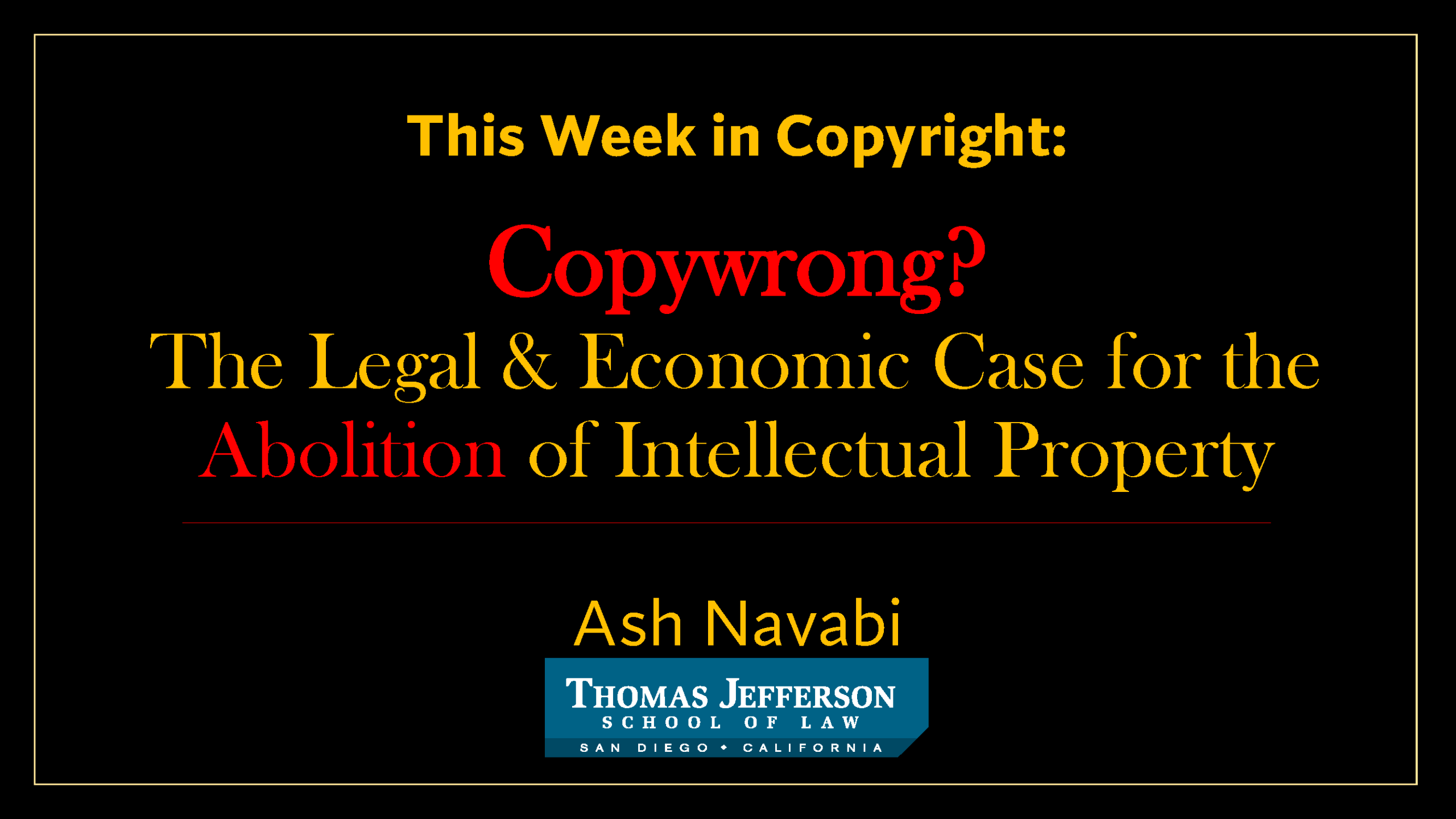
Ash Navabi, former GMU econ grad student (see previous podcast discussion with him),1 now a law student at Thomas Jefferson School of Law, sent me this presentation he gave in his copyright class: “This Week in Copyright: Copywrong? The Legal & Economic Case for the Abolition of Intellectual Property” (pptx; pdf). Heroic!

Image
  1. KOL198 | Intellectual Property as Limits on Property; Trade Secrets and Contract []
Share
{ 0 comments }

In a recent podcast episode, Greenland, Guns, and Money, Richard Epstein predicts Trump’s use of tariffs under IEEPA might be nixed by the Supreme Court, and that he has suggested that if this happens he will find some other way to do it, but it’s not clear what.

There is a recent IPWatchdog podcast interview of Gil Hyatt, Pioneering AI Innovations and Legacy: A Conversation with Inventor Gil Hyatt / IPWatchdog Unleashed, by patent shill and blowhard-buffoon Gene Quinn, who has never met a patent he doens’t like (he has argued for a “patent stimulus plan”: “If we really want to get out of this economic downturn we need a Patent Stimulus Plan. … What we need to do is have President Obama issue an Executive Order directing the Patent Office to start allowing patents.” ).1

[continue reading…]

  1. A “Patent Stimulus” to End the Recession? []
Share
{ 1 comment }

IP, Innovation, Impedance, and the Schlaraffenland

I often rail against IP because it impedes innovation.1 As I wrote in one post,

Patent law distorts and impedes innovation. It makes us all poorer. There is no evidence that it does what the retarded Founders thought it would do—promote the progress of the useful arts (inventions)

… Patent law reduces innovation and impoverishes the human race. As I wrote elsewhere: [continue reading…]

  1.  IP Answer Man: Death Toll of Patent Law; The Death Throes of Pro-IP Libertarianism. []
Share
{ 0 comments }

Related:

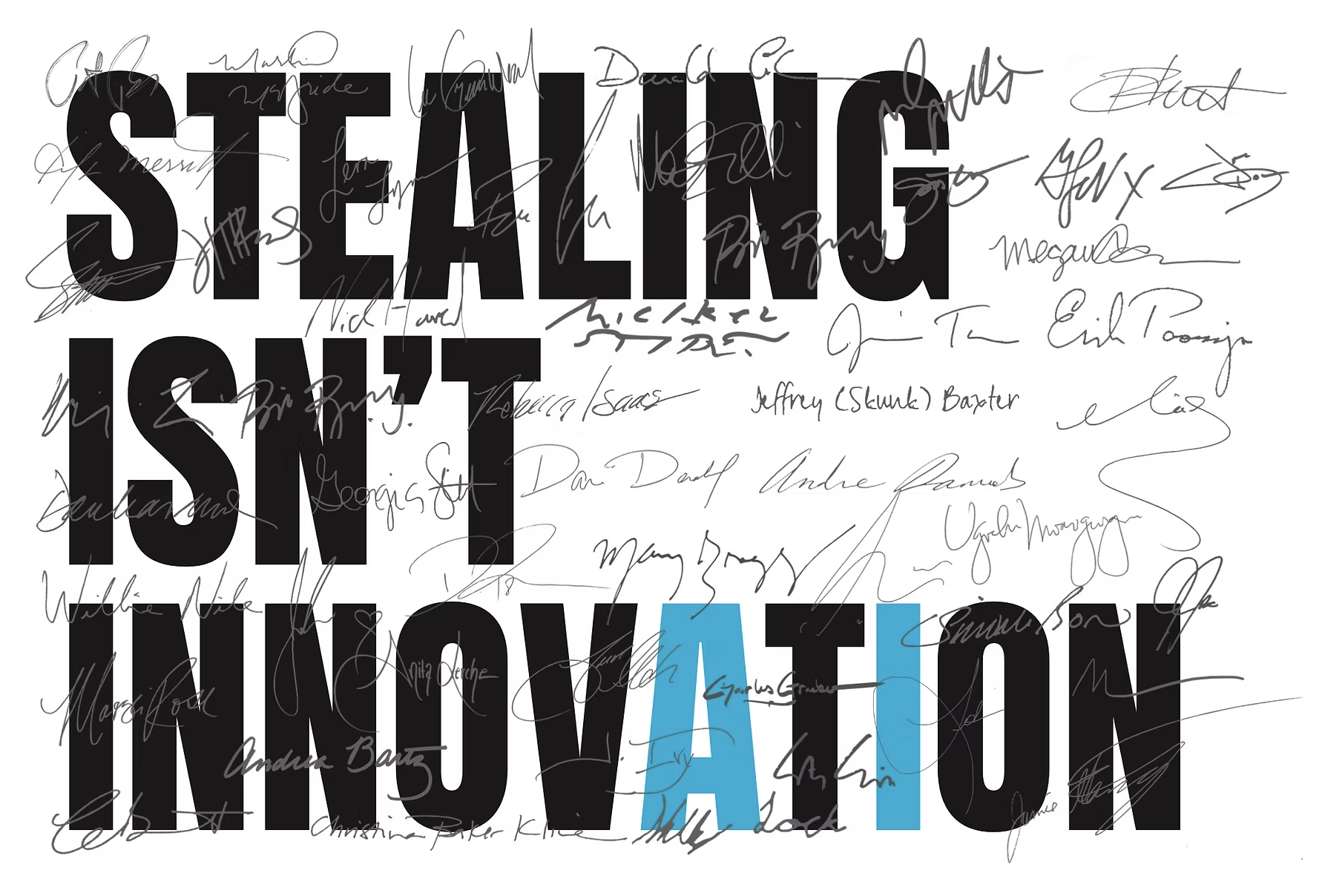
"Stealing Isn't Innovation" IP Propaganda Ad Campaign
I woke up this morning to my daily NY Times news brief email, only to find embedded therein this propaganda, the “Stealing Isn’t Innovation” campaign, which is “a project of the Human Artistry Campaign, a global coalition of more than 180 groups around the world supporting responsible, ethical AI.” The letter’s A and I in the slogan are highlighted in blue to drive the point home—this is about killing AI. It’s a group of artists and other copyright whores who want to shakedown AI tech companies with the threat of killing it with copyright. [continue reading…]

Share
{ 0 comments }