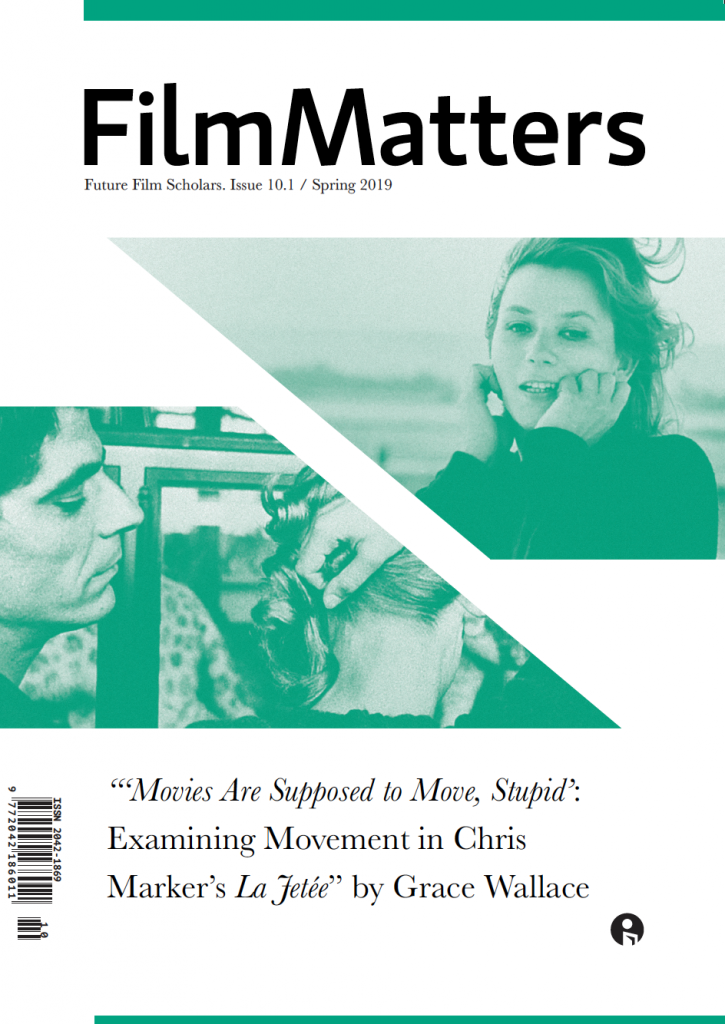
Film Matters is actively seeking book and film/DVD/Blu-ray reviews by current undergraduate students for future print issues.
Continue readingFilm Still Friday! | Excalibur (1981). By Brandon Long

The ultimate cinematic retelling of Arthurian legend, Excalibur (1981) is often lauded for its impeccable cinematography — truly there are too many gorgeous stills from this epic to pull for a single inclusion this week. I’ve chosen this particular image for several reasons: pay attention to the preservation of depth, the vibrant colors, and implied storytelling of its subjects. The sculpted gold armor suggests vanity as well as the expectations of greatness upon this young character. The woman, his mother, is shrouded in white, creating a ghostly effect, which elevates her as a watchful spectre. They both stand out from the dark cave interior, though reflected green hues indicate their ties with the cave’s dark magic. I find this to be a fascinating encapsulation of Excalibur’s visual style.
Posted in Film Still Friday!
Comments Off on Film Still Friday! | Excalibur (1981). By Brandon Long
Unglued From the Screen | What Is Love? Baby, Don’t Hurt Me No More. By Alisha Tan

“Love alters not with his brief hours and weeks, / But bears it out even to the edge of doom. / If this be error, and upon me proved, / I never writ, nor no man ever loved.”
—Shakespeare, Sonnet 116, 1609
When I first watched Sense and Sensibility (Ang Lee, 1995) with my mother—one of her favorite movies—at the age of ten, I did not leave with a renewed interest in the machinations of romance. Instead, I gained an unsubstantiated terror of Alan Rickman’s voice, a terrible understanding of British accents, and a desperate need to sprint across a moor in the pouring rain. During Hugh Grant’s final confession, I peeked over at my mother on the couch to see if she, too, was as taken aback by Emma Thompson’s hyperventilating, only to watch a tear slip down her cheek. Perplexed, I turned back to the screen, wondering how a trembling feather of a man could elicit such an emotional reaction both on and off screen. Ten years later, in the packed theater of the Emory Cinematheque, my sniffles joined the chorus of weeping watchers—safe to say, eventually, I understood.
Continue reading
Posted in Alisha Tan, Matthew H. Bernstein
Comments Off on Unglued From the Screen | What Is Love? Baby, Don’t Hurt Me No More. By Alisha Tan
Unglued From the Screen | Cash, Credit, and Carnage. By Alisha Tan

“The general sucked in his breath and smiled. ‘I congratulate you,’ he said. ‘You have won the game.’ Rainsford did not smile. ‘I am still a beast at bay,’ he said, in a low, hoarse voice. ‘Get ready, General Zaroff.’”
—The Most Dangerous Game by Richard Connell, 1924
We open on a young woman abnormally down on her luck. She’s struggled her entire life to escape her lower-class background, leaving behind a little sister in search of a brighter future. Instead, due to some unfortunate circumstances, she’s found herself trapped in a life-or-death situation: a Satanic cult of rich people trying to hunt and sacrifice her. Oh, her sister is also here. Forced to shoot and slash her way through a posse of privileged buffoons, she eventually makes amends with her sister, and they fight their way to victory. Gore! Screaming! The power of sisterhood!
Continue reading
Posted in Alisha Tan
Comments Off on Unglued From the Screen | Cash, Credit, and Carnage. By Alisha Tan
Stanwyck in Control: He Survived the Amazon, Then He Smelled Her Perfume. By Siena Lonsdorf

“The most dazzling, brilliant, witty, and moving romantic comedy ever made,” is how Bernstein described Preston Sturges’ The Lady Eve. While before this screening I might have said the same about The Awful Truth (Leo McCarey, 1937), after a second viewing, I entirely agree. Barbara Stanwyck blazes across the screen, and we can’t help but react with the same blend of idiocy and infatuation as Henry Fonda’s Charles “Hopsie” Pike.
Continue reading
Posted in Matthew H. Bernstein
Comments Off on Stanwyck in Control: He Survived the Amazon, Then He Smelled Her Perfume. By Siena Lonsdorf
The Map of Salt Lake. A film-title poem by Heejin Han
Arrival
A Ghost Story
Frances Ha
Little Women
Stand by Me
Past Lives
Begin Again
Author Biography
Heejin Han is a filmmaker and Communication student at the University of Utah, specializing in Documentary Studies. With a background as a film festival coordinator and a prolific reviewer with over 200 published insights (@heejin_in_movie), she explores narrative depth and social issues through her lens. Currently, she is directing and editing her latest projects, the documentaries Jazz and Cook.
Posted in Poetry
Comments Off on The Map of Salt Lake. A film-title poem by Heejin Han
YOUR NAME. A film-title poem by Saerome Song
Your name (2016), What a Sweet Thing (1962)

Memories (1995) give ME (2026) What's Left of You (2015)

You are... (1993) My Sunshine (2024),

You are... (1993) A Complete Unknown (2024)

You are... (1993) Everything Everywhere All at Once (2022)

Call Me by Your Name (2017)
Author Biography
Saerome Song is a student at the University of Utah.
Posted in Poetry
Comments Off on YOUR NAME. A film-title poem by Saerome Song
Nights like this. A film-title poem by Jasmine R.
Superman
Fast & Furious
Shrek 2
Wicked
Demon Slayer: Infinity Castle
Jujutsu Kaisen 0
A Quiet Place
Cloverfield
The Conjuring
Child’s Play
Five Nights at Freddy’s
John Wick
Final Destination
Author Biography
Jasmine R. is a film student interested in editing, experimental media, and cinematography. She enjoys exploring how different film genres from horror to action shape storytelling and visual style. Outside of class, she enjoys watching films like John Wick and Cloverfield, as well as playing video games and exploring new media.
Posted in Poetry
Comments Off on Nights like this. A film-title poem by Jasmine R.
Unglued From the Screen | Dig Your Heels In—Kurosawa’s High and Low. By Alisha Tan

“And when I get rich, I will buy this house. . . . Then all you have to do is walk up the stairs.”
—Parasite, dir. Bong-Joon Ho (2019)
In the sweltering depths of Yokohama, Japan, a young man peers up through the nooks and crannies of his lower-class neighborhood to fixate on a distant mansion. Cluttered stacks of books and chipped furniture cage him in, with fraying curtains fluttering beside his sweat-stained cheeks and a creaking ceiling barely brushing his head. That house, a haze-shrouded mirage in an urban wasteland, stands as a stark reminder of his destitution. The only thing separating him and the hill is a few miles—and a lifetime of money.
Continue reading
Posted in Alisha Tan, Matthew H. Bernstein
Comments Off on Unglued From the Screen | Dig Your Heels In—Kurosawa’s High and Low. By Alisha Tan
This Man Ate a Shoe, and We Applauded. By Siena Lonsdorf and Jason Dement

“You assume he doesn’t smell bad.” Through this reflection on Chaplin’s comic incongruity and the irreconcilable tension between his character and star persona, Bernstein introduced the comedic genius of Charlie Chaplin. The line drew immediate laughter and set the tone for the rest of the evening. Inside, the theater filled quickly, which felt appropriate for a film that opens on a high angle of a line of hundreds of people stretching endlessly across a mountain. Dr. Matthew Bernstein offered a reminder that comedy is a “satire on human nature,” built on deviation from the norm. In that case, Charlie Chaplin’s Tramp is deviation embodied. His body tilts, waddles, and resists balance, a walking disruption in a world that demands composure.
Continue reading
Posted in Matthew H. Bernstein
Comments Off on This Man Ate a Shoe, and We Applauded. By Siena Lonsdorf and Jason Dement
Unglued From the Screen | We’ll Always Have Vienna—The Third Man (1949). By Alisha Tan

“For many years, you have asked for America’s help. . . . Now is the time to seize control of your destiny, and to unleash the prosperous and glorious future that is close within your reach. This is the moment for action. Do not let it pass.”
—Donald Trump on the war in Iran, 2026
From its opening scene, The Third Man (Carol Reed, 1949) is cursed. In a darkened lecture room, I watch as American Holly Martins (Joseph Cotten) commits the cardinal sin of sauntering beneath a ladder, seemingly oblivious to the connotations of his actions. “Oh, no,” someone groans from behind me, and I bite back a smile. Thus ignites The Third Man’s 104-minute powder keg of misfortune, a classic film noir that scrutinizes the slow decay of post-war morality.
Continue reading
Posted in Alisha Tan
Comments Off on Unglued From the Screen | We’ll Always Have Vienna—The Third Man (1949). By Alisha Tan