View from the Back
Ramblings of a retiree in France
Friday’s Tall Tales #139
Whenever I photograph a door or gate I wonder about its provenance, who and what has happened across said door or gate, and what lies beyond.
I thought I might pick one from my sextet of Thursday’s Doors and tell you a bit more about it or……maybe even weave a story about it.

I love old traditional shopfronts and Casa Rodriguez has graced Seville since 1913. It’s a family owned and run business that manufactures and distributes traditional and religious items, from liturgical ornaments to religious images and artisan products.

It’s a treasure trove in which a piece of Seville’s history and Semana Santa (April Fiesta) traditions are housed. A workshop-cum-shop, it originally specialised in embroidery alone, however over the years and thanks to Ascensión Rodríguez, the founder’s daughter, the activity has evolved to include much more such as fringes, tassels and handmade silk trimmings in gold and silver with exquisite braiding.

Flora and Fauna Friday #139
This post is my weekly homage to my parents who both enjoyed having a beautiful garden. In particular, they loved sitting and watching the wild life enjoy their garden.

Thursday doors #320

Given my recent trip to Paris, you might expect that these would be Parisian Portes but no, I’m still featuring Spanish doors from my trip to Seville earlier last year.


Thursday Doors is a weekly feature allowing door lovers to come together to admire and share their favourite door photos from around the world. Feel free to join in the fun by creating your own Thursday Doors post each week and then sharing your link in the comments’ on Dan’s site, anytime between Thursday morning and Saturday noon (North American Eastern Time).
Trip to Musée National Eugène Delacroix
Eugène Delacroix is one of the giants of French painting, but his last full retrospective exhibition in Paris dates back to 2018 when, in collaboration with the Metropolitan Museum of Art in New York, the Louvre held a historic exhibition featuring some 180 works—mostly paintings—as a tribute to his entire career.
The exhibition featured the artist’s early big hitters at the Salons of the 1820s to his final, lesser-known, and mysterious religious paintings and landscapes. It showcased the tension that characterises the art of Delacroix, who strove for individuality while aspiring to follow in the footsteps of the Flemish and Venetian masters of 16th and 17th centuries.

Arguably his most recognised painting is Liberty Leading the People, which commemorates the Paris uprising of 1830, know as the Trois Glorieuses, (Three Glorious Days) that ousted King Charles X.
Exhibited at the Salon of 1831 it was purchased by the French state the same year to be hung in the Musée du Luxembourg, but was returned to Delacroix in 1839 as the theme was deemed too controversial. The painting eventually returned to the Louvre in 1871 where it hangs to this day.


Having seen this and some of his other works, it was time to visit the Musée National Eugène Delacroix, located in the apartment and studio where he lived and died. It offers insight into the artist’s life and work, featuring paintings, drawings and personal belongings, including items from his trip to Morocco – where we’re off to next. The museum also includes a small garden and a recreation of his studio.
How it all began

Eugène Delacroix was born in April 1798, near Paris, in Charenton-Saint-Maurice. His father, Charles Delacroix, held an important position as Minister of Foreign Affairs and then as ambassador to Holland. He was later appointed prefect in Marseille, and then Bordeaux, where he died when Eugène was only six years old. His mother, Victoire Delacroix, was the daughter of renowned cabinetmaker, Jean-François Oeben, who worked for King Louis XV.
Eugène was the youngest of a family of four children; his brothers Charles and Henri, and his sister Henriette, were already much older when he was born. The Delacroix family served the Revolution and the Empire that followed it.
When his father passed away, he and his mother moved to Rue de l’Université in Paris. The young Eugène went to the Lycée Impérial, where he formed loyal, life-long friendships. He was of a studious nature, and had already acquired a taste for drawing and reading. The death of his mother in 1814 left him feeling lost and alone, despite the presence of his older siblings, Charles and Henriette.

With the help of his uncle, the painter Henri-François Riesener, Eugène Delacroix entered the studio of painter Pierre-Narcisse Guérin in 1815. Although he was attentive to his students, he failed to recognise the young Delacroix’s talent. The influence of Théodore Géricault, who had already earned acclaim for his paintings shown at the Salon of 1812 and then of 1814, was pivotal.

Aged 24, Delacroix submitted his first work to the Salon of 1822, inspired by Dante’s Inferno, Dante and Virgil in Hell. The artwork immediately caught the attention of critics who designated him a Romantic. Like his contemporaries Victor Hugo, Alexandre Dumas, Hector Berlioz, and Alfred de Musset, Delacroix wanted to pursue his own style and reshape the concept of art.

For the Salon of 1824, he presented a large painting depicting events of the Greek War of Independence, The Massacre at Scio (Louvre). In 1827, Delacroix exhibited several other paintings, including the masterful Death of Sardanapalus (Louvre). Inspired by Lord Byron’s tragedy, the painting portrays the Assyrian ruler upon a pyre, surrounded by his horses, his treasures, his wives, all the possessions he wanted destroyed with him, sentenced to death for treason. While the painting was praised by Victor Hugo and Dumas, critics were shocked by its whirling composition, primacy of colour, and violent tones. Delacroix emerged, definitively, as a remarkable painter, whose style broke with the customs and academic rules of the time.

In January 1832, Delacroix accompanied King Louis-Philippe’s envoy, the Comte de Mornay, to Morocco. He was fascinated by the landscapes, sounds, and colours, as well as the beauty of the people and their attire. He felt he had found the Orient of his dreams, as well as an Antiquity preserved.


Delacroix’s memories of Morocco stayed with him his entire life. The notes he took, the watercolors he painted, and the objects he brought back from his travels and kept in his studio, went on to inspire over 72 paintings on Morocco during his lifetime.

Much of Eugène Delacroix’s work is dedicated to monumental decoration of both secular and religious buildings in Paris. Delacroix painted a moving Pietà for the church of Saint-Denis-du-Saint-Sacrement, on what is now Rue Turenne. In 1849, he was commissioned for the decor of the Saints-Anges chapel in the one of the largest churches in Paris, Saint-Sulpice; his majestic work remained there until 1861. He produced two large mural paintings opposite one another, Jacob Wrestling with the Angel and Heliodorus Driven from the Temple, as well as Saint-Michael Slaying the Dragon on the ceiling.

The 1855 Exposition Universelle in Paris, organised at the request of Emperor Napoleon III, provided an opportunity for Eugène Delacroix to receive recognition, being designated one of the greatest French painters of his time.

Delacroix moved to Rue de Furstemberg in 1857 so he could finish his work on Saint-Sulpice. His apartment was also close to the Institut de France; in January 1857, on his seventh attempt, the painter was finally accepted into the Academy of Fine Arts.

Once he had settled in, Delacroix often expressed his contentment in his Journal and letters:
“My apartment is decidedly charming […]. Woke up the next day to see the most gracious sun on the houses opposite my window. The view of my little garden and the cheerful appearance of my studio always make me happy.” (Journal, 28 December, 1857)

In 1929, the Société des Amis d’Eugène Delacroix was formed to prevent the building’s destruction; in 1952, the Société acquired the apartment, studio, and garden, and in 1954 donated the property to the French government. In 1971, the site became a national museum, and in 1999 its garden was renovated. Since 2004 the museum has been managed by the Louvre.
Trip to Café de Flore
We were spending the day in and around Saint-Germain-des-Prés so it seemed like a good opportunity to re-visit Café de Flore for one of its excellent omelettes for breakfast. I don’t say excellent lightly, but they make them just how I like them: “baveuse.”

How it all began
The Café is located on the corner of Boulevard Saint-Germain and Rue Saint-Benoît, in 6th arrondissement. It’s one of the oldest coffeehouses in Paris, known for its emblematic shopfront and celebrated for its famous clientele, which in the past included influential writers, philosophers and members of Parisian high society.
The café appeared in the 1880s, during the Third Republic; however, the exact opening date remains unknown. The name is taken from a sculpture of Flora, the goddess of flowers and the season of spring in Roman mythology, located on the opposite side of the boulevard. Authors Joris-Karl Huysmans and Remy de Gourmont were two of the first well-known regulars. In late 19th century, Charles Maurras wrote his book Au signe de Flore on the café’s first floor, where in 1899 the Revue d’Action Française was also founded.
In the early 1900s, Cafe de Flore became a landmark Parisian spot with a reputation for attracting the most forward-thinking types. Descartes, Picasso, Simone de Beauvoir, Trotsky, and more began to frequent the cafe – all thriving and humming with promise despite the gloomy German occupation in World War II.
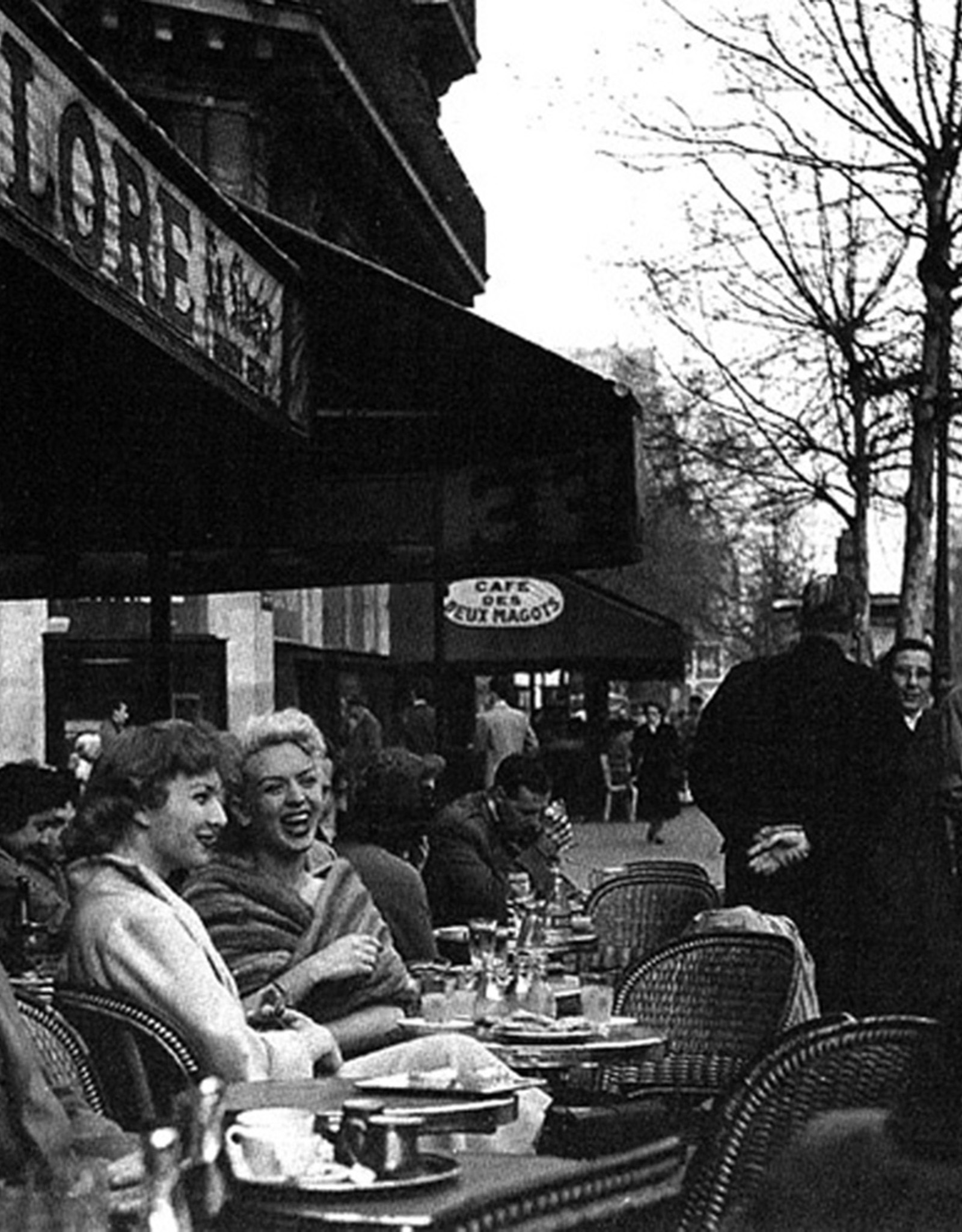
During the Occupation, the Café de Flore changed ownership. French café owner Paul Boubal took over the establishment. It was at this time that Simone de Beauvoir and Jean-Paul Sartre, a leading French literary couple, made it their refuge.
The Café endured the Nazi regime as a hidden sanctuary for the free-thinkers and soon attracted creative types from all industries. Like its nearby rival, Les Deux Magots, Café de Flore was frequented by numerous French intellectuals during the post-war years. In his essay A Tale of Two Cafes and his book Paris to the Moon, American writer Adam Gopnik mused over the possible explanations of why the Flore had become, by the late 1990s, much more fashionable and popular than Les Deux Magots.
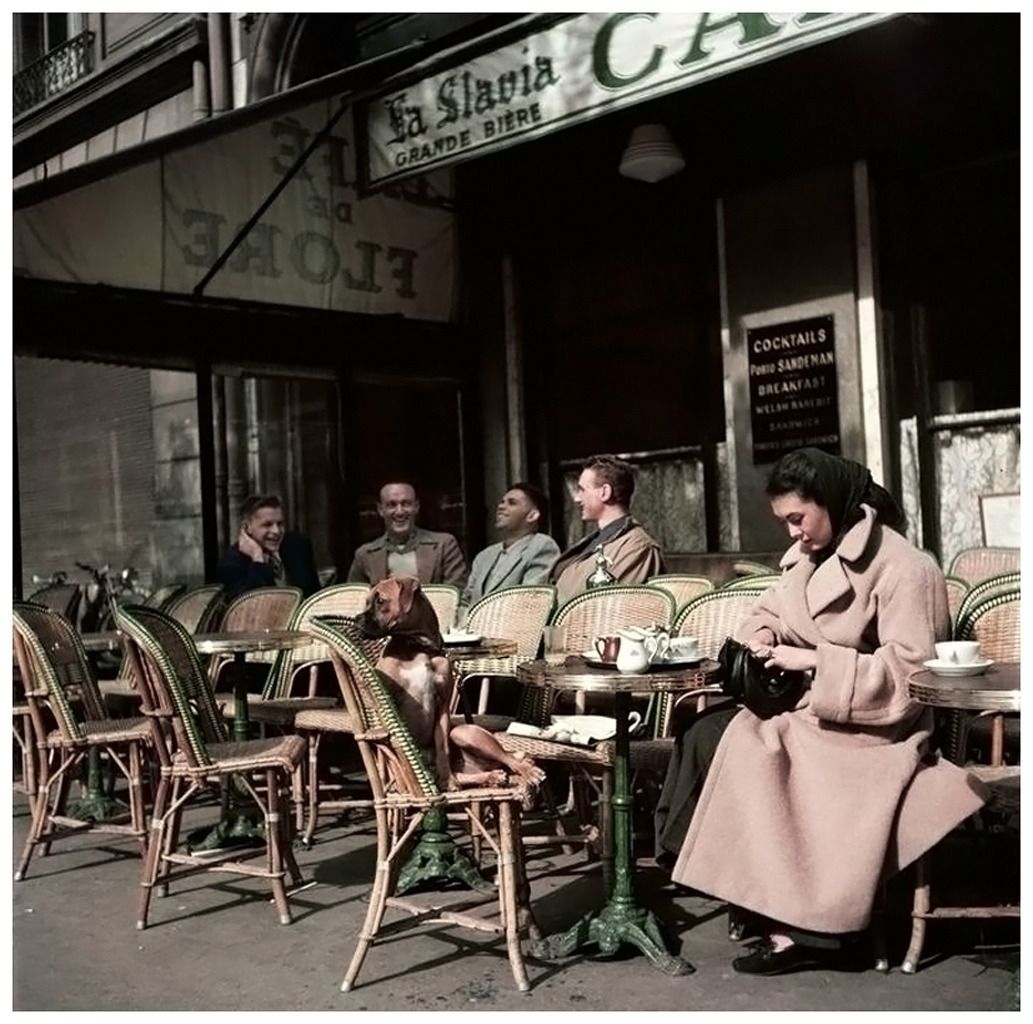
Cinemaphiles like Brigitte Bardot, Sophia Coppola and Quentin Tarantino; the big thinkers like Roland Barthes and Jacques Lacan; sartorialists like Yves Saint Laurent, Givenchy, and Paco Rabanne – they all found refuge here.
Naturally, the crowds, keen to catch a glimpse of the big names, began to flock to the cafe and brought big business with them.
In 1984, after almost fifty years, the Café changed owner again: Miroslav Silegovic and his wife Colette bought it, with nearby La Closerie des Lilas. They promised not to change the charming decor, although they have added the greenery.
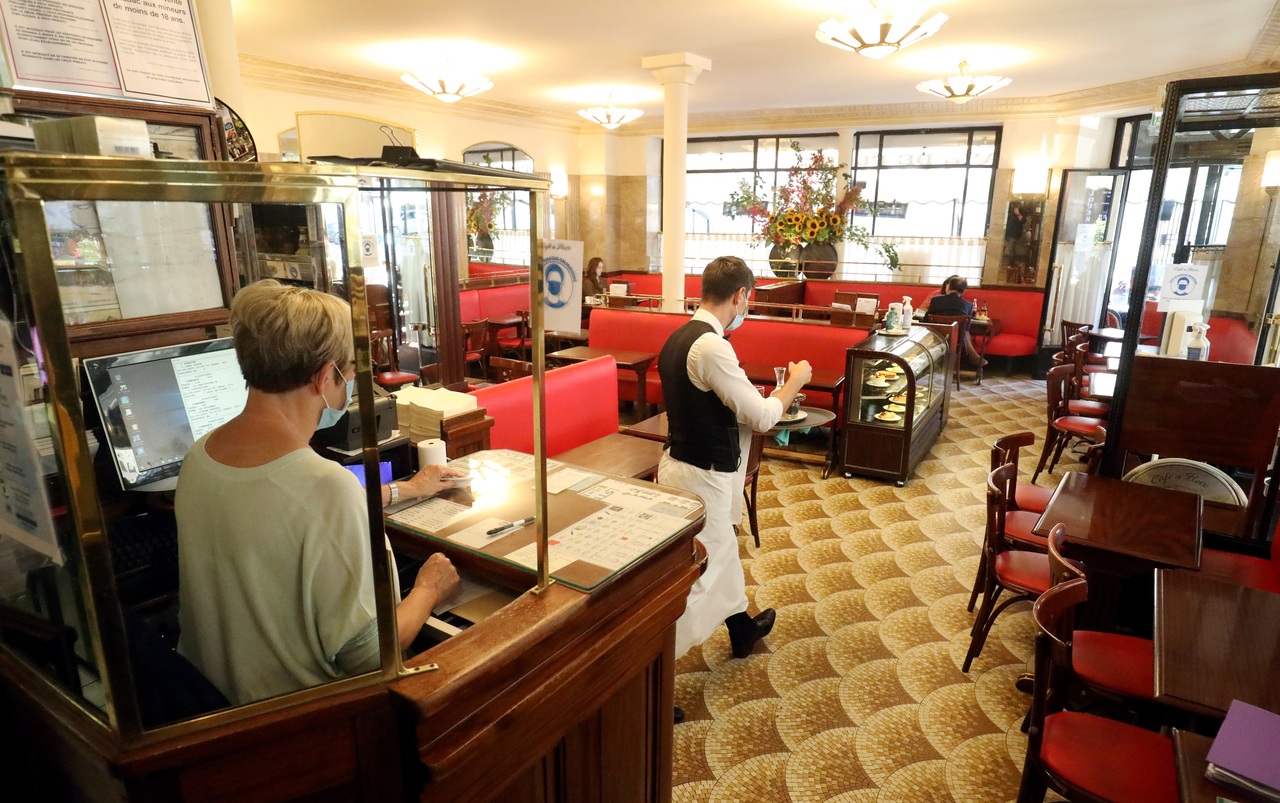
It’s a stretch, but the Café claims that it was the ‘birthplace of surrealism’ – regardless of whether it was or not, it’s a place where the movement found its feet.
Now that it’s become a beloved tourist destination and a spot that even celebrity cafe regulars will sometimes brave the crowds for. With its Art Deco interior of bright red flowers, crimson couches, mirrors and vintage mahogany furniture, it’s no surprise that it’s been featured in popular films and television shows as a chic Parisian hangout.

In 1994, Café de Flore opened a new literary chapter with the creation of the Prix de Flore, conceived by Frédéric Beigbeder. Each year, the prize is awarded to a young author with an original, modern style (Michel Houellebecq, Virginie Despentes, Amélie Nothomb have all won), with a cheque and a glass engraved with the author’s name, filled with Pouilly-Fumé, to be enjoyed at Le Flore for a year. This free-spirited prize reflects the DNA of the place: an address that celebrates audacity, modernity and a taste for letters.
Images courtesy of Café de Flore et moi
Musical Monday: Soundtracks #3

I’ve reported on a whole variety of songs: ones by artists I’ve seen live, covers, duets and those deemed iconic. I’m now turning my attention to what might be called “Soundtracks” those featured in films, television shows and advertisements.
I’m going to kick off with one everyone knows: Stayin’ Alive by the Bee Gees from the soundtrack of 1977’s Saturday Night Fever, a film chock full of banging disco hits.
In 1976, Robert Stigwood, the Bee Gees’ manager, was producing a low-budget film about the New York disco scene, then working under the title “Tribal Rites of the New Saturday Night.” The movie was based on a New York magazine article by Nik Cohn, which focused on working-class youths who found escape from their mundane lives through dance.
Stigwood asked the Bee Gees if they had any songs available for the project. The brothers Gibb were in France at the time, working on a new album, and initially declined, stating they had no time to write specifically for a film they knew little about. However, they had several demo tracks already recorded. Stigwood and music supervisor Bill Oakes listened to these demos, which included tracks like “Night Fever,” “Stayin’ Alive,” and “How Deep Is Your Love,” and they immediately recognised their potential for the film.
The Bee Gees ended up contributing five new songs for the soundtrack in just a few days, mostly on a staircase in the Château d’Hérouville studio. They still had no concept of the movie beyond a rough script and Oakes’ description of a guy who works in a paint store and goes dancing on Saturday night.
The film was originally going to be titled Saturday Night, but Stigwood loved the song “Night Fever” so much that he changed the movie’s title to Saturday Night Fever to match it.
The soundtrack, which combined new Bee Gees songs with pre-existing hits from artists like KC and the Sunshine Band and Kool & the Gang, became a cultural phenomenon. It spent 24 consecutive weeks at number one on the US album chart, sold over 40 million copies worldwide, and won the Grammy Award for Album of the Year, the first soundtrack to ever do so. It single-handedly propelled disco from a vibrant subculture into the global mainstream.
As always, don’t forget to let me know your thoughts.
The Numbers Game 28, Monday 9 February, 2026
Today’s lucky number yielded 132 photos from which I’ve selected 6 at random.


The challenge is kindly hosted by Life Lessons – a blog by Judy Dykstra-Brown
To play along, go to your WP Media file and type that number (232) into the search bar. Then post a selection of the photos you find including that number and post a link to your blog in Judy’s Numbers Game blog of the day – easy!
French Fancies: Griset

At one time, Griset was one of the oldest family-owned businesses in the world.
How it all began
Griset’s rich history began in 1760 when Antoine Griset established a precious metal foundry in Le Marais, Paris. This venture laid the foundation for a legacy that would significantly impact industrial lamination over eight generations, starting with a focus on transforming precious metals for the silversmith industry.
By late 18th century, Antoine’s son, Antoine Alexandre, had propelled Griset forward with a significant innovation: the commissioning of the first strip rolling mills. These early machines, powered by human labour or horse-driven carousels, represented a crucial step towards industrial production. This forward-thinking approach was a response to the increasing demand for precisely processed metals, moving the company beyond its initial foundry operations and showcasing an early commitment to technological advancement. This period highlights the company’s focus of growth on adapting to market needs through innovation.
The factory moved to Rue Oberkampf in 1825. Called the “Cité Griset,” it was a large, purpose-built facility that included both industrial and residential spaces for workers. This is where the platinum bar used by the International Bureau of Weights and Measures to denote the “standard metre” was first produced.
By mid-19th century, the company operated 17 rolling mills, powered by a 40 HPa steam engine, indicating substantial industrial capacity.
In 1878 Griset was awarded a gold medal at the Universal Exhibition, a testament to its recognized quality and innovation.
By late 19th century, the company became the first to laminate aluminum, a pioneering achievement in material processing.
Griset moved from its Cité Griset location in 1920 which was then divided into smaller factories and workshops, with part of the building now housing the Institut d’Etudes Supérieures des Art.
Early 20th century Griset diversified its operations into the manufacturing of metal rivets, expanding its product portfolio. 2013 A patent application for ‘Support for electronic power components, power module provided with such a support, and corresponding production method’ was filed, indicating a focus on modern electronic applications.
Over centuries, Griset had evolved, moving beyond artisanal origins to become a key player in specialised metal fabrication. Its expertise now encompassed custom-rolled copper, copper alloy laminates and semi-finished metal products vital for various high-tech industries.
The company’s journey showcases a remarkable adaptability, transitioning from luxury goods to critical components for sectors like electronics, automotive and avionics. This evolution is a testament to its enduring legacy in metallurgy, influencing its current market position as a specialised supplier.
While often associated with semiconductor test sockets, Griset’s foundational strength lay in its advanced metal fabrication capabilities. This included the production of materials essential for many technological advancements.

The company’s history, subject to international competition in a complex market, could have ended in 2014 following its liquidation. But, its acquisition by TNMG (TONGLING NONFERROUS METAL GROUP) in 2016, China’s leading copper producer, enabled it to rise from the ashes under the name TG Griset. The company, now based in the south of the Hauts-de-France region, has enjoyed steady and promising growth, has hired over 50 employees in just a few years and is run independently of its Chinese parent.
All images courtesy of Griset
The Musette: Roasted Courgette and Feta

What to do with a couple of courgettes and some Feta cheese? This was the question posed at the end of a long week. Now, I don’t know about you but I think these two ingredients go rather well together.
Ingredients (serves 2 as a starter)
Courgettes:
- 2 large courgettes (zucchini), cut into thick chips
- 1 tbsp olive oil
- 1/2 tsp ground cumin
- 1/2 tsp smoked paprika
- 1/2 tsp ground coriander
- 1/2 tsp chili flakes (optional)
- flaky sea salt and freshly ground black pepper, to taste
- zest organic lemon
Feta:
- 150g (1 cup) vegan feta cheese
- 75g (1/3 cup) vegan Greek yoghurt
- 1 tbsp olive oil
- 2 tbsp lemon juice
- freshly ground black pepper
Method
1. Preheat oven to 200°C /180°C fan/400°F/gas mark 5.
2. Cut the courgettes into long spears — about the size of thick chips. Toss in a bowl with olive oil, cumin, paprika, coriander, chili flakes (if using), salt, pepper and lemon zest until evenly coated.

3. Spread the seasoned courgette spears on a lined baking tray, leaving space between each one. Roast for 20–25 minutes, flipping halfway through, until golden and slightly crisp on the edges but soft inside.

4. While the courgettes roast, add the feta, Greek yoghurt, olive oil, lemon juice, and a little black pepper to a food processor.
5. Blend until smooth and creamy. Adjust the texture by adding a splash of water or extra olive oil as needed.

6. Spread the whipped feta generously on a serving plate. Arrange the roasted courgette spears on top. Drizzle with a little extra olive oil and sprinkle with more lemon zest, chili flakes, or fresh herbs such as mint, parsley or dill.

.
.If you’re not vegan, feel free to substitute the vegan feta cheese and Greek yoghurt for non-vegan equivalents.
Sheree’s Shout-Outs: Richard Bist

I cannot take credit for these posts as the idea was firmly planted by Richard Bist but, once planted, it took root.
My blog is probably no different to many in that the number of followers vastly exceeds the number of regular readers and commentators. As I’ve been blogging for a while, readers (and commentators) have come and gone – was it something I said?
In any event, once a month I’m going to throw a light on one of my regulars and it’s, of course, only fitting that I start with Richard.
 If you’re not familiar with his blog, it’s called “An Exercise in Self-Indulgence” which is a fabulous title and frankly true of many of our blogs. Mine included.
Richard though has real writing chops. For the past thirty years, he has been a professional wordsmith by day and a published author by night. He also reviews books. I particularly enjoy reading these as it gives me a good steer on what to avoid but, even better, introduces me to new writers. And, if that wasn’t enough, he produces podcasts, paintings, YouTube videos and he cooks.
I confess to having listened to some of Richard’s podcasts and watched some of his videos. He has a very easy to listen to and melodic voice and he’s a natural in front of the camera – both key attributes.
In his “About” page he says a number of writers have provided him with inspiration over the years, including Tolkien, Shel Silverstein, Judy Blume, Hermann Hesse, Tolstoy, Hemingway and Robert Pirsig. None of these has provided me with any inspiration – except possibly Hemingway’s bar hopping – furthermore, I had to look a couple of these up as I’d never even heard of them. I was reassured when I saw that they were American, like Richard. At least, that’s my excuse.
Having read that brief introduction to Richard and his blog, you might wonder why I enjoy following him. There’s a number of reasons but Richard himself said it best:
I love words, reading them, writing them, learning how to use them like paint on a canvas.
And that’s why I love what he shares. It’s always an entertaining, enjoyable and informative read.
If you don’t already follow Richard, please check out his blog and prepare to be very pleasantly surprised. You can thank me later.
Image courtesy of Richard Bist
 View from the Back
