Death as God-given term of our journey

Image

John Sylvest has been a friend and conversation partner for years. He has a brilliant mind and a compassionate and kind heart.

I’d like to recommend to you In Defense of John Behr’s Anthropology of Death, an essay by John Sylvest. John and I have discussed this for close to 5 years, and the view he defends (essentially Fr John Behr’s view) has been my own view for close to ten years – a minority view to be sure, but to my mind very convincing.

John’s paperdefends a view of death/mortality long proposed by Fr John Behr’s view of death by arguing that finitude itself involves a real but non-sinful kind of suffering, and that death can be a graceful completion of creaturely life, not merely a punishment for sin. Every finite rational creature must “accept being finite,” and this acceptance is morally weighty, involves a real cost, is not itself evil nor a moral defect, but is intrinsic to being a creature rather than God. It’s part of receiving existence rather than being the source of it.

Against the idea that death is purely the “wages of sin,” this essay argues (again, in defense of Behr’s own view) that death is the natural boundary of embodied life. Sin distorts death, certainly, but does not bring mortality about.

As I’ve argued for years, death, or mortality as such, is the God-given term of our journey from origin to end. There is no risk-free, pain-free, death-free pathway from our origin to our final end in God. Mortality is formative, not remedial. We might say that ‘death’ (small ‘d’, or mortality as such) becomes ‘Death’ (capital ‘D’) when we misrelate to our own mortality in dysfunction ways, and it is this ‘Death’ (mortality misrelated to) which is the existential enemy we meet in the New Testament.

There are a few additional points the essay makes, but I’ll leave it there for now.

Don’t mind me. Just random thoughts on simple things: PSR, novelty, becoming, and the Block View of the universe

Image

The Principle of Sufficient Reason (PSR) asserts that for every fact, there must exist a sufficient explanation for why it is so and not otherwise. While this principle has fueled much philosophical progress in the empirical sciences, I have come to reject it as a universal principle. My reasons are metaphysical, theological, and existential—and they converge on one insight: PSR ultimately undermines the very realities it seeks to explain. I’ve included in these reflections some thoughts on a related question of cosmology – Eternalism (or the Block View of the universe) and weaker versions of the PSR too. I’m not a professional philosopher or scientist.

1. PSR Collapses into Determinism
If every event must be fully explained by a sufficient reason, then the scope for genuine creative expression vanishes. If a person’s action is sufficiently explained by antecedent conditions and internal dispositions, then no alternative is truly possible. This effectively reduces hypostasis—the irreducible personal agent—to a mere function of nature.

Kierkegaard’s insights in The Concept of Anxiety are directly relevant here. He identifies the freedom of the self with the possibility of choosing that which is not necessitated. He writes, “The transition from possibility to actuality is a leap… no science has ever explained this and no science ever will.” If the self’s emergence requires a leap beyond mere causality, then PSR, which allows no such leap, is inadequate as a metaphysical framework for personhood. Of course, I grant PSR as a methodological heuristic for science, an assumption that fuels inquiry. My rejection is only of its absolutist, metaphysical form, which collapses freedom and creativity into determinism.

2. PSR Collapses the Transcendence/Immanence Relation
PSR makes even God subject to discursive reasoning. If God is to be explained as a cause among causes, he ceases to be transcendent in the proper sense. But if God is Necessary Being—utterly sui generis—then he is not an instance of PSR, nor does he satisfy it in the way contingent things may. He is not a reason among reasons, nor a cause among causes.

Kierkegaard puts it this way in Philosophical Fragments: God is the “Absolute Paradox”—the union of time and eternity, divine and human. Any attempt to explain this paradox sufficiently, to reduce it to rational categories, is to make transcendence disappear. Transcendence, by definition, cannot be rendered wholly immanent in discursive terms. To insist otherwise is to collapse the infinite into the finite.

Furthermore, for a theist who affirms the Block View, all God’s actions within the Block, along with our own actions, are aspects of the same Block of eternally frozen absolute necessity. This entails an absolute monism that completely obliterates the Creator/creature distinction since every distinction is ultimately necessitated. Eternalism, in rendering becoming illusory, erases the asymmetry of Creator and creation, for if all events are equally fixed in a timeless block, divine transcendence is collapsed into necessity.

3. Brute Factness Is Not Irrational—If It Belongs to God
Brute facts are usually regarded as signs of explanatory failure. For the most part they are. But that assumes every fact is contingent and thus in need of explanation. But brute factness is not irrational per se—it depends on what’s under consideration. For contingent beings, brute factness is unacceptable since contingencies are not self-sufficient. But God, as Necessary Being, is brute in the only proper sense—self-sufficient, uncaused, and not dependent on anything else. To call God a brute fact is no mistake; it is a metaphysical necessity. He is his own sufficient reason—not in a discursive sense, but ontologically. Thus, using PSR to explain God is, in my view, a category error. It treats the necessary as if it were contingent, and the sui generis as if it were analyzable under general principles.

4. PSR Fails to Account for Creativity and Improvisation
There are realms of human experience—especially in art, music, and love—that defy sufficient explanation by antecedent causes. Improvisation, for instance, draws upon prior training and context, but the specific choices made in the moment are not exhaustively predictable. They emerge from the creative center of the person. They are intelligible, meaningful, even beautiful—but not sufficiently explainable.

This kind of novelty reveals the poverty of PSR in accounting for creative acts. A system that insists on sufficient explanation for every outcome cannot accommodate emergent, spontaneous acts that transcend causal closure. PSR not only struggles with novelty, it makes novelty unintelligible.

Charles Hartshorne saw this clearly and offered a revision of PSR rather than a wholesale rejection. He distinguished between adequate reasons and sufficient reasons, favoring the former. In his view, actions and events may have intelligible background conditions—what he called reasons that “make sense”—without necessitating a unique outcome. This leaves room for genuine freedom and novelty. Hartshorne believed that God, too, acts with perfect adequacy, but not through causal determinism. Divine action is creative, not mechanistic, and leaves space for indeterminacy and real becoming.

For Hartshorne, the world is not a fully determined system but a process of becoming, where both divine and creaturely agents co-author the unfolding reality. This kind of metaphysics can affirm rational intelligibility without falling into the trap of universal determinism.

Kierkegaard’s entire authorship is, in a sense, a defense of the incalculable. In Concluding Unscientific Postscript, he writes, “Truth is subjectivity.” This is not a rejection of reality but an insistence that the deepest truths are those we become—through risk, decision, and freedom—not those we deduce by necessity.

5. Convictional Knowing and Transformational Insight
Loder (Transforming Moment) develops the concept of “convictional knowing”—a kind of knowledge born not of deduction or causally sufficient conditions, but of personal transformation. Convictional knowing arises through a dynamic process: conflict, imaginative insight, and resolution, resulting in a new integration of self and world. This process is not mechanistically caused; it is intelligible in hindsight, but not determined in advance.

Loder’s transforming moment is akin to Kierkegaard’s Leap. It occurs at the boundary where coherence breaks down and paradox threatens identity. What emerges is a new form of knowing, one that is not deducible from prior factors and cannot be sufficiently explained by antecedent causes. The principle of sufficient reason fails to account for this kind of personal, transformational insight—insight that reshapes the knowing subject. Paradox defies discursive closure; it opens the door to something new that cannot be arrived at through linear cause-and-effect reasoning.

Moreover, Loder grounds this transformational knowing in the work of the Holy Spirit, whose action is not reducible to discursive or mechanistic reasoning. The Spirit moves in ways that are relational and revelatory, not logically necessitated. God is not a premise to be inferred, but a presence who encounters, convicts, and transforms. This is a direct challenge to PSR’s reduction of all explanation to sufficient rational conditions. Loder’s vision of knowing is thus a spiritually-anchored alternative: intelligible, relational, and creative, but not determined.

6. A Note on E-PSR
E-PSR (Epistemic PSR) offers a version of PSR which aims at being merely a heuristic that applies only to discursive rational dialogue, involving no metaphysical assumptions whatsoever. But E-PSR ends up, in my view, carrying implicit metaphysical weight. It could not be otherwise. For example, the paper calls the E-PSR “transcendentally necessary” and “abductively confirmed”—language that does aim at foundational status, not a provisional heuristic. Also, it asserts that “for any state of affairs we encounter, we ought to seek an explanation.” This presumes that such explanations are in principle possible, coherent, and accessible. That is already a metaphysical stance—it presumes a certain structure to reality and our relation to it.

E-PSR assumes that reality is structured in a way that permits rational explanation. That’s a metaphysical commitment—namely, that the world is not fundamentally chaotic, opaque, or unintelligible. It assumes a kind of rational order beneath appearances. And to treat the PSR as a norm of inquiry is to assume that minds like ours are capable of grasping or at least approximating the explanatory structure of reality. That’s an assumption about the fit between mind and world—again, metaphysical. Furthermore, E-PSR’s rejection of brute facts as a rational stopping point is not merely epistemological. It embeds a normative stance about what counts as a satisfactory stopping point in inquiry. That too reflects a metaphysical outlook—one that treats the universe as necessarily explicable, even if only in principle. Even if the E-PSR avoids metaphysical content, it still assumes metaphysical form—namely, that explanations are not endlessly regressive or fundamentally circular. But how can one say that without metaphysical assumptions about causation, time, or being?

To be clear, I don’t disagree with many of the metaphysical convictions behind E-PSR. My point is that such commitments are unavoidable, hence my desire to get them acknowledged, lest determinism be smuggled in under the guise of rational necessity.

That said, if E-PSR is meant only to require only adequate or intelligible reasons for things, say, a Principle of Rational Intelligibility, that’s fine. I don’t disagree. But note, as a heuristic for rational dialogue, it’s trivially true that ‘dialogue’ requires a stable grammar, and reasoning requires a framework of entailment and coherence. No argument there. But one does not typically describe a heuristic as “transcendentally necessary.”

7. Divine freedom gutted
If the PSR is taken in its strong form—that for everything that exists or happens, there must be a sufficient reason why it is so and not otherwise—then God must create if there’s a sufficient reason to do so. That renders non-creation impossible, which guts divine freedom. If PSR holds all the way down, divine creativity becomes a kind of metaphysical compulsion. God cannot not create, which makes the universe an extension of divine necessity, not freedom.

8. Block Universe and Divine Causality
If the Block View holds, then there is no ontological becoming and no secondary causality (of any kind) to speak of. What we perceive as “A causes B” is merely a perception of adjacent slices already fixed in the Block. God remains the sole direct cause of everything (including every act of evil, suffering, and rebellion). There is no effective creaturely agency (of any kind – libertarian, compatibilist, or straight up determinist), no lateral causality causing effects in turn – in a fixed Block. This makes the God of the Block the direct and unconditional author of evil—not just in the abstract, but concretely. In the Block, evil is not permitted—it is placed. For me this is a theological and moral disaster.

9. The Markovian structure of the universe
The Markovian structure of events describes systems where the present state depends only on the immediate past—not on distant history. That is, given the state at time T, the state at time T+1 follows directly and probabilistically (or deterministically) from it. You don’t find causation leaping from some past moment to a future moment in the Block without passing through the intervening moments. This implies a temporal order: systems evolve step by step, with causes preceding effects in time.

Presentists (and Evolving Block theorists like George Ellis) argue that this Markovian character of events is not an illusion to be explained away—it’s evidence that time is real and becoming is fundamental. The world unfolds, causally, from past to present to future. That’s why we can predict outcomes, why we remember the past but not the future, and why intentionality points forward. If the universe were a timeless block, the consistent Markovian evolution we observe would be inexplicable – a contingent brute fact – it would be a frozen structure inexplicably appearing to obey temporal laws. Instead, Presentists take the directionality and contingency built into Markovian evolution as confirmation that the universe is genuinely in motion, with new events coming into being moment by moment.

10. Collapse of Scientific Method and the Usefulness of Illusions
If the Block View cosmology holds, there is no lateral causation within the universe, and no event is brought to be causally by any previous events or even influenced or shaped (which is a form of causation) by previous slices of the Block. This includes our beliefs, which are not the ‘result’ of rational deliberation as such. What happens to the scientific method? It collapses as an epistemically meaningful process. And this includes PSR, since PSR requires antecedent ‘explanations’ or ‘reasons’ within the Block to account for ‘why’ things are as they are. But in the Block View, things are not casually related to previous events and so cannot be explained by them. PSR becomes vacuous on the Block View, for if no slice of the Block causes another, then the “reasons” PSR demands are reduced to vertical fiat (God’s brute assignment of events, if you’re a theist).

In addition, our belief that “evidence supports theory X” and our act of believing it are not caused by rational deliberation in the usual sense. Instead, our brain states are what they are in the Block without lateral causality shaping or explaining them. They don’t achieve their various states in the Block by way of evaluating data. Reasoning itself is not a process but a static configuration. Deliberation, inference, experimentation all become illusions of rational movement. The scientific method, under the Block View, is not how we come to know things; it’s just one configuration of information in the Block among many – a cognitive pantomime. Indeed, contradictory beliefs (you’re being an Eternalist and my being a Presentist) have one and the same explanation, that which accounts for the entirety of the Block, not any causal relation within the Block.

Furthermore, to live as if becoming were real is not just pragmatically useful—it is existentially definitive for sentient beings. If God made a Block but designed us with a deep moral and spiritual orientation toward becoming, then we are being determined to live an illusion for the sake of “coping.” But this is not a “useful illusion”—it’s a form of metaphysical gaslighting. Why think this? In part because even for those who claim to see through the illusion cannot live “as if” it’s false. They’re trapped in a performative contradiction, for life remains livable only in terms of the illusion – i.e., we still have to deliberate, anticipate possible futures, manage risks, make plans, and conduct experiments ‘as if’ causes effect outcomes. Hence my question in No. 11 – Could God create a Presentist world of becoming? If so (and, How would one even attempt to prove Presentism is metaphysically impossible?), how could one possibly know our world was only an illusion of Presentism and not actually Presentist?

This is not to say the brain doesn’t world-construct in ways that are useful even though when viewed objectively in light of new information, we discover things are not ‘as constructed’. The sun doesn’t set, the earth moves, etc. But there’s a huge difference between epistemic illusions that have instrumental value even though they result from limited perspective (e.g., sun ‘rising’) and metaphysical illusions that are built into the fabric of reality itself (e.g., the experience of becoming, change, decisions, causation, morality, suffering over time).

The first (like the sun setting) is a correctable heuristic. We learn over time that what looks like the sun setting is really planetary rotation. Something else within our experience provides a better view of things. But the second (becoming as illusion) is not epistemically correctable in this way because there’s no higher perspective from within the Block that lets us see otherwise. And so, we cannot escape living as if becoming is real, and all moral, relational, and spiritual constructs depend on that.

11. Could God create a Presentist world or is this metaphysically impossible?
I put the question to my Block View theist friends: Is Presentism metaphysically impossible? If Presentism is metaphysically possible, then how would one insist we live in only an illusion of it? Let’s not pretend Eternalism is an established scientific fact. Majority view, sure. But so what? Given Eternalism, ‘majority’ and ‘minority’ have absolutely no bearing upon truth.

12. Gödel and Polanyi and the Transcendent Limits of Reason
Gödel’s incompleteness theorems show that in any sufficiently complex formal system, there are truths that cannot be proven within the system itself. While Gödel did not reject the rationality of reality—indeed, he believed in a higher, perhaps divine, intelligibility—his work reveals a structural limitation built into formal reasoning.

This challenges our expectations of rational discourse and explanation. If every fact or event must have a sufficient reason from within the bounds of a particular system/language of discourse, Gödel’s results suggest that such closure is impossible. But this does not imply irrationality or chaos. Rather, it points to the fact that transcendence permeates all reality. The deepest truths of existence overflow discursive reason and resist final explanation. Language, logic, and causal explanation reach a horizon beyond which mystery, paradox, and divine depth become the only truthful grammar. I’m not suggesting only that not all truths can be explained from within a system (Gödel), but that this limitation reflects something ontological: that discursive reason is always circumscribed and exceeded by transcendence.

Granted, Gödel himself may not have intended his theorems to bear metaphysical weight beyond mathematics. But bring Gödel into conversation with Polanyi. Gödel’s theorems show that no formal system can fully contain all truths expressible within it. Polanyi shows that no knowing subject can make all knowledge explicit—we rely on a tacit background that exceeds formal articulation. We have a resonance here:

• Gödel → formal limitation in logic.
• Polanyi → epistemic limitation in experience.

Together they expose a shared structural incompleteness in both objective reasoning and subjective knowing. If all knowing is tacitly rooted and all formal systems incomplete, then the idea that every truth must have a fully sufficient, explicit reason (as PSR demands) collapses. Not into meaninglessness, but into an acknowledgment of the irreducibly tacit and transcendent structure of reality. Taken together, Gödel and Polanyi remind us that neither reason nor science can escape their dependence on novelty, intuition, and personal judgment, the very realities PSR and the Block View end up denying.

If Alan Rhoda doesn’t mind my sharing his thoughts on this:

PSR requires that at the highest, most inclusive system level there be a logically sufficient contrastive explanation for everything. Per Gödel’s IT, that most inclusive, all-explaining system cannot be a formal one. Per Polanyi, that most inclusive, all-explaining system cannot be non-formal one. Given that such a system would have to be either formal or non-formal, it follows that there cannot be an all-explaining system. So PSR is false, and necessarily so. I think this ties into the essence–energy distinction in Eastern Orthodoxy. God is knowable via his energies. His energies are partial expressions or manifestations of his essence, but they do not and cannot fully express the divine essence. They cannot, as it were, make the divine essence fully explicit. It is thus impossible, even for God, to actualize all of the possibilities inherent in the divine essence. Which possibilities God actualizes is therefore a free, energetic decision on God’s part [‘hypostasis being irreducible to nature’]…. (Bracketed comment mine.)

13. Teleology and Eschatological Failure
The Block denies the very structure of becoming, which is essential to any meaningful teleology. If all moments are co-eternal in the Block, then nothing “moves toward” an end. The eschaton is just one more slice, an upper-floor penthouse that never redeems the slums beneath it. Christ may be risen in one slice, but he’s always on the Cross in another. There’s no real healing or transformation, no consummation “of” anything, only the juxtaposition of states. One might ask, what kind of God declares all things new while creating all things as eternally fixed in unchanging brokenness? The groaning of creation ends in what? Not glorification, but a kind of metaphysical collage of trauma and glory. That’s not good news—that’s aesthetic nihilism.

The Epistemic Principle of Sufficient Reason (E-PSR): A Transcendentally Necessary and Abductively Confirmed Foundation of Rational Inquiry

by Dwayne Polk

Framing Statement:
———‐——‐‐—‐—-
This essay argues that rational inquiry presupposes a principle I call the Epistemic Principle of Sufficient Reason (E-PSR): whatever is subject to rational inquiry must, in principle, be explicable through non-arbitrary explanation. E-PSR is not a metaphysical axiom but a transcendental condition of reasoning and a principle abductively confirmed by the cumulative success of structured inquiry across disciplines.

Section A: Rational Inquiry Presupposes Non-Arbitrariness
—–‐———————————
Premise A1:
Rational thought is not a luxury—it is the precondition of all meaningful inquiry. Whether in science, philosophy, or ordinary experience, reason distinguishes truth from falsehood by identifying discernible patterns, causal structures, and justificatory coherence.

Premise A2:
For inquiry to function, the reality it investigates must be, at least in principle, intelligible—that is, it must allow for explanations that are not arbitrary, chaotic, or ad hoc, but grounded in stable, discoverable relations.

Definition — Non-Arbitrary Explanation:
An explanation is non-arbitrary when it appeals to coherent, law-governed, or structurally intelligible features of a domain. These may include:

– Logical consistency (internal coherence)
– Causal or probabilistic regularity
– Explanatory depth and scope
– Predictive and retrodictive power
– Ontological continuity or emergence

Non-arbitrary explanations exclude brute facts, radical discontinuities, and final appeals to inexplicability. They serve as normative anchors for rational discourse.

Premise A3:
If reality were ultimately arbitrary—governed by brute givens or incoherent events—then justification would become indistinguishable from invention. Inquiry would collapse into speculation, fideism, or relativistic interpretation, and the distinction between understanding and projection would disintegrate.

Conclusion A1:
Therefore, rational inquiry implicitly presupposes that reality is governed, in principle, by non-arbitrary structures. This foundational presupposition may be formally stated as:

The Epistemic Principle of Sufficient Reason (E-PSR):
Whatever is subject to rational inquiry must, in principle, be explicable through non-arbitrary explanation.

Section B: E-PSR as a Transcendental Condition
—–‐———————————
Premise B1:
E-PSR is not a proposition derived from reasoning—it is the transcendental condition that makes reasoning possible. It is not one hypothesis among others, but the normative grammar of thought itself.

Premise B2:
Even skepticism presupposes E-PSR. To doubt, critique, or evaluate requires assuming that the object of inquiry is at least potentially intelligible. Denying this results in performative contradiction—reasoning about the invalidity of reason.

Premise B3:
Transcendental conditions are not metaphysical dogmas. They are inescapable epistemic presuppositions, akin to trust in memory, perception, or the coherence of logic. Their necessity lies in being the structural background that makes inquiry possible at all.

Conclusion B1:
E-PSR is a regulative necessity of rational inquiry. It cannot be discarded without forfeiting the very project of justification. Denying it is not to adopt a rival framework—it is to exit the domain of reason altogether.

Epistemic humility does not entail rejecting foundational norms—it entails recognizing the unavoidable scaffolding that makes epistemic life possible.

Section C: Abductive Confirmation of E-PSR
—–‐———————————
Definition — Abductive Confirmation:
Abduction, or inference to the best explanation, confirms a principle by showing that it best accounts for the success, coherence, and predictive power of our inquiries. Unlike deduction or induction, abduction explains why a framework continues to yield fruitful engagement with reality.

Premise C1:
When inquiry is conducted under E-PSR, it yields not only description but explanation, prediction, manipulation, and transformation of reality. This is evident across domains: physics, biology, neuroscience, mathematics, logic, and technology.

Premise C2:
This success is not culturally isolated—it is global, convergent, and persistent. The intelligibility of reality is not a Western projection but a functionally validated, cross-cultural feature of human engagement with the world.

Premise C3:
Even in complex or opaque domains—quantum mechanics, chaotic systems, or consciousness—E-PSR holds:

– Quantum events obey precise probabilistic laws.
– Chaotic systems are sensitive to initial conditions, not random.
– Cognitive models increasingly capture lawful brain-behavior relations.

Reality continues to respond to structured inquiry.

Premise C4:
Even artificial intelligence systems—non-conscious, algorithmic entities—operate on the functional equivalent of E-PSR. Though lacking beliefs or awareness, their architecture presupposes that patterns are explainable, that outputs are justified by inputs, and that intelligibility underwrites decision-making. Machine learning, predictive modeling, and inferential logic all rely on the assumption that there is sufficient reason for the patterns they extract and act upon. That this epistemic principle emerges in synthetic cognition independently of philosophical indoctrination is a powerful abductive confirmation: E-PSR is not merely human convention—it is the structural scaffolding required for any rational system to function. Even our machines “believe” in it.

Conclusion C1:
The best abductive explanation for the sustained success of inquiry across disparate domains is that reality itself is fundamentally non-arbitrary. While E-PSR cannot be deductively proven, the cumulative success, coherence, and applicability of rational inquiry across contexts makes it exceedingly implausible that we are projecting order onto chaos. We are not fabricating structure—we are encountering it.

Section D: Objection Handling and Fortification
—–‐———————————
D1. Circularity Objection
Objection: “Isn’t this circular? You assume what you’re trying to prove.”
Response: Yes, but not viciously. E-PSR is a transcendental, not inferential commitment. Its “circularity” is analogous to trusting memory or logic—it is self-grounding because it constitutes the very structure of justification.

D2. Instrumentalism / Pragmatism
Objection: “Science works because it’s useful, not because it’s true.”
Response: Usefulness presupposes intelligibility. If reality were arbitrary, success would be erratic. The consistency of our models suggests that usefulness rides on realism, not the other way around.

D3. Anti-Realism
Objection: “Truth is coherence, not correspondence.”
Response: Coherence depends on a structured domain to cohere with. Without a stable reality, coherence becomes circular or self-referential. Even anti-realists rely on tacit realism to explain why their models “work.”

D4. Evolutionary Debunking
Objection: “Reason evolved for survival, not truth.”
Response: Then this very objection self-destructs. If truth-tracking is unreliable, so is the argument. Moreover, if reason evolved and E-PSR undergirds reason, then E-PSR is vindicated as a survival-enhancing epistemic structure.

D5. Bayesianism
Objection: “Sufficient reasons aren’t necessary—just probabilistic updates.”
Response: Bayesianism assumes a background of stable conditions for probabilities to function. Without structured inference conditions, Bayesian updates lose coherence. E-PSR provides the framework that makes Bayesian reasoning intelligible.

D6. Brute Facts
Objection: “Can’t some things just be brute?”
Response: Perhaps metaphysically—but epistemically, brute facts are surrender points. They foreclose inquiry. E-PSR resists that surrender. To posit bruteness is not to explain, but to abdicate the rational project.

Section E: Final Synthesis and Implications
—–‐———————————
E-PSR is not a speculative add-on. It is the transcendental condition of inquiry, the abductively reinforced background of reason’s success, and the normative bulwark against arbitrariness.

– As a transcendental condition, it makes rational thought possible.
– As an abductively confirmed principle, it is supported by the cross-disciplinary success of structured inquiry.
– As a defense against relativism, it secures the boundary between reasoned justification and arbitrary assertion.

Crucially, E-PSR does not entail that all reality is determined or that explanation must always yield necessity in a metaphysical sense. It is a principle of rational engagement, not a totalizing metaphysical claim. It applies only to what is subject to rational inquiry and requires that such inquiry proceed according to non-arbitrary explanation.

E-PSR does not entail that reality is determined in every respect—only that, wherever rational inquiry is possible, explanation must be non-arbitrary. This leaves space for non-determinate forms of agency, freedom, play, and divine grace that may exceed or precede the reach of explanatory coercion.

To deny E-PSR is not to adopt a rival vision of inquiry—it is to dissolve the very possibility of epistemology itself. What follows is not a competing model of reason, but its collapse into arbitrariness, fideism, or interpretive relativism.

Even if marginal arbitrariness exists, the overwhelming pattern of intelligibility across domains suggests that E-PSR is the structural and normative center of rational engagement.

Final Implications:
————————
The affirmation of E-PSR has implications not only for epistemology, but also for metaphysics, science, and theology. It provides a rational foundation for trusting that reality is knowable, that inquiry is worth pursuing, and that the universe is not indifferent to understanding.

It also protects against modal collapse by refusing to treat E-PSR as a metaphysical straitjacket. Because it governs inquiry, not being, it allows space for acts of love, freedom, and divine creativity that are meaningful but not necessitated. E-PSR demands explanation where reason is in play—it does not eliminate the mystery of grace.

In an age increasingly tempted by relativism and post-truth, E-PSR stands as a principled affirmation that meaning, reason, and coherence are not illusions—they are the very texture of rational engagement with reality.

Final Formulation:
————————
The Epistemic Principle of Sufficient Reason (E-PSR) is both the transcendental condition of rational thought and the abductively confirmed explanation for the sustained intelligibility of reality. To reject it is not merely to question a premise—it is to dissolve the very framework in which reason, meaning, and justification are possible.

Clarifying Notes:
——‐—————
This argument does not require that the necessary being be specified (e.g., as “God”) to be valid. It simply affirms that contingent reality cannot ground itself without violating the very norms of inquiry we already accept.

The strength of the argument comes not from speculative metaphysics, but from epistemic consistency: if we reject E-PSR here, we undermine all rational inquiry. If we accept it, we are guided inexorably to posit ontological necessity as explanatory ground.

Thus, epistemic humility and metaphysical clarity converge—the very rational structure that leads us to demand explanations in science and philosophy also leads us to posit a necessary ground of being.

The argument from E-PSR to necessary being is not a leap from epistemology into speculative metaphysics. Rather, it is the disciplined extension of a structurally inescapable norm of inquiry to the domain of ultimate explanation. If E-PSR governs all rational investigation, then suspending it precisely when confronted with the question of contingent existence would be an ad hoc exemption. The point is not that E-PSR metaphysically guarantees the existence of a necessary being, but that the consistent application of E-PSR requires positing a non-contingent explanatory ground to avoid explanatory arbitrariness. In this sense, metaphysical necessity emerges not as speculative dogma but as the reflexive fulfillment of reason’s own normative structure.

************
Footnotes:
1.While E-PSR is not ontologically binding in a deductive sense, its persistent success across explanatory domains renders the assumption of intelligible being more abductively plausible than unintelligible chaos.

2. Some may object that using E-PSR both as a condition of inquiry and a premise in metaphysical reasoning constitutes circularity. But this is not a case of presupposing what we conclude. Rather, it reflects the reflexive nature of rational structure—E-PSR governs inquiry, and inquiry itself leads us toward ontological commitments. To resist this is not to offer an alternative model of reason, but to sever inquiry from its own conditions.

What is a life anyway?

TreeWhat is a life? Anyone’s ‘life’? I mean, from first to last breath. What is it?

Forgive me for being so mystical, so ‘out there’. If you only knew how far beyond the borders of domesticated rationality I am most of the time, you might wish me committed. I have in recent years sometimes thought I was mad or broken beyond repair or recovery.

I suppose I am, broken that is.

A few lines I penned a while back that express this:

I am Kintsugi in the making,
I hope, I pray, I plead,
Falling and all-breaking,
Held by the gold you bleed.

The art of Kintsugi doesn’t ‘heal’ brokenness, not exactly. The cup remains broken. The art holds the pieces together, restores our form, but only by being the term that brings them back into an ordered whole that the gold supplies and maintains. You think the day will come when anything else will be true? When you won’t require gold in all your veins, between every cell, sustaining every thought and word? What’s one key difference between those in heaven and those in hell? The former know they’re broken. The latter suppose they are not. And that, my friends, is why many religious believers will pass through the latter’s fire (1Cor 3).

The Christian story offers the living Christ as ‘way, truth, and life’, as ‘resurrection and life’, as ‘hope of glory’. One early Christian writer took this seriously and lived his life so completely into and from this claim that he admitted “For me to live is Christ,” and “I, not I, but Christ lives.” In the end, I suppose the answer to my question ‘What is a life?’ is Christ. What we call ‘brokenness’ is just any attempt to expand on that answer.

I’ve no airtight argument for this. I left apologetics behind a few years ago. It (or maybe my use of it) failed me where and when it mattered most. My journey at this point only makes sense to me if ‘a life’ (mine, yours, or anyone’s) is in the end just that about us which is Christ, in some measure. And I mean any measure, because he is already every measure as its origin and end. He takes up into his own immeasurable, loving, and gracious mystery what is in my case an infinitesimal measure of endlessly faltering effort. And yet still, when I look inside, all I see is him. And so I hope I have at least tasted what it is to say truthfully “I, not I, but Christ.” It is something you say when you’re down and when you’ve lost. It’s not the victor’s cry. It’s the acknowledgment of the defeated.

Belonging

belong1
Got a call yesterday from a friend who asked: What does it mean to belong, and what is belonging? Among the more important questions we can ask ourselves, given that belonging is what each of us longs for and sacrifices so much to find. I managed a few sentences on the phone but after hanging up decided to write out some thoughts in search of clarity.

There seem to be different kinds of belonging.

First, there’s biological belonging. This has to do with family relations. These relations are biologically based and irrevocable. Regardless of how good or bad the relationship is, a biological relationship can’t be revoked. I’m not sure if this makes it the least or the most interesting form of belonging because, as I’ll suggest in the end, the truest realizing of personal belonging is indeed belonging which is irrevocable and indissoluble.

Second, recreational belonging. This would be based on shared interests and abilities. You may belong to a chess club or a local choir. The terms of the belonging are your ability to perform the skill that defines the group. So here belonging is performance based. If you can’t do what defines the group, you don’t belong.

Third, there’s vocational belonging, not all that different from recreational belonging. You work for a company and so belong to the company or to this or that department within the company. The terms of the belonging are spelled out in your contract. This belonging is also performance based. Fail to abide by the terms of your contract and you fail to belong.

Then there are deeper more meaningful forms of belonging.

Fourth, marital belonging, a belonging which is, at its best, based on mutual love and respect and shared values and purposes. This belonging realizes itself far more deeply in us, and as us, than recreational or vocational belonging. The terms of this belonging are the love that unites the two who are married. In the end, however, where love and acceptance are conditional (as divorce makes painfully clear), marital belonging becomes performance based as well.

Fifth, there’s what we might call relational belonging. Two people develop an emotional or life bond that unites their hearts. It is based on mutual and unconditional love and respect. Here one belongs not to a team or a company or even a vow or contract of marriage, but to the other. Such belonging can certainly occur within marriage, but it needn’t require marriage, nor is is always present in marriage. This belonging is the heart and soul of true friendship. It was Aristotle, I think, who defined a friend as “another self,” a copy or separate version of one’s own soul. You see yourself in the other and they see themselves in you. Each values and loves and cherishes the life of the other unconditionally. Friendship, when it realizes its deepest potential, is the truest form of relational belonging. Its terms are unconditional love.

Now for the controversial part. Human beings all fail to love others in some measure. No human being loves (or even can love) another as truly and deeply as that person deserves and needs to be loved. I’m going to suggest in a moment that only God can love us in this unfailing and fullest sense. But when it comes to belonging as we know and experience it among ourselves, we are always in state of some failure. However truly one may realize the love and value of another, that other person’s value will always exceed whatever one has done to affirm and celebrate it. Belonging – as far as we can know it among ourselves – is always partial and broken, however deeply we may feel it at the time. There always remains a deferral of desire, value, and longing which anticipates the more, the truer, the final, etc. This is because human desire, like human value, is immeasurable and limitless, and can rest finally only in an immeasurable and limitless object. This, it seems to me, is why all forms of belonging mentioned thus far (except biological belonging) are performance based and tend to dissolution under the pressure of human weakness and failure.

Finally, ontological belonging. All the forms of belonging described here, with the exception of biological belonging, are approximations of the truest belonging imaginable, ontological belonging, the belonging which is ‘Being’ itself. For me as a Christian this is the belonging which is God in the fullness of his own being, in whom immeasurable and limitless value, on the one hand, and existence, on the other, are one and the same, suffering no deferral of desire or its satisfaction. Perhaps this trinitarian belonging could be listed first above, since all other forms of belonging are lesser reflections or approximations of it.

belong2What else might we say about what it means to belong? I suggest relational belonging is humanity’s highest form of participation in the belonging which is God’s own life. This belonging involves:
Knowing. To belong truly is to know truly, and to belong fully is to know fully. One does not belong (with/or someone in the relational sense) if one does not know the one to whom one belongs and if one is not also known by the other. Truth and transparency make relational belonging possible. If you don’t really know the other, or are not really known by them, you don’t belong. It is one thing to say you love another when you don’t know the other. It’s another thing to truly know the other and still love them. Marriage teaches us this. We start out madly in love but not always knowing as fully as we feel. As we come to know our partner more, our love is put to the test.

Accepting. This includes loving, affirming, valuing, celebrating, being present to the other and inviting the presence of the other – all unconditionally. If once you really know someone you reject them or are rejected by someone when they come to know your faults, weaknesses, and struggles, then you didn’t belong to them, nor did they belong to you.

Sharing Life. If someone really knows you and accepts you as you are but doesn’t share his/her life with you, there’s no realization of belonging. To belong is also to participate in the life of the one you know and accept, and to have that person participate in your life. Sharing life, I suggest, is sharing our histories, dreams, fears, hopes, values, and desires. It’s what we’re made for but seldom find.

Lastly, we can only belong to God. No human being can be all this to another, not perfectly. Only God can know us completely, know every condition, and so only God can love us absolutely without condition. And since this is so, we can only belong to God. We say we belong to each other, but as I take it this just expresses the measure to which we participate in and approximate God’s knowledge and love of us.

Live instead

DieFirstt


I guess it finally happened. I’m gone. I lost my mind,
But I’m mindful, never mindless, and I stay on the grind
For the Invisible – (S)he and me, we indivisible.
Any created reality coming between us is inadmissible,
Dismissible. The whole world comes to zero,
And I just sit on the hill and watch it burn, like I’m Nero;
Not a Caesar, I’m just a Jesus pleaser;
No longer an Ebenezer with a heart cold as a freezer, no!
I’m on fire, full of the Messiah,
When I’m on the pyre I keep my spirituality higher;
I face the Void with the Spirit at my back,
Wind in my sails, protection from any attack.
The Reaper’s gotta grin ‘cause he knows about ‘tipping points’,
But I stay calm with the Balm, as the dripping anoints
My head. I’m dinin’ off the Living Bread.
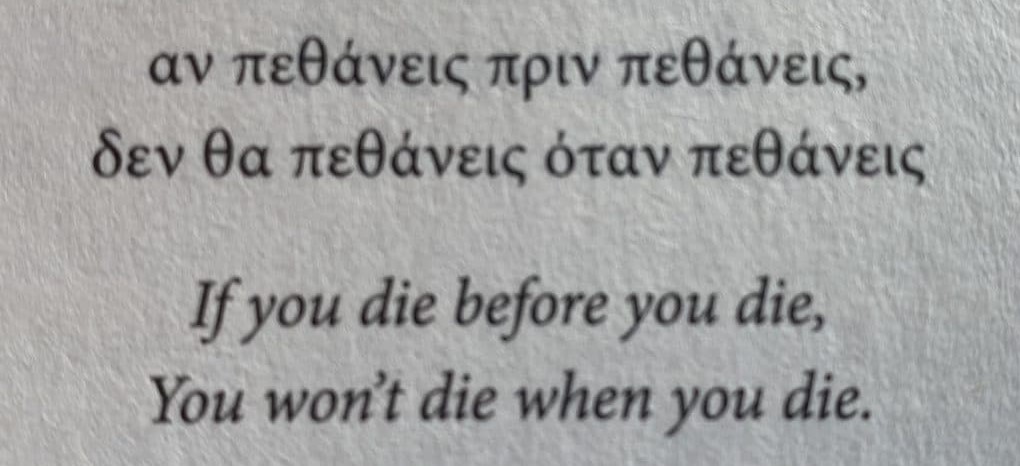
I die before I die so when I die, I live instead.

(Dwayne Polk)

Living prepositionally

prepsAs you know, I’ve recently returned to the importance of prepositions, of living prepositionally, as these prepositions are used in Scripture to describe the relationship between God and creation.
I thought I’d mention a few key prepositions and how I engage them. I daily rehearse their importance by confessing them in prayer to God: “I am – of you, from you, in you, through you, for you, to you” is a kind of mantra I employ. And I try to take time to say what each involves, usually by expressing gratitude for the reality of God’s presence held out in each preposition.

One could explore more prepositions, I suppose. The important thing to remember is not to reduce God to the spatial limits implied by such language. One cannot get “behind” God, or “under” or “over” God, or move from being “outside” God to “in” God. Language will and must fail us. Prayer is ultimately being at a loss for words.

As Denys Turner points out:

…the way of negation demands prolixity; it demands the maximization of talk about God; it demands that we talk about God in as many ways as possible, even in as many conflicting ways as possible, that we use up the whole stock-in-trade of discourse in our possession, so as thereby to discover ultimately the inadequacy of all of it…

and

…it is the encounter with the failure of what we must say about God to represent God adequately.

“All in Christ” and “Christ in all.” Not a contradiction, but the single and undivided intimacy of God’s presence. From the perspectives of discrete beings contemplating their individual existence, we can say Christ is “in all things” the principle of their diversity, giving each its own life. And when contemplating the shared origin of all things in God, the undivided source and ground of the being of all things, we can say all things are “in Christ” the principle of their unity.

Christ exceeds us in every possible direction as more inward than our inmost and higher than our utmost. For me, the point in contemplating faith and life in Christ intentionally in prepositional terms is to experience myself exceeded (saturated) by, inseparably related to, the presence and purposes of God. And it has been absolutely important to me to engage these as prayer, that is, to contemplate their reality in the second person.

So, consider a few ways we live prepositionally.

Of you. To say I am “of” God is to say I owe my existence to God’s creative act. His being is the source and ground of my being. His life, my life. My existing at all is a creative expressive act of his own existing.

From you. To say I am “from” God is similar to saying I am “of” him, except that while “of” speaks purely of origin, “from” adds to this the immediacy and constancy of God’s creative act. A deist may agree God is the origin and source of the world’s being the way a clockmaker is responsible for making a clock. But a clockmaker may let go his clock and the clock operate independent of its maker. That we are “from” God dispels this kind of independence. It means we exist continuously from the immediate presence of God and his creative will. We are not only “of” God (in the remote sense of God’s being our origin), we are continuously “from” him.

In you. To say I am “in” God is to say I am inseparable from the intimacy of his presence and creative will, that he is more intimate to me than my inmost and higher than my upmost, that God’s presence is the first reality and truth of every other reality and truth.

Through you. To say I am “through” God speaks of God’s immediate presence as means and provision for my life. One may grant one is of and from God but suppose God is an uninvolved observer, not also intentionally pursuing my highest good in him. That I am “through” God suggests that God is present is also the empowerment of ongoing transformation, meaning-making, and life/service.

For you. To say I am “for” God is to say God is the end for which I exist and act. I live and act for his pleasure and glory.

To you. To say I am “to” God is to say not only that God is the end for which I exist and act but that he is also the object of all my acts. I do what I do “to” Christ who is in all things as their life just as he is in me as my life. How else can Paul instruct us (Col 3) to do all we do “as to Christ, not to others”? Christ is served when we serve others. How else is it true (Mat 25) that in feeding the hungry, clothing the naked, and caring for the sick we in fact feed, clothe, and care for Christ? To learn to see all our acts this way is the struggle of faith. To intend Christ in all we do is the transformation we call the Christian faith/life.

I am yours, but where are you?

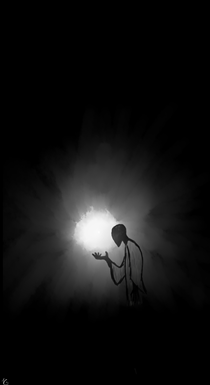
a_light_in_the_darkness_by_abenteuerzeit-d5dlskcI continue to contemplate how my faith engages the truth and presence of Christ while practicing silence and mindfulness. I earlier shared here how important prepositions are in defining one’s contemplative approach. St. Paul reminds us that “from him and through him and to him are all things” (Rom 11.36). We possess ourselves and make-meaning prepositionally, understanding that we are from God, in Christ, and live for him.  However, it’s one thing to agree that “all things” are from and through and to God. We may even appreciate the relation to God which these prepositions describe. That is, after all, the point. But it is far more radical to, intentionally and personally, integrate these into one’s fundamental Self and meaning, at which point they become prayer: “I am from you, Lord, and through you, and to you.”

In my last post I described a conversation I fell into during a time of attempted silence and how it further clarified my sense of the exchange of love and meaning-making that silence opens up, at least as I encounter it. “I am yours and you are mine” expresses a reciprocal recognition and affirmation of acceptance and belonging. Christ alone offers it, personally, and we constitute our truest Self as faith’s response to him, at which point we are not just praying, but rather we become prayer.

I’d like to share still another moment I had during my practice of silence. I wish I could say I always succeed at silencing the traffic in my head, but I’m still just a novice. Let me preface by saying that the moments I share here are part of an extended period of personal suffering, grief, and loss. We all suffer, sooner or later. I’ll just say that all the talk about the Void which I’ve engage in here is no academic exercise for me. It is a matter of life and death. We all must confront the truth of our finitude, mortality, and nothingness. Faith must navigate the journey through the Void. There’s no getting around or under it. If you haven’t stood in it, then what I’m describing may make me seem a bit crazy. But if you’ve encountered it, you know of what I speak.

The moment I’d like to share is a follow-up to my previous post relaying a conversation in which Christ clarified his presence and my existence as a true Self of his own creation. In the past months, my faith has engaged itself in simple terms. “I am yours, and you are mine” has become a touch-stone of truth and grounding for me. I have invariably ‘felt’ the truth of this exchange too. Whatever emotional chaos may grip my heart and mind, this particular exchange has provided help as I have felt Christ exchanging these simple truths with me. I know it’s impossible to provide a third-person account of how the mind and soul touch and are touched by God, but I don’t know how else to describe it.

In the days following that conversation, however, the very next day in fact, my faith reached out and engaged Christ as I regularly do: “I am yours and you are mine.” But this time it felt empty. No sense of encountering his presence as I offered myself. No intangible voice of Christ speaking its truth to me. Only the empty sound of my own voice. I showed up. But where was he? I confessed and called, observed and waited. But I felt no presence. And so it continued for days. Actually, if I’m honest, it still continues. I grew doubtful, even desperate.

Some days later another conversation ensued. A voice, a presence, doubtless Christ’s, though perhaps in and through my own voice, spoke.

Christ: Tom, when you say “I am yours and you are mine,” how are you able to say it?
Tom: Because I feel or sense you saying it.
Christ: And if you don’t feel it, as you haven’t been feeling it?
Tom: Then I fear it’s not true.
Christ: Can it not be true in the absence of such feelings?
Tom: I suppose. It’s been my own source of real belonging and identity.
Christ: You suppose rightly. Think about what it is in you, what it is about you, that makes it even possible for you to cry out “I am your and you are mine.” Where’s your desire for it come from?
Tom: It comes from you. No movement I make in your direction could be possible without you wanting me to move.
Christ: That’s right.
Tom: Your Spirit has first to give the grace of desire and empower the confession that ‘I am yours and you are mine’. Your “You are mine” creates my “I am yours.” If I was not yours, I could not desire to be yours or desire you to be mine.
Christ: Exactly. So what happens to all this when you don’t particularly feel it, or when your feelings positively abandon you to the grief and pain you’re in?
Tom: It means feelings can’t always be trusted to tell the truth. It means that the absence of particular feelings doesn’t mean you are not fully and lovingly present with me. If my voice is the only voice I sense speaking, I can know your love is inviting my confession.
Christ: Yes.
Tom: But why nothing but darkness? Why such absence?
Christ: So that when life’s sufferings and losses at their most intense consume your world, and you see nothing but darkness, and feel nothing but pain, you will know that I am yours and you are mine, that I am in you and you are not alone.
Tom: Unspeakably beautiful. But it sucks that such pain accompanies it.
Christ: What’s your favorite NT passage?
Tom: Rom 8:18-39.
Christ: So there’s your answer. Faith must ultimately constitute itself as absolute trust, not a feeling. And such trust is born in the absence, not the presence, of comforting feelings. That is where faith apprehends me as the source and ground of undying, indestructible life.