What Is a JSON Database?
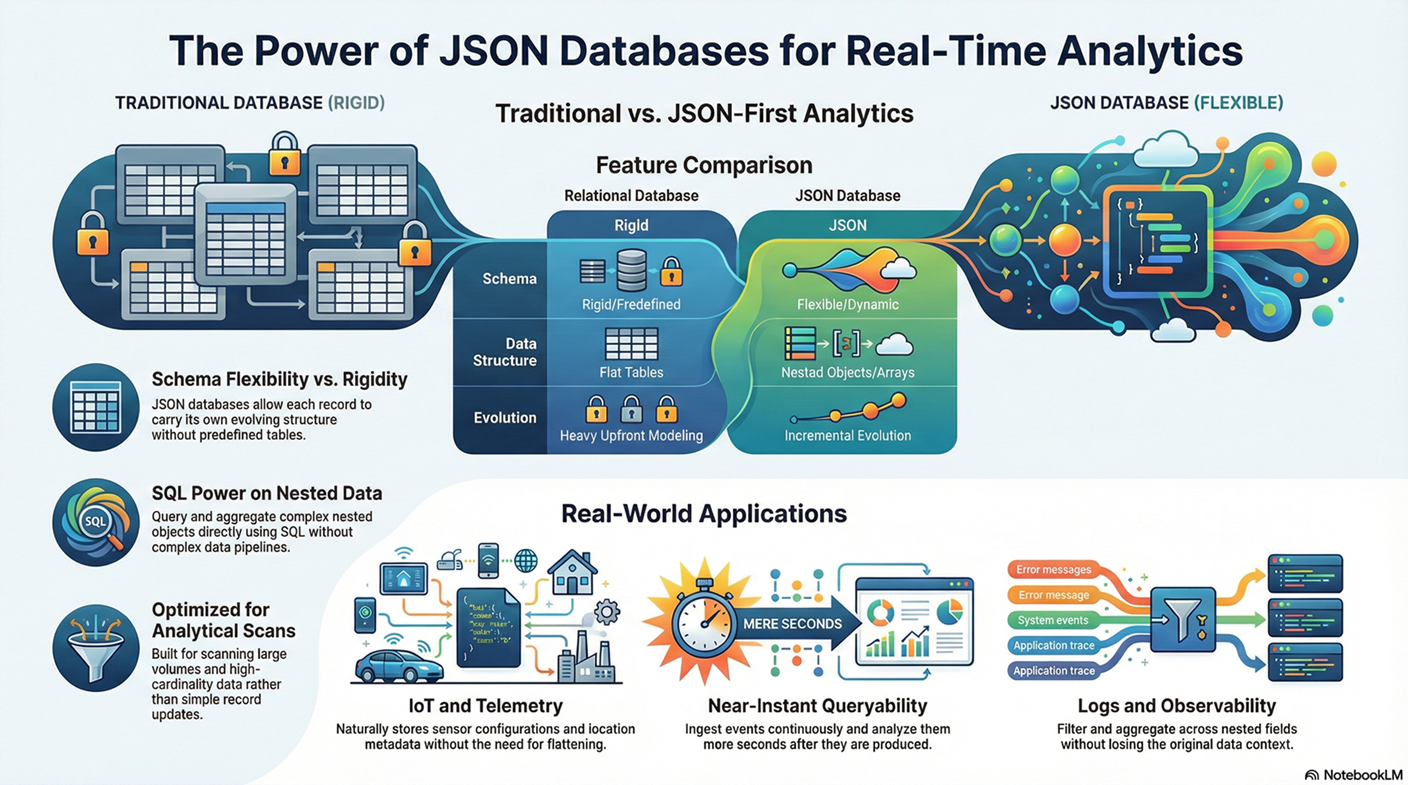
JSON databases are designed to handle semi-structured data represented in JSON format, allowing records to contain nested objects, arrays, and varying fields without rigid schemas. Instead of forcing data into predefined tables and columns, JSON databases preserve the natural structure of semi-structured data.
JSON databases are commonly used when data structures change frequently, when ingesting data from APIs or devices, or when analytics must operate on rich, multi-dimensional records without extensive preprocessing.
At a high level, a JSON database combines:
-
Flexible data modeling using JSON objects
-
Efficient storage and indexing of nested attributes
-
Query capabilities that can access, filter, and aggregate JSON fields

Why JSON Databases Exist
Traditional relational databases require schemas to be defined upfront. Every record must conform to the same structure. This works well for transactional systems, but becomes limiting when dealing with:
-
Event data with optional fields
-
IoT and telemetry data with evolving attributes
-
Application logs and metrics
-
API payloads and external data feeds
JSON databases address this by allowing each record to carry its own structure, while still supporting querying and analytics across large datasets.
Common Use Cases for a JSON Database
JSON databases are widely used across modern data platforms and applications.
Real-Time Analytics: Operational dashboards often rely on semi-structured event data. A JSON database makes it possible to ingest events continuously and analyze them seconds after they are produced.
IoT and Time-Series Data: Device telemetry frequently includes nested metadata such as firmware versions, sensor configurations, or location data. JSON allows this information to be stored naturally without flattening or pre-aggregation.
Application and Event Data: User actions, system events, and API responses are often emitted as JSON. Storing this data directly avoids transformation pipelines and preserves full context.
Logs and Observability: Logs and traces are inherently semi-structured. JSON databases support filtering and aggregations across nested fields without losing detail.
JSON Database vs Relational Database
The main difference lies in schema flexibility.
Relational databases require predefined schemas and fixed columns. JSON databases allow records to evolve over time.
That said, many modern systems blend both approaches. Some databases support JSON alongside traditional tables, enabling structured and semi-structured data to coexist.
Key differences:
-
Schema rigidity vs schema flexibility
-
Flat tables vs nested objects
-
Heavy upfront modeling vs incremental evolution
JSON Database vs Document Database
JSON databases are often compared to document databases such as MongoDB. While both store JSON-like documents, their goals differ.
Document databases focus primarily on application data storage and retrieval, often optimizing for CRUD operations on individual documents.
While many document databases are categorized as NoSQL, JSON databases for analytics often support SQL querying and analytical workloads rather than application-centric CRUD access.
JSON databases designed for analytics emphasize:
-
Scanning large volumes of data
-
Aggregations across many records
-
Filtering and grouping on nested attributes
-
Combining real-time and historical analysis
For analytical workloads, performance under high cardinality and large data volumes becomes more important than single-document access.
JSON Database vs PostgreSQL JSON Support
While PostgreSQL, a popular open-source relational database, has offered native JSON support for many years, its implementation serves a different purpose than purpose-built JSON databases. PostgreSQL allows you to store and index JSON data using the JSON and faster JSONB types, and you can query JSON fields using SQL functions and operators.
However, PostgreSQL’s JSON support is mainly designed for:
-
Mixed workloads where relational and JSON data coexist
-
Moderate JSON usage within traditional transactional applications
-
Leveraging established transactional guarantees and ACID compliance
In contrast, JSON databases focused on analytics — especially those optimized for real-time and high-cardinality workloads — aim to handle:
-
Large analytical scans across many JSON records
-
Fast aggregations and filtering on nested JSON fields
-
Continuous ingestion and near-instant queryability
PostgreSQL is a strong choice for mixed relational workloads with moderate JSON usage, while purpose-built JSON databases are better suited for analytics performance and schema evolution at scale.
What to Look for in a JSON Database
Not all JSON databases are equal. When evaluating a system, consider the following capabilities.
Query Flexibility: The database should allow you to access nested fields, arrays, and objects directly in queries, without complex workarounds.
Performance at Scale: JSON flexibility should not come at the cost of performance. Look for systems that index JSON fields automatically and can handle high-cardinality data.
Real-Time Ingestion: Modern workloads require continuous ingestion and immediate queryability, not batch processing.
Analytics Support: Aggregations, filtering, time-based analysis, and joins should work naturally on JSON data.
Integration with Existing Tools: Support for standard query languages and connectors makes adoption easier.
JSON Databases for Analytics and Real-Time Workloads
As analytics moves closer to production systems, JSON databases increasingly serve as operational analytics platforms.
These systems must:
-
Ingest data continuously
-
Query both recent and historical data
-
Handle evolving schemas without downtime
-
Support complex aggregations and filters
This combination is especially important for real-time dashboards, monitoring systems, and data-driven applications where insight latency matters.
How CrateDB Approaches JSON Data
CrateDB is a distributed SQL database designed for real-time analytics on large, fast-changing datasets. JSON is a first-class data type, not an add-on.
CrateDB allows teams to:
-
Store JSON objects directly without schema rewrites
-
Query nested JSON fields using SQL
-
Combine structured and semi-structured data in the same queries
-
Run aggregations and analytics on fresh data at scale
Unlike systems that require pre-flattening or external pipelines, CrateDB enables analytics directly on raw JSON data while maintaining predictable performance.
When a JSON Database Is the Right Choice
A JSON database is a strong fit when:
-
Data structures evolve frequently
-
You need fast insight on semi-structured data
-
Analytics must run on fresh and historical data together
-
High-cardinality attributes are common
For teams building real-time analytics, IoT platforms, or data-driven applications, JSON databases provide the flexibility and speed required to operate at scale.