Getting going in 2025

The New Year has started with me getting going with my Robin Hood skirmish game project. I have bought some Hinchliffe 25/28mm Robin Hood figures from Lancashire Games in their excellent winter sale. These have yet to be painted but they seem to go well with some other figures that I have just painted, namely a sprue of the new plastic Medieval Peasants from Wargames Atlantic. These are very nice figures with a great selection of weapons. I think they look suitably thuggish!

Image

When the figures are ready, I will need to decide what rules to use. Likely to be either One Hour Ancient and Medieval Skirmish Wargames (OHAMSW) or Song of Blades and Heroes (SOBH).

Image
Image

I will probably try both! There is a dedicated scenario for Robin Hood in OHAMSW and I have also found a Robin Hood Campaign and scenarios online for SOBH.

Long time, no see!

Well – it has been a long time since I made an entry on this blog and I thought it was about time I did something!

I won’t try to catch up on what has been going on wargaming-wise in the two years since I made  an entry.  Instead, I will simply give a brief account of where my wargaming head is at the moment.  Hopefully, this will help get back into the swing of blogging more regularly.

So here goes. . .

To start with, some rules I have enjoyed playing recently:

  • Martin Rapier’s WW2 version of Neil Thomas’ One Hour  Wargaming.  These have been played over Zoom with a group of the Northern Wargames Development crowd.  Martin always does a great job of designing carefully thought through scenarios for the games.  https://tgamesweplay.blogspot.com/p/one-hour-wargames-rules-and-scenarios.html
  • Bob Cordery’s Portable Spanish Civil War wargame, played with my local village wargaming chum.  I mean, what are the chances of finding a wargamer two doors away in a small village!  As for Bob’s rules, they really add some great period flavour to the basic Portable Wargame engine.  Try getting Anarchists to do what a Communist commander tells them!  https://wargamingmiscellany.blogspot.com/2021/07/faster-than-speed-of-light-arriba.html
  • Several different skirmish games that all create a great narrative.   Song of Drums and Tomahawks (based on Song of Blades and Heroes) for French Indian Wars,  Fistful of Lead for Western Gunfights and One Hour Skirmish Wargaming.  For the latter, my good mate and long standing wargaming colleague, Sean,  put together a great looking scenario for Black Hawk Down era game.   A really engaging game.

Rules I am looking forward to buying:

Miniatures I have bought recently:

  • 28mm Hinchliffe Robin Hood miniatures from Lancashire Games.  Lots of character and only just over a pound per figure in Allan’s winter sale.  When I get these painted, the plan is to use them for One Hour Ancient and Medieval Skirmish Wargames.  https://www.lancashiregames.com/lg/25mm-robin-hood.html

That is all for now.  Hopefully there will not be as long a gap before my next blog and that one will have a few pictures – if I can remember how!

Old schools toys … and old school miniatures

After being converted by Sheffield wargaming chum Tim Gow to the Fistful of Lead skirmish game engine by Wiley games ( https://wiley-games.myshopify.com/ ), I got both the Core Rules and the Mexican Revolution supplement with scenarios and additional rules. Looking around for toys to play the rules with, I chanced on a nice “old school” 20mm range produced by Jacklex Miniatures https://www.jacklexminiatures.com/

The excitement of the figures arriving was increased still further by the great looking packaging:

Image

… and some good old fashioned sawdust for further protection:

Image
Image

The figures themselves are crisply moulded with no flash – and look as if they will be easy to paint.

Image

I got some US Intervention figures and some of Pancho Villa’s men. I hope to paint them soon and will post the pictures.

Starting with napoleonics

I have recently bought the DBN rules as I would like to start in this period without the need for loads of figures or complex rules. So – I bought DBN https://dbnwargaming.weebly.com/

The rules look very promising and Alex, one of the authors, has been very helpful in responding to a couple of questions I had. As an enthusiastic DBA player, I found the rules quick to grasp.

As for figures, I saw some 6mm mdf miniatures at the Reading Wargames show at Ascot race course recently. I bought a pack to see how my eyes would get on with painting them. Others will no doubt be able to paint them a lot better than me but I was quite pleased with my attempt. Cavalry, artillery and a French army have now been ordered. I do like the fact that you can buy them either in acks or individual strips of 8 infantry or 3 cavalry. These can be found at http://www.commission-figurines.co.uk/ They also do ancients and ACW and some very cost effective buildings.


Image

I look forward to painting the rest of the armies when they arrive and having my first game of DBN!


First UK DBA Tournament for a while!

I was very pleased to be able to host the first UK DBA tournament for a while. Due to the rule of six Covid rules, the twelve players were divided into two permanent teams for the day – one team playing at my house and the other in the function room at the (very) nearby pub, The Farmyard Inn in Youlgrave. As the weather was good, we were all able to get together at lunchtime in the pub garden for an excellent ploughman’s – and in some cases a beer!

Image
The Farmyard Inn

The format was “open” so any legal DBA v3 army with or without allies could be used and these ranged from Biblical armies to late 15th century European. The scoring system was 3 for a win, 1 for a loss and 0 for a draw and any ties were decided by taking into account net equivalent elements lost or won. Prizes for the tournament were kindly donated by Gavin at Alternative Armies https://www.alternative-armies.com/ and were from their 15mm scenic range. Thanks also to Mark Johnson for helping out before the tournament and on the day, managing things for the “pub team.”

Image
The Alternative Armies prizes

The Myers clan -Martin (father) and Patrick (son) came joint first – an overall winner could not be determined in this case as they had the same net enemy destroyed won! Here are the overall results:

1 = Martin Myers (II/32a Later Carthaginian)
1 = Patrick Myers (II/76 Koguryo Korean)
3 Simon Wilson (II/52 Dacians with Sarmatian Allies)
4 Colin O’Shea (IV/82 French Ordonnance with Venetian allies)
5 Tom Whitehead (Greek Kyrean I/56a)
6 Mark Johnson (III/15 Tibetan)
7 Mark Skelton (IV/65 Wallachians with Polish allies)
8 Andy Wheeldon (II/32a Later Carthaginian)
9 Martin Smith (I/28 Sea Peoples)
10 Keith Murphy (1/58 Meroitic Kushite)
11 Baldie (III/54b Qaramita)
12 Phil Johnson (Late Roman Eastern with Pre-Islamic Arab allies)

And – here are the players –

Image

They are:

Back L-R – Andy Wheeldon, Mark Skelton, Colin O’Shea, Martin Myers, Patrick Myers, Keith Murphy

Centre L-R – Simon Wilson, Mark Johnson, Baldie

Front L-R – Martin Smith, Phil Johnson, Tom Whitehead.

Here are some other photos of the action at my house: (Martin Smith has created an album and uploaded more photos on the Groups IO SBA site at https://groups.io/g/DBAList/album?id=265935

Image
Martin Smith watches Martin Myers’ intricate manoeuvres with concern!
Image
Martin Smith adjusts his glasses to better read the rules small print while Phil Johnson and Andy Wheeldon
try unsuccessfully to contain their amusement
Image
Tom Whitehead looks on in despair, anticipating another killer move from Martin Myers.

Now I need to start planning the Bakewell Paired armies tournament in late September!

Hexing Lion and Dragon Rampant.

hex lion rampant

I really enjoy Dan Mersey’s rules and I have Dux Bellorum, Lion Rampant, Dragon Rampant, The Men Who Would be Kings and Rebels and Patriots.

After joining the Sheffield Wargames Society about a year ago, I was introduced to some great miniatures games on hex or square grids. I liked the speed of play that these brought rather than lots of fiddly measuring. When COVID reared its ugly head and we started playing games over the internet, it rapidly became clear that grids were the way to go when playing with Zoom or Skype.

So, taking both the above into account, it seemed to make sense to have ago at seeing if Lion/Dragon Rampant could be played on a grid. What follows are my thoughts on how this might be done. These are based on Dragon Rampant but could easily be applied to Lion Rampant.

Movement

There are four movement rates in Dragon Rampant. Foot move 6 or 8 inches and mounted move 10 or 12 inches. One of my design criteria was to be able to play on a small Kallistra hex grid eg 8 x 8 with each hex representing 6 inches. I decided to have a 1 hex move rate for infantry and 2 hexes for mounted. In order to give lighter units some advantage in movement, I introduced some turning restrictions. Heavy foot (basic 6″ movement) and heavy mounted (10″ basic movement) can only turn 60 degrees or about face for free. Other turns cost a hex of movement. Light foot or mounted (base move of 8 or 12″) can make two such free turns in a turn. Scouts/skirmishers can turn as often as they want for free.

Terrain

The original rules have 1/2 movement rate in difficult going such as woods. I can’t have 1/2 hex movement so the rule is that most troops who are allowed in such terrain must remain stationary for a turn after they move in. Those with the Fleet Footed trait can move freely as usual.

Facing

Troops can only shoot or charge into their front 3 hexes. Also, Armour is reduced by one if shot at or charged into their rear three hexes.

Shooting

This was relatively easy – just divide the existing ranges by 6 to give the range in hexes. Eg Foot missiles (18″) are 3 hex range and Short range missiles (6″) are 1 hex.

Charging

In order to maintain the ratio between shooting ranges and movement, I decided to make it the rule that a unit must charge into the enemy hex to initiate close combat. The alternative was to add a hex to missile ranges. If you don’t do one of these, troops may be able to charge straight in without taking any fire when they wouldn’t be able to do this in the original rules.

Retreats

Units retreat 1 hex. If this is blocked, the normal rules apply.

Size of units.

As it is really unit strength points that matters in this game rather than numbers of figures, I generally made one figure = 2 strength points and used markers to indicate casualties. I made large monsters etc 6 or even 12 points per model. This helps make sure that there is enough room in a hex, particularly when two opposing units are in close combat.

The trial game worked well – it ran smoothly and quickly – and seemed to maintain the feel of the original rules. I look forward to any comments or further ideas!

Update

CRIPES!!! It is nearly six months last my last blog. I thought I had better write something before this blog dies altogether.

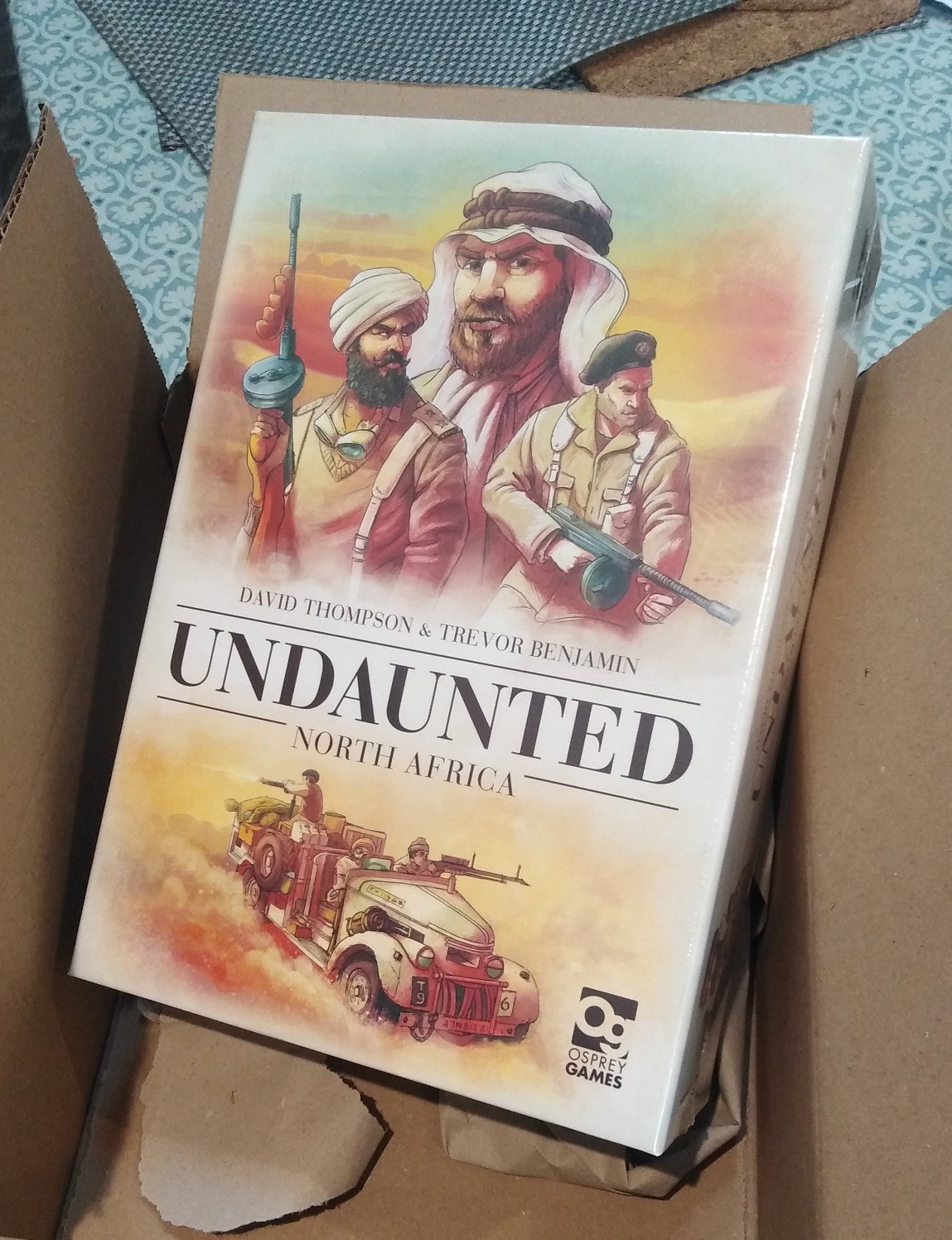
Well, I guess I do have some excuses. Going through a major house development during a pandemic being the main one. But, we are now at last in the new house with a gaming room nearly sorted. On the wargaming side, there has been the occasional face to face game when allowed with Sean, my long standing (and suffering) wargaming mate. He recently introduced me to Osprey games “Dauntless – North Africa.” This is an excellent little game that combines simplicity and speed of play with the need for some complex and challenging decision making. It is sort of a card deck building game with board wargaming aspects. The scenery is made up of terrain tiles that can be re-arranged in various ways to fight the scenarios that are included in the game. I really enjoyed the way it is asymetric with the LRDG mainly attempting to blow things up or evade and the Italians wanting to hold buildings/airfields etc or drive their opponents off. I am thinking of playing it with 15mm miniatures rather than counters. Well worth checking out.

LRDG game

My main wargaming activity has continued to be the virtual games with guys from Sheffield Wargames Society. We have now really got the hang of playing by Zoom or Skype – Zoom having been found to be better for us. The games have been mainly ones using rules developed by the guys – principally Tim Gow, Martin Rapier and John Armatys – all wargaming royalty! A great range of games ranging from the Cold War in 1980s Germany, North African deserts of WW2 to the Eastern front of WW1 and the Austrro-Prussian War of 1866. ,.. and not forgetting the AWI and Naploeonic Naval games.

People say that COVID may permanently change some things. I have been very much converted to grid/hex systems after using them to facilitate Zoom games. I suspect I will be continuing to use them. I am currently working on hex variants for Lion/Dragon rampant and AK47 Classic. More posts to follow soon on this subject.

Portable Wargame Ancients – house rules

I had a very enjoyable Portable Wargame Ancients with Martin Smith by Skype.   There were some internet connectivity issues but not enough to stop us running another session in the future!

Following the game, we had a few ideas on some house rules as follows:

  • Only allow pulling out of combat if you are faster than the enemy, and only if directly away from enemy front face, and not hard flanked. 
  • Only apply having to turn to face rule if in enemy’s front’ square.  
  • Massed bows (not skirmish bow fire) add +1 to die roll, take away the general -1 for  shooting if moving but apply the -1 for moving to massed bows only.
  • For hits on elephants, use the normal hit resolution table but apply the flee/retreat rule only when the last SP is lost.
  • Do not to apply the “-1 if attacked by elephants” modifier to light infantry. 
  • Light troops may retreat one extra grid after a ‘retreat’ outcome from shooting or Close Combat to pass through friends behind – but only if facing same direction, and not into enemy front square or impassable terrain. 
  • Evade option for light troops (LI / LC).  When testing for result of a hit, add +1 to dice for light troops, so they’re more likely to retreat than take damage. Also, MUST choose retreat whenever able, rather than dig their heels in and take an SP loss.  
  • LI bows /slings may not be activated to engage in close combat.
  • Troops MAY shoot (rather than CC) if enemy is in adjacent square to front. 
  • When a retreat reaction is received, first must turn to face the shooter or CC opponent before the retreat.  Retreat reaction when flanked/reared – unable to retreat, lose an SP, but still turn to face the cause of SP loss. 
  • End of Game – pinched from Alan Saunders’ ECW set – ‘Break Point’ is 1/2 army’s SPs, rounded up (or 1/3 rounded up). When, at end of turn, an army has suffered enough SP loss to reach that, dice D6. Adjust by +1 if objective attained, -1 if Commander lost.  Score of 3 or less, army morale fails, and game is lost. If survive the test, retest at end of each turn thereafter.  

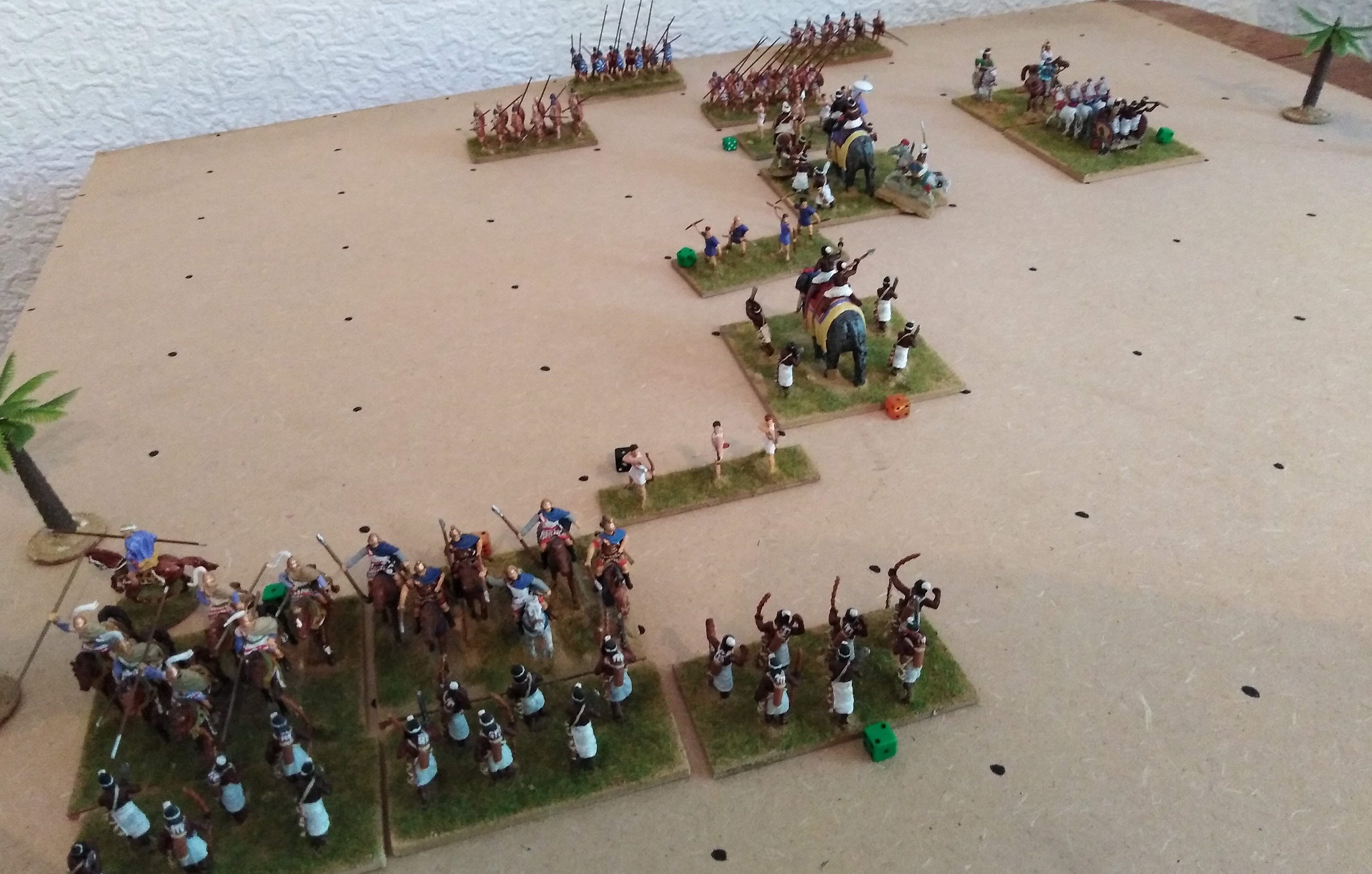
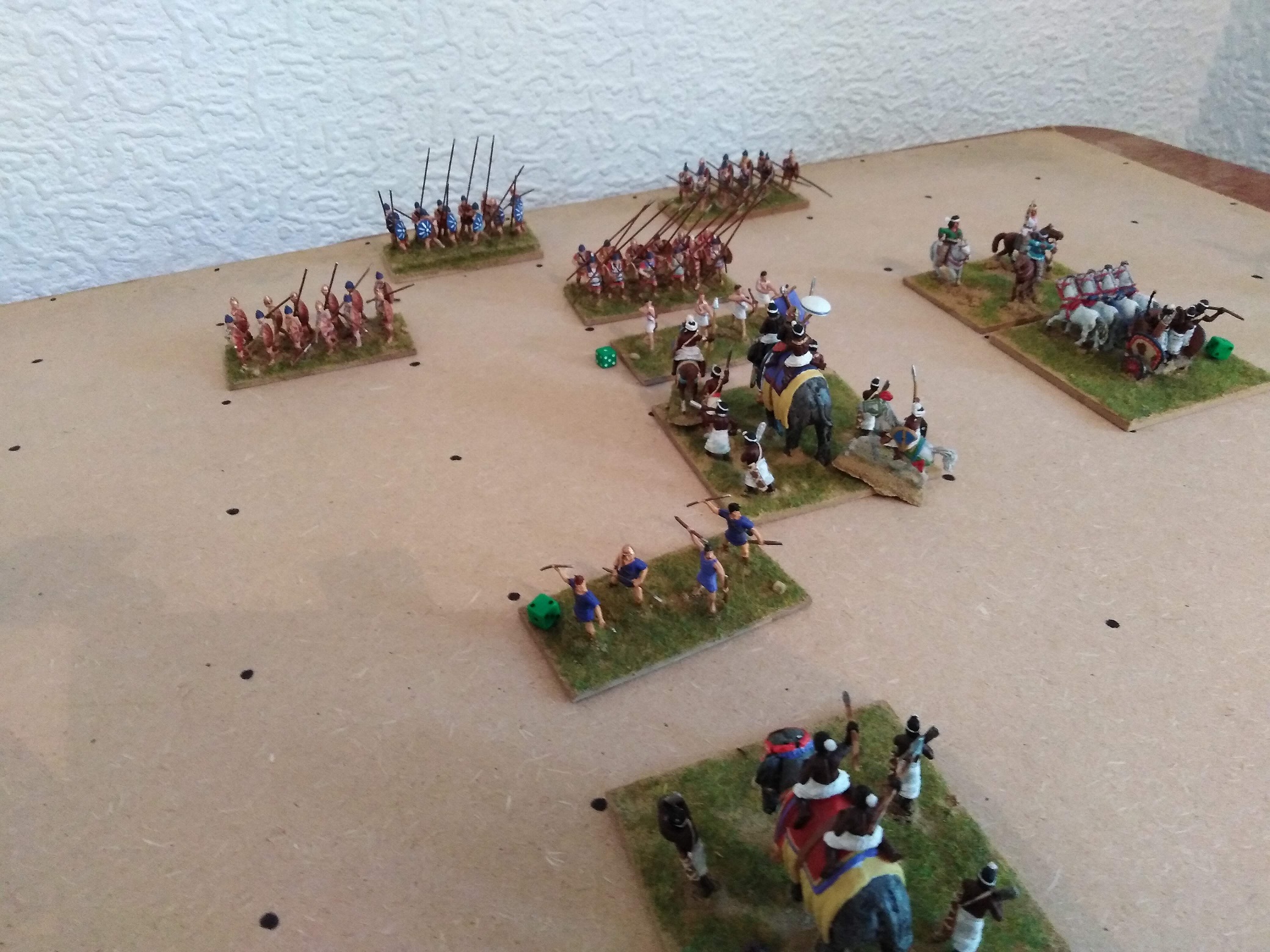
Here are a couple of photos from our game – Alexander v Porus.   The figures are 20mm on 80mm frontage bases with a grid of 80mm.  The uncluttered plain table made it easier to play by Skype.

PWA ancients blog2PWancients blog1

Trying out Bob Cordery’s Portable Napoleonic Wargame rules for ACW

I thought I would try out the Portable Napoleonic Wargame rules by Bob Cordery for the American Civil War.

The scenario was loosely based on the early morning assault at Antietam by Hooker’s Union First Corps on Confederate General Jackson’s Corps, which formed the left wing of Lee’s army.  This was the part of the battle that featured the very bloody fight over Miller’s cornfield.

Although this was a Corps level battle, I used the Division level rules from Bob’s book – the book having rules for Brigade, Division and Corps level games.

Each side had 10 brigades spread across three Divisions.  On the Union side, there were the Divisons of Doubleday, Meade and Ricketts.   On the Confederate side, the Division Commanders were Lawton, Hood and Jones.

All Brigades were average apart from one elite Brigade (5SP) in each army – Hood’s Texans and the Iron Brigade in Doubleday’s Division.

As far as the rule changes were concerned,  the key ones were:

  • The activation system involved having X counters, each with a different number from 1-X with X being 1/2 of all the units on the table.   Each side could place a number of counters face down, equal to half the number of units it had on the table at the time.   The counters were then turned over and that was the order in which the units were activated.   Units could save their activation for firing later in the turn if they wished.
  • There was no separate artillery phase – they were activated like other units.
  • Rifled artillery had a longer range than smoothbore but was less effective at closer range to take into account smoothbore grapeshot.
  • I scaled the grids at about 300 yards – about the same frontage as a typical 900 strong brigade.  Each brigade had two bases and I allowed two brigades in a grid.
  • I have read that troops were rather lessing willing to charge or stand a charge in the ACW.   To take this into account and introduce a bit of the to and fro action,  units had to throw less than or equal to their SP (strength point) to charge in and likewise to stand if the enemy was charging them with a bonus if a commander was present.  If they failed to charge or stand, they could fire instead but at -1.  Failing to stand meant the unit had to retreat.
  • I limited musket and rifle fire to one grid.    With all the smoke around, I am not sure that rifled muskets were shooting effectively at much more than a couple of hundred yards anyway!
  • If attacking, brigades got a +1 if there was a brigade lined up behind them and in the same grid.  This is meant to represent wave attaks but I am not sure about this!
  • Although not relevant to this scenario,  I treat cavalry as more or less mounted infantry and took out any references to forming squares and all that milarkey!  (Although I did recently discover that,  apparently,  squares were very occasionally formed, but this, like cavalry charges, was very rare).

All in all, the changes seemed to work well in a brief solo game, with the bloody attacks over the cornfield being well replicated.

Here are a few pictures of the game:

Antietam deplyment all units

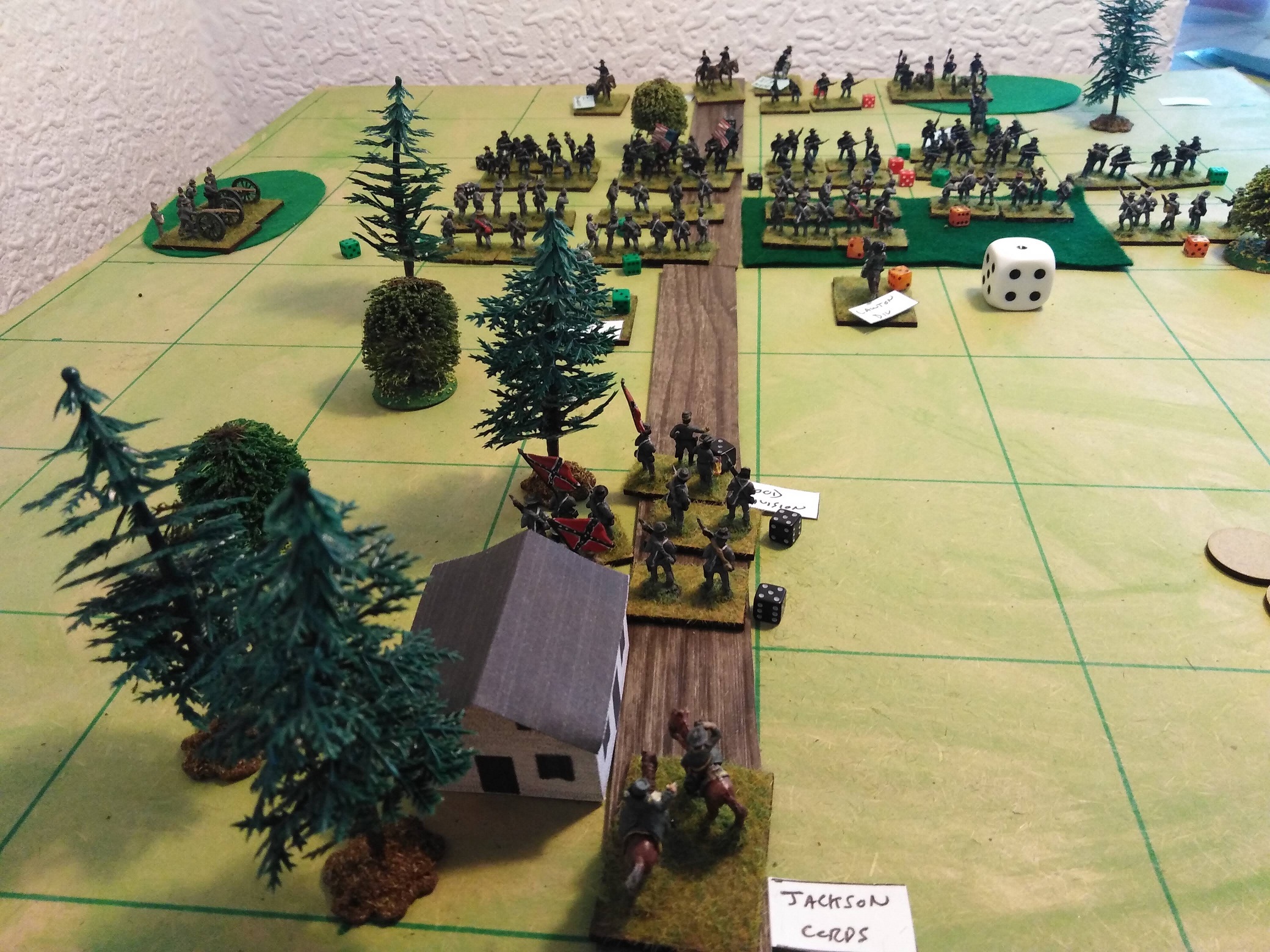
Here is the initial deployment from behind the Confederate lines and looking North.  Dunker Church is in the foregrouns and the green felt is the cornfield.

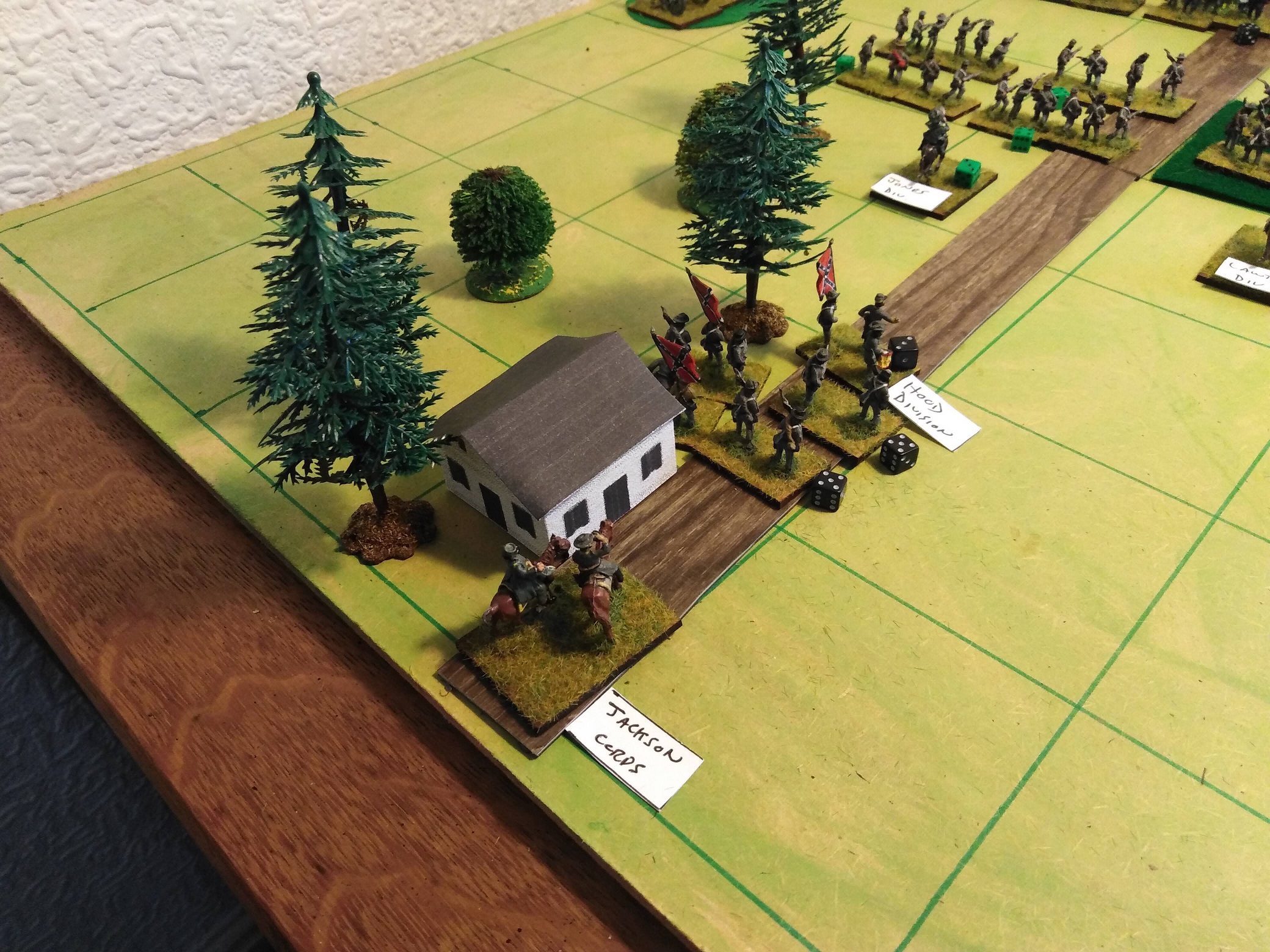
Dunker church with Hood in reserve
General Jackson by Dunker Church with Hood’s reserves close by.   The 6mm scale church is a free paper download from http://docshare01.docshare.tips/files/23969/239695307.pdf

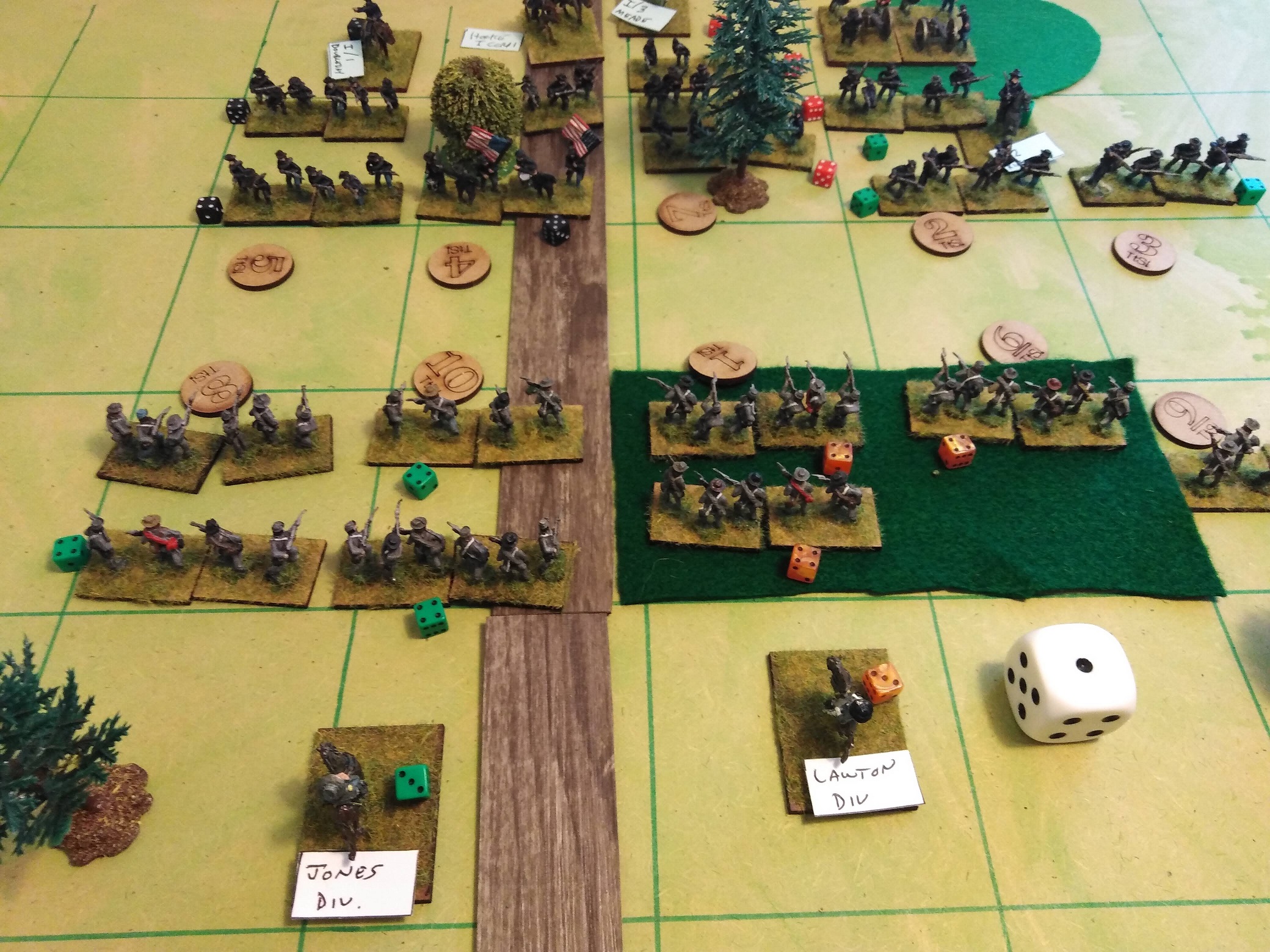
Initial deployment Antietam
This shows the activation counters.  The small dice are the current Strength Points and the colours of the dice differentiate the Divisions.

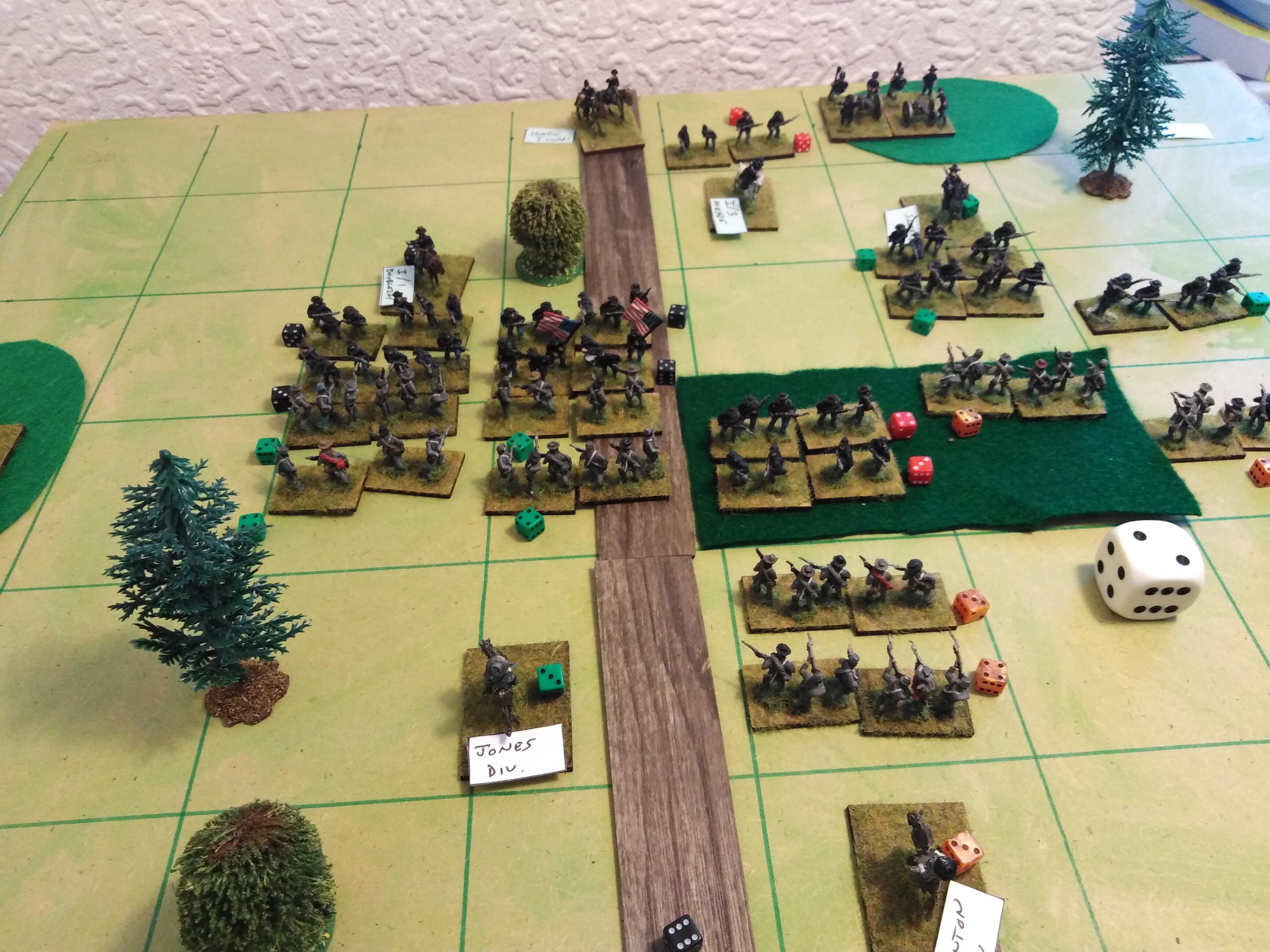
Cornfield battle
The fight over the cornfield with Confederates being driven back.

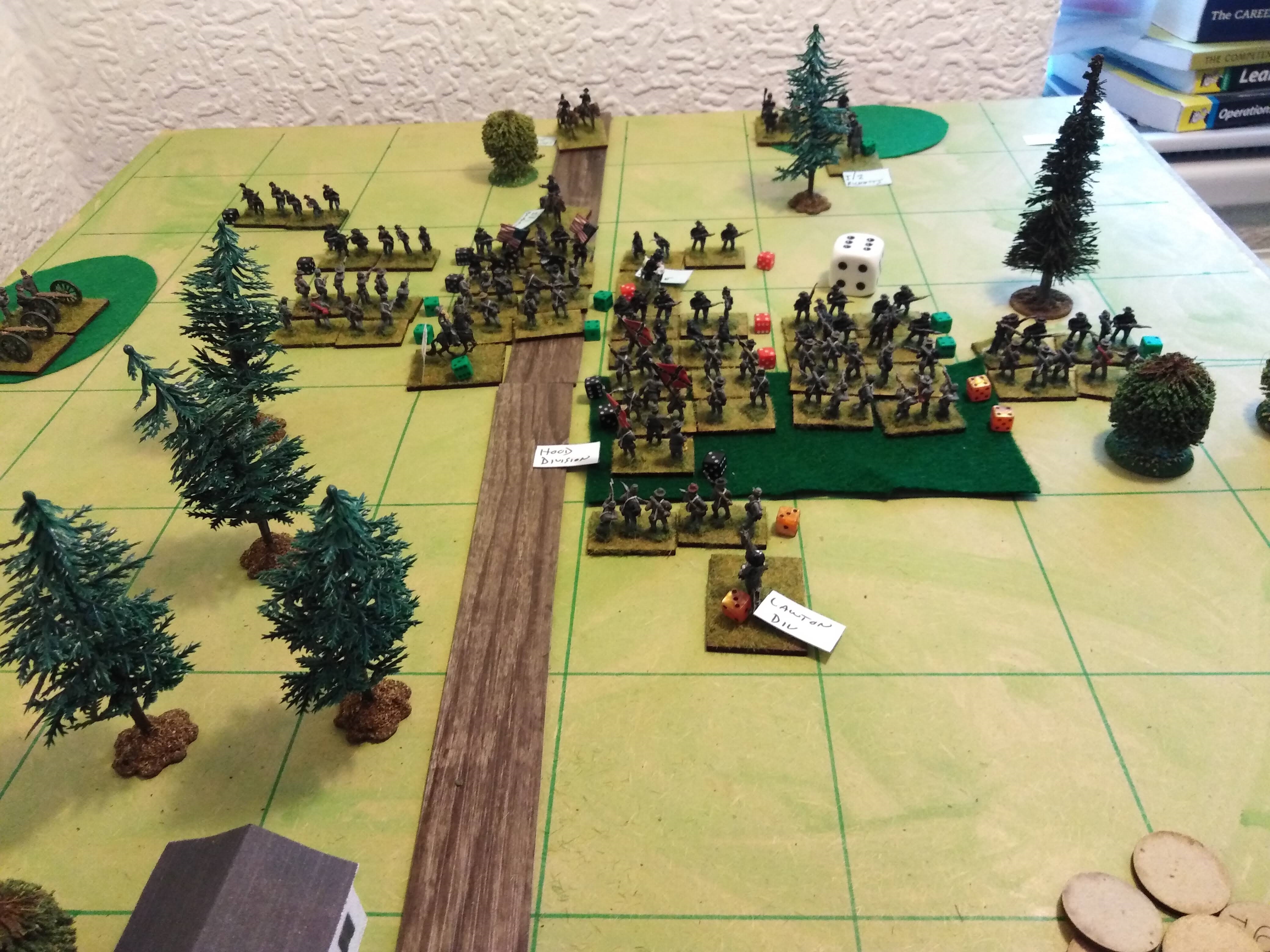
Hood's reserves move up.
Hood’s Texans move up to stabilise Jackson’s line.

A fun little experiment that I will try again.   The Portable system can cope well with being played around with and,  I believe, can also be good for historical scenarios.