-
-
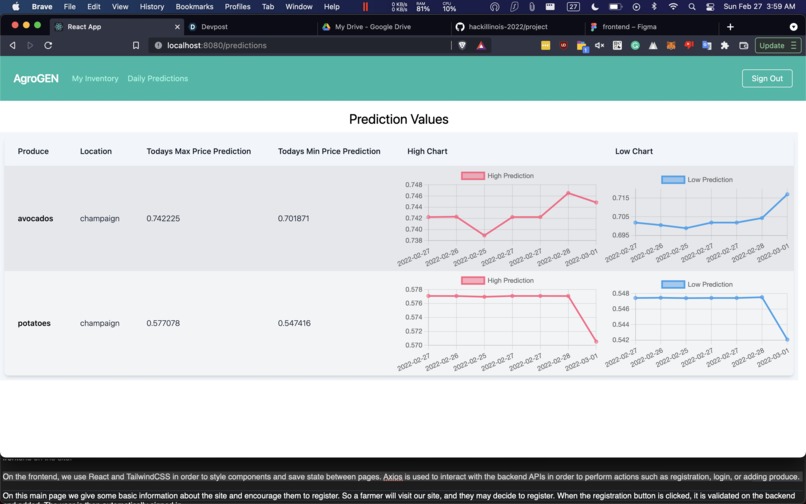
The main page of AgroGEN: A prediction metric for every one of the farmers crops, displayed for a week alongside the daily predictions.
-
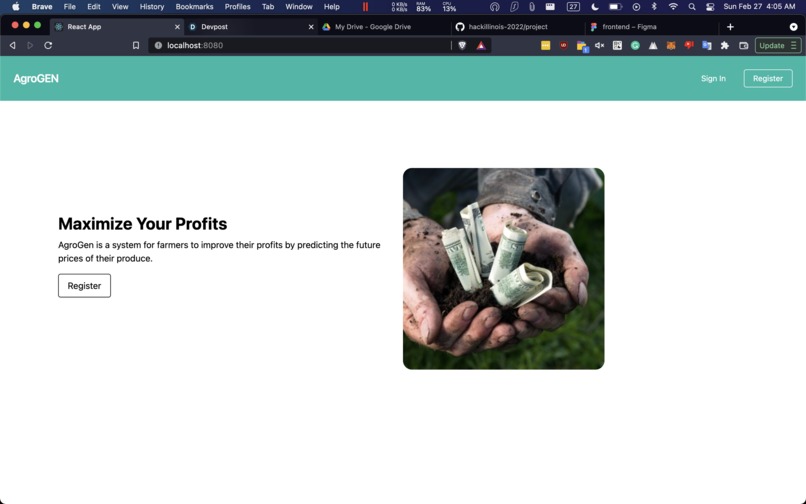
The welcome / hero page of AgroGEN.
-

The produce management system. It displays your current produce and allows you to add more.
-
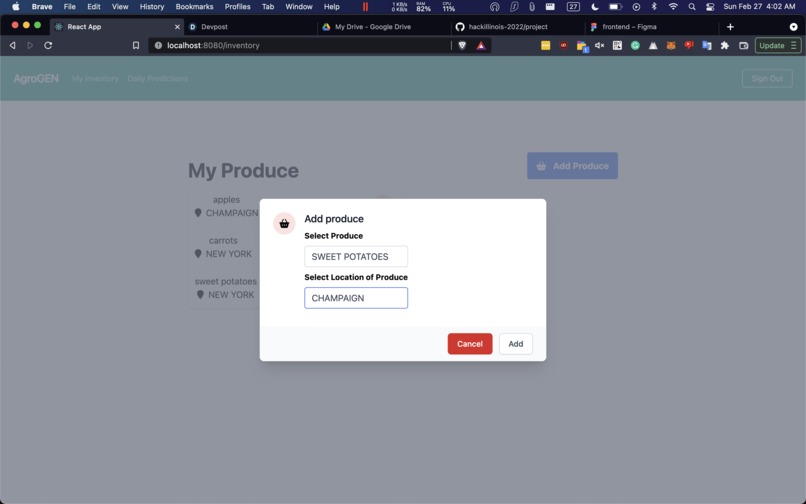
The produce management 'add produce' system.
-

The user login system. It enables farmers to keep track of indicated crops.
-
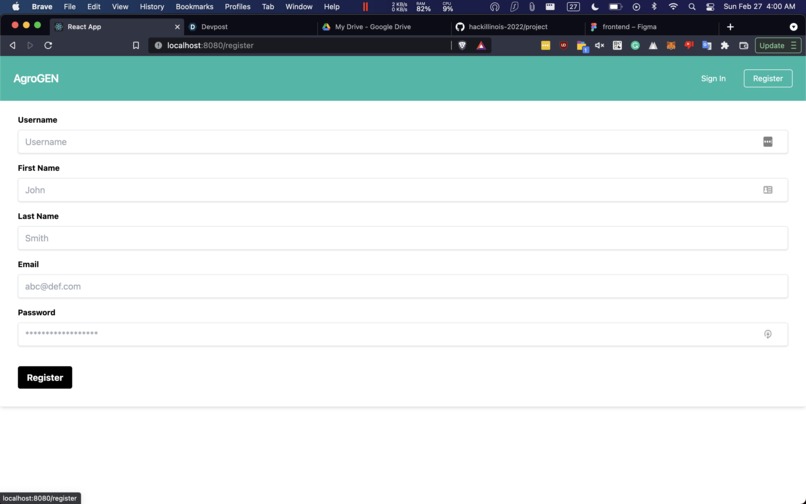
The registration system. Complete with feedback and registration is stored in the cloud on GCP.
-
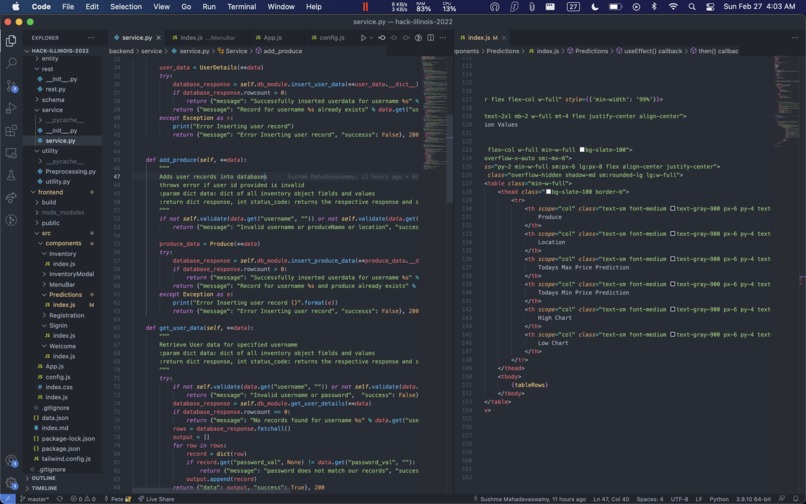
A snippet of the code written: Backend code on the left, with frontend on the right.
-
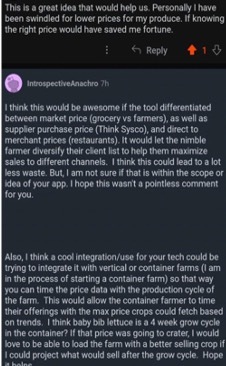
Initial customer reaction from Facebook and Reddit


Inspiration
In the United States, small farmers community are finding it harder to compete with large farmers because of fluctuating produce prices, unsustainable income, and extreme weather. These factors can lead to economic insecurity, higher debt for those small farmers in the farming community. It's become harder for farmers to sustain their livelihood and support their family. Therefore, the number of farms in the U.S have declined by 1,80,000 (9%) since 2007. We created AgroGEN to make the lives of farmers more sustainable, prevent farmers from entering into debt cycle due to loss of profits, incentivise the young generation farmers to take interest in the possibilities of digital agriculture.
What it does
AgroGEN is a website tool that predicts the future price of food based on factors such as location, inflation, weather, and historical prices. It allows a farmer to manage their produce, and view the price fluctuations for the produce for a week. This price trend will equip the farmer to make the right decision to sell his produce on a day that provides him the maximum profit.
Backend
AgroGEN uses Google Cloud, MySQL, flask, and python in the backend. We came up with a MySQL database structure running on GCP in order to store the farmer's login information as well as their produce items. To get our data, we scrape data from http://www.producepriceindex.com/ and use the weather API to get live weather data. We then train the model was using Tensorflow to predict the prices of select produce by location.
Frontend
On the frontend, we use React and TailwindCSS in order to style components and save states between pages. Axios is used to interact with the backend APIs in order to perform actions such as registration, login, or adding produce.
Process
First, our team gathered on discord and met up in person in order to discuss ideas. We then created a Figma - https://www.figma.com/file/xoyKsKd98EsgAnlROY8nWw/frontend - in order to draft the design of the site.
We split up the tasks we needed to perform by people's respective skill sets, working on the frontend, backend, or data collection / modeling.
We communicated with each other, integrated our work together and discussed on the revisions to the models, backend, and frontend design.
Challenges we ran into
One particular problem we ran into was finding good, clean, agriculture data that was granular enough to work for our needs, as well as structuring the input datasets in such a way that the weather and historical price data would line up.
Accomplishments that we're proud of
- Creating a cloud-backed solution that is deployable anywhere.
- Developing a model with 5% error rate.
Industry Impact
- This solution helps farmers make accurate estimates about when is the best time to sell their produce
- Given that location is also a factor that is considered, farmers can look at the best location to sell in order to maximize their profits
- AgTech like these will incentivize the younger generation to consider farming as a solid career choice and maybe end the trend of people quitting agriculture
Future Scope
Given the short time frame to develop this application we were able to implement only a part of our idea. This product will be developed in future to include details about the nearby locations to sell their produce, who are buying it at a good price. We also plan to develop an ML model that provides insights to the farmers about their farming plan based on their location, season and price rates. This would help the small farmers adopt a sustainable farming plan based on the latest geographic and economic trends.
Built With
- flask
- google-cloud
- my-sql
- python
- react
- tailwind-css


Log in or sign up for Devpost to join the conversation.