-
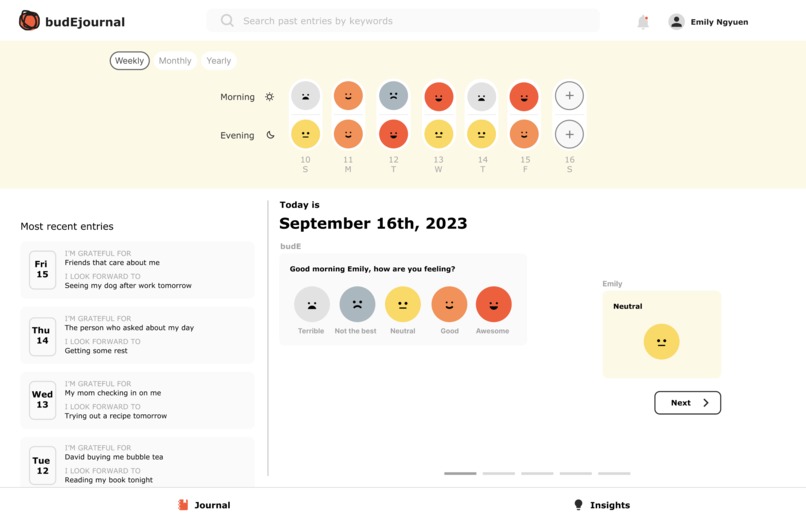
Home Page & Emotion Check Question
-
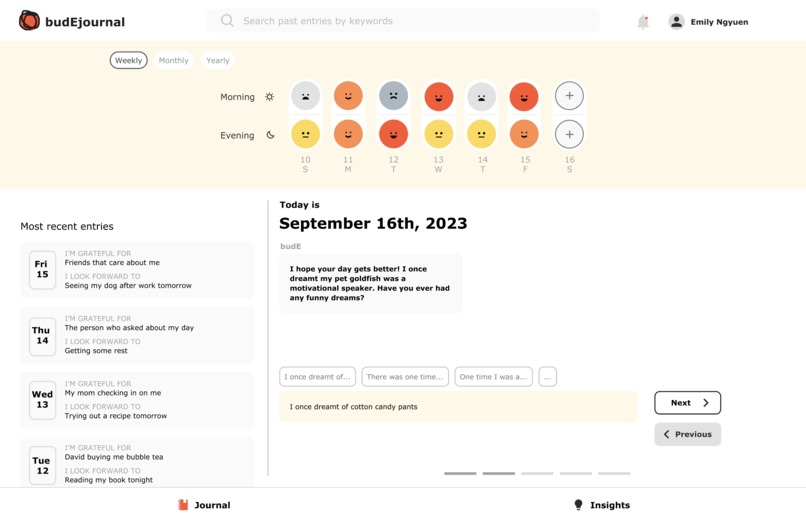
Writing Diary Thoughts
-
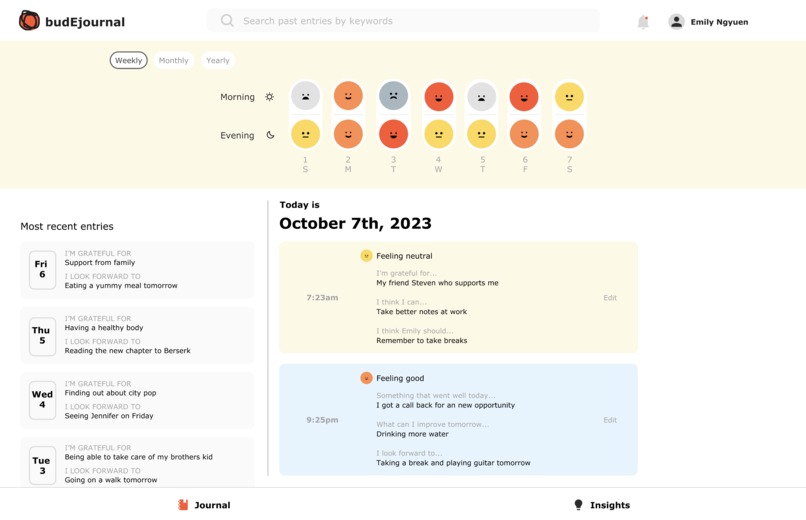
Two Records per Day
-
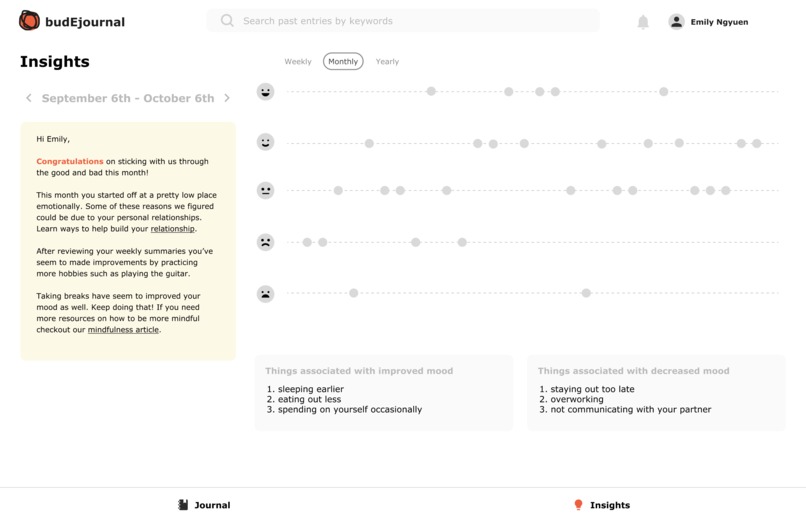
AI that takes data such as emotions and keywords from answers and helps users generate journal summaries across weeks, months, and years.


💡 Inspiration
We got inspiration from or back-end developer Minh. He mentioned that he was interested in the idea of an app that helped people record their positive progress and showcase their accomplishments there. This then led to our product/UX designer Jenny to think about what this app would target as a problem and what kind of solution would it offer. From our research, we came to the conclusion quantity over quality social media use resulted in people feeling less accomplished and more anxious. As a solution, we wanted to focus on an app that helps people stay focused on their own goals and accomplishments.
⚙ What it does
Our app is a journalling app that has the user enter 2 journal entries a day. One in the morning and one in the evening. During these journal entries, it would ask the user about their mood at the moment, generate am appropriate response based on their mood, and then ask questions that get the user to think about such as gratuity, their plans for the day, and what advice would they give themselves. Our questions follow many of the common journalling practices. The second journal entry then follows a similar format of mood and questions with a different set of questions to finish off the user's day. These help them reflect and look forward to the upcoming future. Our most powerful feature would be the AI that takes data such as emotions and keywords from answers and helps users generate journal summaries across weeks, months, and years. These summaries would then provide actionable steps the user could take to make self-improvements.
🔧 How we built it
Product & UX
- Online research, user interviews, looked at stakeholders, competitors, infinity mapping, and user flows.
- Doing the research allowed our group to have a unified understanding for the app.
👩💻 Frontend
- Used React.JS to design the website
- Used Figma for prototyping the website
🔚 Backend
- Flask, CockroachDB, and Cohere for ChatAI function.
💪 Challenges we ran into
The challenge we ran into was the time limit. For this project, we invested most of our time in understanding the pinpoint in a very sensitive topic such as mental health and psychology. We truly want to identify and solve a meaningful challenge; we had to sacrifice some portions of the project such as front-end code implementation. Some team members were also working with the developers for the first time and it was a good learning experience for everyone to see how different roles come together and how we could improve for next time.
🙌 Accomplishments that we're proud of
Jenny, our team designer, did tons of research on problem space such as competitive analysis, research on similar products, and user interviews. We produced a high-fidelity prototype and were able to show the feasibility of the technology we built for this project. (Jenny: I am also very proud of everyone else who had the patience to listen to my views as a designer and be open-minded about what a final solution may look like. I think I'm very proud that we were able to build a good team together although the experience was relatively short over the weekend. I had personally never met the other two team members and the way we were able to have a vision together is something I think we should be proud of.)
📚 What we learned
We learned preparing some plans ahead of time next time would make it easier for developers and designers to get started. However, the experience of starting from nothing and making a full project over 2 and a half days was great for learning. We learned a lot about how we think and approach work not only as developers and designer, but as team members.
💭 What's next for budEjournal
Next, we would like to test out budEjournal on some real users and make adjustments based on our findings. We would also like to spend more time to build out the front-end.


Log in or sign up for Devpost to join the conversation.