-
-

Digital Pantheon Logo
-
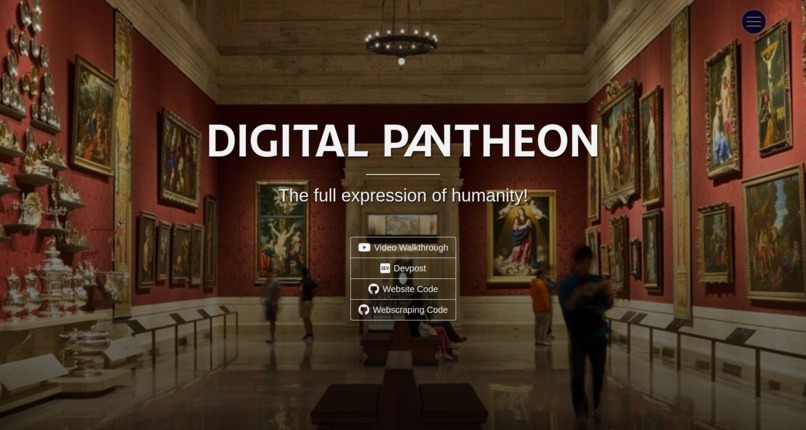
Website Landing Page


Inspiration
Most people will never get to visit all the amazing museums around the world. Even in the UK not everyone is able to go to the Natural History Museum. We found that some museums have started creating 3d models but they are not easily collated and the viewing experience is quite sterile. We decided to create a better environment in which to virtually exhibit important artefacts.
What it does
We have a Unity project that exhibits museum artefacts on plinths. The Unity project follows the movement of the user and automatically generates a longer corridor with more artefacts, creating our 'infinite museum'. We also have a website which advertises our product, including links to the code bases, and a video demoing the user experience.
How we built it
The 3d models are downloaded by python scripts that scrape the webpages that the models are hosted on. The python scripts use a combination of Beautiful Soup and Selenium to search through the HTML code and interact with various elements of the websites in order to navigate to the download button. The models are then uploaded to Google Cloud where they are stored publicly. When the Unity project is build, it downloads the files from the Google Cloud, generates the museum corridors, the capsule that the user can control, and generates the 3d models such that they are gently hovering and spinning above the plinths.
Challenges we ran into
- Downloaded file formats and loading 3d models
- Navigating webpages requiring a login
- Finding unique keys in HTML tags that Selenium could use to identify elements
Accomplishments that we're proud of
- Piecing together the various parts
- Trying a 3d project, which was new to us all
What we learned
- How to interact with a webpage using Selenium
- Generating and interacting with 3d objects in Unity
- How to use GitHub Pages with a custom domain and remote theme
What's next for Digital Pantheon
To improve the user experience further, the museum could be integrated into VR or AR, so that the user can have a more realistic experience of exploring a museum. To improve the generation of the 3d models, a consistent file type should be used, and it would be beneficial to investigate ways of accessing the models directly from google cloud as downloading them slows the build considerably. To further improve the similarities to a physical museum, the associated metadata should also be downloaded, and anything like a title or description of an artefact should be displayed with it. With a greater number of museums and artefacts accessed, the artefacts could also be sorted in some logical way, for example, by museum, or by historical period or artefact type.


Log in or sign up for Devpost to join the conversation.