-
-
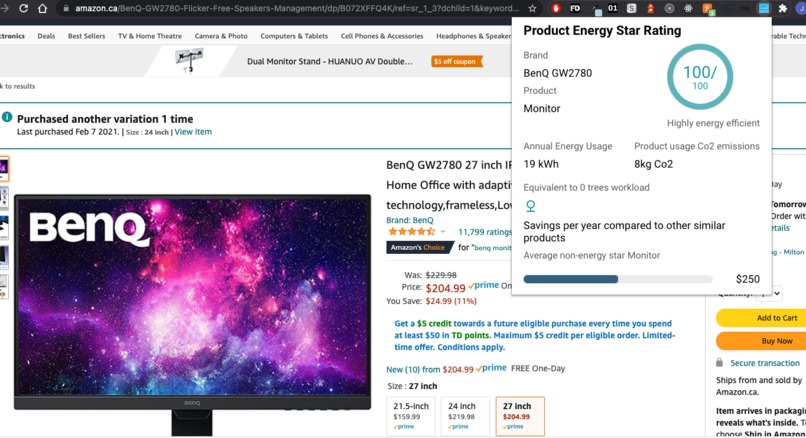
Working chrome extension
-
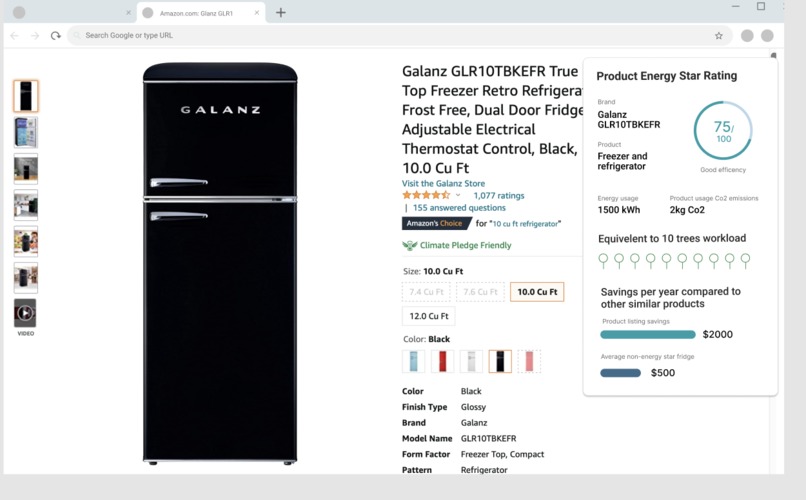
Design variation 01
-
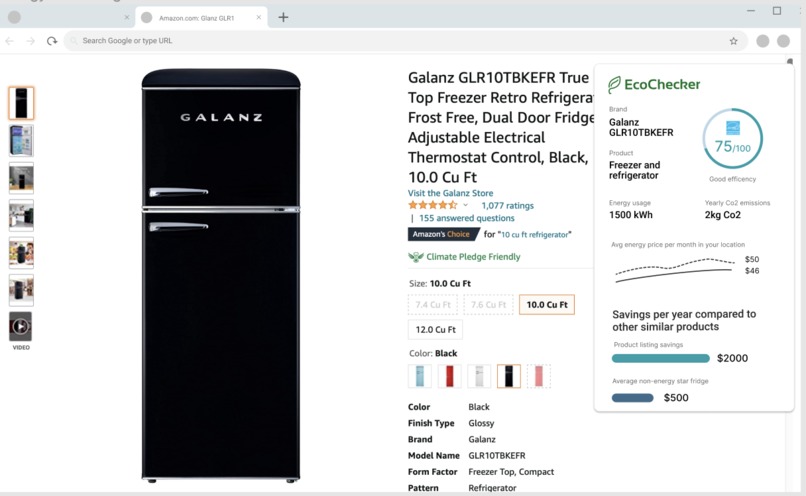
Design variation 02


Inspiration
For our EcoHack, we pondered on how to conveniently provide relevant and thoughtful environmental impact information for the products we browse online. Today’s transactions of goods and services are often completed through e-commerce platforms. Platforms like amazon were designed to fulfill our needs for speed and convenience. Since environmental awareness wasn’t designed into the UI, We often overlook the environmental impacts that are the byproduct of our online shopping sprees.
What it does
EcoChecker is a chrome extension that compares a shopper's search result from Amazon with energy saving information from Energy Star API, and informs the user if the product is Energy Star compliant, as well as its degree of energy efficiency. Currently, our minimum viable product only works for computer monitors, but can be easily expanded for other electronic products.
How we built it
EcoChecker was built using React, and interacts with the Energy Star API using a request call. The product data from Amazon was scrapped from their HTML page, using a specific ID, found across all products. Energy data was gathered from research across the web, and data returned from the Energy Star API call. Data visualization of energy efficiency was achieved using D3.js integrated into React.
Challenges we ran into
Accessing data in the Chrome DOM from our Chrome extension DOM was a challenge, and took some research and trial and erroring. Integrating D3.js with React for data visualization in the donut graph took some research and trial and erroring. It was our first time working with Chrome extensions, and D3, this hackathon.
Accomplishments that we're proud of
We are proud that we moved our project from idea conception, to design, to completed code, all over one weekend. And we conquered any technical obstacles that occurred over the course of the hackathon.
What we learned
We learned a lot more about energy conservation, and an appliance's equivalent to power consumed, carbon dioxide produced, and trees used. We also learned a lot about designing, and coding for chrome extensions, and the associated limitations and workarounds.
What's next for EcoChecker
For future iterations of EcoChecker we’re planning to implement expansions to more e-commerce platforms by streamlining our framework to be able to check parameters in a variety of websites.
We also plan to introduce more product categories such as microwaves, stoves, and more by expanding use of the energy star API. We can easily scale up from our proof of concept iteration to cover a wider variety of products for a user ready experience.
Additionally, we plan to expand our collection of environmental certification APIs to provide a higher degree of confidence to our users .


Log in or sign up for Devpost to join the conversation.