-
-
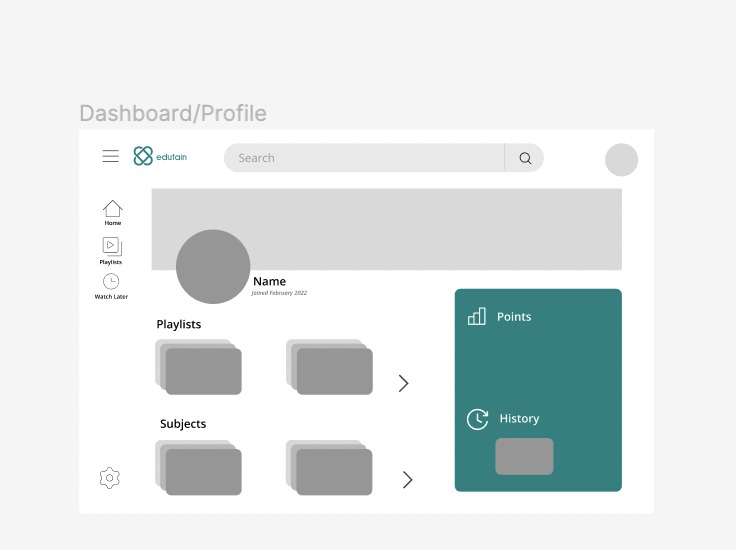
initial prototype dashboard
-
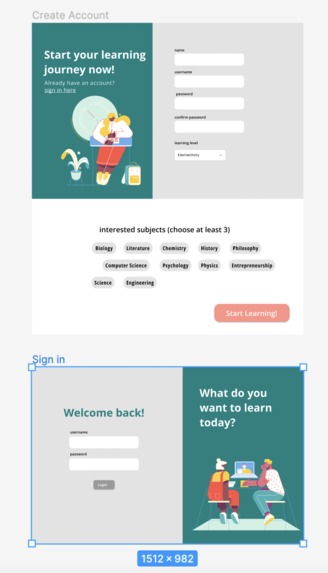
initial prototype account creation
-
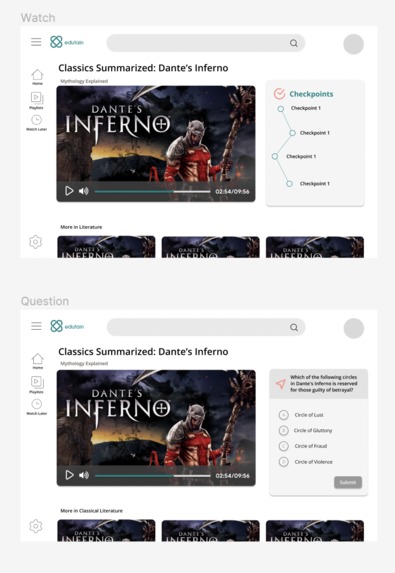
initial prototype video watching
-
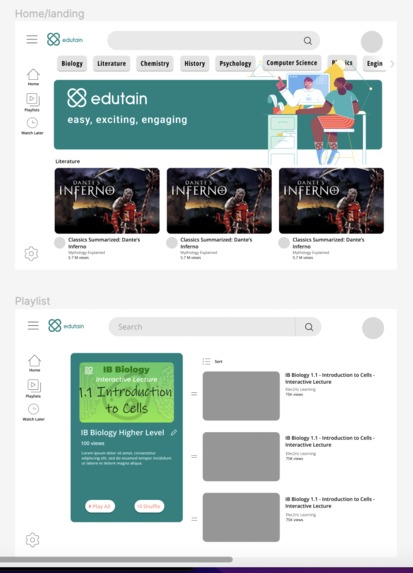
initial prototype homepage & playlist


Inspiration
Finding interesting and genuinely educational content on Youtube has become increasingly difficult in recent years. While Youtube has ample content targeted towards learning and skill acquisition, its algorithm steers users away from intellectual long-form content because short-form content increases user engagement and ad revenue. Personally, many of our members have felt frustrated with the platform’s persistent recommendations of addictive and unproductive videos. Additionally, we believe the divide between education and entertainment is unreasonably strong. The formalized learning environments that we grow up in have created an untrue idea that education and entertainment are mutually exclusive.
In line with our educational goals, as students we also felt that educational content, such as lecture videos, was too passive. Gen Z students have an average attention span of eight seconds and with our current technology, students often space out and disengage while passively consuming educational content.
What it does
Edutain is a video learning platform that efficiently sorts through Youtube’s overwhelming attention-grabbing content to generate recommendations based on the user’s subject interest. An algorithm generates checkpoints based on the video’s transcript and asks students multiple choice questions at these key moments to ensure involved learning. We transform learning so that students are no longer merely passively consuming content, but instead actively grapple with the concepts introduced. Through this model, Edutain extrinsically motivates students to change amotivation within the student population into intrinsic motivation.
How we built it
Our team used Node.js, React.js, and Next.js to develop Edutain as an efficient and scalable web application. Using the Youtube API, we dynamically queried for educational content and extracted the audio data with the corresponding timestamps with AssemblyAI. Translating this speech to text, we ran Gemini on the transcript and dynamically generated multiple choice questions based on the video content and embedded these questions into the video.
Challenges we ran into
Working with the different LLMs and agents was a challenge, since it was the first time any of us had used them and we had to explore lots of different options and APIs.
Accomplishments that we're proud of
Since this was the first (in-person) hackathon for all of us, we were really proud of all the learning that happened. We used novel machine learning technologies to assist in dealing with a variety of data formats and also really developed our problem-solving skills when we came up with bugs. We also went through several prototyping phases with non-coded versions and leveraged the skill set of everyone on the team.
What we learned
Our team learned how to use a variety of new APIs and machine learning tools, including Google’s Youtube API, Gemini, and other LLMs such as AssemblyAI. We also learned how to integrate frontend and backend for web development.
What's next for Edutain
We hope to target specific age groups next to further reinforce the concept of lifelong learning. Specifically, we are looking to create specific interfaces for kids under the age of six and seniors over 65. We want to add more elements of gamification for the kids version, so that when parents want to occupy their kids they can give them Edutain instead of Youtube and games. For seniors, we hope to add an AI chatbot to individualize their experience and reduce their technological barriers to learning. Ultimately, Edutain aims to bridge the gap between education and entertainment, make learning casual, and transform the way social media influences intellectual development.


Log in or sign up for Devpost to join the conversation.