-
-
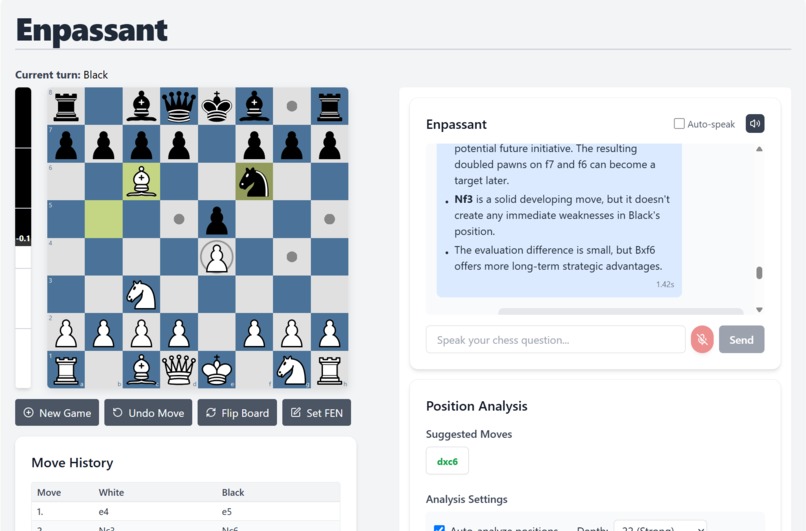
Demo of the Website
-
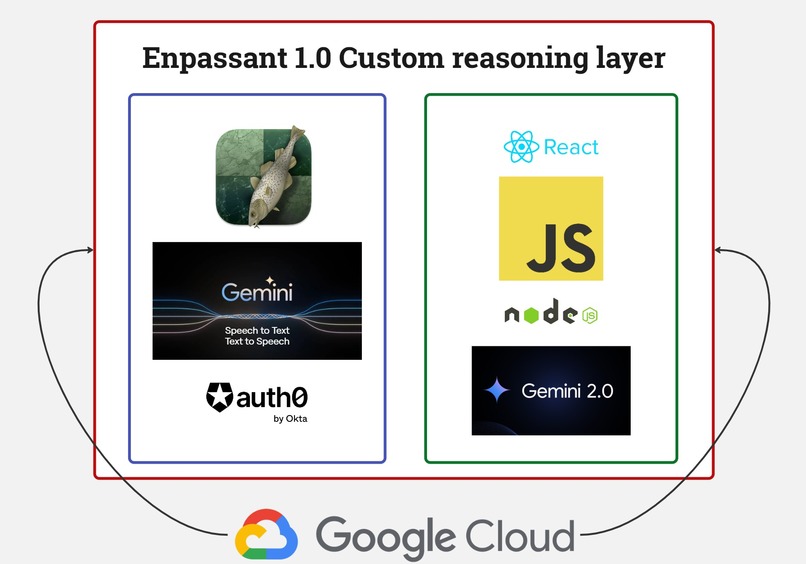
Tech Stack
-
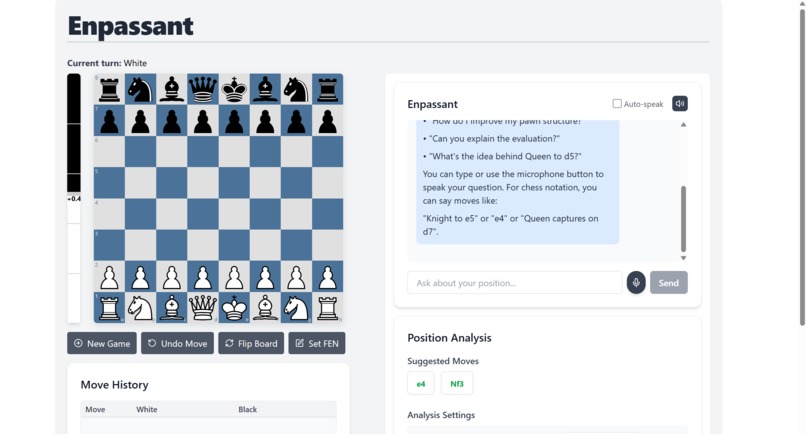
Demo


Inspiration
40% of people stop playing chess after reaching 1400 ELO. Our team members faced similar experiences - we were once good at chess but got demotivated because we couldn't improve our performance as easily as when we were beginners. This inspired us to create Enpassant, where players can access Stockfish's moves with Custom reasoning and understanding.
What it does
It coaches users on chess thinking by explaining the thought process behind moves. Enpassant takes natural language or text input and analyzes whether the user's thinking is correct, providing validation through suggested moves and ELO improvement metrics. We built our own reasoning model using input from a chess master friend, chess literature, and the Stockfish API. This approach ensures that LLMs, which typically struggle with chess reasoning, can focus on comprehending and communicating the analysis rather than performing the reasoning themselves.
How we built it
We used Google Gemini 2.0 Pro and Stockfish API, extracting the current move and future three moves from the API. We fed Gemini with these moves, the user's input (via voice or text), the user's move, and the board state. For the frontend, we used React and JavaScript, while the backend was built on Google Cloud.
Challenges we ran into
Integrating all of the API calls, getting multimodal input from the user, and building our own custom Enpassant 1.0 reasoning layer was an immensely challenging task. We used several mentors' help and fixed various issues including the voice input synchronization issue, the chatbot UI issue, and several other problems along the way.
Accomplishments that we're proud of
The idea is immensely valuable for us, the TAMU community, and everyone else. This commoditizes information for every single person, allowing everyone to learn 10x faster and achieve higher heights.
What we learned
We learned a lot about Machine Learning and how to integrate multiple AI LLM models into a project. We also learned a lot about chess as well.
What's next for Enpassant
Next for Enpassant is optimizing to reduce server costs, improving the entire UI/UX for users, making the codebase robust with better error handling and edge case management, and monetizing through advertisements and deployment.




Log in or sign up for Devpost to join the conversation.