-
-

Company Logo
-
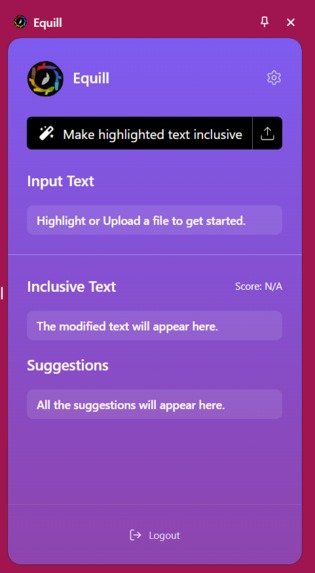
Landing page
-
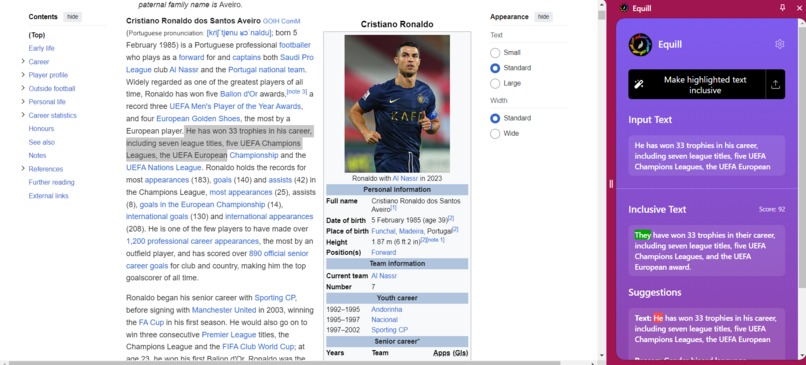
Real-time application
-
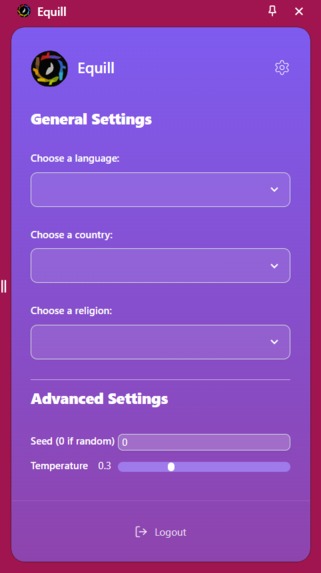
Settings feature


Inspiration:
Gen z is creating a cultural revolution where diversity and inclusivity is becoming a more prominent focus; in contrast to this shift in culture, inclusive communication is still a grey area ignored by businesses, perpetuating a non inclusive workplace that is costing US companies over $1 Trillion (https://chief.com/articles/non-inclusive-workplaces-cost-us-companies-1-trillion-heres-how-to-change-that). According to the American Psychology association, Generation Z is on track to become the most diverse generation in history. Nearly half (48%) identify as people of colour and over one in five (20.8%) identify as LGBTQ+. Furthermore, according to witty works 79% also believe that the language we use has an impact on workplace inclusion. A survey conducted by Lingoda stated that, In Germany and France only 44% and 49%, respectively said that they are familiar with gender-inclusive language. Inclusive language is becoming more prominent for workplaces as more workers and clients are susceptible to harmful non inclusive language, and isnpired with this growing need for an inclusive environment we created,
What It does
Equill, a chrome extension that can instantly recognize text for sources of non-inclusive or discriminatory language and replace it with more welcoming vocabulary. Aiming to subconsciously implement the idea of inclusive language, Equill can allow companies to mould an environment where everyone is accepted.
Technology:
To incorporate the project, we utilized the Cohere language model, and we implemented this in the format of a Google Extension. The state of the art LSTM, machine learning model that is popular for Natural Language Processing, from Cohere was used to process the input text and made it more inclusive through prompt engineering. Since we were on a time-crunch we decided to use a well-known pre-trained model, rather than training an LSTM from scratch. Tailwind CSS was used to style the chrome extension, so it is appealing for the user.
Challenges:
- Prompt Engineering → Had to be very specific to get wanted results
- Had to meticulous work to ensure that code could be used for generalized inputs
- Had to create different code and prompts for every separate function i.e.International communication
- Inclusive and culturally appropriate language in different nations such as Saudi Arabia and Iran
- Communicating with people more religiously devoted
- Ensuring that text was religiously appropriate and culturally appropriate
- Had to adapt working with technology the team has not worked with before, in this case Google Extensions
- Technical challenge → could not implement real-time editing due to the need to constantly query textboxes, and check for mutation which doesn't work depending on what the application is
Accomplishments:
- Successfully built a working chrome extension that can be used.
- Completely transformed the UI/UX design that was originally built from chrome manifest V3 into an extension with a high level of functionality and visual appeal
- Created pathways for future implementation and future development
What We Learned:
Working with Chrome Extensions with Manifest V3, prompt engineering and making use with Cohere.
Next Steps:
- Continuing to improve AI model accuracy with prompt adjustments and fine-tuning
- Real time → Further implementation
- More customizable
- Ability to give multiple different replacements and the user can choose what they prefer
- Make UI available outside of the side panel → highlighting text and allow the user to hover over the text, choosing what to replace
Built With
- bun
- chrome
- chrome-extension-api
- cohere
- css
- javascript
- lstm
- tailwind


Log in or sign up for Devpost to join the conversation.