-
-
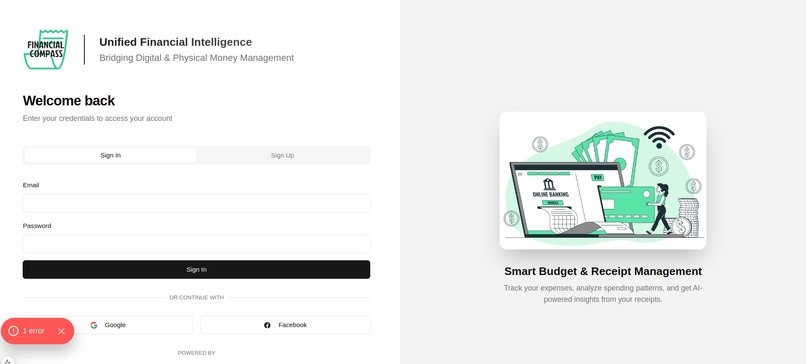
Login page UI
-
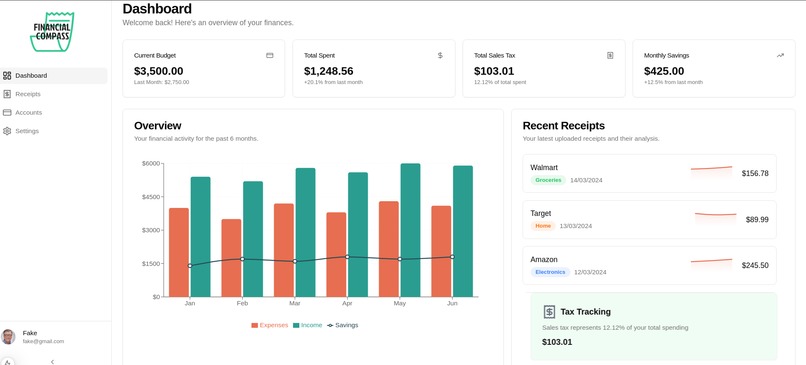
Dashboard insights
-
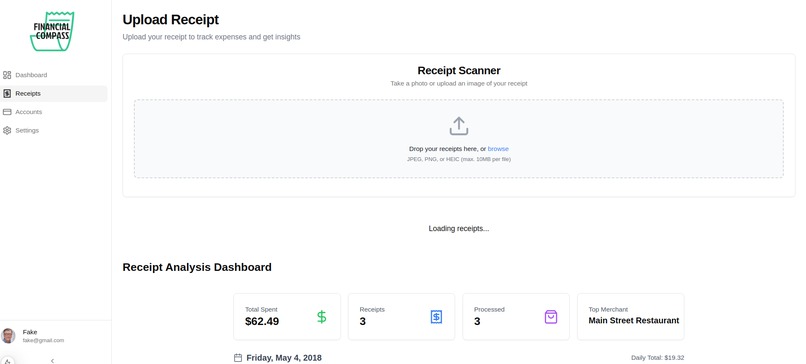
Receipt upload page
-
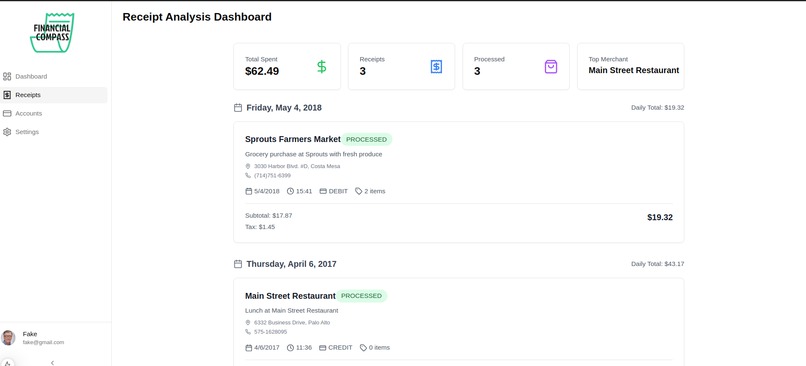
Receipt information from upload
-
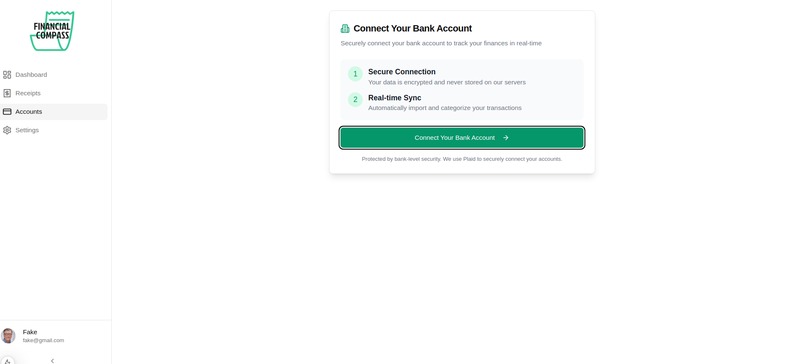
Account connection page using Plaid


Inspiration
Our team was inspired to create Financial Compass after recognizing how many people struggle to manage their finances in a simple, organized way. Personal finance can often feel overwhelming, and many individuals find it difficult to track their spending, savings, and financial goals. We wanted to build a tool that would make managing money effortless, helping users take control of their finances and gain peace of mind. Through this project, we are combining our passion for technology with real-world solutions, integrating AI alongside tools like databases, APIs, and user interfaces. Ultimately, our goal is to create something that not only reduces financial stress but also empowers users to make smarter, data-driven decisions for their financial future.
What it does
Financial Compass is an all-in-one personal finance tracker designed to help users effortlessly manage and track their finances. Linking multiple accounts provides a real-time overview of balances, categorizes spending, and allows users to set and track budgets across different categories. With the help of AI, it analyzes spending patterns, predicts future expenses, and offers personalized recommendations to help users make smarter financial decisions. Ultimately, Financial Compass aims to reduce financial stress, provide peace of mind, and empower users to take control of their financial journey.
How we built it
We built Financial Compass using a Next.js front-end and a Django back-end to provide a seamless user experience. For receipt photo analysis, we integrated Gemini and employed prompt engineering techniques to parse the data from receipts, extracting key information and converting it into a structured JSON format. This allows users to upload photos of receipts, and the system automatically identifies and categorizes the relevant details, such as store name, items, and total cost. For file storage, we used Pinata, which enables secure and decentralized storage of user files, ensuring that all uploaded receipts and documents are safely stored and easily accessible. To connect with users' bank accounts and enable real-time tracking of balances and transactions, we integrated Plaid, a powerful financial technology API. This combination of tools and technologies allows Financial Compass to provide users with an intuitive, AI-powered platform for managing their finances, all while ensuring security, accuracy, and efficiency.
Challenges we ran into
Some of the challenges we ran into while building Financial Compass included getting Gemini to consistently provide the desired responses during receipt photo analysis. Despite using prompt engineering, we encountered issues with accurately parsing all types of receipt data, especially when receipts were unclear or had unusual formats. Ensuring the AI was able to extract and categorize the correct information in a structured way required fine-tuning and multiple iterations. Another significant challenge was integrating the back-end (Django) with the front-end (Next.js). Synchronizing data between the two systems, managing user authentication, and ensuring smooth communication between the front-end and back-end proved to be complex at times. We had to troubleshoot issues related to API calls, session management, and ensuring real-time data flow for features like balance tracking and receipt processing. Despite these challenges, we were able to overcome them with persistence, iterative testing, and continuous improvement of our systems.
Accomplishments that we're proud of
Some of the challenges we ran into while building Financial Compass included getting Gemini to consistently provide the desired responses during receipt photo analysis. Despite using prompt engineering, we encountered issues with accurately parsing all types of receipt data, especially when receipts were unclear or had unusual formats. Ensuring the AI was able to extract and categorize the correct information in a structured way required fine-tuning and multiple iterations. Another significant challenge was integrating the back-end (Django) with the front-end (Next.js). Synchronizing data between the two systems, managing user authentication, and ensuring smooth communication between the front-end and back-end proved to be complex at times. We had to troubleshoot issues related to API calls, session management, and ensuring real-time data flow for features like balance tracking and receipt processing. Despite these challenges, we were able to overcome them with persistence, iterative testing, and continuous improvement of our systems.
What we learned
We’re proud of several accomplishments in the development of Financial Compass. First, the seamless integration of the Next.js front-end with the Django back-end was a significant achievement, ensuring smooth communication between the two platforms and providing a user-friendly interface. We were able to successfully implement AI-driven receipt photo analysis using Gemini, overcoming initial challenges in parsing data and fine-tuning the model to provide accurate and structured responses. Another accomplishment was integrating Plaid for secure and reliable bank account connections, allowing users to track transactions and balances in real time. We’re also proud of implementing robust file storage using Pinata, ensuring that all uploaded receipts are securely stored and easily accessible. Finally, the combination of these technologies resulted in a fully functional, AI-powered personal finance tracker that offers users an intuitive and comprehensive tool for managing their finances, something we are incredibly excited to have built.
What's next for Financial Compass.
Given more time we would like to Implement the following:
AI-Powered Spending Insights We plan to integrate Artificial Intelligence to leverage our receipt database, enabling deeper insights for users. This AI integration will provide:
Smart Shopping Recommendations: Help users identify where specific products can be purchased for less, based on historical receipt data.
Budget Planning & Alerts: Assist users in staying on budget by suggesting optimized spending plans and providing reminders for recurring expenses, especially when budgets are running low.
Holistic Financial Analysis By merging data from both receipts and linked financial accounts, we aim to offer users a comprehensive view of their spending. This combined analysis will provide users with better insights into their physical (in-store) and digital (online) purchases, helping them understand and manage their expenses more effectively.
Enhanced Receipt Page We will enhance the receipts page by integrating receipt images directly into the receipt information view. Additionally, the receipt information will be auto-populated using our backend's data extraction, streamlining the process and offering a more user-friendly experience.
Built With
- django
- gemeni
- nextjs
- pinata
- python
- react
- typescript


Log in or sign up for Devpost to join the conversation.