-
-
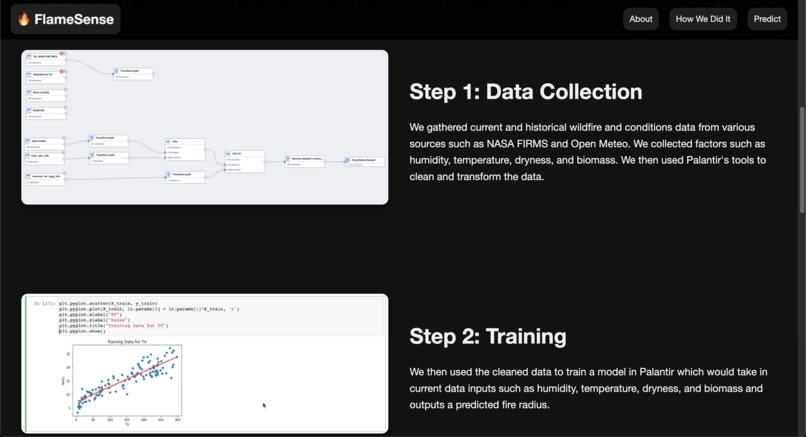
How we did it 1
-
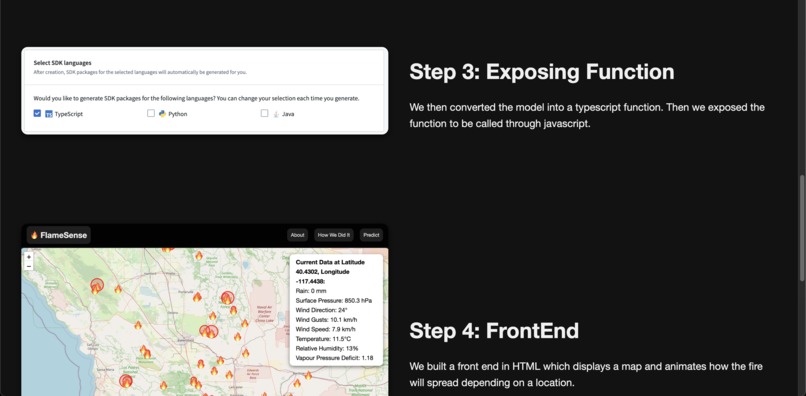
How we did it 2
-
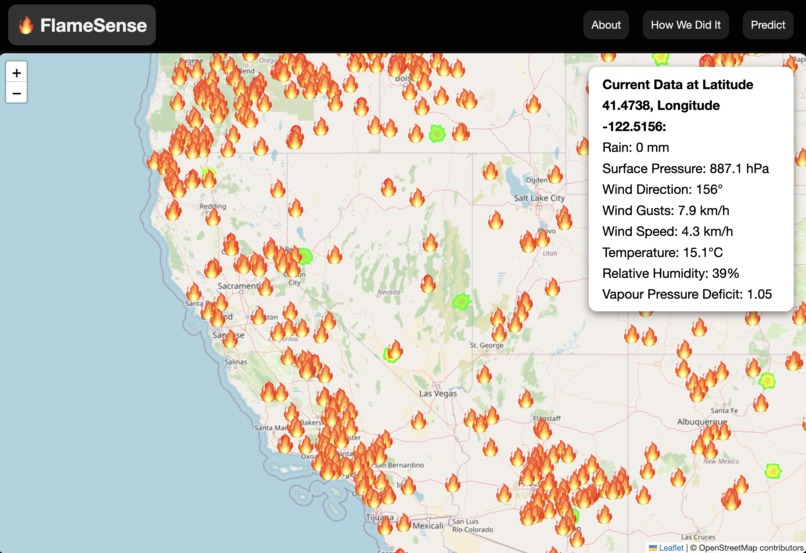
Current Wildfires
-
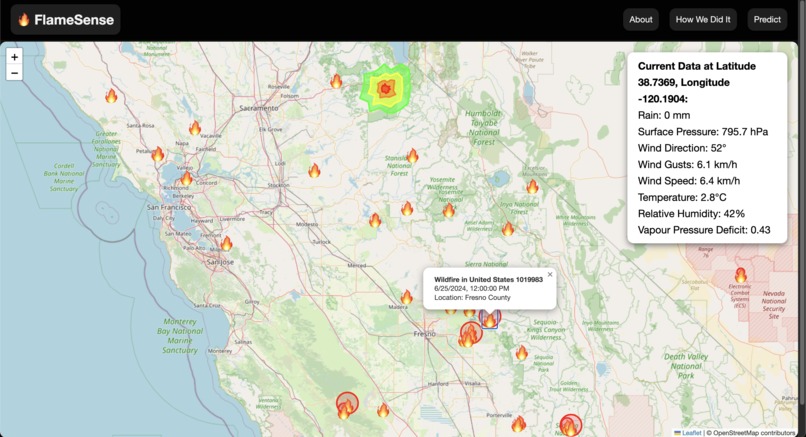
Current Fire Description + Fire Simulation
-
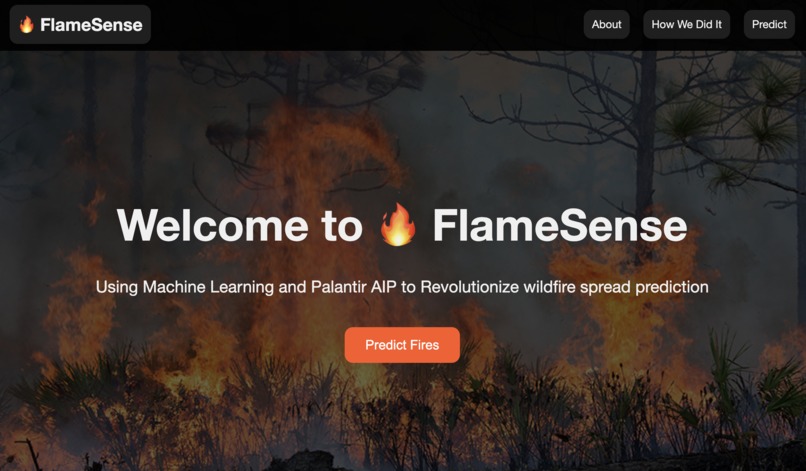
Landing
-
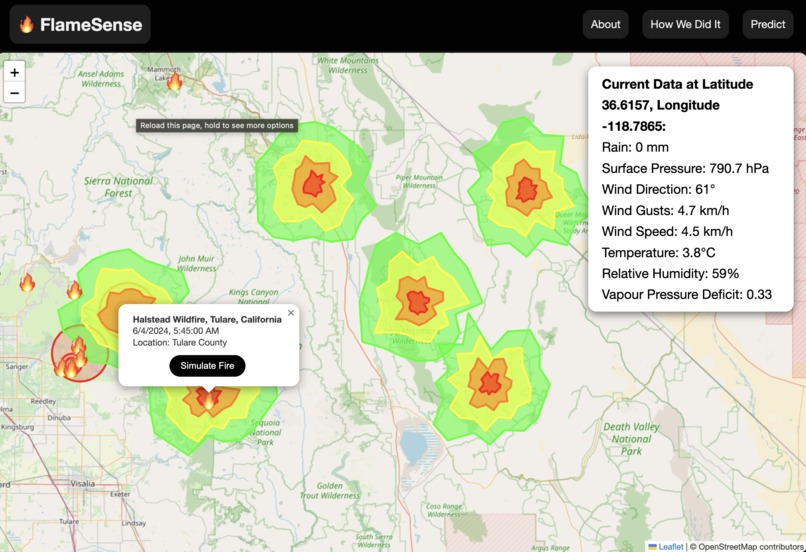
fire simulations


Inspiration
Many of our relatives and friends lived in LA and were impacted by the horrible Palisades wildfire. We wanted to create this tool to help first responders plan and allocate resources against wildfires as well as inform the general public about ongoing fires.
What it does
FlameSense allows users to simulate the spread of current wildfires as well as in chosen areas. It utilizes a sequential neural network trained on historical fire spread data, along with temperature, humidity, precipitation, wind speed/gusts, and water vapor levels. When the user clicks on a spot on the map or chooses to simulate a current wildfire, the data at that point is fed into the trained model, and a percentage growth is output. The fire spread is then rendered on the map as a heat map, and the path of the fire is visualized taking into account conditions like wind.
How we built it
Firstly, we gathered current and historical wildfire and condition data from various sources such as NASA FIRMS, Open Mateo, and the Canadian Fire Spread Dataset. We then used Palantir's tools to clean and transform the data. We then used the cleaned data to train a model in Palantir, which would take in current data inputs, such as humidity, temperature, dryness, and biomass, and output a predicted fire spread rate. We then built an API endpoint to take in the necessary parameters and plug it into the model. Finally, we built a front end in HTML that displays a map and animates how the fire will spread based on the location.
Challenges we ran into
Palantir was hard to learn as it was a complex platform with many aspects to learn. The hardest part was figuring out how to access the model and deploying it. The other hard part was training the model. Due to limited time, the model performed well, but wasn't as accurate as it could be.
Accomplishments that we're proud of
We loved talking with the Palantir mentors, as they were really helpful in assisting us with deploying our function. We are most proud of the fact that we made an accurate model that can help millions in the face of wildfires in an easy to navigate way.
What we learned
We learned how to use Palantir as well as how to filter through many data sources and effectively build a model that predicts fire spread. We learned how to connect things like data, the model, and the actual website together in a full-fledged visual application.
What's next for FlameSense
We plan to expand our model and train it with more data to make more accurate predictions as well as use more features of Palantir to enhance its functionality.
Built With
- html
- jupyter
- palantir
- python
- typescript


Log in or sign up for Devpost to join the conversation.