-
-
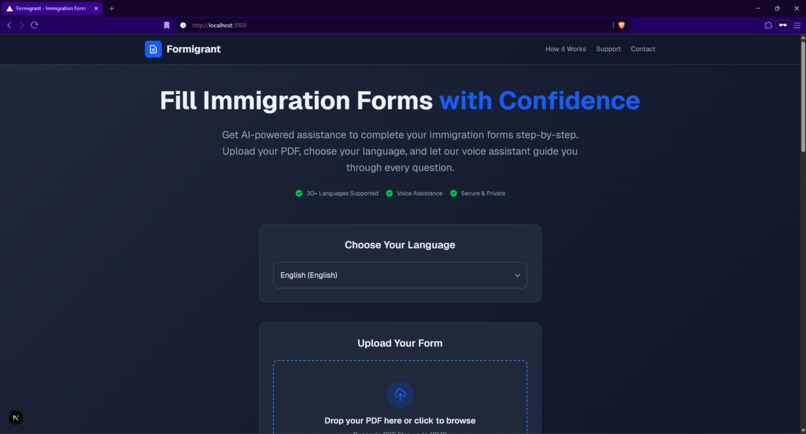
Home Page
-
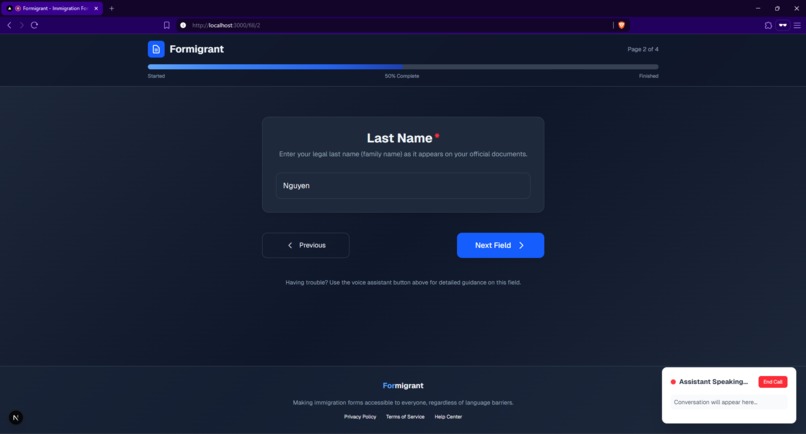
Form Filling Page
-
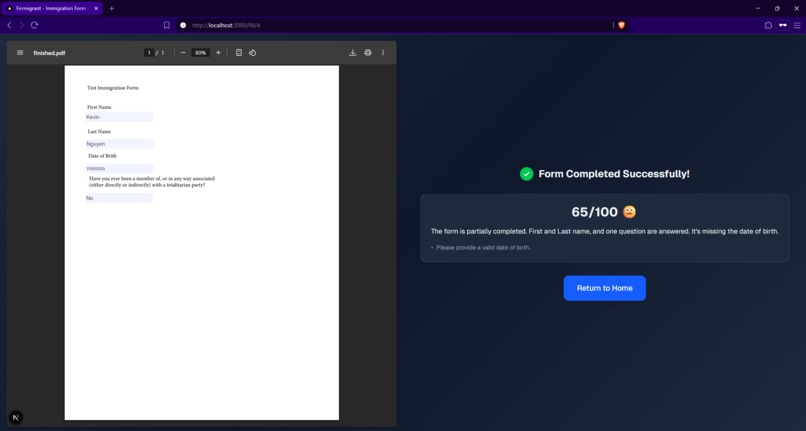
Form Review Page


💭 Inspiration
Growing up as children of immigrants, our parents constantly asked us to translate everything for them—from legal notices to hospital paperwork. While we were happy to help, we always felt the weight of adult responsibilities far too early. Not every family has English-fluent children, and even when they do, kids deserve to just be kids. That’s what inspired us to build a tool that lifts that burden. Formigrant is here to help families handle complex paperwork, so no child has to act as their family’s translator.
💡 What it does
Formigrant is an AI-powered, multilingual assistant that guides users through filling out immigration paperwork. Users upload a PDF and select their preferred language. The app breaks down each section of the form into clear, digestible prompts with plain-language explanations. A voice assistant—powered by VAPI—can answer user questions in real time, offering culturally aware and context-specific support. Once all sections are complete, Formigrant generates a summary of the user's inputs to ensure clarity and review before submission.
🧱 How we built it
👥 Sponsors: VAPI, Google Gemini 🖥️ Frontend: Next.js ⚙️ Backend: FastAPI
VAPI, provided with the context of your current form, serves as our supportive and insightful voice assistant. Gemini powers our initial form breakdown and provides an overview score after everything is filled out, allowing you to catch any last-minute errors.
🧗 Challenges we ran into
Parsing PDFs consistently across various document formats was a significant hurdle—many forms don't follow a standard structure. Handling multilingual voice interactions with varying accents and response quality also required fine-tuning VAPI's settings and context prompts. We also spent a lot of time refining how the assistant should respond in a helpful, non-overwhelming way, especially for first-time users who might not be tech-savvy.
🏆 Accomplishments that we're proud of
We’re proud of creating an experience that’s actually usable by the communities we care about. From building a smooth voice assistant to supporting multiple languages, we managed to turn a personal pain point into a real, functional tool. Seeing our demo work end-to-end—with voice support, real form data, and intuitive flow—was a proud moment for the whole team.
📚 What we learned
We learned a lot about accessibility and the importance of designing with empathy. Building for communities that are often overlooked meant reconsidering standard UX practices. We also gained valuable experience integrating voice interfaces and working with complex document structures. Most importantly, we deepened our understanding of how technology can meaningfully reduce barriers for vulnerable populations.
⏩ What's next for Formigrant
We're just getting started—immigration forms are only the beginning. In the near future, Formigrant will support a broader range of essential documents, including medical records, school enrollment forms, housing applications, and more. Our goal is to become a one-stop assistant for anyone facing language or literacy barriers when dealing with critical paperwork.
We're also implementing user authentication and secure login features. This will allow users to create accounts, save their progress, and pick up right where they left off—whether they're completing a form over multiple sessions or switching devices. These upcoming features are designed to make Formigrant even more accessible, reliable, and personalized for every user.
Built With
- fastapi
- gemini
- next.js
- vapi


Log in or sign up for Devpost to join the conversation.