-
-
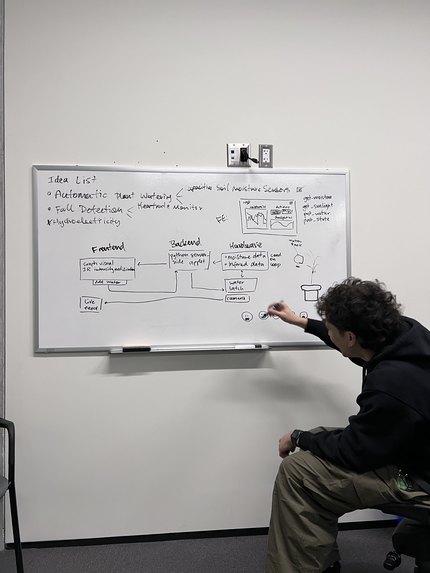
Brainstorming components
-
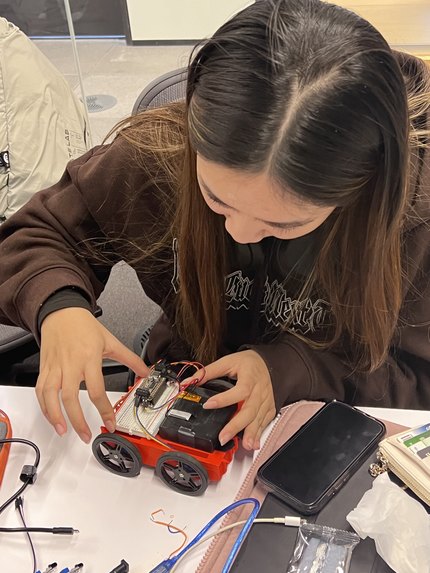
Putting together robot
-
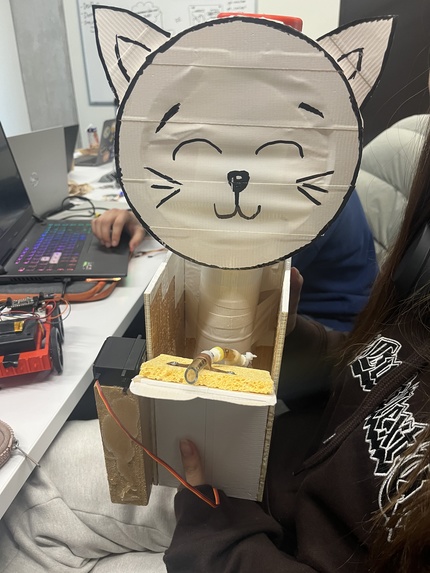
This is the robot!


Inspiration
Our inspiration for creating this device lies in the desire to assist individuals who love having houseplants but struggle to maintain them due to busy schedules. Our goal is to bridge the gap by combining engineering innovation with a passion for plant care. The cute, intelligent robot we've developed detects when plants need water, ensuring their health even in the busiest households. Real-time monitoring and website updates provide users with a comprehensive view of their plant's well-being, making plant care accessible and stress-free for all plant enthusiasts.
What it does
Our cute little robot detects when your plants are thirsty and waters them for you. You can view your plant's health stats on a website that updates the moisture levels of the plant in real time and ensures that your plant is not suffering from dehydration or lacking sunlight.
How we built it
There are many aspects of our design that make it functional, we will break down our explanation as follows:
Mechanical
The primary objective of this project was to develop a device capable of autonomously caring for a plant with minimal human effort. To achieve this, we sought mechanisms to precisely deliver water to targeted plants. Our mobility solution involved a 3D printed chassis equipped with wheels and a motor, enabling controlled movement. For the watering mechanism, we implemented an analog servo motor mounted to a plywood structure, that facilitated the controlled dispensing of a flowing stream of water at an optimal height. This responsive system tilts the watering apparatus based on our software, ensuring timely hydration when the plant requires it.
AI/Machine Learning
As a core innovation within our project, we've integrated a time-series regression model designed to revolutionize plant care. This sophisticated system not only forecasts precise water levels for various plant types, but also dynamically adapts and refines its predictions weekly. By taking regular moisture samples, the model tailors its recommendations, ensuring optimal hydration for each plant type. This approach guarantees precision and efficiency in maintaining plant health.
Hardware
Our smart plant care system uses advanced hardware, including ultrasonic sensors, soil moisture sensors, servo motors, and an array of microcontrollers. Soil moisture sensors in direct contact with the soil continually send moisture data to the frontend, displayed on our user-friendly website. A light sensor also provides real-time information about the plant's exposure to light. The robot's mobility is achieved through wheels and four sensors programmed to follow a specific path, guided by an ultrasonic sensor detecting plants in its vicinity.
Back-End
Our device revolves around a Flask server that collects data from our vast sensor array and packages it for streamlined viewing on the frontend. It is also responsible for handling requests made by the vehicle unit to check whether plants need to be watered. It will route the vehicle to a designated plant.
Front-End
The Reactjs front-end monitors the backend for varying plant data, and produces a visualization of it using the d3 library. It will also be able to control the device if premature watering is desired. It will also notify users of potentially harmful conditions for the plant.
Challenges we ran into
Our team faced numerous challenges during the development of the automated plant watering device. One difficulty that came up in achieving the precise stopping of the mobility device to ensure optimal watering for the plant. One difficulty that came up, when fulfilling the mechanical portion of the design, was to acquire the proper mechanism that allowed the water tube to tilt forwards and back. It was difficult to find and make a motor to rotate a heavy piece, especially with the water tube, where there is the potential risk of water dripping on the electrical hardware. Additionally, our AI model did not have enough data to train, so we had to generate our own data in order to train our model effectively.(Ai/backend explanations)
Accomplishments that we're proud of
- Built and trained an AI model in a very short amount of time.
- Integrated many components and aspects into one complete project.
- First hackathon experience for many of our team members. ## What we learned Achieved successful implementation of various project components, including capacitive soil moisture sensor, analog, and DC servo motors, and frontend with machine learning elements. We learned a lot about integration between the different subsystems we had, as well as how to adjust our project with the limited resources and time we had throughout this project. ## What's next for Happy Plant Happy Plant envisions several exciting next steps to enhance and refine our hackathon project. To begin with, our focus will be on training and rigorously testing the AI model over the next few months. This iterative process aims to optimize the model's accuracy and efficiency in watering plants. The implications of this advancement extend beyond our project, offering significant potential for widespread implementation in agriculture. In addition, we plan to incorporate LED growing lights into our system as a valuable enhancement. These lights will leverage light intensity data to supplement plant growth during periods of low sunlight or inadequate light conditions. This feature proves particularly beneficial for greenhouse plants that reside indoors and becomes crucial in sustaining plant health during the winter months when natural sunlight is limited. These thoughtful additions represent pivotal strides toward a more advanced and impactful Happy Plant system.


Log in or sign up for Devpost to join the conversation.