-
-
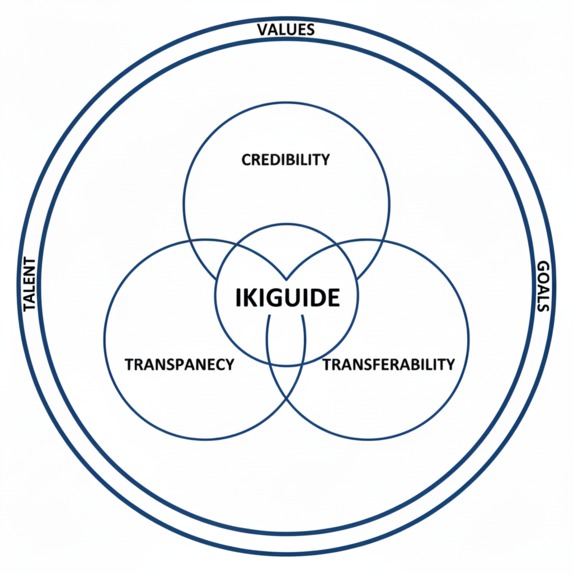
Opportunity matchmaking guide aligning both recruiters and candidates with credibility, transparency and transferability
-
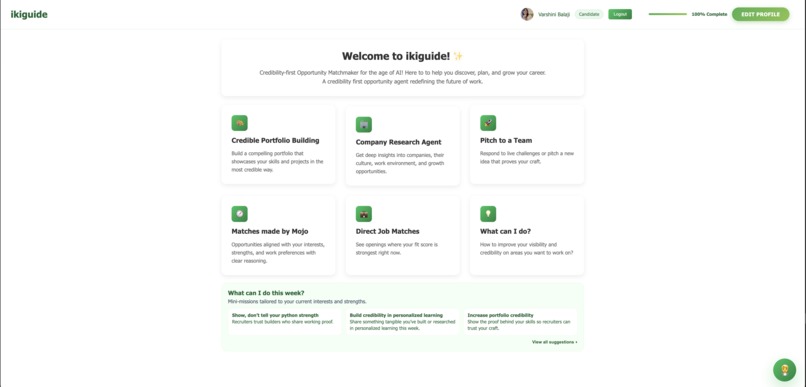
Candidate Page
-
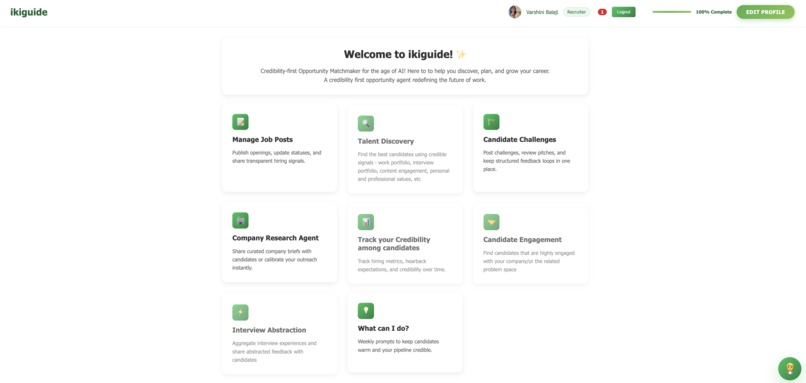
Recruiter Page


Inspiration
I’ve seen how hard it is for students and fresh grads to get their first job. You send out hundreds of applications, never hear back, and don’t know what went wrong. Recruiters are equally frustrated, flooded with résumés that don’t really show who can do the work.
That’s what inspired me to build Ikiguide, a platform that lets early-career talent prove their skills with credibility and engagement and a better incentive for recruiters to be transparent with their hiring decision, using FIC guarantee (Feedback/Interview/Compensation guarantee) which helps them get high quality signals from candidates both invested and skilled to work on their team/product. This mechanism design improves truthfulness guarantee of both parties while making hiring more efficient.
What it does
Ikiguide connects candidates and companies through a system called Challengers. Recruiters post short, scoped problems from their product or engineering backlog. Candidates can either take on those challenges or pitch their own problem ideas after researching the company. All submissions are anonymized so feedback and evaluations are based only on the quality of work. Candidates receive feedback, interview calls, or small bounties. Every outcome adds credibility to their portfolio.
How we built it
I built the platform with a FastAPI + MongoDB backend and a Vanilla HTML + CSS The Opportunity Agent learns about each user’s goals, values, and skills to personalize recommendations and match them to challenges. The Company Research Agent helps candidates understand an organization’s products, culture, and engineering challenges before they apply. Together, they make hiring more transparent, personal, and fair. Challengers system using FIC guarantee (Feedback/Interview/Compensation guarantee) from recruiters as explained above, creates a win-win for both parties involved.
Challenges we ran into
- Figuring out a way to Balance incentives for both candidates and recruiters - took a lot of thought.
- Ensuring fairness, and credibility, without relying on other social media engagement - which have stringent rules on scraping, for eg. Linkedin (spent a long time figuring out the use of Linkedin content to understand user persona better, but pivoted, as this approach won't scale, and had a lot of challenges)
- Handling long-context AI memory efficiently, currently integrating supermemory.ai to handle long context for LLMs.
Accomplishments that we're proud of
- Built a working end-to-end prototype with many moving components on both recruiter and candidate side.
- Created a clear mechanism that rewards truthfulness and engagement
- A simpler way to ensure credibility using FIC mechanism, without complex social media integrations.
What we learned
- Early-career hiring doesn’t fail because of lack of talent but lack of credible signals (from my user research)
- Feedback is the most powerful motivator for learning and improvement for candidates
- With AI memory and personalization, we can finally design fairer systems that understand people beyond their résumés
What's next for Ikiguide
- Next, we’ll onboard students through hackathons and career fairs and partner with early recruiters who commit to our Feedback–Interview–Compensation (FIC) guarantee. Already found a founder here, interested in this strategy of screening (Orcava founder)
- I plan to refine credibility scoring for both sides, expand the AI memory layer for deeper personalization, and integrate with tools like Jira or GitHub to abstract real work into shareable credibility signals.
- Ikiguide is where students earn credibility by doing, and recruiters discover talent by seeing real work.




Log in or sign up for Devpost to join the conversation.