-
Main Page
-
Constructive Criticism


Inspiration
It is known that the best way to learn a language is to immerse yourself in the media of that language. However, watching media is traditionally a passive process, which has been indicated in many studies to have limited effectiveness in knowledge retention. Our goal was to innovate a solution that transforms the act of video watching into an active, engaging process, ultimately enhancing language learning and expediting the acquisition of new languages for our users.
What it does
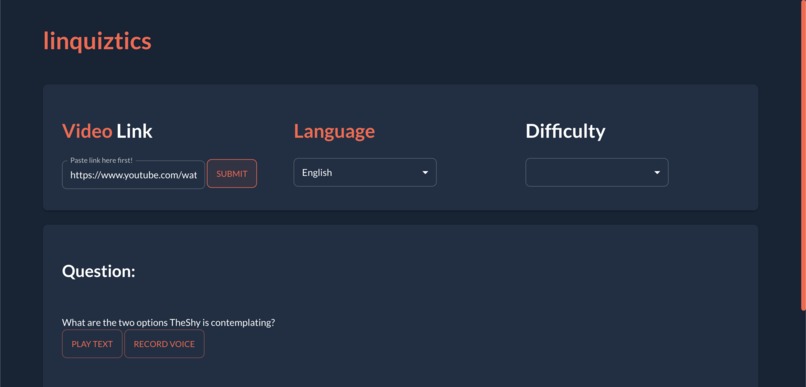
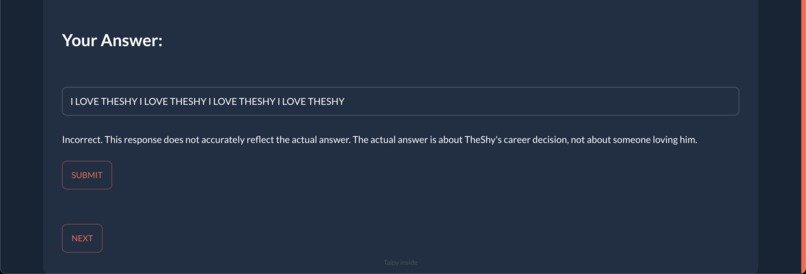
linquiztics analyzes the video you are watching and creates a list of questions using AI that evaluates your understanding of the content of the video and provides detailed feedback on how the user can improve their understanding of the content. Not only does it have the functionality of playing audio for learning the pronunciation, it also can interpret the words that the user is saying for input.
How we built it
Leveraging Taipy for both the frontend and backend development, we seamlessly integrated various APIs to enhance our project's functionality. By tapping into YouTube's API, we efficiently retrieved video transcripts, which were then processed through OpenAI's GPT to dynamically generate quiz questions. Introducing the Whisper API allowed us to incorporate voice input, enabling users to engage in vocal practice during the quiz. Furthermore, we employed gTTS to implement an auditory component, integrating sound playback for an immersive pronunciation learning experience.
Challenges we ran into
One of our most significant hurdles in the development process was related to Chrome extensions. We encountered compatibility issues when attempting to integrate them with the YouTube and GPT APIs. Faced with this roadblock, we decided to pivot towards using Python, a language we were more familiar with and confident about its seamless integration with APIs. However, the transition came with its own set of challenges, particularly in learning Taipy, a language we chose for its suitability to our project. Adapting to Taipy's unique syntax posed a learning curve, demanding additional effort to grasp the intricacies of its Markdown style syntax. Overcoming these challenges became an essential part of our journey, ultimately contributing to the growth and expertise of our team.
Accomplishments that we're proud of
We are especially proud of learning to use and implement Taipy into a product that works seamlessly. This success is a testament to our commitment to acquiring new technical skills and adapting to innovative tools. Connecting various APIs showcased the effectiveness of our teamwork and technical expertise. Beyond enhancing our technical capabilities, this experience fostered a stronger sense of camaraderie within our team as we collaborated toward a shared objective.
What we learned
Throughout the hackathon, our team immersed ourselves in learning new skills and technologies. We not only became adept at version control using Git, but also connecting APIs became a breeze, allowing us to seamlessly integrate a variety of functionalities. Gaining proficiency in Taipy brought a distinctive flair to our toolkit, providing a versatile and powerful language for our project. This learning journey not only expanded our technical know-how but also armed us with the expertise to approach challenges creatively, nurturing a collaborative spirit within the team.
What's next for linquiztics
Our vision for linquiztics involves transforming it into a Chrome extension, seamlessly integrating it into the Chrome browser for enhanced accessibility. To elevate the user experience, we're introducing live transcription functionality, highlighting problematic words in real-time when watching videos. This feature not only aids in identifying and addressing language comprehension challenges but also reinforces learning through visual cues. Additionally, we're incorporating a pronunciation coach equipped with a language phonetic guide, utilizing the International Phonetic Alphabet (IPA). This guide will offer users precise assistance in mastering pronunciation, adding an invaluable dimension to language learning.


Log in or sign up for Devpost to join the conversation.