-
-
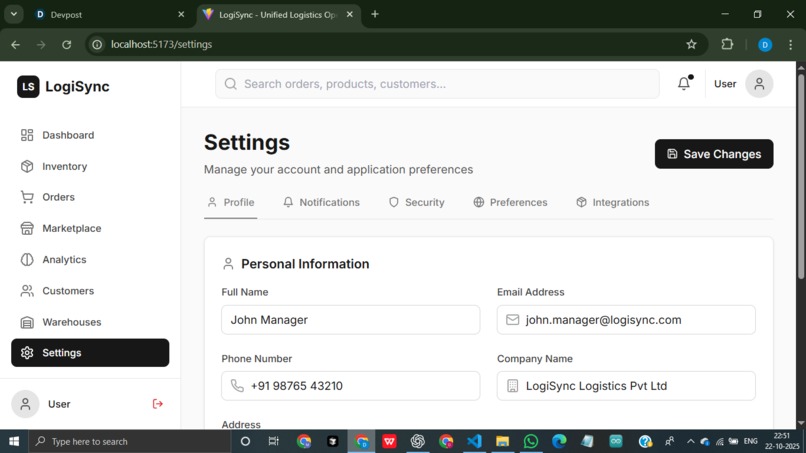
Setting
-
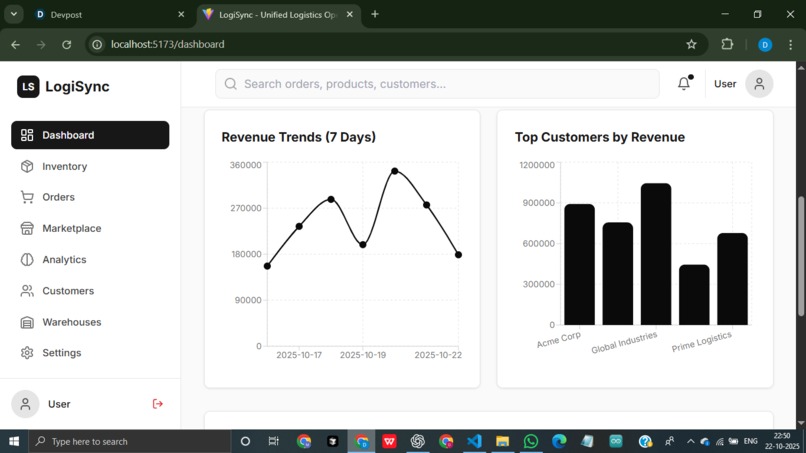
analytics
-
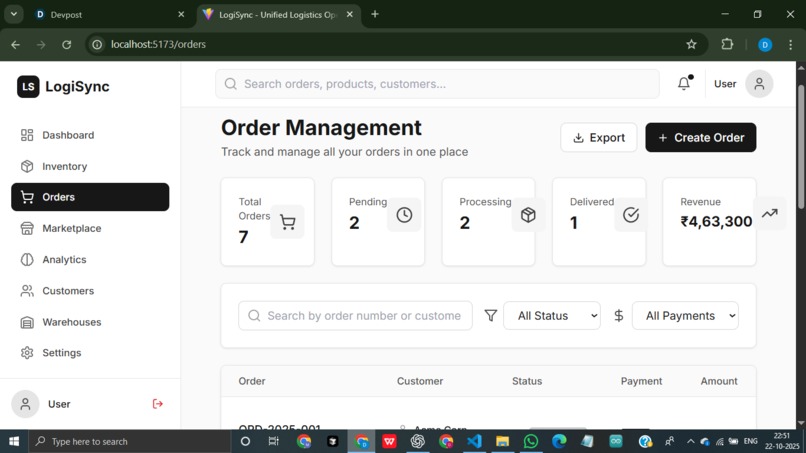
order Management
-
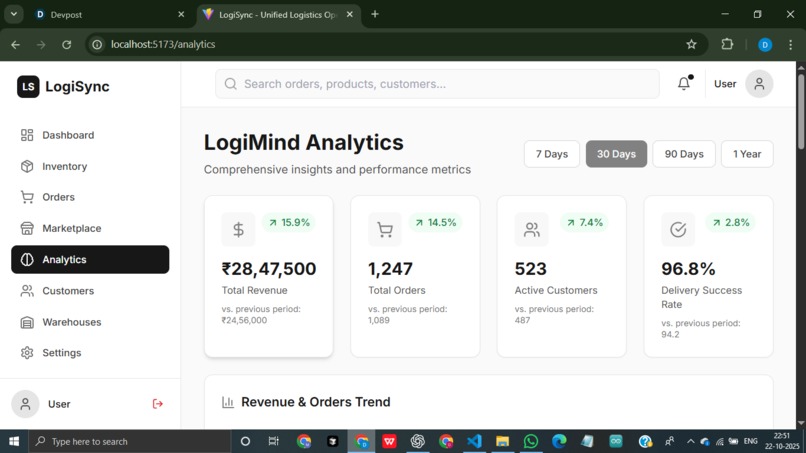
Ai-Analytics
-
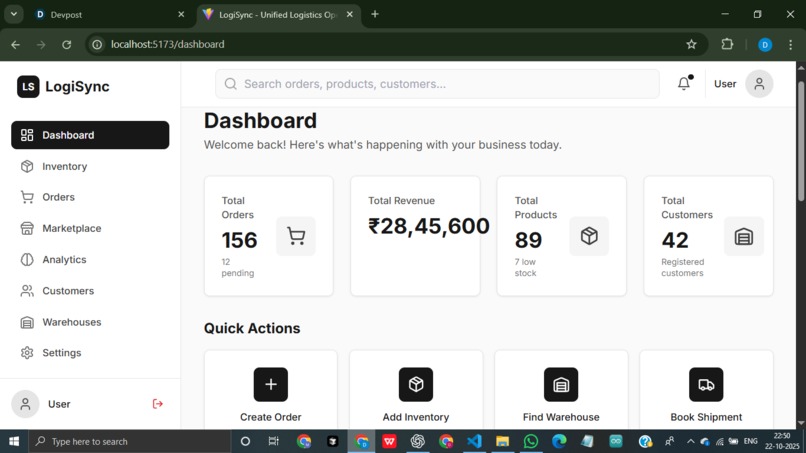
Dashboard
-
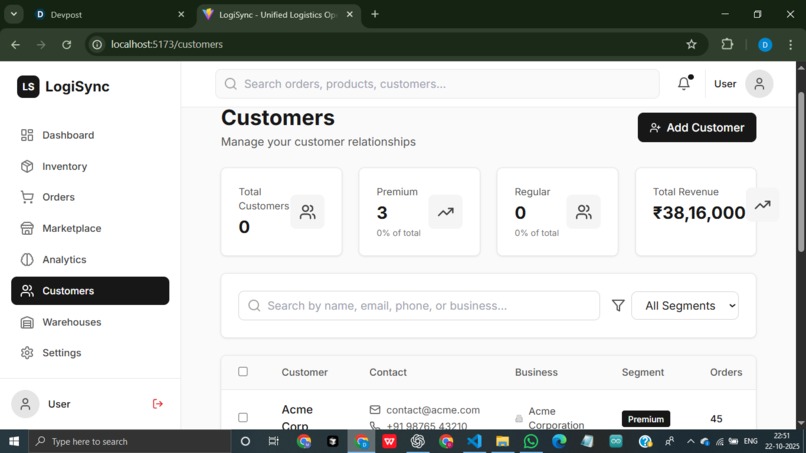
customer
-
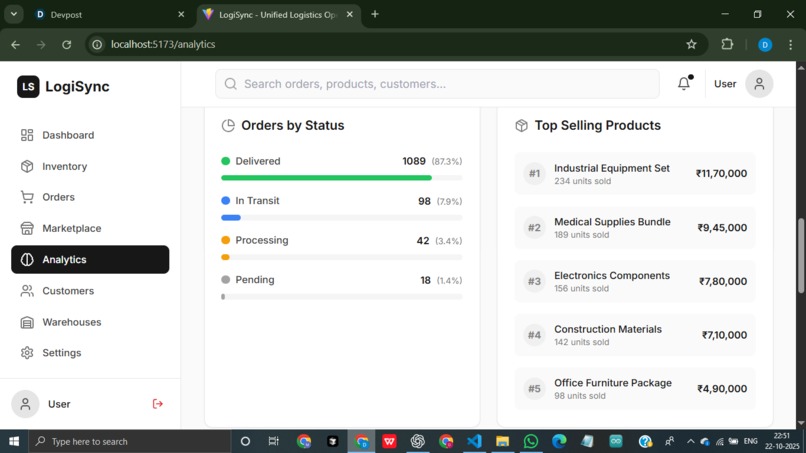
-
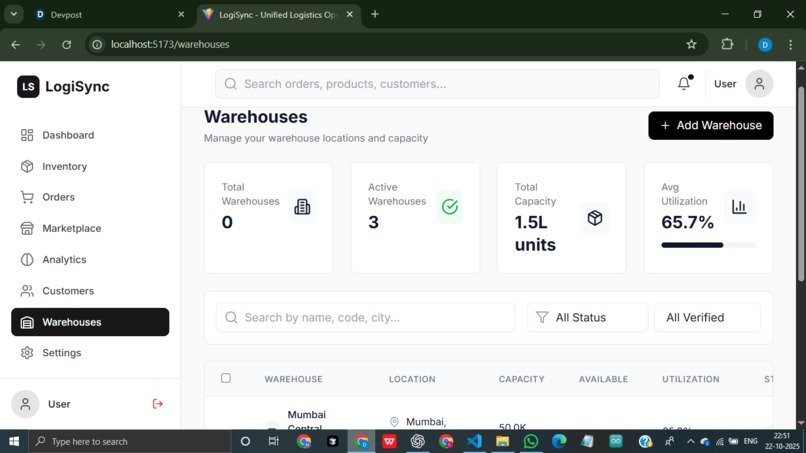
WareHouse
-
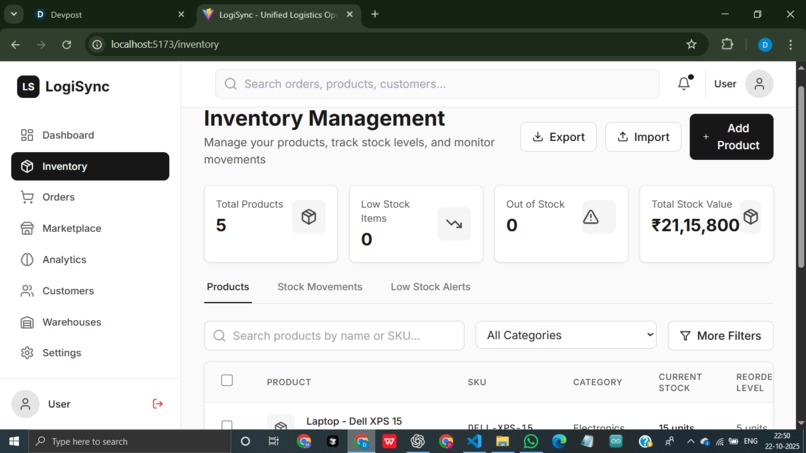
Inventory Management
-
-
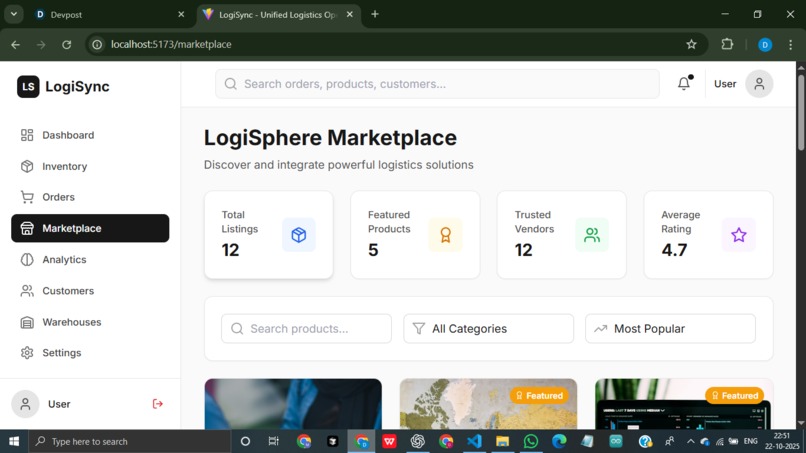
MarketPlace
-


LogiSync: Revolutionizing Supply Chain Management with AI and Blockchain 🌟 The Inspiration The supply chain industry has long struggled with opacity, inefficiency, and trust issues. Traditional logistics systems operate in silos—manufacturers, warehouses, distributors, and customers rarely have complete visibility into the entire supply chain. We witnessed firsthand how:
Inventory discrepancies cost businesses millions in lost revenue Fraudulent orders and payment disputes erode trust between parties Manual analytics lead to poor forecasting and missed opportunities Centralized authentication creates security vulnerabilities
We envisioned LogiSync—a next-generation logistics platform that combines the transparency of blockchain with the intelligence of AI to create a supply chain ecosystem that is secure, predictive, and trustworthy. 🎯 What LogiSync Does LogiSync is a comprehensive supply chain management platform that reimagines every aspect of logistics through two revolutionary technologies: Blockchain Integration
Immutable tracking of products from manufacturer to customer Smart contract automation for payments, escrow, and order fulfillment NFT-based digital licensing for software and digital products Decentralized identity management for customers and authentication On-chain audit trails for configuration changes and warehouse conditions
AI-Powered Intelligence
Predictive analytics for inventory, demand, and revenue forecasting Anomaly detection to identify fraud, unusual stock changes, and security threats Intelligent recommendations personalized to user behavior Computer vision for automated warehouse operations Natural language processing for generating insights from complex data
🔧 How We Built It Architecture Overview Our system is built on a modular architecture with nine core components, each leveraging cutting-edge AI models and blockchain protocols:
- Dashboard Module
Time-series analysis using statistical models for revenue monitoring Anomaly detection with Isolation Forest to flag unusual variations Real-time visualization of KPIs and growth patterns
The revenue trend forecasting uses:
R^t+1=αRt+(1−α)R^t\hat{R}_{t+1} = \alpha R_t + (1-\alpha)\hat{R}_tR^t+1=αRt+(1−α)R^t where α\alpha α is the smoothing factor for exponential weighted moving averages.
- Blockchain-Enabled Inventory
Ethereum smart contracts record every stock movement LSTM networks predict stock levels: ht=LSTM(xt,ht−1)h_t = \text{LSTM}(x_t, h_{t-1}) ht=LSTM(xt,ht−1) Prophet handles seasonal decomposition: y(t)=g(t)+s(t)+h(t)+ϵty(t) = g(t) + s(t) + h(t) + \epsilon_t y(t)=g(t)+s(t)+h(t)+ϵt XGBoost optimizes reorder points using gradient boosting Isolation Forest detects inventory anomalies
- Order Management System
Smart contract escrow for secure payment releases Random Forest for order volume forecasting Autoencoders detect fraudulent patterns by learning normal order behavior Gradient Boosting predicts delivery times with high accuracy Reinforcement Learning (Q-Learning) optimizes fulfillment sequences:
Q(s,a)←Q(s,a)+α[r+γmaxa′Q(s′,a′)−Q(s,a)]Q(s,a) \leftarrow Q(s,a) + \alpha[r + \gamma \max_{a'} Q(s',a') - Q(s,a)]Q(s,a)←Q(s,a)+α[r+γa′maxQ(s′,a′)−Q(s,a)]
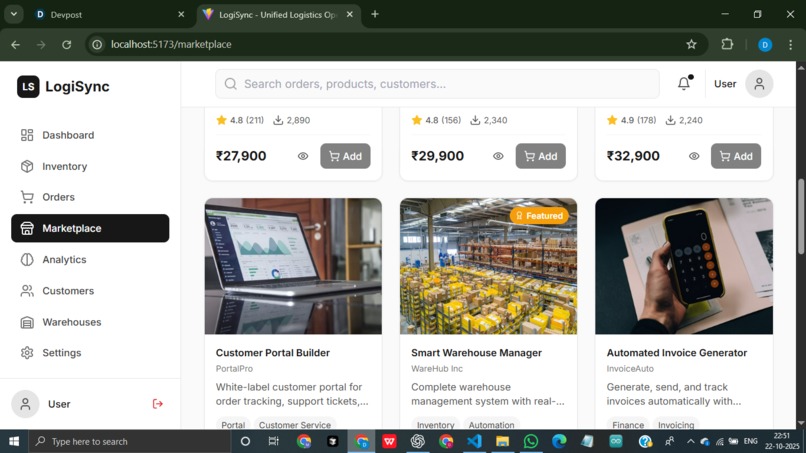
- NFT Marketplace
ERC-1155 tokens represent software licenses as tradeable NFTs Hybrid recommendation engine:
Collaborative filtering using matrix factorization: R≈UVTR \approx UV^T R≈UVT Deep learning embeddings with Neural Collaborative Filtering (NCF) Content-based filtering for personalized suggestions
Crypto payment integration for seamless transactions
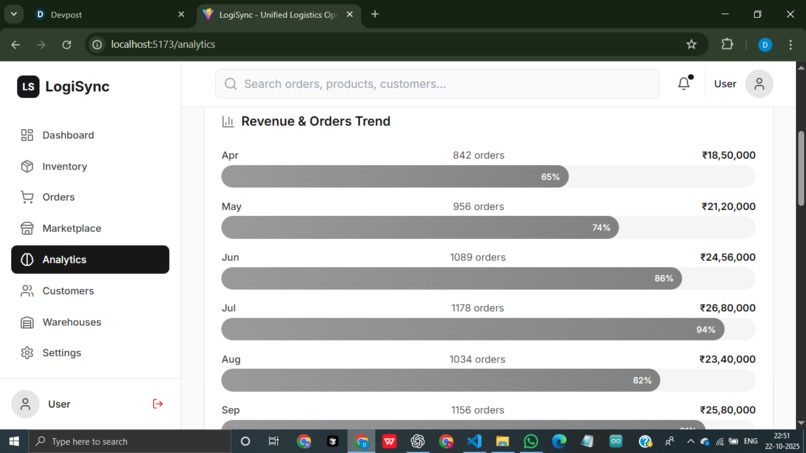
- Advanced Analytics
Graph Neural Networks (GNNs) model complex supply chain relationships K-Means & DBSCAN for customer segmentation ARIMA & Prophet for revenue forecasting Time Series Transformers capture multi-variable dependencies BERT & GPT models generate automated insights from analytics data Gradient Boosting Machines predict customer churn
- Customer Management
Self-Sovereign Identity (SSI) via blockchain DIDs Tokenized loyalty programs stored on-chain XGBoost regression for customer lifetime value: CLV=∑t=1nRt(1+d)tCLV = \sum_{t=1}^{n} \frac{R_t}{(1+d)^t} CLV=∑t=1n(1+d)tRt BERT/RoBERTa for sentiment analysis of feedback Reinforcement Learning suggests next-best actions for retention
- Smart Warehouses
IoT + Blockchain integration for environmental monitoring Genetic Algorithms optimize warehouse space allocation Deep Q-Networks (DQN) for route optimization YOLOv8 & EfficientDet for package detection and damage inspection Real-time computer vision for label verification
- Secure Settings
On-chain configuration logs for complete audit trails Markov Chains analyze user behavior patterns Autoencoders flag suspicious configuration changes Binary classifiers prevent unauthorized modifications
- Web3 Authentication
MetaMask & WalletConnect integration Sign-In with Ethereum (SIWE) protocol for decentralized login Random Forest & Neural Networks for fraud detection Isolation Forest detects login anomalies Logistic Regression enables adaptive MFA
Technology Stack Blockchain Layer:
Ethereum smart contracts (Solidity) ERC-1155 token standard Web3.js for blockchain interaction IPFS for decentralized storage
AI/ML Layer:
TensorFlow & PyTorch for deep learning Scikit-learn for classical ML algorithms Hugging Face Transformers for NLP OpenCV for computer vision
Backend:
Node.js with Express Python FastAPI for ML inference PostgreSQL & MongoDB for data storage Redis for caching
Frontend:
React.js for responsive UI Web3Modal for wallet connection D3.js for data visualization
💡 What We Learned Technical Insights
Blockchain Scalability: We learned to optimize gas costs by batching transactions and using Layer 2 solutions for high-frequency operations Model Selection: Different AI models excel at different tasks—LSTM for sequences, XGBoost for tabular data, Transformers for NLP. Choosing the right model is crucial. Real-time Inference: Deploying ML models in production requires careful optimization. We used model quantization and caching strategies to achieve sub-200ms inference times. Data Quality: Blockchain provides immutable data, but AI models are only as good as the data they train on. We implemented rigorous data validation pipelines.
Business Insights
Trust is paramount in supply chains—blockchain's transparency dramatically reduces disputes Predictive accuracy directly translates to cost savings (20-30% reduction in inventory holding costs) User experience matters even in B2B—Web3 authentication must be seamless
🚧 Challenges We Faced
- Integrating Blockchain with AI Challenge: Blockchain data is append-only and immutable, while ML models need clean, structured training data. Solution: We built a data pipeline that validates blockchain events, normalizes them into feature vectors, and maintains separate analytical databases optimized for ML training.
- Gas Cost Optimization Challenge: Every blockchain transaction costs gas fees, making frequent writes expensive. Solution: We implemented batching mechanisms and used off-chain computation with on-chain verification for AI predictions that need blockchain validation.
- Model Deployment at Scale Challenge: Serving multiple ML models (LSTM, Transformers, CNNs) with low latency for thousands of concurrent users. Solution: We containerized models using Docker, implemented a microservices architecture, and used Kubernetes for auto-scaling based on demand.
- Privacy vs. Transparency Challenge: Blockchain transparency conflicts with business confidentiality requirements. Solution: We used zero-knowledge proofs for sensitive transactions and implemented role-based access controls where only verified parties can view specific data.
- Handling Imbalanced Data Challenge: Fraud detection and anomaly detection face severe class imbalance (frauds are rare). Solution: We employed SMOTE for oversampling, used anomaly-specific algorithms (Isolation Forest, Autoencoders), and carefully tuned decision thresholds.
- User Adoption of Web3 Challenge: Many logistics professionals are unfamiliar with cryptocurrency wallets and blockchain concepts. Solution: We created an intuitive onboarding flow with guided wallet setup and provided both Web3 and traditional authentication options during the transition period.
Built With
- alchemyapi
- ant-design
- apache-kafka
- apache-spark
- arbitrum
- bert
- blockchain
- can
- celery
- chart.js
- css3
- d3.js
- datadog
- django
- docker
- double-check
- efficientdet
- erc-1155
- ethereum
- ethers.js
- express.js
- fastapi
- flask
- ganache
- git
- github
- google-analytics
- gpt
- gpt-4
- graphql
- hardhat
- html
- hugging-face
- infura
- ipfs
- javascript
- jwt
- keras
- kubeflow
- kubernetes
- lightgbm
- lstm
- make
- material-ui
- matplotlib
- metamask
- mistakes.
- mixpanel
- mlflow
- moralis
- new-relic
- next.js
- node.js
- numpy
- oauth
- opencv
- pandas
- paypal
- please
- plotly
- polygon
- postgresql
- postman
- prophet
- python
- pytorch
- ray
- react.js
- redux
- rest-api
- retryclaude
- roberta
- scikit-learn
- scipy
- seaborn
- selenium
- sentry
- smart-contracts
- solidity
- sql
- stripe
- tailwind-css
- tensorboard
- tensorflow
- the-graph
- transformers
- truffle
- twilio
- typescript
- vercel
- walletconnect
- web3.js
- web3modal
- websocket
- weights-&-biases
- xgboost
- yolov8


Log in or sign up for Devpost to join the conversation.