-
-

-
Goals


Inspiration
Many stores require masks and enforce occupancy limits to limit the spread of COVID-19. However, there doesn't yet exist a streamlined system to help ensure shoppers are wearing masks, and close doors when the safe occupancy limit is hit.
What It Does
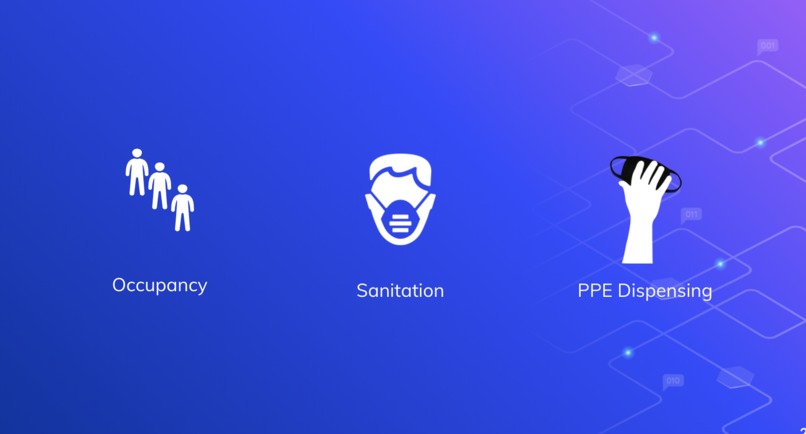
Our hack is composed of:
- A deep learning model which detects whether a person is wearing a mask or not in real time trained using Microsoft Azure.
- Two ultrasonic sensors that track customer entry/exit by measuring signal spikes when the door is crossed (directionality is achieved by seeing which sensor was crossed first)
- A mask dispenser that dispenses masks when an unmasked face is detected
Our solution reduces the risk of having an extra human that could potentially be infected or get easily infected by several customers - and cuts cost of having to pay an extra employee. -MaskOn is cheaper to implement than having to pay an employee to do the same job for a week!
The system will (A) automatically keep the door closed when the occupancy cap has been reached, and (B) instruct unmasked users to retrieve and put on a mask before allowing them inside.
The idea is to integrate our software with existing stores CCTV/automatic door systems to keep installation costs at a minimum. Businesses with this existing hardware can use our Microsoft Azure API to get the pretrained model for mask/face detection and integrate our solution seamlessly.
How We Built It
- We were able to find many datasets online for masked/unmasked faces, which we used to train a CNN using keras and Azure GPU acceleration -Saved the trained model in Azure and created an API to allow for easy business integration
- We used OpenCV to stream video from the camera and detect masks in real time using the model
- We used an Arduino to control a mask dispenser and detect when people cross the threshold using ultrasonic sensors
Challenges We Ran Into
Optimizing the framerate; running mask detection on every frame is slow, so we used partial face recognition to identify if there is a subject visible in the camera first before running the more intensive mask detection model.
It was difficult to get the people counting working, ultrasonic sensors were noisy and we spent a lot of time finding the right way to filter the readings. We ultimately used an FIR moving average filter to get smoother detection. An IR sensor would have been easier to work with.
The Future of MaskOn
-Better entry/exit counter system -Smaller mask disposal solution -Modules for easier integration onto any business storefront


Log in or sign up for Devpost to join the conversation.