-
-
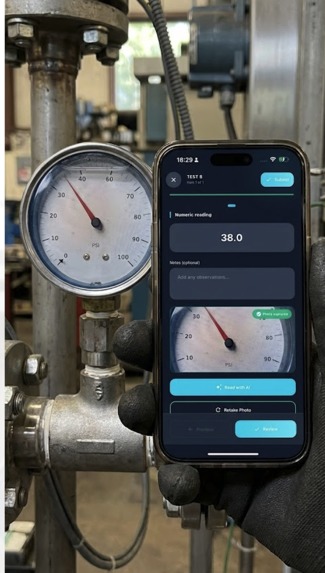
Integration with app in flutter
-

Web demo with Gradio
-
header


Inspiration
Walking through an oil refinery, a power plant, or a manufacturing floor, you'll see them everywhere — analog gauges. Pressure gauges, thermometers, ammeters, flow meters. Millions of them. And despite all our advances in automation, most are still read by humans walking inspection routes, clipboard in hand.
The predictive maintenance market is projected to grow from $13.6B to $70B+ by 2032. Yet this critical data entry bottleneck remains: a human squinting at a dial, writing down numbers, sometimes making errors that cascade into equipment failures and safety incidents.
I asked a simple question: Can ERNIE-4.5-VL learn to read these gauges?
What We Built
MeterMind is an end-to-end solution for automated analog gauge reading:
- Synthetic data generator producing photorealistic gauge images
- Fine-tuned ERNIE-4.5-VL achieving 86.7% accuracy within ±1 unit
- Production API with sub-second inference (0.85s)
The results exceeded expectations:
| Metric | Before | After | Improvement |
|---|---|---|---|
| Mean Absolute Error | 2.82 | 0.60 | 79% ↓ |
| Within ±1 unit | 46.7% | 86.7% | +40% |
| Within ±2 units | 56.7% | 100% | +43% |
How We Built It
Phase 1: The Data Problem
No labeled dataset exists for industrial gauge reading. Stock photos lack ground truth. Real industrial images are proprietary.
Solution: Procedural synthetic generation. We built a pipeline creating 600 gauge images with:
- Realistic dial faces (pressure, temperature, amperage)
- 3D perspective transforms simulating camera angles
- Industrial backgrounds (metal panels, concrete, machinery)
- Damage effects (scratches, dust, rust stains)
- Variable lighting (harsh sun, low-light, industrial fluorescent)
Training set: 570 images
Validation set: 30 images
Gauge types: Standard pressure, Glycerin-filled, Bimetal thermometer
Phase 2: Training at Scale
ERNIE-4.5-VL-28B is a 28 billion parameter vision-language model. Training it required serious hardware.
Infrastructure:
- NVIDIA B200 GPU (192GB VRAM) via Modal
- Images resized to 512×512 to fit memory constraints
- LoRA fine-tuning (rank=8, α=16) for parameter efficiency
Training config:
learning_rate: 2e-4
batch_size: 1 (gradient accumulation: 2)
epochs: 1 (285 steps)
training_time: ~45 minutes
One epoch was enough. The model learned the task quickly — a testament to ERNIE's strong vision-language foundation.
Phase 3: The Inference Nightmare
Training worked. Evaluation looked great. Then came deployment.
First attempt: Unsloth-based inference on H100 GPU.
Result: 110 seconds per prediction.
That's not a typo. Nearly two minutes to read a single gauge. Completely unusable.
Phase 4: The 100x Speedup
We refused to accept 110s latency. The optimization journey:
- vLLM migration — But ERNIE-4.5-VL support required nightly builds
- LoRA merging — vLLM needed full weights, not adapters
- Processor configs — Missing
preprocessor_config.jsoncrashed the image pipeline - Prompt format debugging — Vision models need specific placeholder tokens
After significant iteration:
Before: 110.0 seconds
After:    0.85 seconds
Speedup:  129x
Challenges We Faced
GPU Memory Constraints
The model barely fits on a B200. We had to:
- Reduce image resolution (512×512 max)
- Use 4-bit quantization during some experiments
- Carefully manage batch sizes
vLLM Bleeding Edge
ERNIE support was merged into vLLM recently. Documentation was sparse. We debugged through source code and GitHub issues to understand:
- How to format multimodal prompts
- Why processor configs were missing
- The correct way to pass base64 images
Balancing Realism vs. Training Signal
Synthetic data is a double-edged sword. Too simple = poor generalization. Too complex = model can't learn the core task. Finding the right balance of augmentations took experimentation.
What We Learned
Inference optimization is half the battle. A model that takes 2 minutes per prediction is useless in production, regardless of accuracy.
Synthetic data works. 600 procedurally generated images achieved strong results. Careful augmentation design matters more than volume.
Vision-language models are ready for industrial applications. Fine-tuning unlocks capabilities that zero-shot prompting can't match.
The ecosystem is still maturing. vLLM + ERNIE required nightly builds and source-code diving. This will improve, but early adopters face friction.
Technical Architecture
┌─────────────────┐     ┌──────────────────┐     ┌─────────────────┐
│  Gauge Image    │────▶│  ERNIE-4.5-VL    │────▶│  Reading: 70.5  │
│  (base64)       │     │  (fine-tuned)    │     │  (0.85s)        │
└─────────────────┘     └──────────────────┘     └─────────────────┘
                               │
                    ┌──────────┴──────────┐
                    │   vLLM Runtime      │
                    │   H100 GPU (Modal)  │
                    │   API Key Auth      │
                    └─────────────────────┘
Results
Accuracy:
- MAE improved from 2.82 → 0.60 (79% reduction)
- 100% of predictions within ±2 units
- Works across pressure gauges, thermometers, ammeters
Performance:
- Inference latency: 0.85 seconds (down from 110s)
- Cold start: ~2.5 minutes (model loading)
- Production-ready with API authentication
What's Next
- Edge deployment — Optimize for mobile/embedded inference
- Multi-gauge support — Digital displays, LCD readouts, seven-segment
- Video processing — Real-time monitoring from camera feeds
- Industrial integration — SCADA, IoT platforms, predictive maintenance systems
Built with ERNIE-4.5-VL, Unsloth, vLLM, and Modal for the ERNIE AI Developer Challenge 2025.
- ** Demo Link: https://huggingface.co/spaces/luliuzee/metermind-demo


Log in or sign up for Devpost to join the conversation.