-
-
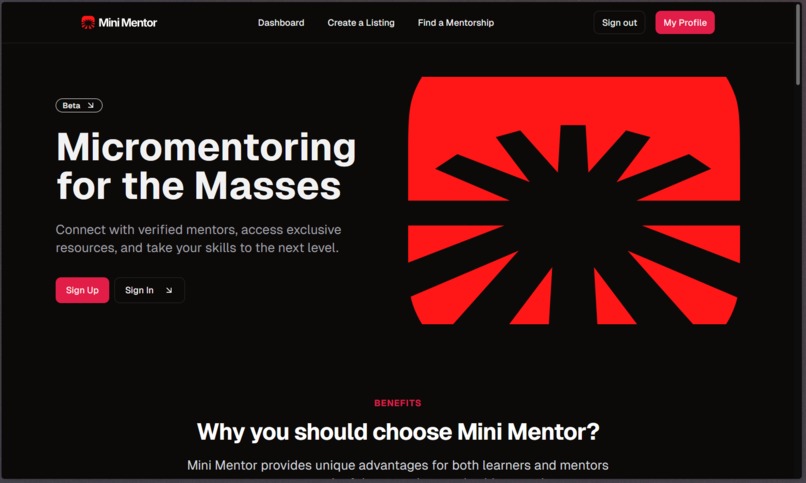
Landing Page Screenshot
-
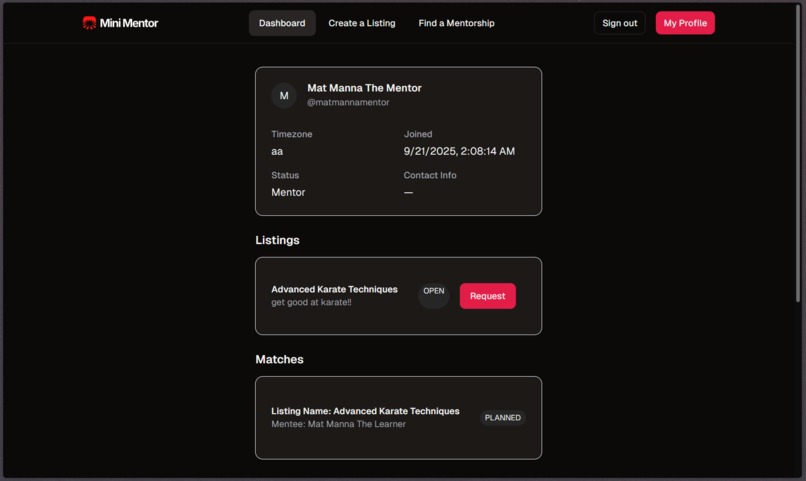
-

Mini Mentor 1/1
-

Mini Mentor 1/2
-

Mini Mentor Concept Image
-

Mini Mentor Finalized Image


Inspiration
Mini Mentor was created for people to voluntarily share their skills and experiences. While platforms like SkillShare offer knowledge-sharing through structured courses, with Mini Mentor, people can offer their expertise, insights, and real-world experience to help others grow in a more personal, interactive, and flexible way. Research shows that mentoring is a two-way street, where both mentors and mentees grow and improve through the experience. We wanted to bring this into our concept and project, and give people an opportunity to give back, as our collective knowledge is built on that of everyone before us.
What it does
Within Mini Mentor, you can sign up as a Learner or a Mentor. As a Learner, you can explore and select from a variety of mentorship sessions offered by experienced guides. Each Mentor shares their unique expertise, allowing anyone to pick what fits them best.
How we built it
Frontend: The user interface was constructed with Next.js and React. For a sleek interface, we used shadcn/ui, which gave a great foundation for further edits.
Backend: For the backend, we used Supabase, which gave us both a database and user authentication. This allowed us to focus on building features instead of configuring backend infrastructure.
Challenges we ran into
An early challenge we encountered was our initial heavy reliance on Python for both front-end and back-end logic, which increased development time and complexity. To cut down on time, we transitioned to Next.js. This shift significantly reduced development time and allowed us to create a more seamless user experience.
Accomplishments that we're proud of
We're proud to have successfully built Mini Mentor with all its core features. Beyond the project, a significant achievement was the amount of knowledge we gained by connecting interfaces and looking at different frameworks. Also, working together as a team to help each other grow and reach the goal was an extremely valuable experience.
What we learned
We discovered that while ambitious features can drive innovation, they often require careful scaling to meet deadlines. Rather than removing certain functions entirely, we focused on finding a middle ground. We prioritized core features that delivered the most value and planned more advanced capabilities for future updates. This allowed us to maintain our vision without compromising our launch timeline. In terms of software platforms, we all improved/learned skills for the frameworks/software we used.
What's next for Mini Mentor
Looking ahead with Mini Mentor, we plan for additions of:
- Review Systems
- Resource Libraries
- Advanced Search and Filter Capabilities
Built With
- nextjs
- node.js
- postgresql
- react
- shadcn/ui
- supabase




Log in or sign up for Devpost to join the conversation.