-
-
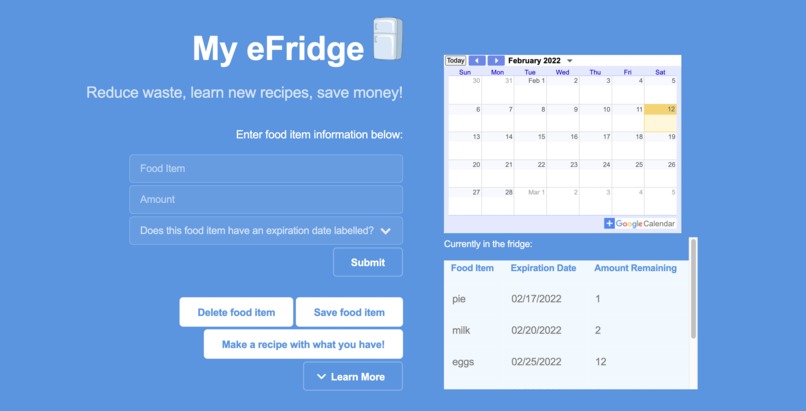
My eFridge - Your Smart Fridge

Inspiration
The huge amount of food wasted because it is forgotten and expires unnoticeably in the fridges of households and big businesses in the food industry. We thought to ourselves: what if there was a concise way to see all of your fridge contents and when they'll expire (even if they have no label)? Hence, my eFridge was born!
What it does
The goal of My eFridge is to reduce and prevent food waste. It does this by: (1) allowing users to always see their fridge inventory through a clear/simple interface (sorted by upcoming soonest expiration dates); (2) storing fridge inventory information with expiration/best before dates in order to alert users when foods are coming close to expiration; (3) leveraging an AI recipe generator to offer users ideas on how to use upcoming expired foods. In addition, the alert system of upcoming expiring foods would allow users to make other decisions around these foods such as eating them ASAP or donating them. The steps that a user can take to prevent food waste are further explained by clicking the 'Learn More' button.
How we built it
We used a base webpage template (linked in GitHub repo) to build the UI and functionality of My eFridge. We then added functionality for our three main components: taking in user input, displaying the user input in the fridge contents table, and the calendar. Furthermore, my eFridge estimates the expiration date of fresh foods using the FDA's cold food storage database (linked in GitHub repo) and displays this information in the fridge table.
Challenges we ran into
Integrating the Google calendar into the website was something none of us had done before, which had some challenging aspects. Additionally, we were originally thinking of having the AI recipe generation run directly in the backend of the website, since the website had published a Google Colab with some pertinent code, but we decided on hyperlinking the original website instead due to time constraints.
Accomplishments that we're proud of
We are very proud of the final product! The concept itself is something that we all think is an important issue that needs to be solved, and it brings awareness to people of the scale of the problem, as well as giving them an easy and actionable avenue for ameliorating food waste in their personal lives.
We believe this project can be scaled for both individual household use and commercial use, as it would allow both households and large businesses to track inventory in their fridges.
As well as being proud of the concept of our idea and the problem it aims to solve, we are also very proud of the UI and design of the website itself! We think it looks very appealing and intuitive, making it easier to use as well as increasing the probability of frequent usage.
What we learned
We learned greatly about the issue of food insecurity and how big of an impact food wastage has on it. We also learned more about front end designs and how to integrate external features. Additionally, in exploring how to integrate the AI recipe generation, while we ultimately did not go down that path, we learned more about how one could approach it as well as different frameworks, which was great.
What's next for My eFridge
We see many future ideas for My eFridge. Some examples are:
- A database to store the fridge contents long-term.
- Using AI for image recognition of items in the fridge rather than manual entry for fresh/non-labelled items.
- Using AI for image recognition of labels/barcodes for labelled items.
- Creating a phone application for the project.
- Expanding My eFridge to having My ePantry/My eKitchen.
- Incorporating GPS to allow users to find donation spots near them (especially useful for businesses, such as grocery stores).
- Ads can be incorporated to recommend food items (e.g., from local markets for more sustainability considerations) based on the most consumed food items in an individual's My eFridge.




Log in or sign up for Devpost to join the conversation.