-
-
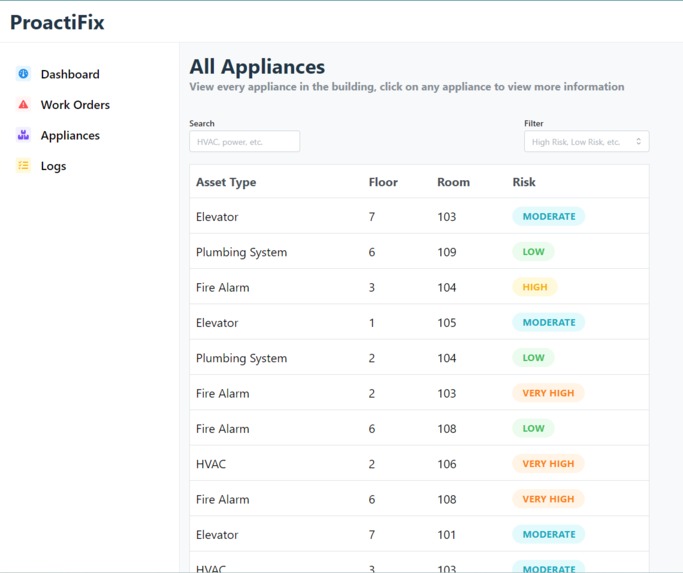
All Appliances Listing
-
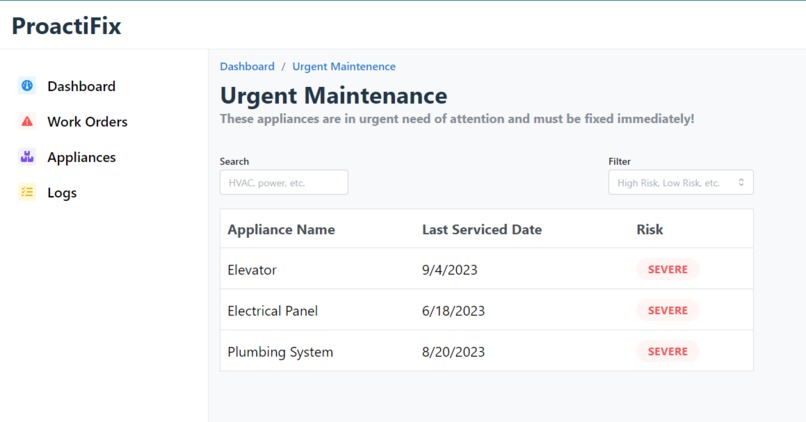
Urgent Issues Listing
-
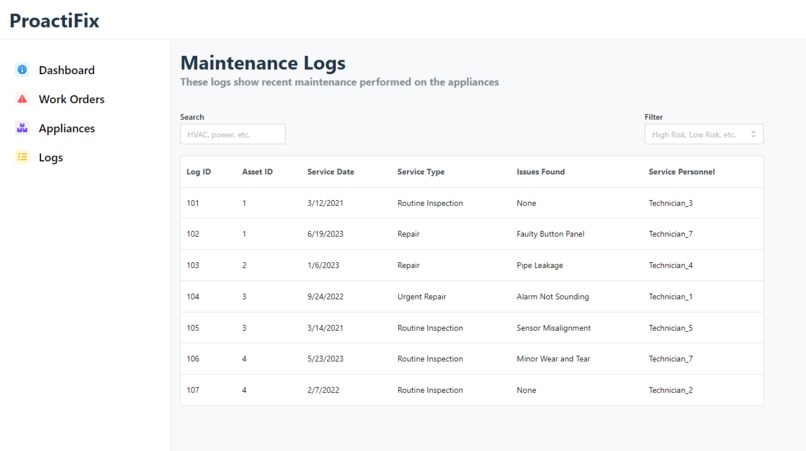
Maintenance log
-
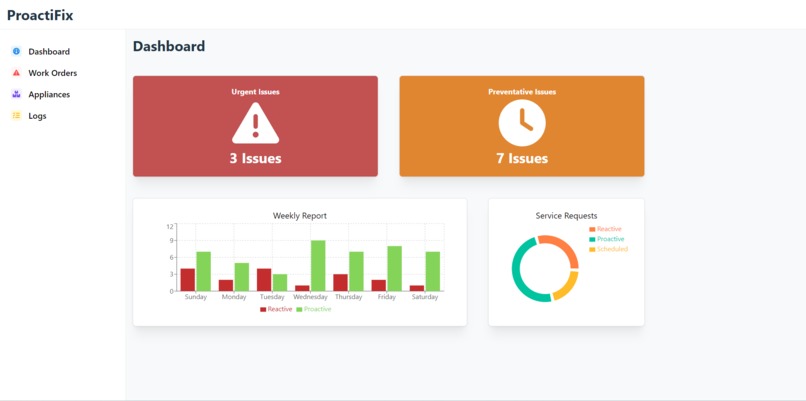
Dashboard
-
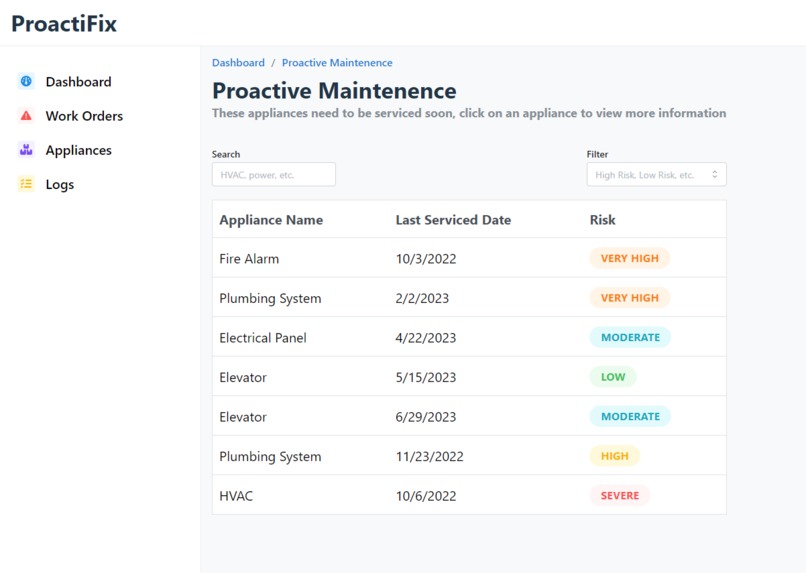
Proactive Issues listing
-
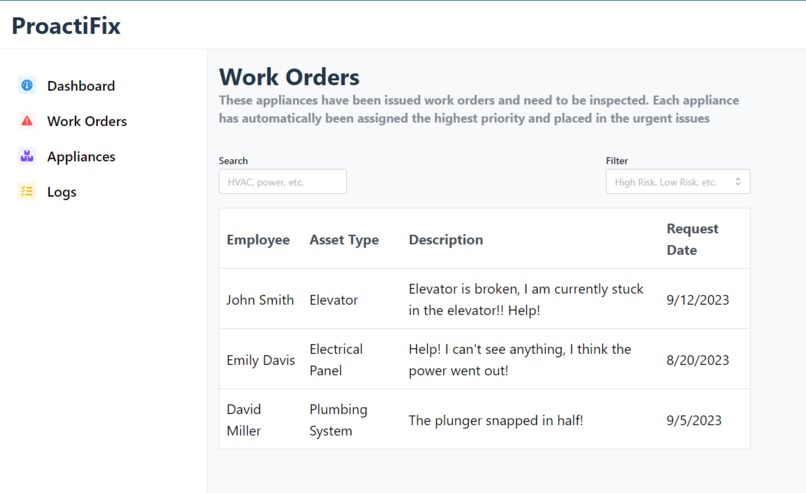
Work Orders Listing
-
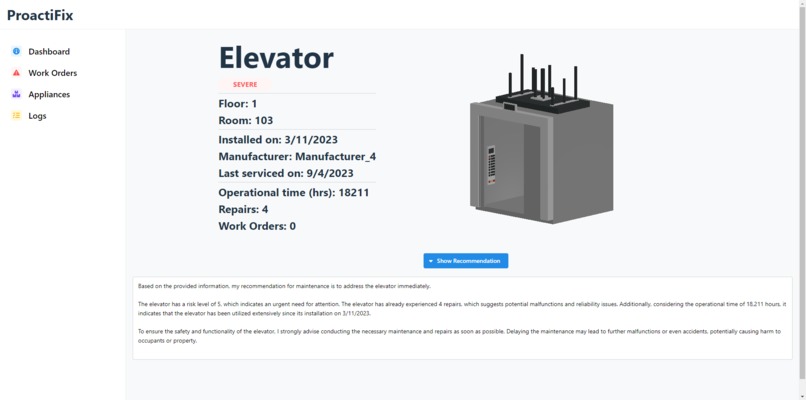
Appliance view with recommended action
-
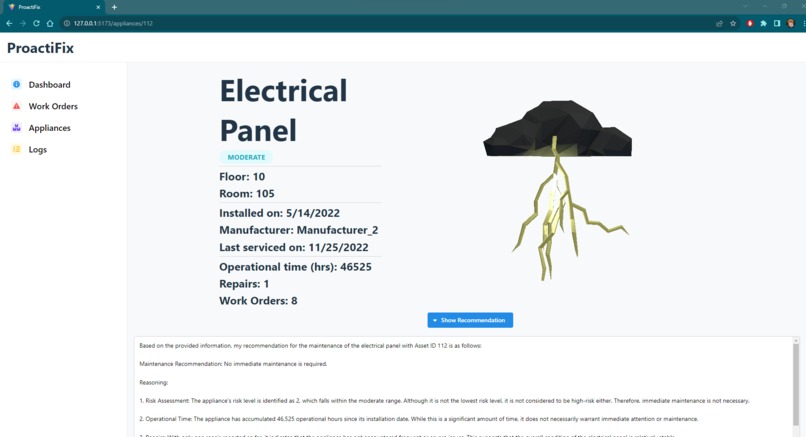
Electrical Panel Appliance
-
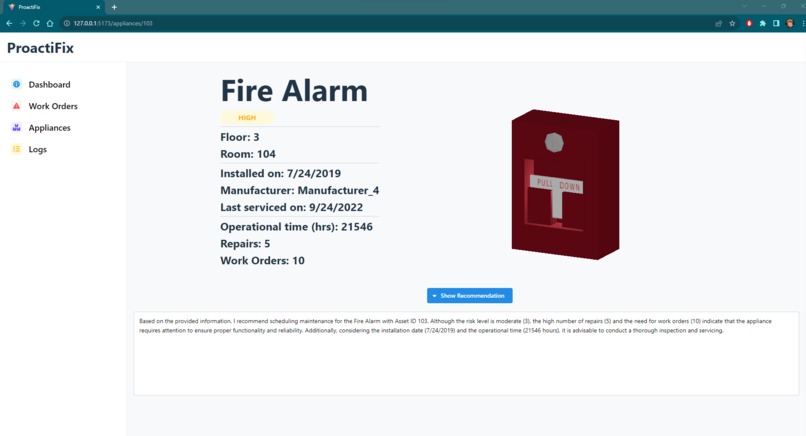
Fire Alarm Appliance
-
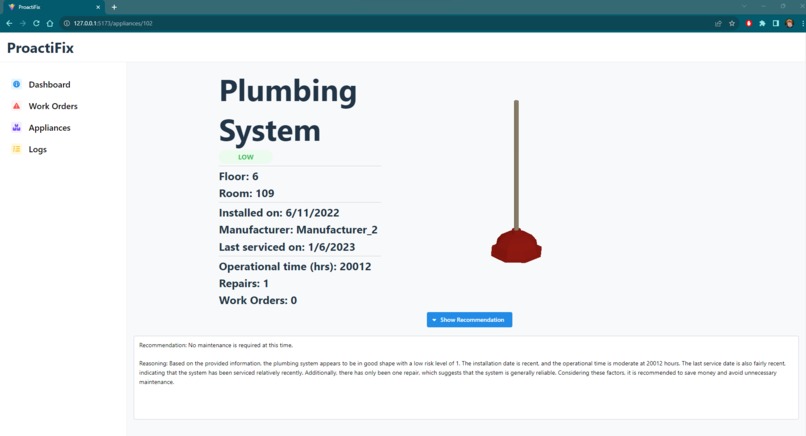
Plumbing System Appliance
-
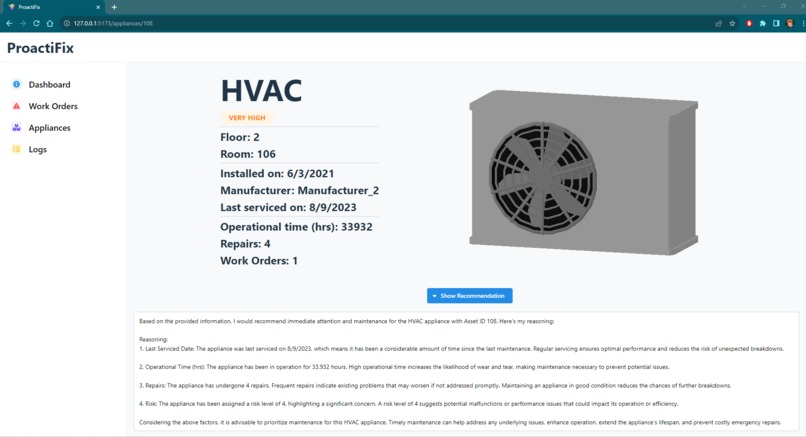
HVAC Appliance


Inspiration
The inspiration for this project was to provide property owners with the ability to quickly identify what maintenance needs to be performed and when. The problem we focused on was the difficulty involved in managing large amounts of appliances at scale. We wanted to simplify the process of effectively tracking the condition of various assets in commercial buildings by reducing various appliance data metrics into a single value to instantly identify what assets need attention.
What it does
Our intuitive dashboard leverages AI technology to allow anyone to view which assets need urgent attention, and which ones are due for preventative maintenance. Our aim is to minimize the amount of reactive service done to assets to reduce downtime costs. By being proactive in maintenance we can significantly improve customer satisfaction and maintenance costs by using AI to select the appliances that would benefit the most from a tune up. One of the most impressive features of the application is the ability to view any appliance in the commercial building and determine which maintenance would be most appropriate using AI.
How we built it
We used ReactJS in the frontend with TypeScript as well as ThreeJS to render 3D models from Echo3D. Our React app made requests to a NodeJS app running an express server to query data from the database. We used Firebase real time database to store information. Additionally, we determined risk assessments using a random forest classifier through scikit-learn with python. Lastly, we used the OpenAI API to prompt GPT-3.5 for recommended actions given any appliance in the commercial building.
Challenges we ran into
One of the challenges we ran into was evolving the schema of our data throughout as requirements changed. Although we spent a significant amount of time planning the project with extensive requirement elicitation, there was inevitable changes in how we wanted to query our data, resulting in the necessary evolution of our schema. This posed a challenge as we frequency changed how our database was formatted and how we would then fetch that data.
As Winston Churchill once famously said, "Plans are are worthless, but planning is everything". This resonated with our project development experience as we invested in planning the project early, and quickly found that our plans would become worthless. Nonetheless, our team adapted to changes quickly and we overcame our challenges.
Accomplishments that we're proud of
Some of the accomplishments that we are proud of is successfully implementing a ThreeJS canvas into React to dynamically render models from Echo3D of the selected appliance to get a better look at the assets condition. Additionally, it was our first time using the OpenAI API to query GPT-3.5 for recommended maintenance. There was a lot of unfamiliar territory that required digging through documentation and resolving issues to complete the application.
What we learned
There were a lot of new tools learned throughout this project that involved working with 3D assets as well as using AI to determine optimal asset condition management. No one on the team had any experience with AI/ML, so we had to take a step back and learn a little bit more about the subject to be prepared when it came time to implement.
We also wanted to thank the SMU AI Club for the AI workshop that they hosted as well as the CBRE team for answering our questions and hosting an excellent talk as well.
What's next for ProactiFix
One major aspect of our project that we could continue to work on is scaling up to multiple commercial buildings. Currently, we only support all the appliances in one commercial building, however the ability to view any building that you manage would allow CBRE to monitor all properties under one platform.
Additionally, a notification system would enable teams to be notified of urgent requests instantly via SMS, Email, etc. This way we can improve our visibility to make sure that no issues go unnoticed.


Log in or sign up for Devpost to join the conversation.