-
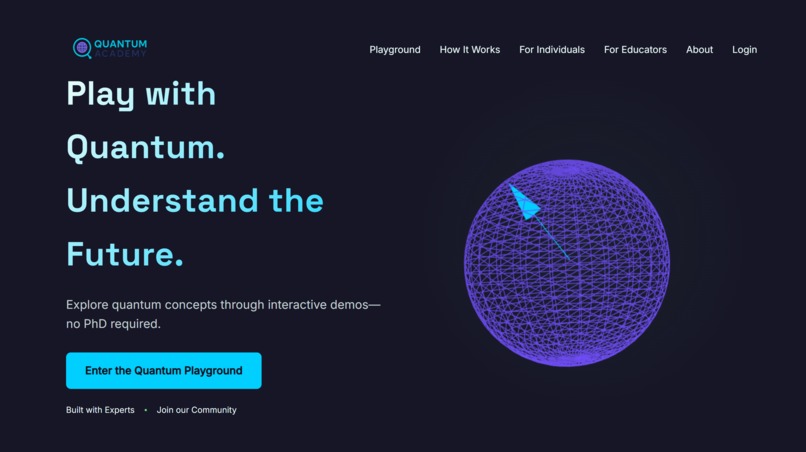
Website landing page
-
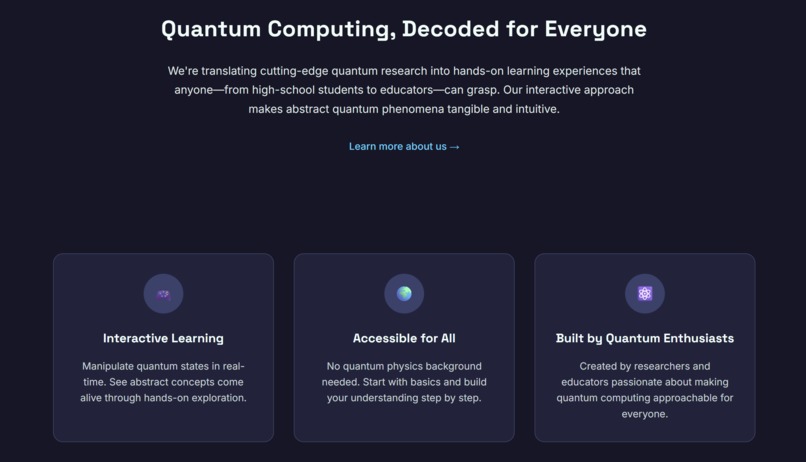
Landing page cont.
-
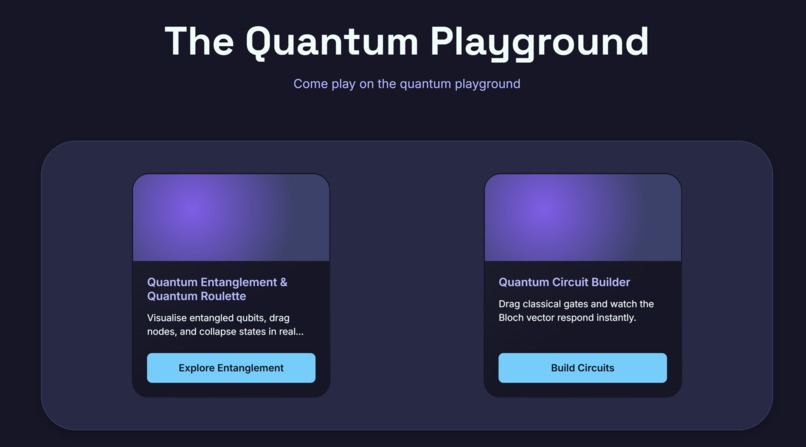
Quantum playground demos
-
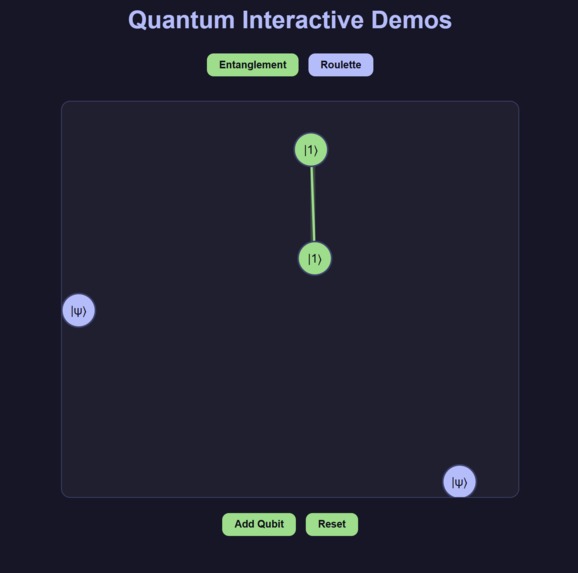
Entanglement demo
-
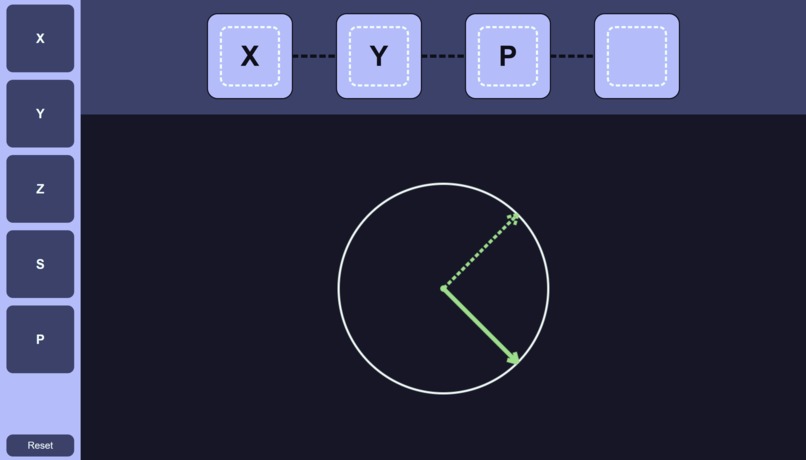
Quantum circuit simulator


Quantum Academy - Hackathon Project
💡 Inspiration
Quantum computing holds the potential to transform our world—across medicine, finance, energy, and AI—but the learning curve to even begin understanding it is brutally steep. Most educational resources today are long, abstract, and math-heavy, which alienates beginners and slows progress.
We wanted to change that.
At Quantum Academy, we believe that powerful ideas don’t need to be hidden behind complex equations. Just like you don’t need to know how a combustion engine works to drive a car, you shouldn’t need a physics PhD to grasp how qubits and superposition shape the future. Our inspiration came from imagining a world where anyone—from high school students to lifelong learners—can see and play with quantum concepts in real time. Interactive, visual, intuitive—that’s the vision behind Quantum Academy.
⚙️ What it does
Quantum Academy is a hands-on educational platform that teaches the practical side of quantum computing through interactive visualizations and mini-games. Users can drag and drop quantum gates, observe state vector transformations, and complete challenges that reinforce core ideas like superposition, entanglement, and measurement.
No jargon. No endless PDFs. Just the essential concepts taught with clarity, curiosity, and code.
On the surface, it looks like a game. Underneath, it’s an on-ramp to one of the most revolutionary technologies of our time.
🛠️ How we built it
We designed Quantum Academy to run entirely in the browser—no installation, no setup. The frontend was built with HTML/CSS and vanilla JavaScript, using custom SVG animations to show how qubit states evolve with each gate.
The game engine logic was implemented from scratch to simulate quantum operations and ensure the educational mechanics were accurate but not overwhelming.
We also surveyed over 150 students—high school and university—to validate our concept. The response rate was 45%, and feedback confirmed what we suspected: students are eager to interact, not read. This drove many of our design decisions.
🚧 Challenges we ran into
Making quantum visual. Quantum computing lives in complex vector spaces—it’s inherently hard to visualize. We spent a lot of time iterating on how to make states and transformations intuitive, eventually landing on a state vector and gate animation system that works.
Balancing simplicity with accuracy. We had to be careful not to oversimplify concepts while still making them approachable. This led to a lot of back-and-forth between design and physics.
Performance and compatibility. Ensuring our animations and drag-and-drop interface work smoothly on all modern browsers, including mobile, took careful optimization.
🎉 Accomplishments that we're proud of
- We built a working, interactive quantum demo from scratch, entirely in the browser, in under 36 hours.
- We created a tool that educators told us they would actually use in classrooms.
- We took an abstract subject and made it visual, tactile, and even fun.
- Our financial model and growth roadmap are already outlined for long-term viability.
🧠 What we learned
This project pushed us to blend pedagogy, physics, and product design in real time. We learned how to communicate complex ideas with clarity, how to validate product-market fit quickly, and how to build fast, functional prototypes under pressure.
We also deepened our technical skills in frontend development, game logic, and UX design—especially with translating quantum mechanics into visuals.
🔮 What's next for Quantum Academy
We’re just getting started. Next, we plan to:
- Build a library of interactive lessons and challenges.
- Launch a user dashboard for progress tracking and class integration.
- Partner with STEM-focused charter schools.
- Expand to full curricula for school boards.
Our long-term roadmap aims to serve both individuals and institutions, turning Quantum Academy into the Khan Academy of quantum computing. With high retention, a clear path to revenue, and a massive underserved market, we’re excited to keep building.
This isn’t just a hackathon project—it’s the beginning of a movement to democratize quantum education.


Log in or sign up for Devpost to join the conversation.