-
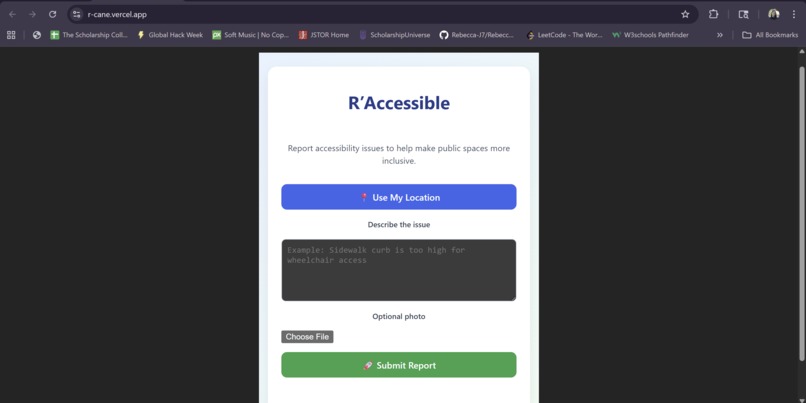
R'Accessible Report
-
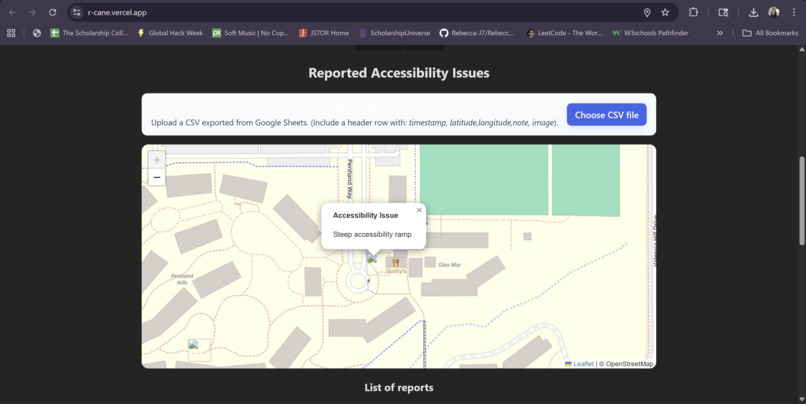
R'Accessible Map
-
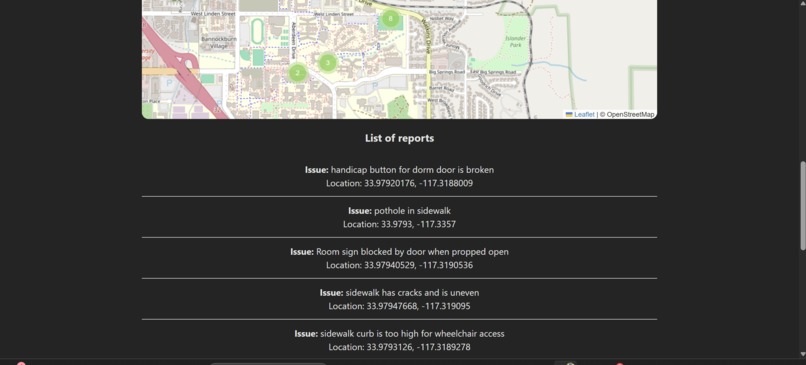
R'Accessible Report List
-
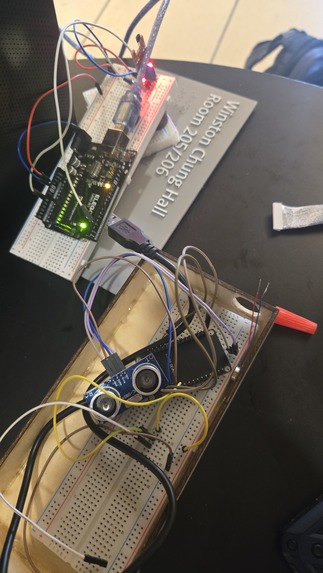
R'Cane Parts


Social Impact
Inspiration
Navigating the everyday world presents many obstacles for the visually impaired. Poor accessibility infrastructure often remains in disrepair. Mobility canes are limited to detecting low-lying obstacles. Braille signs are sometimes placed in awkward areas and may be difficult to locate for those unfamiliar with the area. The R'Accessible and R'Cane subsystem seeks to individually tackle these issues.
What it does
The R'Accessible system is a website where users capture their current coordinates at the location of hard-to-navigate locations. An optional written description of the obstacle may be uploaded with the report. This data is logged onto a database, where non-profit organizations that can advocate for accessible infrastructure may access. There is also a live map feature where non-profits can upload a CSV file of the data collected and see the areas where issues are reported.
The R'Cane system comprises an ultrasonic sensor that scans the immediate area above the user's waist. Should an obstacle materialize in the immediate vicinity above the user's waist, haptic feedback will be provided in the form of a vibrating handle. In addition, a magnet embedded in the tip of the cane will trigger a noise to be played from the buzzer mounted on a sign.
How we built it
R'Accessible was built with Vue 3 (Composition API), Vite (development & build tooling), HTML5 / CSS3, Browser Geolocation API, Google Apps Script (serverless backend), and Google Sheets (data storage) to allow users to report poor infrastructure in their location. The R'Cane was built using arduino with a hall sensor, an ultrasonic sensor, a vibrating motor, and an ESP32 as a microcontroller, to detect obstacles in the immediate area.
Challenges
- Utilizing ESP32 Bluetooth to connect via hardware and mobile device.
- Storing image URL from user upload to access in data base.
- Implementing a live map to pinpoint the reported locations.
- Deciding whether to implement Bluetooth vs wifi components.
- Designing a cane that is lightweight and cost-effective for existing solutions.
Accomplishments
- Created a hardware prototype that addresses existing solutions for vision-impaired individuals while implementing additional features to aid in detecting objects above the waistline.
- Developed a website where users can pinpoint their location to report on accessible infrastructure for those who are disabled.
What We Learned
- How to utilize Google Apps Scripts to take user inputs and append them to a Google Sheets data.
- Implementing the browser geolocation api to get permission from users to share their location.
- How to implement a CSV file upload to reflect the location and description on a live map.
- Combining an ultrasonic sensor and a vibrating motor to react via the cane handle.
What's next for R'Cane
In the future, R'Accessible would have the functionality to add images to the report so the area of the. Additionally, the sign should provide spoken feedback of the room. Another future goal is to integrate R'Accessible and R'Cane, such that the cane can add logs to the R'Accessible database with a push of a button.
Schematics
R'Cane Ultrasonic Sensor System
[R'Cane Audio Feedback System]
Built With
- api
- arduino
- byte
- c++
- css3
- csv
- google-apps-script
- google-drive
- google-sheets
- html5
- javascript
- leaflet.js
- openstreetmap
- view3


Log in or sign up for Devpost to join the conversation.