-
Splash Page
-
Login
-
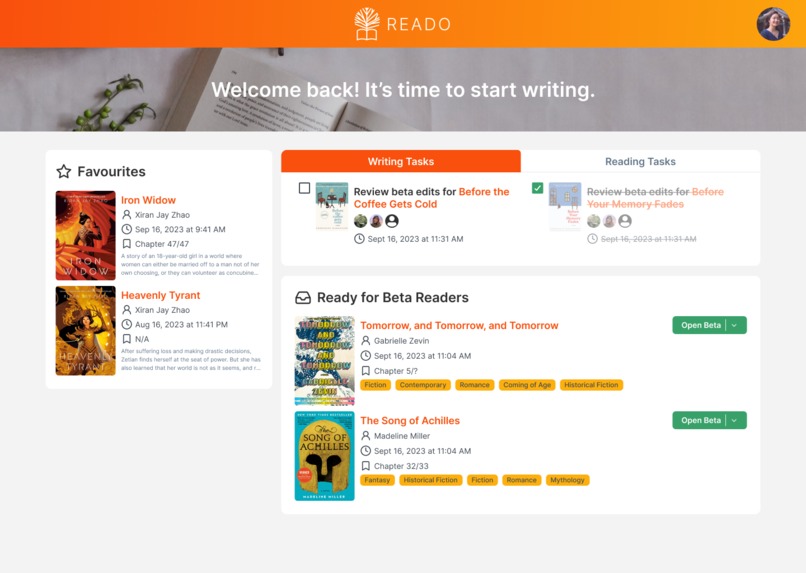
Writer's dashboard with summaries of favourite stories, writing/reading tasks, and projects ready for beta readers
-
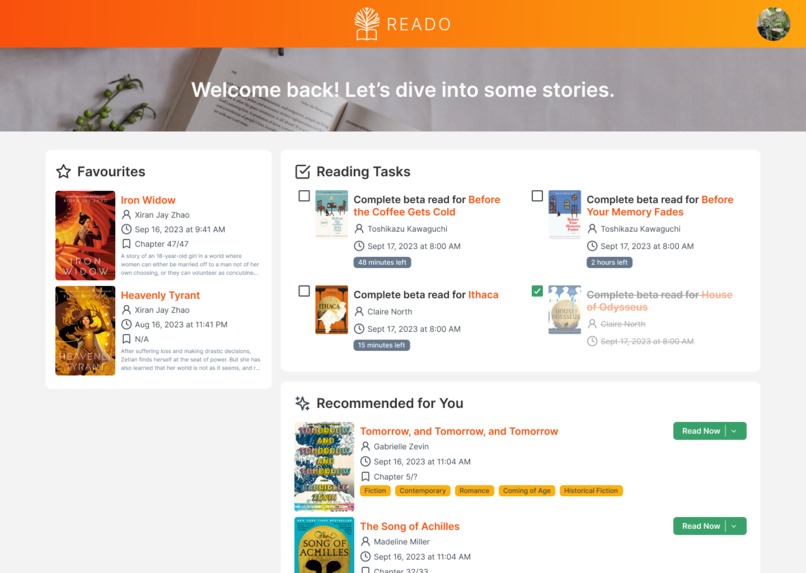
Beta reader's dashboard with summaries of favourite stories, reading tasks, and recommended works
-
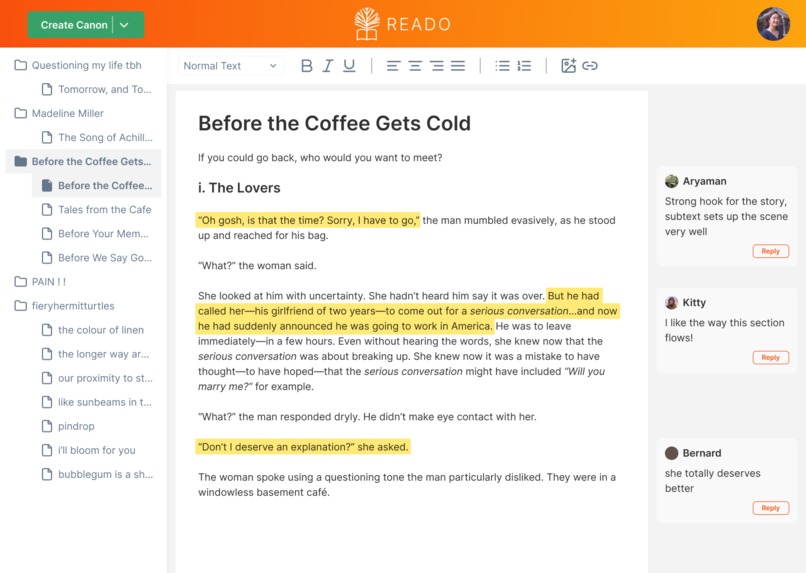
Collaborative text editor for writers to review beta readers' comments, make edits accordingly, and pull the changes into the main story


“Version control is highly correlated with writing habits, but speaking from personal experience, it's frustrating having to make new documents for each structural edit.”
“There's a reason why most of us don't have beta readers and that's because we rely on the goodwill of others for edits.”
💡 Inspiration
Imagine a world where GitHub didn't exist.
Every time you make a change to a line of code, you would need to save a new copy of the file in case you ever needed to retrace your steps.
This is the challenge that writers face: a clunky system of document version control that results in essay-draft1.doc, essay-draft2.doc, essay-final.doc, and so on.
Just like hackers, writers also require document version control to enhance their workflows — it’s important to simultaneously maintain historical versions of their documents and new changes that can be retrieved at any moment.
Additionally, aspiring writers lack a platform for collaborating with their online community of fellow writers, beta readers, and audiences. As such, they often need to seek out, manage, and communicate with these stakeholders on their own – all while writing their stories.
📖 How Reado Works
"People often conflate editing with proofreading, but structural edits are just as important."
Reado is a version control platform for collaborative writing, bringing together writers, beta readers, and audiences to tell stories.
Similar to GitHub, each story is a repository with a single source of truth: the canon (i.e. trunk). When writers create iterations to any part of this main story, they create branches of the story, which can be opened to beta readers for comments and feedback. After making the necessary changes, writers can merge the new branch of the story back into the trunk as a canon event (i.e. pull request). This type of version control is especially beneficial to writers, who will make many structural edits to their story (e.g. rearranging scenes, rewriting scenes, etc.).
Key Features
- Version control for writing
- Text editor and commenting
🔨 How We Built It
With a lot of blood, sweat, and tears...
- Frontend: Astro web framework
- Backend: GitHub API
- UI/UX Design: Figma
❓ Challenges
- Using the Astro web framework for the first time!
- Designing the data and model was challenging, as Git was not made to be a database.
- GitHub API's documentation was unclear at times, posing challenges to back-end development.
- Linking the back-end to front-end was difficult due to the Astro web framework being incompatible with dynamic components.
🏆 Accomplishments
- Successfully using Astro for front-end development.
- Creatively adapting GitHub as a database.
- Leveraging Figma variants for prototyping different interactions.
✅ Key Learnings
- Spend more time properly scoping out the project and tech stack at the beginning to determine potential blockers.
🔮 What's Next for Reado
Research into additional use cases and conversations with industry professionals confirmed that document version control could have many valuable applications. With more time, our team would also invest in additional functionalities that would complement the existing features.
Future Roadmap Items
- Community platform: Building a community of writers, beta readers, editors, and other stakeholders on the platform.
- Content moderation: Use OpenAI Moderation AI or Google’s Perspective AI to scan for inappropriate content.
- Collaborative writing: Enable WebSockets (e.g. socket.io) for bidirectional communication between the client and the server.
- Additional applications: Explore potential applications of existing features in academic papers, the publishing industry, etc.
Ultimately, we hope that Reado will support the demand for diverse and inclusive content by offering a platform where writers and readers from various backgrounds and perspectives can contribute to a community of creative storytelling.
Built With
- astro
- figma
- github




Log in or sign up for Devpost to join the conversation.