-
-
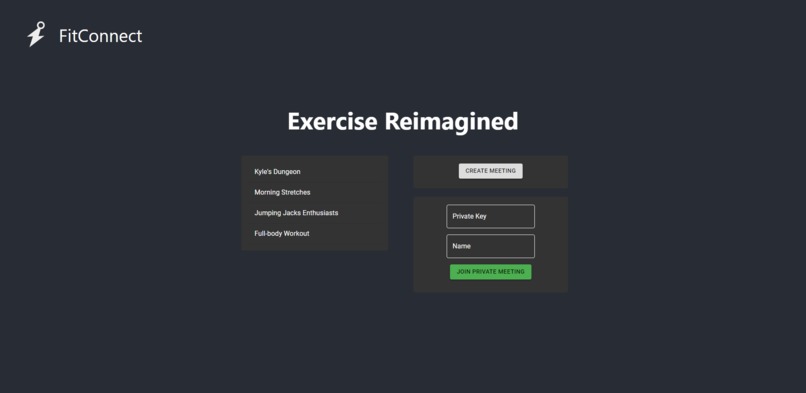
Screenshot of the homepage
-
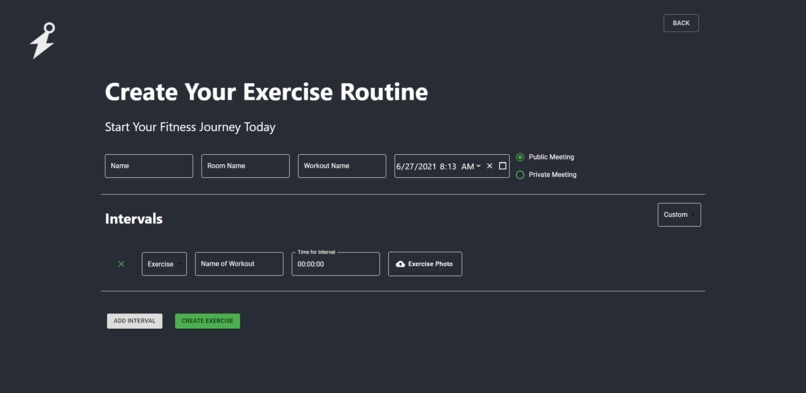
Screenshot of the create exercise page


Inspiration
When COVID-19 hit the United States, gyms began to close, and regulations limiting groups of people coming together were put in place. So, with gyms becoming less accessible and more expensive, our team of seniors turned to their PE class to deliver the necessary fitness. However, we quickly found that Zoom's online platform was not well equipped to handle these types of gatherings. Zoom lacked the necessary organization and social aspect that our app hopes to deliver on. In our PE class, the transition from workout to workout was slow and killed valuable class time. The timer was readout by our coach, who would often take long amounts of time to move onto the next second. And most importantly, we no longer have to rely on our PE class to exercise as a group. Whether we are split up for college or simply not in town, Fitness Connect provides us with the ability to create our routines and exercise as a group.
What it does
FitConnect is a social exercise app designed with features to enhance the social aspect of exercise and to increase the organization of remote exercise. Whether you are creating a private room for friends and family or are creating a public room for all to share, FitConnect is the place to create memories.
How we built it
The bulk of FitConnect is written in Javascript using the ReactJS framework. We also use REST APIs using Python hosted on AWS to send and get information about the meeting rooms and workouts to and from our NoSQL database.
Challenges we ran into
Some challenges that we ran into while building our app were building the REST API, utilizing controlled components, and learning React.js. The REST API was difficult to build because it required us to connect and coordinate all the parts we were working on. While someone was working on the create page and another was working on the video page, we had to come back and coordinate exactly what information would be stored and how it would be stored. The second thing was utilizing controlled components in our code. For example, being able to create as many intervals as you wanted, being able to load a Captain America or Black Panther workout, being able to remove an interval that you did not want required us to utilize controlled components. Lastly, two of our members have no previous background in React.js, one of our members has made one to two projects, and our last member has some experience in React.js. So, since the majority of our group does not fully understand all the packages in React.js, it required us to learn while developing.
Accomplishments that we're proud of
We are all proud that we managed to complete our project for this amazing hackathon. Our 36 hours of hard work have culminated in FitConnect. We are also proud of our ability to integrate several new technologies and techniques that we learned over the course of the hackathon, such as accessibility using the REST API and the use of controlled components to allow for user responsive inputs in React.js.
What we learned
Some of our team members have never had experience with ReactJS before, so they learned a lot about React over the course of the hackathon. For the rest of us, we were able to review our JS skills before we go to college. As mentioned earlier, we also learned about several new JS and React.js technologies and libraries that we utilize in FitConnect.
What's next for FitConnect
We need authentication; users do not always want to stay anonymous. Also, creating FitConnect curated public rooms, connecting with health apps to monitor growth, and partnering with local gyms so that they can provide instructors would be great ways to interact with and help grow the community.


Log in or sign up for Devpost to join the conversation.