-
-

Final Product
-

Top PCB
-
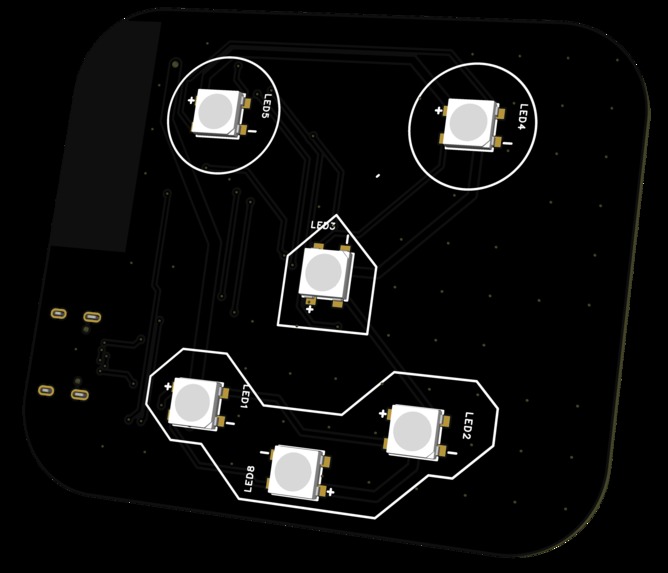
Bottom PCB's Top view
-
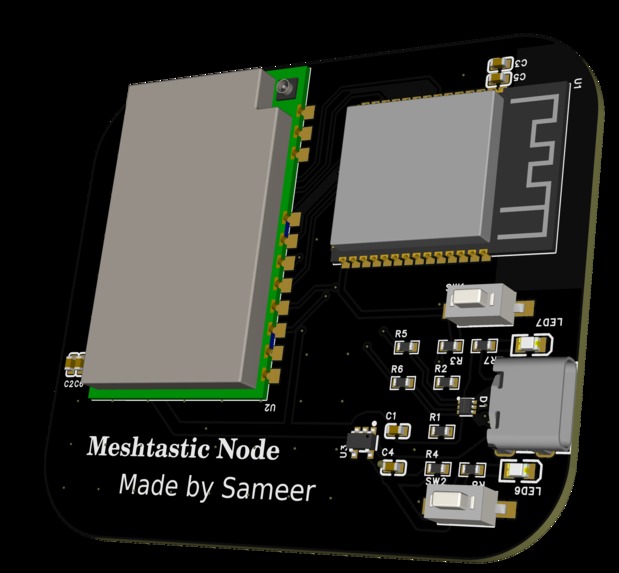
Bottom PCB's Bottom view


Inspiration
This project was inspired by a real-life challenge I encountered during a recent trip to a remote hill station. In that region, proper network infrastructure was almost nonexistent, which made even basic communication extremely difficult. The absence of reliable cellular connectivity highlighted a major dependency on centralized networks for day-to-day communication and data exchange.
This experience led me to think about how communication systems could be made more resilient and independent of conventional infrastructure. The idea was to design a solution that could operate in any part of the world—especially in areas with limited or no network coverage—without the need for a centralized service provider or a government-issued license.
The objective of this project, therefore, is to create a decentralized communication system that allows users to connect and exchange information safely and securely, even in the absence of traditional internet or mobile networks. By eliminating the reliance on centralized infrastructures, this system ensures uninterrupted connectivity, promotes accessibility, and empowers users to communicate freely under any circumstances.
What it does
This device allows people to communicate wirelessly over long distances—up to 12 km—without using the internet, mobile networks, or any kind of license. It works on the 868 MHz ISM band and connects with other similar devices to create a self-hosted mesh network.
Each device acts as a Meshtastic node, forming part of an encrypted off-grid communication system. Messages sent from one node can be passed through multiple devices until they reach their destination, even if the sender and receiver are far apart.
The device connects to a phone, laptop, or tablet using Bluetooth or Wi-Fi. Through the Meshtastic app, users can send text messages that the device forwards to the mesh network. The receiving node then displays the message on the app at the other end.
It is especially useful in areas with poor or no network coverage, such as remote regions, hiking trips, or emergency situations. In short, it provides a simple, secure, and reliable way to communicate without depending on any existing network infrastructure.
How we built it
To start the project, I first researched different types of wireless communication systems and studied how mesh networks work. I explored existing projects like Meshtastic to understand how devices can communicate without relying on the internet or a centralized network. This research helped me choose the right components and plan the design of the device.
After finalizing the concept, I selected the ESP32-S3-N16R8 microcontroller for its powerful performance and built-in Wi-Fi and Bluetooth support. For long-range communication, I chose the E22-900M30S LoRa module, which works efficiently on the 868 MHz ISM band and can transmit data up to 12 km.
Finally, I designed two custom PCBs — one for the main circuit and another purely for aesthetic and structural purposes. I also created 3D-printed enclosures to give the device a compact and durable body while keeping it lightweight and easy to handle.
Challenges we ran into
During the development of this project, we faced several challenges at different stages — from research to assembly.
One of the first challenges was understanding and configuring the LoRa communication protocol. Getting the right settings for frequency, spreading factor, and power level was essential to achieve a stable connection and maximum range without interference. It took several attempts and adjustments to find the most efficient configuration.
Another major challenge was hardware integration. Connecting the ESP32-S3 with the E22-900M30S LoRa module required careful handling of power, logic levels, and pin configurations. Minor mistakes in wiring or code often led to communication failures, so debugging took significant time.
Designing and printing the 3D enclosure also presented some difficulties. Getting the correct dimensions to fit both PCBs while maintaining a compact and aesthetic design required multiple iterations and adjustments.
Accomplishments that we're proud of
One of our biggest accomplishments is successfully creating a fully functional off-grid communication device that can operate without any external network or internet connection. Seeing the concept come to life — from initial research and design to a working prototype — was a major achievement for our team.
We are proud of how the device can communicate wirelessly over long distances (up to 12 km) using the 868 MHz ISM band, while maintaining strong and stable connections between multiple nodes. Achieving this level of performance with minimal power consumption and no centralized infrastructure was a significant technical milestone.
Another accomplishment was the compact and aesthetic design of the device. By combining two custom PCBs with 3D-printed enclosures, we managed to create a device that is both functional and visually appealing.
We also take pride in the ease of use and compatibility of the system. The device can seamlessly connect to smartphones, laptops, or tablets via Bluetooth or Wi-Fi, allowing users to send encrypted messages through the Meshtastic app with minimal setup.
Overall, this project demonstrated our ability to integrate hardware, wireless communication, and design into a single, reliable product. It reflects our dedication to solving real-world communication challenges with innovation and creativity.
What we learned
Throughout the development of ⚡ SPECTR ⚡, we gained a deep understanding of how wireless communication systems and mesh networks function. We learned how LoRa technology can be used to create long-range, low-power networks that operate independently of traditional infrastructure.
Working with the ESP32-S3 microcontroller helped us improve our knowledge of embedded systems, serial communication, and integrating multiple modules to work together smoothly. We also developed valuable skills in PCB design, 3D modeling, and hardware debugging, which taught us the importance of precision and planning in every stage of the build.
Beyond technical skills, we learned how to approach real-world problems with creativity and persistence. Every challenge we faced—from design adjustments to component selection—helped us become better at problem-solving, collaboration, and system optimization.
Overall, this project strengthened our understanding of both the technical and practical aspects of building reliable communication devices and gave us confidence to take on more advanced hardware projects in the future.
What's next for ⚡ SPECTR ⚡
Looking ahead, we plan to further improve ⚡ SPECTR ⚡ by enhancing both its hardware and software capabilities. One of our main goals is to reduce the device size and power consumption, making it even more portable and energy-efficient for field use.
We also aim to add GPS and sensor integration, allowing the network to share not just messages but also location and environmental data between nodes. This would make the system more useful for outdoor activities, disaster management, and search-and-rescue operations.
On the software side, we plan to work on improving the user interface and connectivity options, ensuring smoother communication between the device and the Meshtastic app.
In the long run, we hope to make ⚡ SPECTR ⚡ an open-source project so that others can build, customize, and contribute to it — helping create a stronger and more connected off-grid communication community.
Built With
- easyeda
- esp
- lora
- meshtastic
- onshape


Log in or sign up for Devpost to join the conversation.