-
-
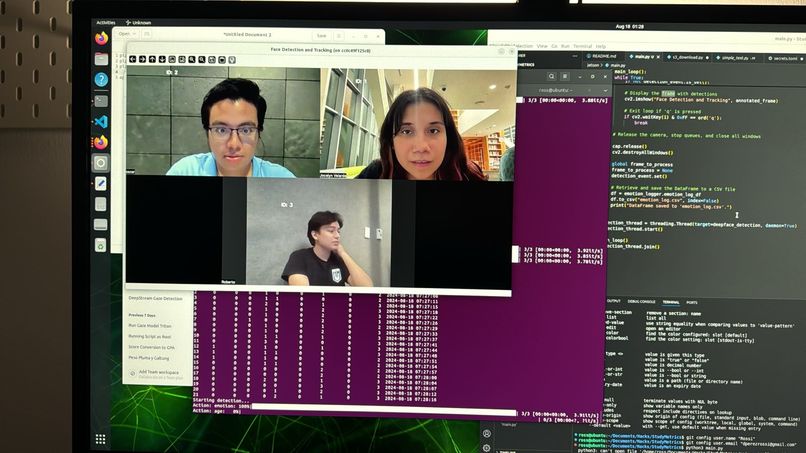
Live video analysis from recording
-
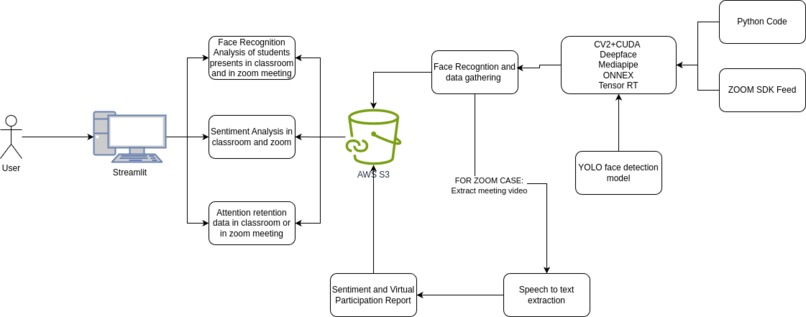
Architectural Overview
-

Financial Projection of the Project


Inspiration
In recent years México has been lagging behind in education. The long lasting effects of the pandemic has left students with complications during their learning experience, as most feel that they can't pay attention for long stints, and sadly this is not only a reality for México, as it also affects other countries, as The Guardian's article mentions "The survey of 504 primary and early years teachers in schools in England by the online subject resource Kapow Primary found that 84% agreed that children’s attention span was “shorter than ever” post-Covid. Nearly two-thirds (69%) had noticed an increase in inattention and daydreaming".
This is why we decided to attack this problematic the innovative solution, study metrics, an AI SaaS that empowers teachers into creating new and innovative experiences for their students, all by the power for artificial intelligence as a data centric approach.
What it does
We evaluate the performance of classes by analyzing the feelings, and attentiveness of the students in a physical or digital classroom. The data is collected in a second by second basis, thus enabling a granular approach on understanding areas of opportunity within the class, thus empowering teachers to uncover new ways to mitigate student disengagement.
Business Approach
In order to turn this idea we evaluated the Mexican market as a first approach. Through a market research we found that in Mexico City there are 9,293 schools, which we need to only attack 1.99% of the market in order to create a SaaS that is profitable in it's first month. To do this we decided to do an initial rollout using physical hardware that we rent to schools, which lowers our variable costs connected to the use of cloud computing, which has also a great advantage, as the tasks of video analysis are not required to perform in real time we can distribute the resources into other endeavors or clients, thus minimizing API costs. With this implementation of our business model we are geared to become a thriving SaaS startup, generating around 40k USD in our first year by only targeting less than 2% of all schools in Mexico City.
How we built it
Programming Language: Python Front End: Streamlit Computer Vision: Opencv +CUDA Deepface Mediapipe ONNEX Tensor RT YOLO Large Language Model: OpenAI Speech Recognition Model: WhisperX Sentiment analysis library: nltk VADER Textblob Data Base: Amazon S3 Other Tools: ZOOM SDK
Why we believe it will transform how educators teach
StudyMetrics will revolutionize education by providing educators with actionable insights into student engagement in real-time. By using AI to analyze students' emotions and attentiveness, teachers can pinpoint exactly when and why students lose focus. This allows for immediate intervention and tailored teaching strategies that resonate with individual students' needs. No longer will educators have to rely solely on traditional assessment methods; instead, they can adapt their teaching on the fly, making education more dynamic, inclusive, and effective. The ability to personalize learning experiences based on data-driven insights will empower teachers to reach students like never before, ultimately leading to better learning outcomes and more engaged classrooms.
Use of AI and Computer Vision Algorithms
The approach we use in our case for computer vision is primarily based on optimizing the resources available on the system. We opted for a tiny YOLO model specifically designed to detect only two states, which allows the program to operate more efficiently and consume fewer resources.
Computer vision tools, such as OpenCV, can be quite demanding in terms of processing power, especially when aiming to provide a high-quality user experience. However, recent technologies enable us to leverage the potential of modern graphics cards through the use of tensors, which optimize both performance and processing efficiency.
The use of tensors, in conjunction with libraries like TensorRT, facilitates the deployment of deep learning models that are highly efficient and fast. This results in real-time processing capabilities, which are crucial for applications where latency and speed are determining factors.
Challenges we ran into
One of the constant challenges we faced was during the installation of the necessary tools, particularly when it came to installing CUDA, cuDNN, and OpenCV. Compiling these libraries often resulted in errors that required significant time to resolve, including uninstalling previously installed components. In the most extreme cases, when Ubuntu ceased to function properly, we resorted to reformatting the system to start over. Fortunately, after several attempts and a downgrade of the operating system, we were able to resume work with improved fluidity.
Accomplishments that we're proud of
We're proud of creating a solution that not only works but has the potential to make a significant impact on education. Successfully integrating multiple AI and computer vision technologies into a single, cohesive system is a major achievement. We were able to optimize our models to run efficiently on local hardware, reducing operational costs and making our solution accessible to schools with limited resources. Additionally, the ability to generate actionable insights from complex, real-time data is a testament to the robustness and effectiveness of our approach.
What we learned
Throughout this project, we learned a great deal about the usage of Amazon Web Services and the application of computer vision techniques involving systems like CUDA. What stood out to us during the 36 hours of building this project was the immense potential of AI in educational contexts. We realized how powerful AI could be as a tool for the benefit of all, reinforcing our commitment to leveraging technology for meaningful impact.
What's next for StudyMetrics
The future for StudyMetrics involves scaling our solution to more schools and expanding our feature set. We plan to incorporate more advanced AI models for even deeper analysis of student engagement and explore partnerships with educational institutions to refine our algorithms based on real-world feedback. Additionally, we're looking to expand our market beyond Mexico City, eventually reaching schools across Latin America and globally. We also aim to explore integrations with existing educational platforms, making it easier for schools to adopt our technology. Continuous improvement, driven by user feedback and ongoing research, will keep StudyMetrics at the forefront of educational innovation.
Built With
- amazon-web-services
- cuda
- cudnn
- jetson
- openai
- python
- s3
- speech-to-text
- streamlit
- whisper
- yolo


Log in or sign up for Devpost to join the conversation.