-
-
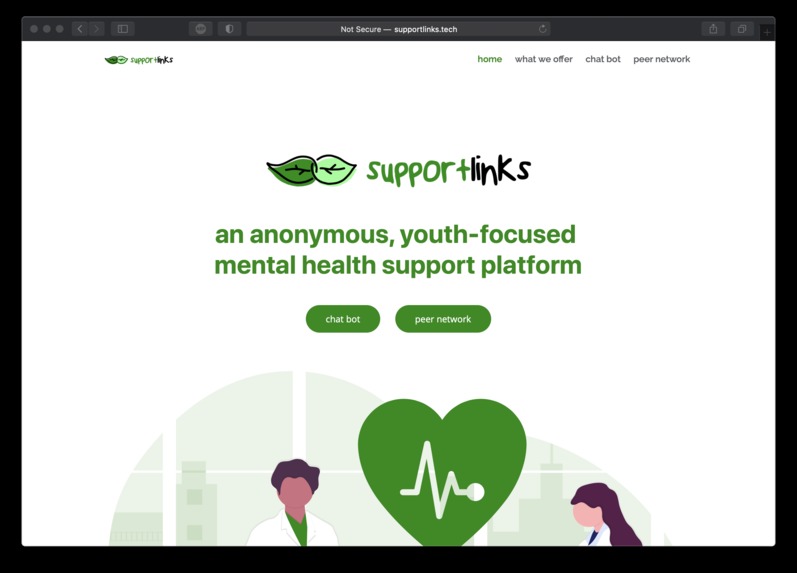
the home page for supportlinks

inspiration
it is estimated that 13–20% of youth living in the United States experience a mental disorder in a given year. the pandemic certainly hasn't helped, and 56.2% of young adults (ages 18-24) now report symptoms of anxiety and/or depressive disorder.
youth's mental state is deteriorating, and we need resources for youth well-being now more than ever.* with link, we can help users identify the root of their symptoms and compile mental health resources all in one place, providing users with everything they need in one place. there has also been research in support of peer support, so we chose to add peer connection to our platform.
what it does
the basis of our platform is link (they/them), a natural language understanding chatbot. they’ve been trained to recognize depression, suicidal tendencies, stress, anxiety, and some eating disorders. by sharing what you’re feeling with a link, they’ll provide you with student-centered resources to seek help and make strides towards a healthy mind. if you’re in crisis, in danger, or harmed, they will connect you to hospitals in your area. link can also introduce you to our peer network.
our peer network is our second core offering. beyond connecting you with external resources, we can link you to other students with similar experiences.
how we built it
we built link, our favorite chatbot, using Google Cloud’s Dialogflow, with all interactions implemented as intents. in cases of injury and crisis, we connected link with the public Hospital General Information dataset using BigQuery API. our website was built using HTML/CSS/JS and our logo was custom-designed.
challenges we ran into
our biggest challenge was our lack of experience with integrating BigQuery API with Dialogflow—having used neither of this before this hackathon and with limited online documentation, we really struggled; thankfully, our mentor, Ron, was incredible and helped us work through the integration.
accomplishments that we're proud of
we're incredibly proud of our finished chatbot. link successfully provides users with resources relevant to their needs, and is capable of recommending our peer network and identifying local hospitals. we're also super proud of our branding and finished website because it's functional and aesthetically pleasing.
what we learned
we learned how to use Dialogflow for the first time, as well as how to integrate an API with Dialogflow. we also learned how to use Google's BigQuery to search databases. on the side, we learned more about responsive web design and branding!
what's next for supportlinks
our first steps will be to compile more mental health resources and better train link to identify causes; we will also want to incorporate specificity within broad categories, such as subsets of anxiety. next, will will expand our peer support network and build a connection platform specific to supportlinks to better preserve anonymity and allow for instantaneous, automatic connection. (our connect network is currently not automated and run through Google Forms but, with more time, we hope to use Flask and a database to store users; in addition to an anonymous text platform, we hope to also implement a Clubhouse-esque anonymous call platform.)
Built With
- api
- css
- dialogflow
- google-bigquery
- html
- javascript


Log in or sign up for Devpost to join the conversation.