-
-
Our mission is to promote Carbon Centric Browsing
-


Inspiration
As internet users, we often don't think about the impact that we may have on the environment. We remember to turn off the lights or shut off the water, but we often leave videos playing in the background unknowingly or download multiple identical files, wasting valuable resources used to stream and play the video. With enough users on the internet, these wasted resources can quickly pile up - if users were to leave 25% of videos playing in the background, an equivalent of 323,000 tonnes (metric for tons) of CO2 will be produced in total. Other activities also have an impact: Google searches, file downloads, etc.
If users were more aware of the carbon footprint of their internet activity, they would be more inclined to reduce their screen time and thus reduce their impact. With enough users, we can really make a dent and reduce emissions.
What it does
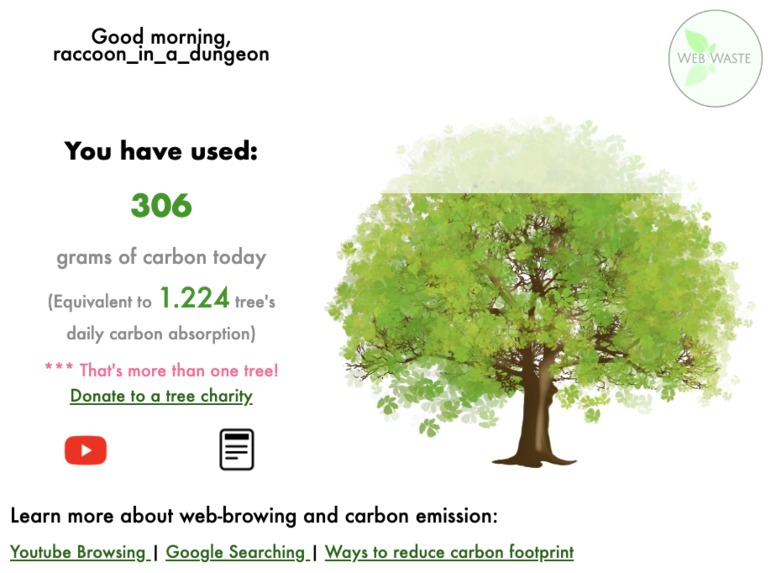
WebWaste is a Chrome extension that tracks the carbon footprint of your internet browsing activity and displays it to you in the form of grams of carbon emitted and the equivalent number of trees needed to absorb this amount. Additionally, we included additional features to conserve resources: preventing Youtube videos from being played in the background and disabling multiple downloads of the same file. These features can be disabled by the user if desired (if the user wanted to play music in the background, for example).
How we built it
Since WebWaste is a Chrome extension, we used web technologies such as HTML, CSS, JavaScript, and Google Chrome APIs. We started by conducting online research to understand more about the effects of technology on carbon emissions. From then, we set up a Chrome Extension and started developing our logic for the core functionality as well as the front-end design for the popup.
For storing user data, we simply used Chrome's data features, which can sync across devices using a user's account.
Challenges we ran into
Most of us had less experience with Chrome extension development, so it was challenging to get started. It was a challenge understanding how Google Chrome's Storage & Download API worked, since Google Chrome is a particularly different technology.
Accomplishments that We're Proud Of
We're proud of the coordinate effort it took to bringing together the project, from researching about carbon emissions, designing what the project would consist of, and developing the logic for our functionality. We are also very proud of the front-end that we created which we feel accurately shows how much carbon dioxide the user uses.
What I learned
We did a lot of research on the impact of internet browsing, and it was really interesting to see how all our activity adds up and how much of an impact we really have. Chrome extension development was also a new skill we picked up, and it was really fun!
What's next for WebWaste
We see WebWaste as the future of spreading awareness about digital carbon footprints. We hope to include more accurate measurements from sites such as Amazon, Facebook, and any website in general.
Bibliography
- https://blog.mozilla.org/firefox/digital-carbon-footprint/
- https://dl.acm.org/doi/10.1145/3290605.3300627
- https://searchengineland.com/calculating-the-carbon-footprint-of-a-google-search-16105
- https://www.co 2meter.com/blogs/news/could-global-co2-levels-be-reduced-by-planting-trees
- https://www.google.com/search?q=grams+to+pounds&oq=grams+to+pounds&aqs=chrome.0.0l8.1672j0j7&sourceid=chrome&ie=UTF-8


Log in or sign up for Devpost to join the conversation.