Answer Engine Optimization (AEO) is how brands get cited inside AI-generated answers from ChatGPT, Perplexity, Claude, Grok, and Google AI Overviews.
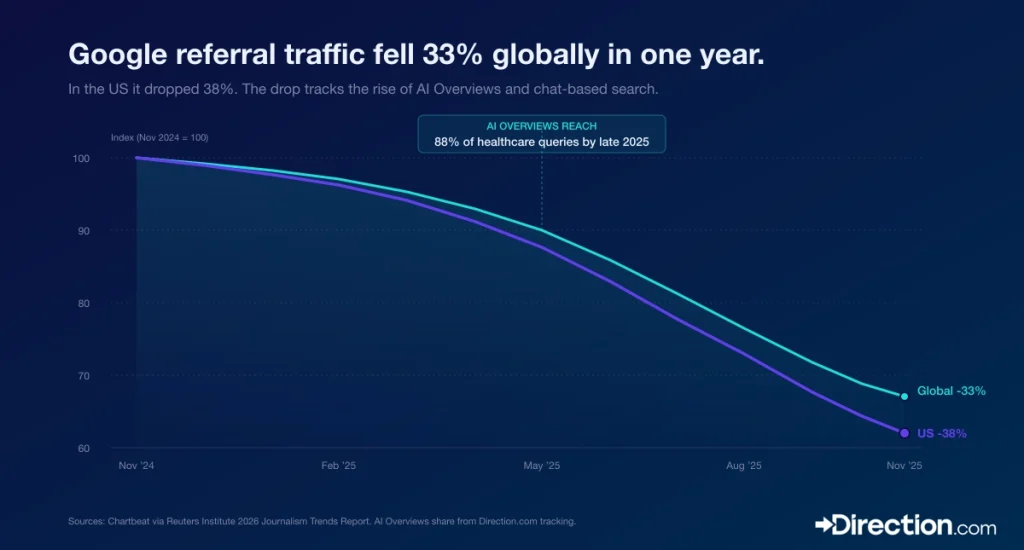
Chartbeat data published in the Reuters Institute’s 2026 Journalism Trends Report shows Google search referral traffic dropped 33% globally and 38% in the US between November 2024 and November 2025, and AI Overviews now show on 88% of healthcare-related Google queries by late 2025.
We hit the peak of the AEO hype cycle in healthcare marketing about eighteen months ago. Noise hasn’t stopped since. Every LinkedIn feed has a consultant warning that practices not investing in AEO right now will be invisible to ChatGPT by year’s end. Most of those consultants are repackaging the same SEO services they’ve sold for a decade, with a new acronym attached.
AI answers have changed organic search, and healthcare practices are feeling it in patient call volume. Rankings are going up while inbound calls are going down.
Is there really anything different in AEO from SEO? We audited 40 AEO programs at Direction over the past 18 months (some ours, most belonging to other agencies or in-house teams asking for second opinions). Only four were doing something genuinely distinct from solid technical SEO with FAQ schema layered on top. Four out of forty.
So what were the four doing that the other 36 weren’t?
What is Answer Engine Optimization (AEO)?
A patient pulls out their phone at 9pm on a Sunday and types into ChatGPT: “best fertility clinic in Buckhead Atlanta.” Three practice names come back. AEO is the work that decides whether your practice is one of those three.
If your name isn’t there, the patient never knows you exist. They book one of the three. You can’t see the loss in your analytics because the patient never visited your site.
The Zero-Click Trap
Patients searching “best cosmetic dentist near me” used to scan ten blue links and call one practice the next day. Now they get the answer at the top of Google’s AI Overview, or ask ChatGPT at home, and never click any practice site. Rankings stayed the same. Traffic disappeared.
I call this the Zero-Click Trap. Joy Hawkins has been writing about the same pattern from the local SEO side for nearly a year now. Healthcare practices ranking well in Google’s blue links are seeing those useful rankings be less useful over time. Pew Research found 26% of users end their search right after reading the AI answer.
Answer Engine Optimization is the response. You stop competing for a click that won’t happen anymore. You work to become the source AI cites inside its answer.
Why does AEO matter more in healthcare than in other industries?
Patients asking ChatGPT about hormone therapy are researching a decision with real consequences for their bodies and their families. When AI shows your practice as a recommendation, patients are actually a lot more pre-qualified, so conversion math differs from a cold lead off paid search.
What’s that look like in the data?
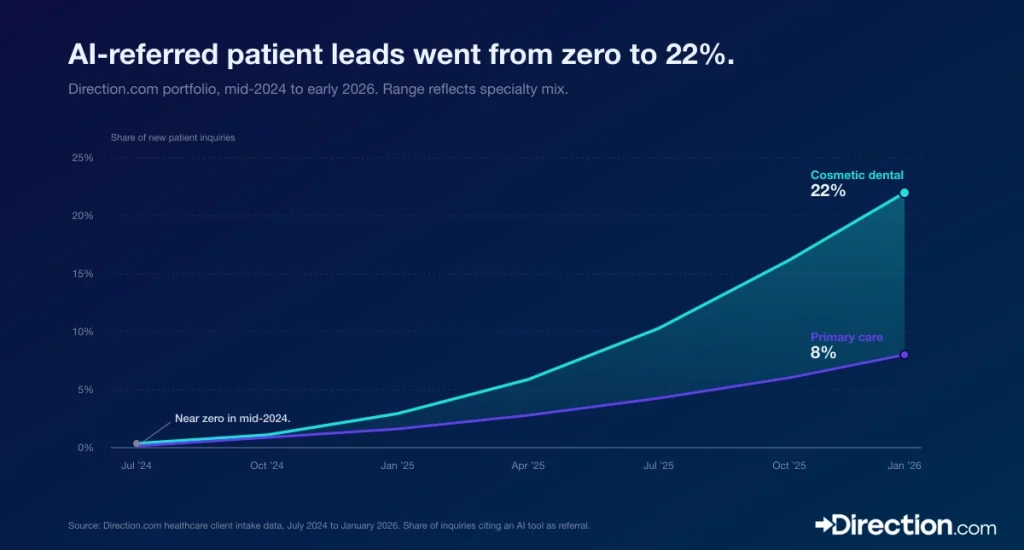
Our intake numbers show AI-referred leads grew from near zero in mid-2024 to between 8% and 22% of new patient inquiries by early 2026, depending on the specialty (cosmetic dental at the high end, primary care at the low end).
Enough volume to matter for revenue planning, and the trend continues climbing every month.
How does AEO relate to SEO?
SEO gets your page ranked. AEO gets your content cited inside the AI answer. Same web underneath both methods, different selection criteria on top of it.
AEO builds on your SEO foundation. Meaning your overall online reputation, content quality, technical health, and backlink profile combined are what let AI find and trust your content in the first place. Practices abandoning SEO to chase pure AEO undermine the authority signals that make AI citation possible.
Agencies pitching AEO-only programs leave out what happens at month six: AI citations drop when authority signals weaken underneath them. Backlinks, technical health, content depth, and the rest of the SEO fundamentals are what AI systems use to decide whose name to surface. Cut the SEO budget and the AI citations disappear within months.
What are the four AEO moves that actually work?
Four differences came up between who was doing real AEO vs. who was just repackaging SEO.
1. Build web-wide brand presence.
Brand mentions across podcasts, publications, directories, Reddit, YouTube, and social media correlate with AI Overview presence at 0.664, compared to 0.218 for backlinks (Ahrefs 2025 analysis of 75K brands). Muck Rack’s Generative Pulse 2025 report found 82% of AI citations come from earned media.
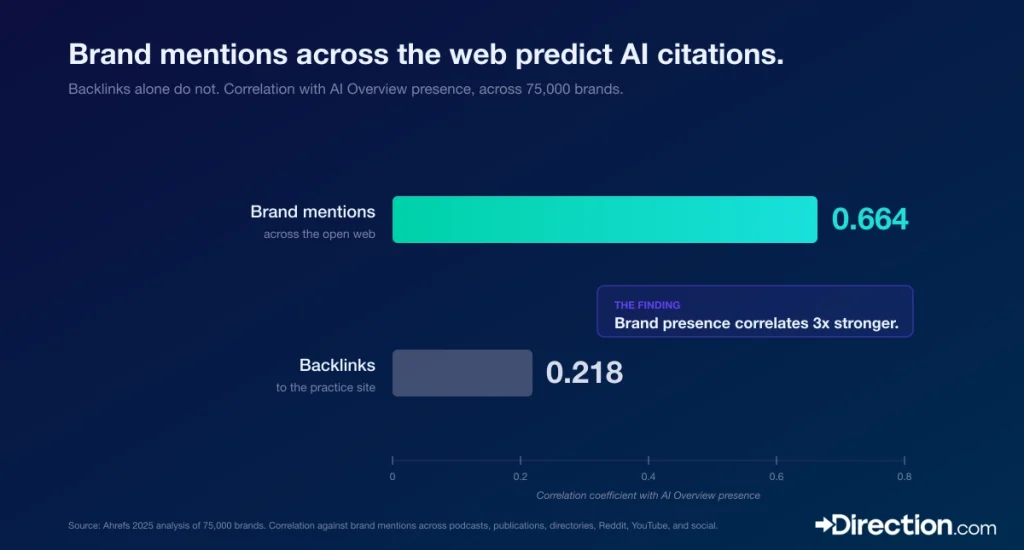
Your own site contributes the other 18%. Practices with strong brand mention growth get mentioned by AI engines 3 to 4 times more often than peers with flat brand presence. Sources and statistics inside your content lift AI visibility by another 41% (Princeton/Georgia Tech 2024 GEO research). Four channels matter most: digital PR placements in healthcare publications, provider profiles on Healthgrades and Zocdoc, podcast and YouTube appearances, and consistent social media activity.
2. Show up across all six AI engines.
Patients are asking healthcare questions across:
- ChatGPT (~900M weekly users by early 2026)
- Google AI Overview (88% of tracked healthcare keywords show one)
- Perplexity (30M+ monthly users)
- Google Gemini (750M+ monthly users per Alphabet’s Q4 2025 earnings)
- Anthropic Claude (18.9M monthly web users)
- xAI Grok (60M+ monthly users)
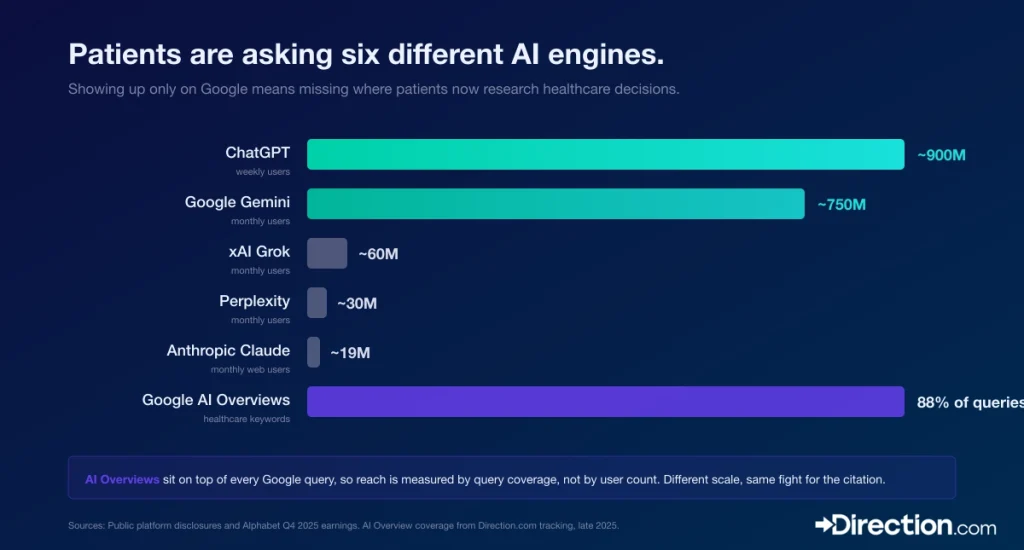
And on top of that, each large language model (LLM) pulls from different sources.
- ChatGPT leans on Mayo Clinic, WebMD, MedlinePlus, and YouTube transcripts.
- Perplexity rewards structured FAQ pages and peer-reviewed citations.
- Gemini overlaps with Google’s organic ranking signals.
- Claude leans on long-form sourced content.
- Grok pulls from X posts and Grokipedia entity pages.
SE Ranking’s analysis of 50,807 health queries found Reddit and YouTube transcripts dominate healthcare AI citations. Practices showing up only on Google are losing ground to competitors mentioned across all six.
Now, SEO is no longer just Google and Bing. With six additional search engines having different methods of optimizing for, it’s certainly not easy to stay on-top of all of them. But the good news is that if you have great SEO fundamentals, your chances of appearing in each of those six LLMs are way higher.
3. Deploy the three-layer healthcare schema stack.
MedicalBusiness for the practice, Physician for each provider, MedicalProcedure for each service. Schema’s job here is entity recognition, helping AI verify your practice, your providers, and your services as one connected system.
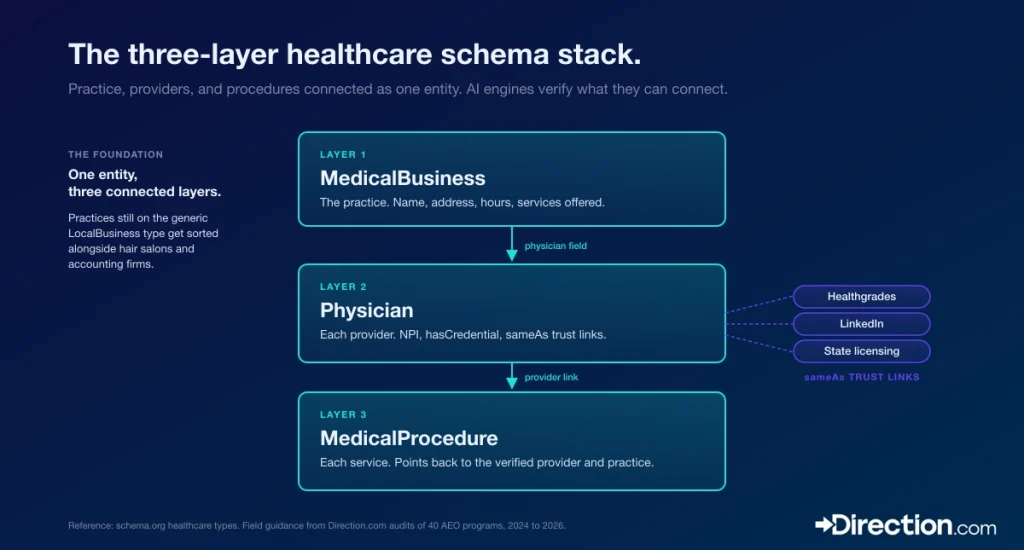
Practices still running LocalBusiness get categorized alongside hair salons and accounting firms, which makes entity confirmation harder for the AI engines trying to figure out who you are. Google’s March 2025 core update reinforced this. Sites with verified named expertise gained ground while faceless content sites lost it.
Three layers need to connect: MedicalBusiness includes a physician field pointing to your providers, each Physician carries NPI, hasCredential, and sameAs links to Healthgrades and LinkedIn, each MedicalProcedure points back to the verified provider and practice. AI engines can’t verify what they can’t connect.
4. Build a quarterly content refresh cadence.
Half of all content cited by AI answers is less than 13 weeks old (Frase 2026 GEO analysis). A blog post ranking #1 on Google can fall out of AI citations entirely within a quarter.
SEO content compounds; AI content decays. Fix that with a quarterly cycle: pull your top 20 pages by organic traffic, run each target query through Perplexity and ChatGPT, identify which pages have dropped out of AI mentions, refresh the content (updated statistics, current treatment protocols, named provider authorship, verified structured data), update the “last updated” date in schema, and resubmit through Search Console.
Healthcare practices treating content as a one-time investment lose AI visibility steadily, even when organic rankings hold.
How do you measure AEO performance?
Google Analytics misses most of your AEO impact. GA can’t see inside ChatGPT, Perplexity, Claude, or Google AI Overviews. Most practices doing AEO can’t tell if the work’s paying off until intake patterns shift months later.
Four signals worth tracking:
- Search in incognito in each AI platform weekly using your patients’ most common questions, and document where you appear versus where competitors get cited.
- Watch Google Search Console branded search trends. Spikes after content publishes often correlate with AI citation activity.
- Track direct traffic patterns. A rising direct traffic trend alongside flat organic is sometimes an AEO signal (not conclusive alone, but worth investigating with other data).
- Add “ChatGPT or another AI tool” as an option on your intake “How did you hear about us?” question. Our portfolio has seen AI-referred intake grow from zero in mid-2024 to between 6% and 18% by Q1 2026.
None of these alone is conclusive. Combined, they tell you whether AEO’s producing real patients or just slide-deck vanity metrics.
What do practices get wrong most often with AEO?
A few patterns show up repeatedly in our audits.
Treating schema as a direct cause of AI citations.
Schema matters for entity recognition, but it doesn’t directly cause more AI citations on its own. Ahrefs tracked 1,885 pages that added JSON-LD between August 2025 and March 2026, matched against 4,000 control pages, and found no statistically meaningful citation uplift on Google AI Mode (+2.4%), ChatGPT (+2.2%), or Google AI Overviews (where treated pages actually dropped 4.6% versus controls).
A separate searchVIU experiment found that during real-time retrieval, every major AI engine extracted only visible HTML content. JSON-LD got ignored entirely. 53% of AI-cited pages running schema correlate with the broader signals AI actually weights: brand mentions, content depth, technical health, and link quality. If your underlying content and authority signals are weak, schema won’t make up the difference.
Writing in marketing voice instead of patient voice.
Marketers write “all-inclusive dental implant solutions for tooth replacement.” Patients ask “what’s the best option for replacing a missing back tooth?” Build content around the patient version every time.
Building new content instead of restructuring and refreshing existing content.
Most practices have years of trustworthy content already on their site, just packaged in formats AI struggles to extract from. Restructuring usually works better than rewriting (and is dramatically cheaper).
Abandoning SEO entirely.
I’ve been hearing about the “SEO is dead” narrative since 2010. It’s never happened, and fear that it will is a dangerous move. Don’t cut your SEO investment. Those who do watch their AI citations drop six months later because the foundation weakened underneath them. Anyone selling that narrative is usually selling something new and trying to make what you already have look obsolete.
What comes next for AEO in healthcare?
Here’s my expectation on what’ll happen over the next 18 months.
AI agents are moving from answering questions toward taking actions (scheduling appointments, comparing providers, contacting practices). Practices cited in AI recommendations now are probably the first ones agents surface to patients. Probably. Agent rollouts could slow if liability questions around medical recommendations get answered restrictively, which I’d welcome for patient safety.
Voice queries keep growing fast, especially in healthcare, where patients are driving, multitasking, or just don’t want to type at midnight. AEO content with clear structure performs well across voice interfaces because retrieval mechanics overlap with text-based AI search.
Less certain territory: which platforms dominate two years out. ChatGPT could lose some lawsuits they’re in, and lose share to a new, better-funded competitor. Perplexity could consolidate or get acquired. Google AI Overviews could roll back if accuracy complaints keep mounting across the industry. Grok could become the leading tool. Who knows.
Thing is, none of that changes the actual work. Under all that platform churn, AI rewards content that’s useful, credible, and complete. Build content that earns it and the platform question matters less than whether you deserve the citation.
Frequently Asked AEO Questions & Answers
How is AEO different from SEO?
Different goals on top of the same foundation. SEO targets the ranking signals that determine whether your page appears in search results. AEO targets selection criteria AI uses when picking what to cite. Success looks different too: rankings and clicks for SEO, versus AI citations, branded search lift, and patients calling who mention an AI tool when the front desk asks how they found you.
How long until AEO shows results?
Faster than traditional SEO, but variable depending on starting position. Well-structured content answering high-interest questions can start appearing in AI citations within 2 to 4 weeks of publication. AI systems update their knowledge bases more frequently than Google recrawls pages.
Can small practices compete with large health systems?
Often more effectively than they can on traditional SEO. Health systems produce broad generalist content across hundreds of specialties at once. Independent practices can own specific niches with deep specific answers a system trying to cover 400 conditions won’t bother producing. A solo orthodontist with the most complete adult-orthodontics resource in their market regularly outranks a major health system’s generic orthodontics page in AI citations.
Which content formats work best?
FAQ sections in simple-to-understand patient language get cited most often. Comparison tables with clear criteria, step-by-step procedural guides, and glossary-style definitions in plain English all get cited regularly. Common thread: formats that make information easy for AI to grab and use on its own.
How often should AEO content get updated?
Six months minimum on primary pieces. More often for topics where clinical guidelines, pricing, or treatment technology shifts faster than that. AI favors current information when building answers, and outdated stats kill citation rates fast in our portfolio data. Build review cycles into your calendar.
Get Your AEO Strategy Taken Care Of
If you want a second opinion on how your practice is showing up across AI platforms, our team at Direction runs AEO audits as part of our healthcare engagements. Reach out today, and we’ll walk through what we’d test for your specific market.