
What's new?
Advancing GMS-2030
Explore our latest infographics for key updates on GMS-2030 implementation


2030 Vision
The GMS-2030 Vision is to develop a more integrated, prosperous, sustainable, and inclusive subregion.


Where We Work

Transport
The GMS Program is advancing intermodal transport, enhancing cross-border logistics, and improving road safety. It focuses on developing railways, ports, and inland waterways, and promoting investments in airports and secondary roads to boost regional connectivity and support underserved communities. The GMS Transport Sector Strategy 2030 provides a unified framework for cooperation in these efforts.

Environment
Natural ecosystems – and the food, water, energy, and other vital elements they provide – lie at the heart of the development of the GMS. How these natural resources are protected, managed, and enhanced will determine the long-term sustainability of its environment and economic development. The GMS Climate Change and Environmental Sustainability Program prioritizes actions to accelerate implementation of selected GMS-wide interventions towards meeting the national and international commitments on climate resilience, greenhouse gas mitigation, biodiversity conservation, and environmental sustainability.

Energy
New energy solutions are crucial to developing the GMS, where power demand is surging. The GMS Program promotes a just energy transition to low-carbon and renewable energy resources by (i) expanding clean energy trade, including the development of interconnections; (ii) initiating efficiency and conservation measures; and (iii) strengthening capacities for energy transition. Through the GMS Energy Transition Task Force, the program is creating an open platform for enhanced energy cooperation with the ASEAN and development partners.

Urban Development
By 2050, GMS is expected to be at least 50% urbanized. Careful planning is needed to balance urban growth with environmental protection and economic equity so that healthy cities can be enjoyed by all residents.

Trade & Transport Facilitation
The GMS Transport and Trade Facilitation Action Program is working to overcome existing barriers in order to link the subregion to the ASEAN Economic Community’s single market and production base, as well as other regional cooperation initiatives.

Health Cooperation
GMS health priorities focus on communicable disease control. The GMS Program also aims to accelerate universal health coverage, strengthen health systems to manage public health threats, and support compliance with the World Health Organization’s International Health Regulations through a unified “One Health Approach.” The new GMS Health Cooperation Strategy 2024-2030 aims to guide programming, foster innovation, increase engagement with key stakeholders, and mobilize new project financing.

Tourism
GMS tourism promotes post-COVID-19 pandemic recovery efforts and the development of higher value-added and secondary destinations. It will also strengthen human capital, connectivity infrastructure, public–private linkages, and environmental sustainability. Countries in the GMS are working together to promote the subregion as a single destination with diverse, high-quality subregional products, distributing tourism benefits widely while minimizing adverse impacts.

Agriculture
GMS has a great opportunity to be a major supplier of safe and environment-friendly agriculture products. The GMS-2030 Kunming Strategic Framework for Transformation of Agrifood Systems (GMS 2030 KSFTAS) addresses the evolving needs of the subregion’s agricultural sector, while aligning with broader GMS cooperation initiatives. It outlines a strategy for transforming the agrifood trade as a crucial economic driver through sustainable farming systems, low-carbon and climate resilient value chains, digital technologies, and financing mechanisms to enhance livelihoods, reduce food loss, and meet the rising demand for safe, high quality, and green products.


Latest Publications

GMS Strategy for Private Sector Engagement
This publication outlines a practical approach to strengthen private sector involvement in the Greater Mekong Subregion (GMS) Economic Cooperation Program, aligning with GMS-2030 and national development plans. The strategy sets a roadmap for deeper and more structured collaboration with businesses, from dialogue to delivery. Its goal is to harness private sector expertise, resources, and innovation to drive sustainable economic growth and address regional challenges, fostering dynamic, innovative, and results-oriented solutions that ensure private sector participation delivers tangible benefits across the subregion.

GMS Regional Investment Framework 2026-2028
This publication presents the Greater Mekong Subregion (GMS) Economic Cooperation Program’s Regional Investment Framework 2026–2028 (RIF 2028)—a three-year rolling pipeline that translates the program’s strategic priorities into actionable investments and initiatives. Reflecting a strong commitment by GMS countries to deepen subregional cooperation, the latest RIF features 88 regional priority projects with a total estimated value of $18.8 billion. Driven by transformative transport investments and diverse sectoral priorities, the RIF 2028 embodies the region’s ongoing efforts to mobilize resources for integrated, sustainable growth and tangible impacts across the subregion.

GMS-2030 Kunming Strategic Framework for Transformation of Agrifood Systems
GMS has a great opportunity to be a major supplier of safe and environment-friendly agriculture products. The GMS-2030 Kunming Strategic Framework for Transformation of Agrifood Systems (GMS 2030 KSFTAS) addresses the evolving needs of the subregion’s agricultural sector, while aligning with broader GMS cooperation initiatives. It outlines a strategy for transforming the agrifood trade as a crucial economic driver through sustainable farming systems, low-carbon and climate resilient value chains, digital technologies, and financing mechanisms to enhance livelihoods, reduce food loss, and meet the rising demand for safe, high quality, and green products.
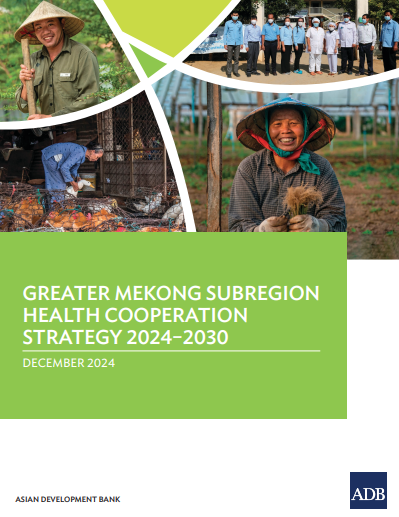
GMS Regional Health Cooperation Strategy 2024-2030
The GMS Health Cooperation Strategy 2024-2030 builds upon the previous 2019-2023 strategy and two decades of development partner support, including the Asian Development Bank.
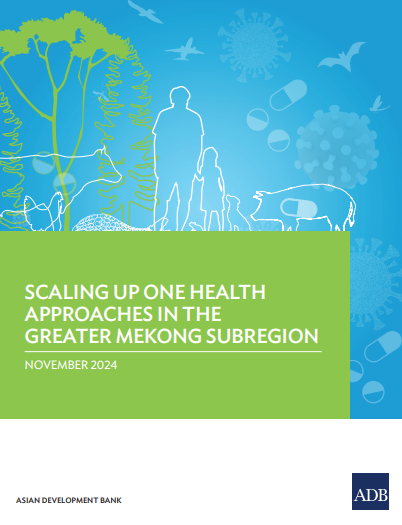
Scaling Up One Health Approaches in the Greater Mekong Subregion
The publication addresses the use of wildlife, underlines the need to ramp up action against diseases such as rabies, and shows why countries should build up their animal health capacities.
Harmonization of Sanitary and Phytosanitary Measures for Greater Mekong Subregion Countries
Pointing to rising trade between GMS countries and explaining the link between food security and global value chains, the brief shows how some exporters may initially be impacted by SPS measures due to adaptation costs.

Greater Mekong Subregion Gender Strategy Implementation Plan 2025-2030
This report shows how improving gender mainstreaming via the Greater Mekong Subregion Economic Cooperation Program Strategic Framework 2030 (GMS-2030) can bolster inclusivity and ensure women benefit equally from regional cooperation initiatives.
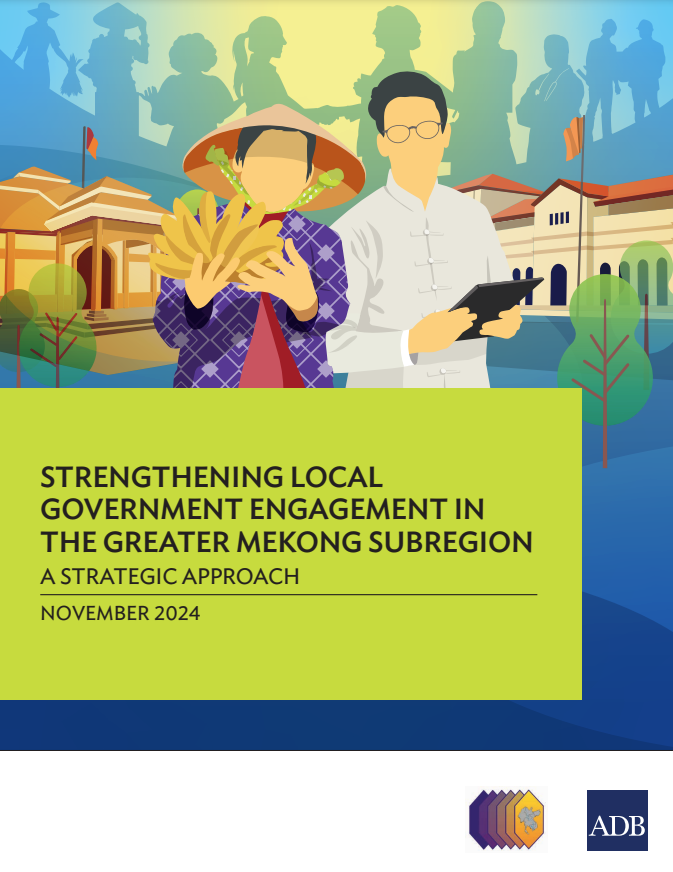
Strengthening Local Government Engagement in the Greater Mekong Subregion: A Strategic Approach
Outlining a strategy designed to boost local government participation in the Greater Mekong Subregion (GMS) Economic Cooperation program, this report presents practical implications and offers recommendations to help drive a more sustainable future.
GMS 2030 Strategic Framework for Accelerating Climate Action and Environmental Sustainability
The GMS 2030 Strategic Framework for Accelerating Climate Action and Environmental Sustainability aims to prioritize actions to accelerate implementation of selected GMS-wide interventions towards meeting the national and international commitments on climate resilience, greenhouse gas mitigation, biodiversity conservation, and environmental sustainability.
GMS Digitalization Action Plan (2025–2027)
This was developed based on the Scoping Study on Digitalization in the GMS, presented for notation in the 26th GMS Ministerial Conference, and a complement to the GMS Digital Economy Cooperation Initiative, which was developed and proposed by the People’s Republic of China and endorsed by the 25th GMS Ministerial Conference.
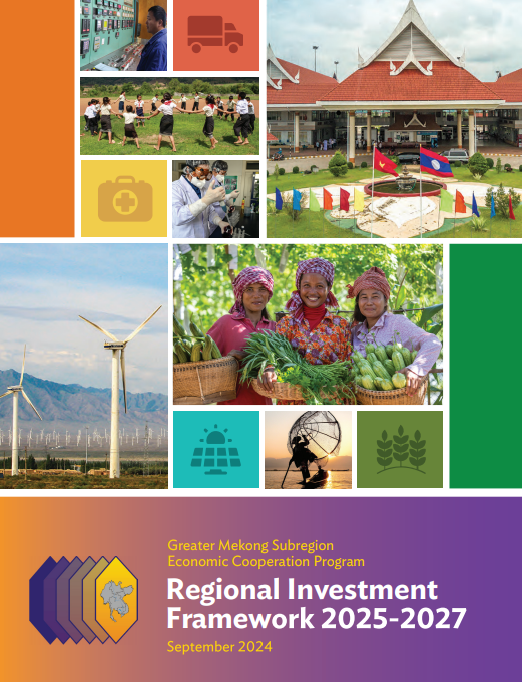
Regional Investment Framework 2025-2027
The Greater Mekong Subregion (GMS) Regional Investment Framework 2025–2027 (RIF 2027) is the subsequent 3-year rolling pipeline of projects of the GMS Program. It is comprised of 176 projects across the countries and sectors of the GMS program.
GMS Digitalization Action Plan (2025–2027)
This was developed based on the Scoping Study on Digitalization in the GMS, presented for notation in the 26th GMS Ministerial Conference, and a complement to the GMS Digital Economy Cooperation Initiative, which was developed and proposed by the People’s Republic of China and endorsed by the 25th GMS Ministerial Conference.

The Greater Mekong Subregion Program Strategy 2030: Results Framework
The GMS Secretariat, in close coordination with GMS countries, will prepare a results framework to trace the implementation of GMS-2030...

Report to the Leaders on Recent Achievements and Directions of GMS Cooperation
This document outlines the achievements of the GMS Program since the 7th GMS Summit. This report has three parts: I – The Work and Accomplishments of the GMS Program Since the Last Summit; II – The Various Deliverables for the 8th GMS Summit; and III – The Proposed Future Directions for the GMS Program.
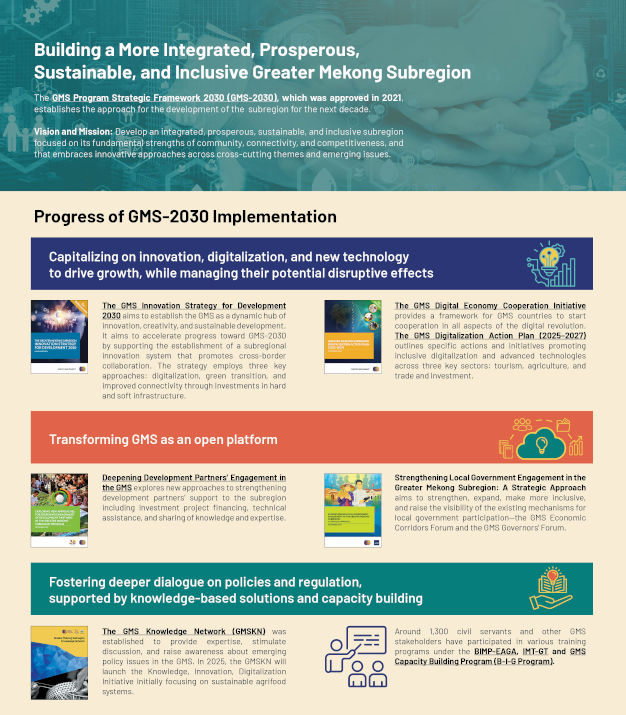
Greater Mekong Subregion Infographics 2024
The latest GMS infographic gives a snapshot of progress in implementing the GMS Economic Cooperation Program Strategic Framework (GMS-2030).
Latest News
27th GMS Ministerial Conference
The Kingdom of Thailand will host the 27th Greater Mekong Subregion (GMS) Ministerial Conference (MC‑27) on 28 November 2025 in Bangkok, Thailand. The conference will bring together ministers and senior officials from the GMS countries, development partners, private sector representatives, and other stakeholders.
GMS Innovation Week 2025: Advancing Sectoral Digitalization through Regional Action
The GMS Innovation Week 2025 will bring together government officials, technical experts, development partners, and private sector actors to accelerate the implementation of the GMS Digitalization Action Plan (2025-2027).
GMS Knowledge for Innovation
The upcoming five-day training in Hanoi are a complete training course in Knowledge and Innovation Management, tailored for the GMS Knowledge Network and focused on the topic of sustainable agrifood systems. The participation in the certification course is limited to the 30 core participants of the KFI Initiative, who will be awarded “Certified Knowledge and Innovation Managers.”
GMS Knowledge Network: Knowledge for Innovation Program Launch
The Greater Mekong Subregion (GMS)—comprising Cambodia, the People’s Republic of China (Yunnan Province and Guangxi Zhuang Autonomous Region), Lao People’s Democratic Republic, Myanmar, Thailand, and Viet Nam—has worked together since 1992 to advance economic and social development through subregional cooperation.
Greater Mekong Subregion Tourism Strategy 2030
Tourism is a key pillar of development in the Greater Mekong Subregion (GMS), supporting economic growth, cultural exchange, and regional cooperation among Cambodia, Lao PDR, Myanmar, PRC, Thailand, and Viet Nam.
