Image

Pushing China’s EAST Tokamak Past The Greenwald Density Limit

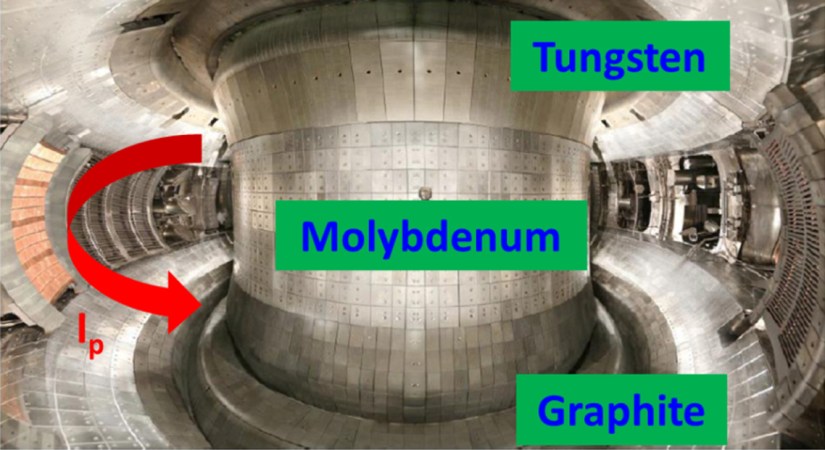
Getting a significant energy return from tokamak-based nuclear fusion reactors depends for a large part on plasma density, but increasing said density is tricky, as beyond a certain point the plasma transitions back from the much more stable high-confinement mode (H-mode) into L-mode. Recently Chinese researchers have reported that they managed to increase the plasma density in the EAST tokamak beyond the previously known upper Greenwald Density Limit (GDL), as this phenomenon is known.

We covered these details with nuclear fusion reactors in great detail last year, noting the importance of plasma edge stability, as this causes tokamak wall erosion as well as loss of energy. The EAST tokamak (HT-7U) is a superconducting tokamak that was upgraded and resumed operations in 2014, featuring a 1.85 meter major radius and 7.5 MW heating power. As a tokamak the issue of plasma and edge stability are major concerns, even in H-mode, requiring constant intervention.

Continue reading “Pushing China’s EAST Tokamak Past The Greenwald Density Limit”
Image

When Electricity Doesn’t Take The Shortest Path

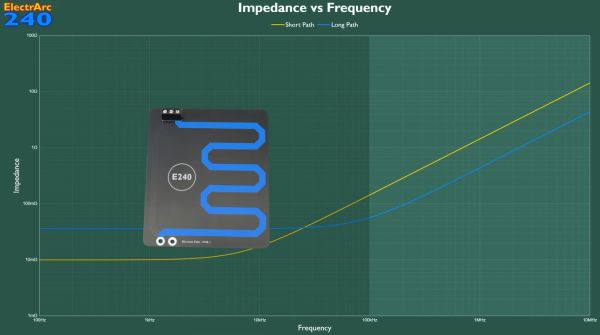
Everyone knows that the path of least resistance is the path that will always be taken, be it by water, electricity or the feet of humans. This is where the PCB presented by [ElectrArc240] on YouTube is rather confusing, as it demonstrates two similarly sized traces, one of which is much shorter than the other, yet the current opts to travel via the much longer trace. If you were to measure this PCB between each path, the shorter path has the lowest resistance at 0.44 Ω while the longer path is 1.44 Ω. Did the laws of physics break down here?

Of course, this is just a trick question, as the effective resistance for an electrical circuit isn’t just about ohmic resistance. Instead the relevant phrasing here is ‘path of least impedance‘, which is excellently demonstrated here using this PCB. Note that its return path sneaks on the back side along the same path as the long path on the front. To this is added a 1 MHz high current source that demonstrates the impact of alternating current, with reactance combining with the resistance.

Although for direct current it’s fair to say that impedance is the equivalent of resistance, once the inductance of a trace has to be taken into account – as in the case of AC and high-frequency signaling – the much higher inductance of the short path means that now the long path is actually the shortest.

When you are doing some impedance matching in your favorite EDA software while implementing an Ethernet RMII link or similar, this is basically part of the process, with higher frequencies requiring ever more stringent mechanisms to keep both sides happy. At some point any stray signals from nearby traces and components become a factor, never mind the properties of the PCB material.

Continue reading “When Electricity Doesn’t Take The Shortest Path”

Image

Electronic Nose Sniffs Out Mold

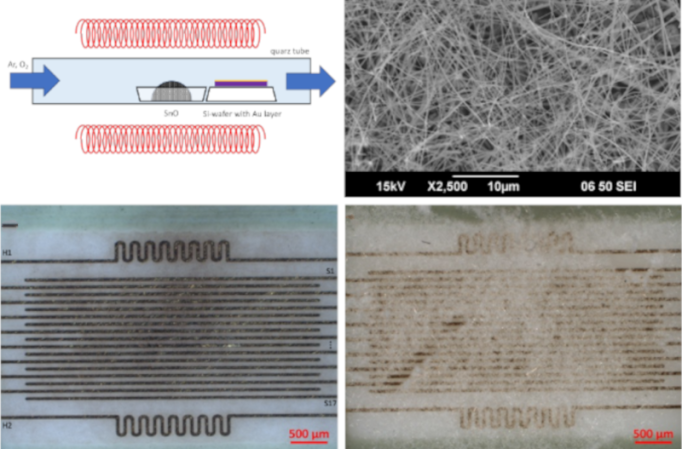
It turns out, that mold is everywhere. The problem is when it becomes too much, as mold infestations can have serious health effects on both humans and animals. Remediation is extremely expensive, too. So there are plenty of benefits to finding mold early. Now, German researchers are proposing an electronic “nose” that uses UV-activated tin oxide nanowires that change resistance in the presence of certain chemicals, and they say it can detect two common indoor mold species.

The nanowire sensors can detect Staachybotrys chartarum and Chaetominum globosum. The real work, though, is in the math used to determine positive versus negative results.

Continue reading “Electronic Nose Sniffs Out Mold”

Image

Michelson Interferometer Comes Home Cheap

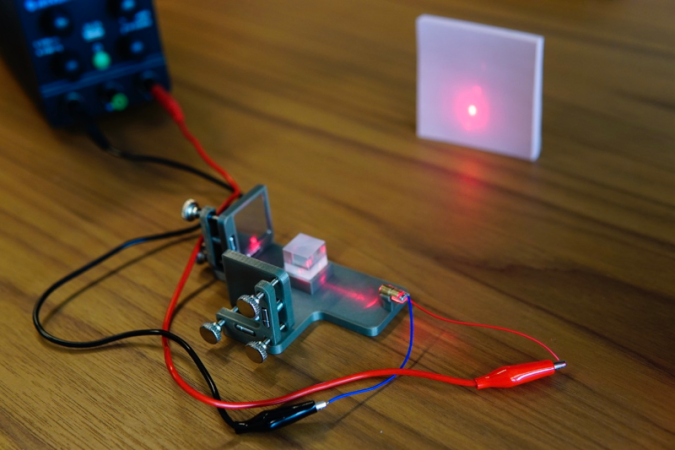
We suspect there are three kinds of people in the world. People who have access to a Michelson Interferometer and are glad, those who don’t have one and don’t know what one is, and a very small number of people who want one but don’t have one. But since [Longest Path Search] built one using 3D printing, maybe the third group will dwindle down to nothing.

If you are in the second camp, a Michelson interferometer is a device for measuring very small changes in the length of optical paths (oversimplifying, a distance). It does this by splitting a laser into two parts. One part reflects off a mirror at a fixed distance from the splitter. The other reflects off another, often movable, mirror. The beam splitter also recombines the two beams when they reflect back, producing an interference pattern that varies with differences in the path length between the splitter and the mirror. For example, if the air between the splitter and one mirror changes temperature, the change in the refraction index will cause a minute difference in the beam, which will show up using this instrument.

The device has been used to detect gravitational waves, study the sun and the upper atmosphere, and also helped disprove the theory that light is transmitted through a medium known as luminiferous aether.

Continue reading “Michelson Interferometer Comes Home Cheap”

Image

Yamato-1: The World’s First Ship With Magnetohydrodynamic Propulsion

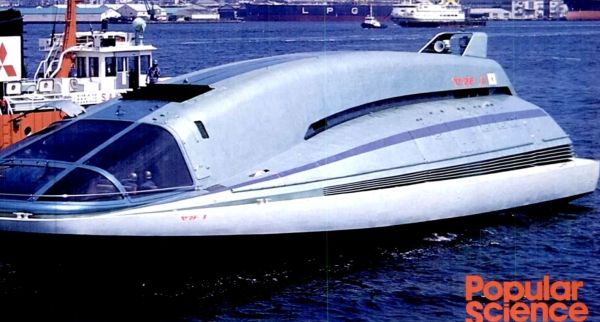
Although the humble propeller and its derivatives still form the primary propulsion method for ships, this doesn’t mean that alternative methods haven’t been tried. One of the more fascinating ones is the magnetohydrodynamic drive (MHDD), which uses the Lorentz force to propel a watercraft through the water. The somewhat conductive seawater is thus the working medium, with no moving parts required.

The end of the MHD thruster from the Yamato 1. It has six smaller green tubes surrounding a central circle. All of these pieces are coming through a grey metal fixture that is a circular shape. Small labels are affixed with Japanese writing on them. It is inside a sky blue metal frame.
The end of the MHD thruster from the Yamato-1.

Although simple in nature, only the Japanese Yamato-1 full-scale prototype ever carried humans in 1992. As covered in a recent video by [Sails and Salvos], the prototype spent most of its time languishing at the Kobe Maritime Museum, until it was scrapped in 2016.

There are two types of MHDD, based around either conduction – involving electrodes – or induction, which uses a magnetic field. The thrusters used by the Yamato-1 used the latter type of MHDD, involving liquid helium-cooled, super-conducting coils. The seawater with its ions from the dissolved salts responds to this field by accelerating according to the well-known right-hand rule, thus providing thrust.

The main flaw with an MHDD as used by the Yamato-1 is that it’s not very efficient, with a working efficiency of about 15%, and a top speed of about 15 km/h (8 knots). Although research in MHDDs hasn’t ceased yet, the elemental problem of seawater not really being that great as the fluid without e.g. adding more ions to it has meant that ships like the Yamato-1 are likely to remain an oddity like the Lun-class ekranoplan ground effect vehicle.

For as futuristic as this technology sounds, it’s suprisingly straightforward to build a magnetohydrodynamic drive of your own in the kitchen sink. Continue reading Yamato-1: The World’s First Ship With Magnetohydrodynamic Propulsion”

Image

Math Breakthrough Helps Your Feng Shui

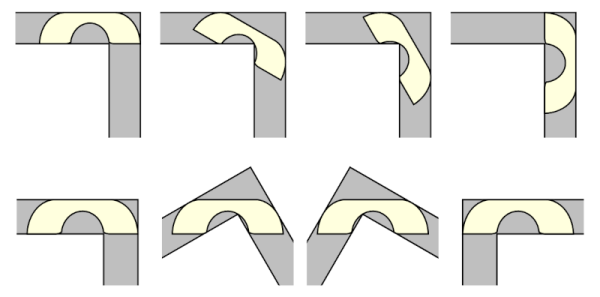
In 1966, a mathematician named [Leo Moser] proposed what sounds like a simple problem: What’s the largest shape you can move through a 1-meter corridor with a right-angle corner? Now, Korean mathematics whiz [Baek Jin-eon] claims to have solved the problem, nearly 60 years later.

The trick is, apparently, the shape of the sofa. By 1968, [John Hammerley] introduced a shape that did better than a rectangle, and by 1992, [Joseph Gerver] proposed something shaped like a phone handset, which remains the largest anyone had found, at 2.2195 square meters.

Continue reading “Math Breakthrough Helps Your Feng Shui”

Image

Fighting Food Poisoning With A Patch

Food poisoning is never a fun experience. Sometimes, if you’re lucky, you’ll bite into something bad and realize soon enough to spit it out. Other times, you’ll only realize your mistake much later. Once the tainted food gets far enough into the digestive system, it’s too late. Your only option is to strap in for the ride as the body voids the toxins or pathogens by every means available, perhaps for several consecutive days.

Proper food storage and preparation are the key ways we avoid food poisoning today. However, a new development could give us a further tool in the fight—with scientists finding a way to actively hunt down and destroy angry little pathogens before they can spoil a good meal.

Continue reading “Fighting Food Poisoning With A Patch”