Image

All Projections Suck, So Play Risk On A Globe Instead

The worst thing about the getting people together is when everyone starts fighting over their favourite map projection– maybe you like the Watterman Butterfly, but your cousin really digs Gall-Peters, and that one Uncle who insists on defending Mercator after a couple of beers. Over on Instructables [madkins9] has an answer to that problem that will still let you play a rousing game of Risk– which will surely not drag on into the night and cause further drama– skip the projection, and put the game on a globe. 

Image
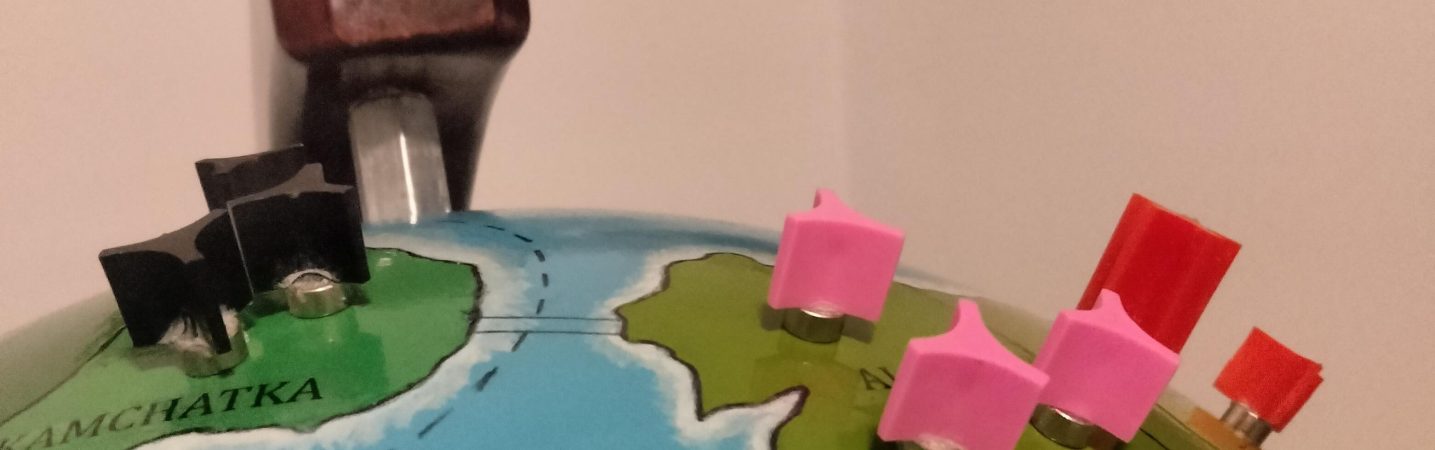
The pieces are from a 1960s version. The abstract tokens have a certain charm the modern ones lack.

Most globes, being cardboard, aren’t amenable to having game pieces cling to them. [madkins9] thus fabricates a steel globe from a pair of pre-purchased hemispheres. Magnets firmly affixed to the bases of all game pieces allow them to stick firmly to the spherical play surface. In a “learn from my mistakes” moment, [madkins] suggests that if you use two pre-made hemispheres, as he did, you make sure they balance before welding and painting them.

While those of us with less artistic flair might be tempted to try something like a giant eggbot, [madkins] was able to transfer the Risk world map onto his globe by hand. Many coats of urethane mean it should be well protected from the clicking or sliding magnet pieces, no matter how long the game lasts. In another teachable moment, he suggests not using that sealer over sharpie. Good to know.

Once gameplay is finished, the wooden globe stand doubles as a handsome base to hold all the cards and pieces until the next time you want to end friendships over imaginary world domination. Perhaps try a friendly game of Settlers of Catan instead. 

Image

The Lethal Danger Of Combining Welding And Brake Cleaner

With the availability of increasingly cheaper equipment, welding has become far more accessible these days. While this is definitely a plus, it also comes with the elephant-sized asterisk that as with any tool you absolutely must take into account basic safety precautions for yourself and others. This extends to the way you prepare metal for welding, with [Dr. Bernard], AKA [ChubbyEmu] recently joining forces with [styropyro] to highlight the risks of cleaning metal with brake cleaner prior to welding.

Much like with common household chemicals used for cleaning, such as bleach and ammonia, improper use of these can produce e.g. chlorine gas, which while harmful is generally not lethal. Things get much more serious with brake cleaner, containing tetrachloroethylene. As explained in the video, getting brake cleaner on a rusty part to clean it and then exposing it to the intensive energies of the welding process suffices to create phosgene.

Continue reading “The Lethal Danger Of Combining Welding And Brake Cleaner”

Hackaday Links Column Banner

Hackaday Links: June 29, 2025

In today’s episode of “AI Is Why We Can’t Have Nice Things,” we feature the Hertz Corporation and its new AI-powered rental car damage scanners. Gone are the days when an overworked human in a snappy windbreaker would give your rental return a once-over with the old Mark Ones to make sure you hadn’t messed the car up too badly. Instead, Hertz is fielding up to 100 of these “MRI scanners for cars.” The “damage discovery tool” uses cameras to capture images of the car and compares them to a model that’s apparently been trained on nothing but showroom cars. Redditors who’ve had the displeasure of being subjected to this thing report being charged egregiously high damage fees for non-existent damage. To add insult to injury, if renters want to appeal those charges, they have to argue with a chatbot first, one that offers no path to speaking with a human. While this is likely to be quite a tidy profit center for Hertz, their customers still have a vote here, and backlash will likely lead the company to adjust the model to be a bit more lenient, if not outright scrapping the system.

Continue reading “Hackaday Links: June 29, 2025”

Image

A Wood Chipper From First Principles

For whatever reason, certain pieces of technology can have a difficult time interacting with the physical world. Anyone who has ever used a printer or copier can attest to this, as can anyone whose robot vacuum failed to detect certain types of non-vacuumable waste in their path, making a simple problem much worse. Farm equipment often falls into this category as well, where often complex machinery needs an inordinate amount of maintenance and repair just to operate normally. Wood chippers specifically seem to always get jammed or not work at all, so [Homemade Inventions] took a shot at building one on their own.

To build this screw-based wood chipper, the first thing to fabricate is the screw mechanism itself. A number of circles of thick steel were cut out and then shaped into pieces resembling large lock washers. These were then installed on a shaft and welded end-to-end, creating the helical screw mechanism. With the “threads” of the screw sharpened it is placed into a cylinder with a port cut out to feed the wood into. Powering the screw is a 3 kW electric motor paired with a custom 7:1 gearbox, spinning the screw at around 200 rpm. With that, [Homemade Inventions] has been able to easily chip branches up to 5 centimeters thick, and theorizes that it could chip branches even thicker than that.

Of course, wood chippers are among the more dangerous tools that are easily available to anyone with enough money to buy one or enough skill to build one, along with chainsaws, angle grinders, and table saws, so make sure to take appropriate safety precautions when using or building any of these things. Of course, knowing the dangers of these tools have led to people attempting to make safer versions like this self-propelled chainsaw mill or the semi-controversial table saw safety standard.

Thanks to [Keith] for the tip!

Continue reading “A Wood Chipper From First Principles”

Image

Hand Truck Turned Into Motorcycle

For those motorcyclists looking to get a classic American-style cruiser, often the go-to brand is Harley-Davidson. However, these bikes not only have reputations for being stuck in the past, both in terms of design and culture, but they also tend to be extremely expensive—not only upfront, but in maintenance as well. If you want the style without all of that baggage, you might want to try out something like this custom motorcycle which not only looks the part, it reduces those costs by being built around a hand truck.

By the end of the project, though, the hand truck does not retain much of its original form or function. [Garage Avenger] has cut and welded it essentially into a custom frame for the diminutive motorcycle, while retaining much of its original look and feel. Keeping up with the costs savings aspect of this project, the four-stroke engine was free, although it did take some wrenching to get it running and integrated into the frame. A custom axle, a front end from another bike, a gas tank from an online retailer (that needed re-welding), and some wiring finishes out the build.

With a fresh paint job to match the original color of the hand truck, it’s off to the track. Of course it doesn’t have quite the performance of most street legal motorcycles, including some quirks with the handling and braking, but for the trails around [Garage Avenger]’s home it’s certainly a fun transportation mode he can add to his repertoire. If this is your first time seeing one of his projects, be sure to check out his other work including this drifting shopping cart and this turbine-powered sled.

Continue reading “Hand Truck Turned Into Motorcycle”

Image

A Field Expedient Welder Only MacGyver Could Love

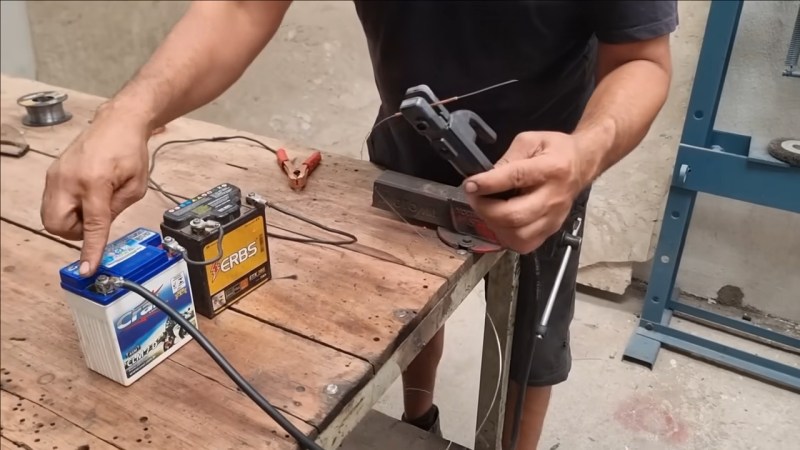
If you needed to weld something in a pinch, what’s the minimum complement of equipment you could get away with? In [Professor Bardal]’s case, it’s a couple of motorcycle batteries and a roll of flux-core wire, and not much else.

We suspect this one is going to elicit quite a few comments, not least by the welding fans who no doubt will be triggered by just about everything in the video below, especially by characterizing this as MIG welding; it’s FCAW, or flux-core arc welding. But it bears some superficial similarities to MIG, at least insofar as there’s a consumable wire electrode through which a high-current DC supply flows, creating enough heat to melt it and the base metal. In this case, the current is provided by a pair of 12-volt motorcycle batteries hooked together in series. There’s also a torch of sorts — a short length of copper capillary tubing with a 1-mm inside diameter clamped in the jaws of a stick welder stinger, or a pair of locking pliers if you’re really in a pinch. The torch is connected to the negative terminal on the battery with a jumper cable, and the positive terminal is connected to the workpiece.

To create the weld, a piece of 0.8-mm flux-core welding wire is threaded through the capillary and into the joint, and fed by hand as it’s consumed. It’s awkward and awful, but it works. Of course, there’s no control over amperage as there would be with a legit welding machine, which would make it hard to adapt this method to different materials. Weld quality appears poor, too. But we suspect that if you were in a position to need a welder like this, you wouldn’t really care about any of that.

Fabricobbled welding rigs seem to be [Professor Bardal]’s thing — witness this much more professional MIG welder, complete with a baking soda and vinegar shielding gas generator.

Continue reading “A Field Expedient Welder Only MacGyver Could Love”

Image

Welding Wood Is As Simple As Rubbing Two Sticks Together

Can you weld wood? It seems like a silly question — if you throw a couple of pieces of oak on the welding table and whip out the TIG torch, you know nothing is going to happen. But as [Action Lab] shows us in the video below, welding wood is technically possible, if not very practical.

Since experiments like this sometimes try to stretch things a bit, it probably pays to define welding as a process that melts two materials at their interface and fuses them together as the molten material solidifies. That would seem to pose a problem for wood, which just burns when heated. But as [Action Lab] points out, it’s the volatile gases released from wood as it is heated that actually burn, and the natural polymers that are decomposed by the heat to release these gases have a glass transition temperature just like any other polymer. You just have to heat wood enough to reach that temperature without actually bursting the wood into flames.

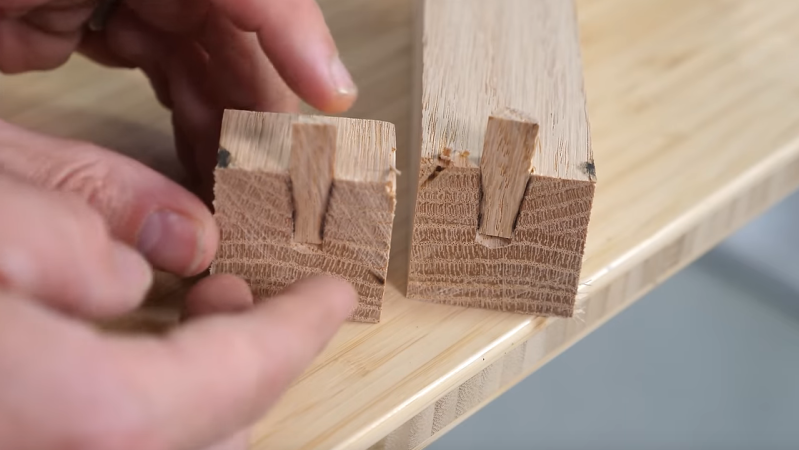
His answer is one of the oldest technologies we have: rubbing two sticks together. By chucking a hardwood peg into a hand drill and spinning it into a slightly undersized hole in a stick of oak, he created enough heat and pressure to partially melt the polymers at the interface. When allowed to cool, the polymers fuse together, and voila! Welded wood. Cutting his welded wood along the joint reveals a thin layer of material that obviously underwent a phase change, so he dug into this phenomenon a bit and discovered research into melting and welding wood, which concludes that the melted material is primarily lignin, a phenolic biopolymer found in the cell walls of wood.

[Action Lab] follows up with an experiment where he heats bent wood in a vacuum chamber with a laser to lock the bend in place. The experiment was somewhat less convincing but got us thinking about other ways to exclude oxygen from the “weld pool,” such as flooding the area with argon. That’s exactly what’s done in TIG welding, after all. Continue reading “Welding Wood Is As Simple As Rubbing Two Sticks Together”