Introduction
Questions about nutrition accuracy, food labels, and how to actually estimate food energy come up a lot for people trying to track and log their intake. Some common ones include:
- Are nutrition labels allowed to show zero Calories when Calories are present?
- Why do the same items have different nutrition data in different databases?
- Does cooking change Calorie counts?
- If we can’t accurately count Calories, should we bother trying?
While precise Calorie counts might seem ideal, the real question is: How much does this actually impact results? In this article, we will explain how to determine nutrition data, the variables that affect its accuracy, and why most of the time, the biggest thing to worry about is your consistency.
Let’s dig in!
Where does nutrition data come from?
First, we need to understand how the food itself is examined for its nutritional content. In other articles, we’ve covered how to determine protein quality or even individual Calorie values in different types of fiber. So, this would be a good time to cover the Calorie itself and how to determine the energy in food.
Energy units
The energy in food is measured using Joules (J) or calories (cal). Practically speaking, a Joule or a calorie is an extremely small amount of energy, so the energy content of food is typically expressed in terms of kilojoules (kJ; one kJ = 1,000 Joules) or kilocalories (kcal; one kcal = 1,000 calories). “Calories” on U.S. nutrition labels actually denote kilocalories and, more broadly, “Calories” spelled with a capital C typically refers to kilocalories as well. Much of the world just calls them kilocalories (kcal) on nutrition labels.
| Equivalent quantities of energy | |
| Calories (Cal) | 1 |
| kilocalories (kcal) | 1 |
| kilojoules (kJ) | 4.184 |
| calories (cal) | 1,000 |
| Joules (J) | 4,184 |
Measuring potential energy of food
Researchers obtain energy content estimates of food through many methods, but the gold standard is bomb calorimetry. The process involves combusting a food sample in a sealed chamber surrounded by water and measuring temperature change. Bomb calorimeters can vary in their design and function. Some use oxygen-based systems, while others use water bath chambers. Various techniques for the food itself are employed depending on the method. The accuracy of bomb calorimetry can depend on factors ranging from the machine itself to calibration and food sample preparation. Foods can be dried, ground, pelletized, or frozen before testing. Even small differences in sample preparation can influence the final result. Point being? The bomb calorimeter is our first step in understanding accuracy variability.
Atwater and estimated metabolized energy
So, the bomb calorimetry measures the gross energy of a food item, representing its total energy potential. However, not all of that energy is absorbed and used by the body. This energy is typically called metabolized energy, which is what the body uses for various metabolic processes. For now, you can think of bomb calorimetry as measuring the maximum energy potential of an item, but often not the amount we’d end up using. Think of it like wage systems in that gross pay is your total earnings before deductions, while net pay is what you actually take home.
To determine metabolized energy, researchers analyze waste products. This could involve using bomb calorimetry on the waste products, but other methods, such as respiration calorimetry, are also employed. These days, however, metabolizable energy for a new food product is typically estimated using formulas derived from prior experiments that more directly measured the metabolizable energy of food. The pioneer and popularizer of this estimation approach was a chemist named Wilbur Olin Atwater in the late 1800s. Since then, slight variations help determine macronutrient energy (for example, urine analysis to account for losses, particularly from protein metabolism). Ultimately, Atwater and his formulas are how we arrived at the common stats we see that represent each macronutrient.
Carbohydrate: 4 Calories per gram
Protein: 4 Calories per gram
Fat: 9 Calories per gram
Alcohol: 7 Calories per gram
As we will discuss later, the actual stats of each food item can vary. And there are arguments over the use of Atwater coefficients for this reason, but this is the current standard for labeling and tracking estimates.
Databases and labeling
Now that you understand how researchers test energy content in food, we move to how those values are stored and relayed to the public. After laboratories analyze various foods for their nutrient content and energy value, the results are compiled into databases. It’s important to note that these entries might be gross or metabolized estimations. The most reliable databases typically start with bomb calorimeter-derived data as a baseline and then apply Atwater factors to estimate metabolizable energy, better reflecting real-world energy usage.
Manufacturers can pull numbers from lab testing, measure by ingredient, and/or use approved databases (e.g., USDA FoodData Central), but they must follow guidelines set by organizations like the Center for Food Safety and Applied Nutrition and AOAC International.
Different countries also have their own labeling rules, which can introduce more variability in Calorie counts. In the United States, nutrition labels allow a 20% margin of error, meaning a food labeled as 200 calories could contain anywhere from 160 to 240 calories. Other regions have slightly different tolerances but still allow for some degree of error.
There are also allowances for “zero-Calorie” foods. In the U.S., anything under 5 Calories per serving can be labeled as zero. Other countries have their own thresholds, typically falling within a similar range.
While we’ll discuss how these variations might impact tracking, it’s important to recognize that labeling regulations are another source of discrepancy when estimating energy intake.
Nutrition labeling differences by country
| Label specifications | U.S. | EU |
| Use of the Atwater system | Yes | Yes |
| Labeling error allowed | ±20% | Not specifically defined but typically <±20% |
| Threshold for zero-calorie allowance | <5 kcal/serving | <4 kcal/100g, <2 kcal/100mL |
| Regulatory agency | FDA | European Commission |
| Label specifications | Canada | Japan |
| Use of the Atwater system | Yes | Yes |
| Labeling error allowed | ±20% | Not specifically defined but typically ±10% |
| Threshold for zero-calorie allowance | <5 kcal/serving | Different for solid and liquids but <5 kcal per 100mL or 100g |
| Regulatory agency | Health Canada | Consumer Affairs Agency |
Nutrition apps can use any database they desire. This is an important point because some nutrition websites tout higher numbers of entries, but they aren’t always verified or quality entries. In this instance, more is not always better. You want a database that has vetted quality and quantity as much as possible. MacroFactor uses the best databases for our standard search for common foods (NCC Food & Nutrient Database).
Factors that affect energy content and metabolized energy
There are still variables that affect how much energy we can extract from individual food items via our digestion. While I won’t go into exhaustive detail, here are a few factors that can cause variability.
Physical structure and complexity of food
One of the more well-documented examples comes from nuts. Several studies show that the amount of fat absorbed from nuts is affected by their physical structure. The lipids (fat) of a nut rest within the cells of hardened walls. Depending on chewing, digestive enzymes, and microbiome, the actual metabolizable energy of these nuts could vary by a pretty notable range. This has been studied in various tree nuts, where we see a range in value from Atwater to metabolized energy.
| Comparison of Atwater energy estimates to metabolizable energy (ME) for nuts | ||
| Nut type | Atwater estimate (kJ/30g) | Lowest range of ME estimate (kJ/30g) |
| Almonds | 765 | 555 |
| Cashews | 760 | 615 |
| Pistachios | 750 | 680 |
| From Nikodijevic et al (2023). | ||
Similar results are found in foods with a higher fiber content or more resistant starch. Essentially — and if you think of it in a super simple manner — the more complex the food’s matrix is and the harder its layers are, the less likely it is that we scrape every bit of its energy. And, to be fair, that’s not necessarily the goal. These structures and fibers could play a beneficial role in our digestive system. In short, it’s not bad that we don’t always obtain every Calorie; it’s just part of the process.
Cooking
Cooking (or not cooking) can introduce another variability in metabolized energy. Cooking, for example, can allow us to obtain more energy from certain foods than we can from those foods in a raw or less cooked state because it breaks down cell walls or allows access to stored lipids. This doesn’t add Calories per se, but it makes the energy already present more available. Conversely, a less complex food matrix may result in greater energy loss through incomplete digestion. This will all vary depending on the type of food and the cooking method, but protein digestion, starch, and lipid availability can all be enhanced (and therefore more Calories absorbed) via cooking.
Microbiome
Lastly, different microbiome activities and consistent diets can affect absorption. Our levels of bacterial and gut diversity can alter how easily we can or cannot extract or absorb nutrients. In a 2023 study by Corbin et al, participants who ate a microbiome-enhancing diet (MBD) showed higher energy losses and lower metabolizable energy than those on a Western diet (WD).

Generally speaking, a diet high in harder foods, even if they are technically more energy-dense, like fatty nuts, might contribute more to higher energy losses. And by contrast, diets with more processed foods could allow for easier absorption. This is just one more layer that adds to the variables of accurate nutrition counts.
Midway recap
- Food contains energy, which our bodies use to function.
- The gross energy potential of food is determined through methods like bomb calorimetry.
- Calorimetry measurements and metabolic formulas help estimate how much energy we can use. Over time, these methods have provided averages and estimates for the metabolizable energy of different foods.
- From there, food labeling agencies allow various errors and allowances up to 20% in some countries, as well as the labeling of “zero-calorie” foods if they fall under certain limits.
- Additional factors, like food properties and cooking methods, can further impact the amount of Calories we access in our food.
Some people could take all of this to mean calorie tracking is futile, but that’s the wrong takeaway! In the next section, we’ll explore why these estimates, despite their imperfections, are still useful and how consistency in tracking matters far more than perfect precision.
Why imperfect data still works
There are two main reasons you don’t need perfect Calorie counts for tracking to be helpful:
- Errors tend to cancel out
- Even if there are consistent tracking errors in one direction, the precision should still be sufficient for the data to be useful
Errors tend to cancel out
I think people tend to see that individual foods can have labeling errors of up to 20% and tacitly assume that this means their daily Calorie counts may be off by 20%. However, labeled Calorie counts can differ from actual Calorie counts in both directions, which tends to reduce Calorie counting errors over the course of a day, week, or month. In other words, if the maximum allowable error for a single food is 20%, the typical error for each food will be less than 20%, the typical error for a day of tracking will be even smaller, and the typical error for a week or month of tracking will be smaller yet.
Just to illustrate, let’s assume you’re aiming to eat 2000 Calories per day. Each day, you only consume four food items, each of which has 500 Calories. The labeling error for each of the foods is ±10%, meaning about two-thirds of foods labeled to have 500 Calories will actually have between 450-550 Calories (errors up to 10%), and about 95% of foods labeled to have 500 Calories will actually have between 400-600 Calories (errors up to 20%), and about 5% of foods will have labeling errors exceeding the allowable 20% threshold.
Here’s how this distribution of food labeling errors looks graphically:

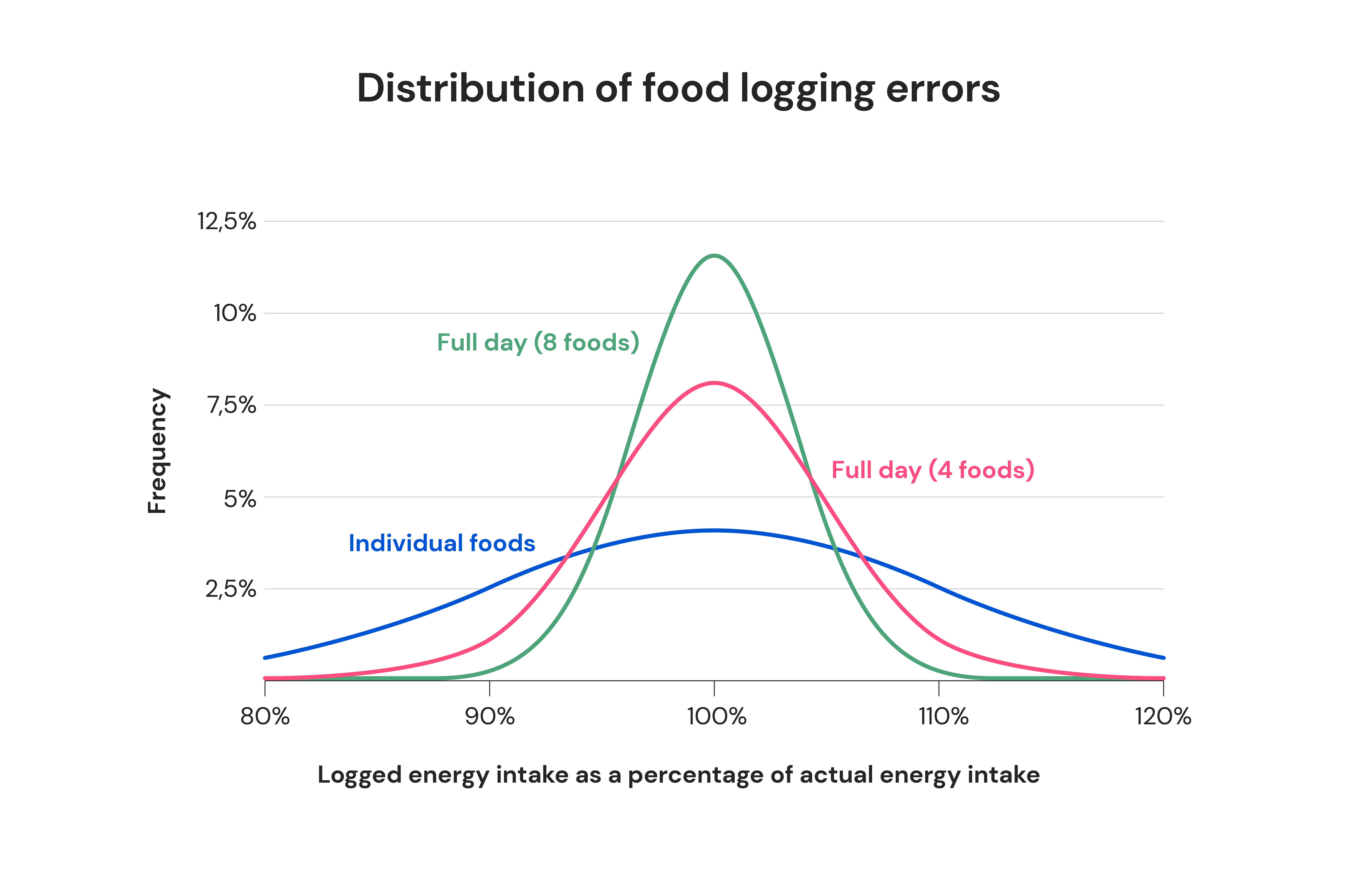
With this range of food labeling errors, how wide of a distribution of Calorie tracking errors should you expect to see each day? To find out, I simulated 1000 days of eating and tracking four foods, each of which is labeled to have 500 ± 50 (mean ± standard deviation) Calories. From there, I compared the actual intake for each day (the sum of four foods with 500 ± 50 Calories apiece) to the expected intake (2000 Calories per day).
Daily tracking errors had a standard deviation of just ±5% (2000 ± 100 Calories). So, the potential error when tracking four foods (±5%) is already half the size of just tracking one food (±10%). Here’s how that looks graphically:

However, most people consume more than just four foods in a day. Individual food items are prepared with multiple ingredients, and meals contain multiple dishes. What if we assume that, instead of just eating four foods per day, you eat (and log) eight foods per day, with an average of 250 Calories apiece? For each of these foods, the distribution of labeling errors is still ±10%.
By logging more foods each day, the distribution of errors shrinks further, from ±5% to ±3.5%. That may sound like a relatively small improvement in precision, but it means that daily tracking errors exceeding 10% go from occurring about 5% of the time, to less than 1% of the time. Here’s how that looks graphically:
But, it’s rare to just log your food on a single day. Instead, most people who log their food do so consistently, with the aim of understanding their typical energy intake and determining how much they should eat to gain, lose, or maintain their weight. So, to what extent does precision improve over a week of food logging compared with a single day of logging?
Well, as we’ve seen so far, the more we log, the more those food labeling errors cancel out. The jump in precision from a day of logging to a week of logging is a big one. The distribution of errors shrinks from ±3.5% to ±1.35% when you go from logging eight foods in one day, to eight foods per day for an entire week. In other words, over the course of a week, even 5% errors should be uncommon. If you think your average intake was 2000 Calories per day, you can be quite confident that it was actually somewhere between 1900-2100 Calories per day. Here’s how that looks graphically:

But naturally, big changes on the scale or in the mirror take longer than a week to manifest. Furthermore, you probably don’t plan to massively increase or decrease your energy intake based on a single week of data. Instead, you may want to take note of your monthly progress and your average energy intake over the past month, in order to determine whether you need to increase or decrease your Calorie targets. So, how much more does precision improve over a month of food logging compared with a single week of logging?
Once again, it’s a big jump in precision. The distribution of errors shrinks from ±1.35% to ±0.65% when you go from logging eight foods per day for a week, to eight foods per day for an entire month. Here’s how that looks graphically:
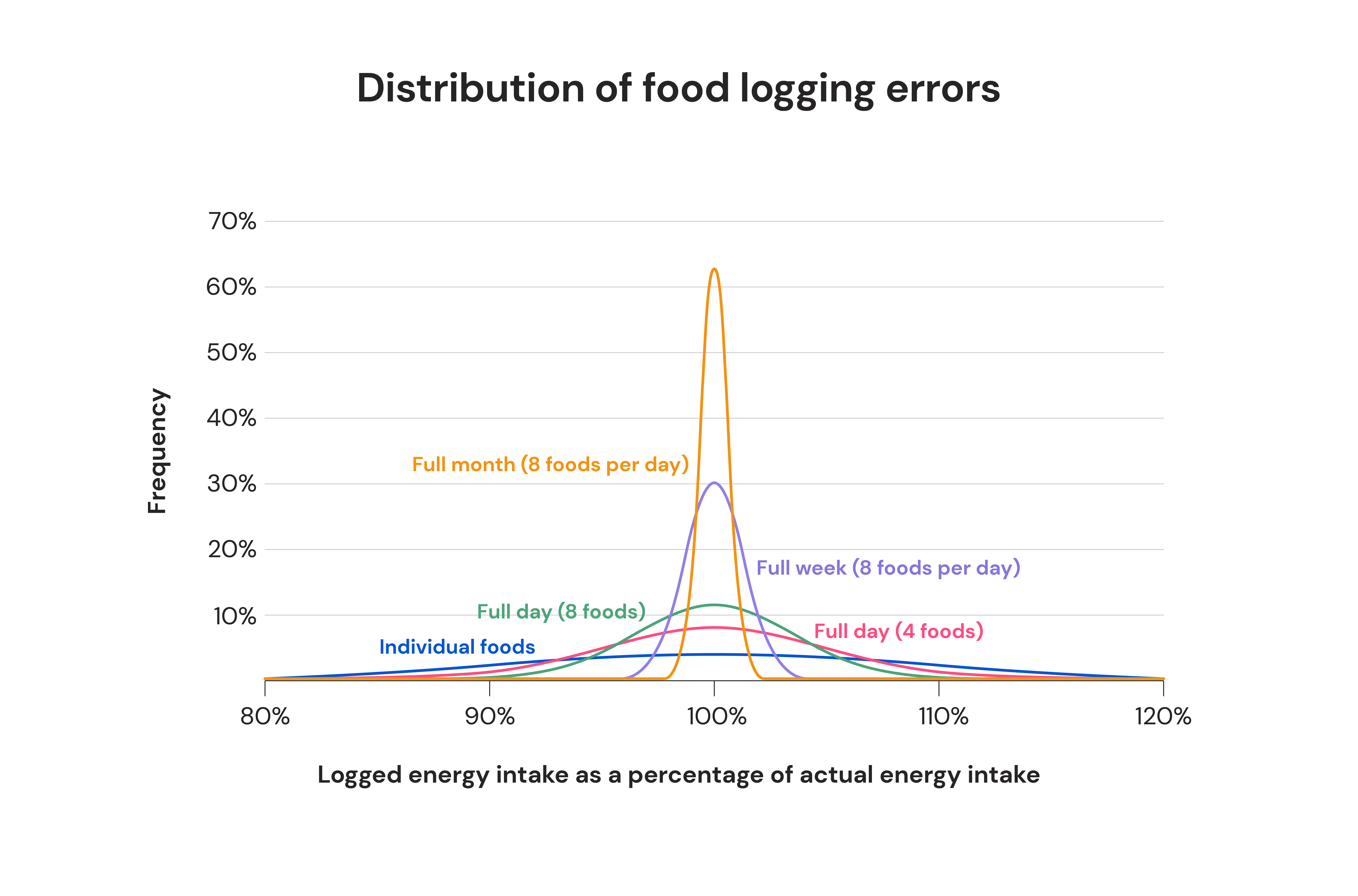
So, in this illustration, we can see that logging all of your food for a month can increase the precision of your tracking approximately 15-fold. Individual foods may have labeling errors of up to 20%, but the more you track, the more you cancel out those errors.
This is an important concept to understand — assuming you log all of your food, the maximum labeling or logging error for a single food is always larger than the maximum possible logging error for a whole meal, which is always larger than the maximum logging error for a full day, which is always larger than the maximum logging error for a full week, etc. As long as you make a good-faith effort to log everything you eat, you can have a very good idea of your energy intake, even if some foods have 20% more or 20% fewer Calories than their labels suggest.
However, I’ll note that the real world can differ from this illustration in certain key ways. A baked-in assumption in the simulated data is that the average logging/labeling error was 0%. In other words, some foods may have >20% more or fewer Calories than a food label would suggest, but the overestimates and underestimates were symmetrical in both frequency and magnitude. However, most people have reasonably consistent diets, and the labeling errors of the foods you eat most consistently probably aren’t random. In other words, a random assortment of foods labeled to have 300 Calories may have anywhere from 240-360 Calories, but a particular brand of bagels that’s labeled to have 300 Calories may consistently have 330-340 or 280-290 Calories per bagel. So, it’s entirely possible that the foods comprising the bulk of your diet do, on average, over-list or under-list their caloric content. Maybe you always get lunch at the same restaurant, and your go-to order has 500 more Calories than the menu lists. As a result, even if all of the other foods you eat have an average labeling error of 0%, you’re still consuming 500 more Calories per day than you think you are.
So, would that be problematic? If your actual daily energy intake does, on average, differ from your logged energy intake, does that reduce the utility of food logging?
Not really.
When using logged nutrition data to inform energy intake targets, labeling and logging errors wash out
Most people log their food with a functional outcome in mind. Typically, they want to know how much they’re currently eating because they want to determine how much they need to eat to gain, lose, or maintain their weight.
So, let’s assume that someone is currently maintaining their body weight, they have a goal of losing weight, and their food logging suggests that they’re eating 2500 Calories per day.
Since their goal is weight loss, what should they do?
The answer is fairly obvious: they should aim to eat fewer than 2500 Calories per day. If they’re aiming to lose a pound per week, a target of 2000 Calories per day would be appropriate.
However, let’s also assume that this person happens to mostly eat foods that consistently under-list their Calorie counts. So, they think they’re eating 2500 Calories per day, but they’re actually eating 3000 Calories per day. As a result, if they want to lose weight, they need to consume fewer than 3000 Calories per day. If they’re aiming to lose a pound per week, a target of 2500 Calories per day would be appropriate.
Does this 500-Calorie gap between their actual energy intake and their logged energy intake create any problems?
Generally, no.
If they aim to reduce their energy intake to 2000 Calories per day, they’re aiming to reduce their logged energy intake to 2000 Calories per day. When they thought they were eating 2500 Calories, they were actually eating 3000. So now, when they think they’re eating 2000 Calories, they’re actually going to be eating around 2500.

In other words, reasonably consistent directional errors wash out once you start using your food logging data to inform your Calorie targets for weight change (or weight maintenance) goals. So, if the foods you eat actually have more Calories than the nutrition label suggests, that’s totally fine. Or, if you eat a lot of raw, unprocessed fruits, vegetables, and nuts, and you don’t absorb a significant portion of their caloric content, that’s also totally fine. If you don’t log your food with perfect accuracy, that’s also perfectly fine, as long as you make a good-faith effort to log all of your meals.
Referring back to the previous section, the gains in precision from consistently logging your food are far more important than any gains in accuracy.

Here’s an easy way to think about it. Imagine you could choose between two ovens. One of them is perfectly accurate, but the temperature fluctuates wildly. If you set it for 350°F, it may dip down to 250°F or get up to 450°F, but over the entire bake, its average temperature will be exactly 350°F. The other oven isn’t perfectly accurate — it always runs 25°F cooler than where you set it — but it keeps a consistent temperature. If you set it for 350°F, the average temperature for the bake will be 325°F, but it will only fluctuate between 315°F and 335°F.
I think all of us would take the second oven. The number it displays on its thermometer may not be perfectly accurate, but you’ll be able to turn out consistent bakes with a tiny bit of trial and error. The optimal baking temperature for a dish may be 400°F. But, based on experience, you think it turns out better when you bake it at 425°F. In reality, the optimal temperature is still 400°F, but when you think you’re baking at 425°F, you’re actually baking at 400°F. And, since the oven holds a steady temperature, you get consistent outcomes.
The impact of consistent, directional food logging or food labeling errors is similar to having an oven that runs a little warm or a little cool, but maintains a steady temperature. As long as your data is sufficiently precise (and it will be, if you’re logging consistently), it doesn’t matter too much if it’s not perfectly accurate.
Of note, this is one of MacroFactor’s key advantages: Since the app calculates your energy expenditure and nutrition targets based on your logged energy intake, its recommendations will reflect and correct for the sorts of nutrition labeling and food logging errors discussed in this section.
Takeaways
It’s true that nutrition data isn’t perfectly accurate, and researchers are still refining methods for estimating food energy and absorption. That said, it’s an overreaction to think that these estimates mean Calorie tracking can’t still produce predictable and reliable results.
If you consistently log food the same way each day, built-in errors become a non-issue. Since your intake and weight trends should drive your adjustments over time, minor discrepancies won’t affect your ability to make progress. So instead of stressing over nutrition labels or databases, focus on your consistency. If you track the same way, follow your trends, and build solid logging habits, you can make informed adjustments and keep moving toward your goals.