About the challenge:
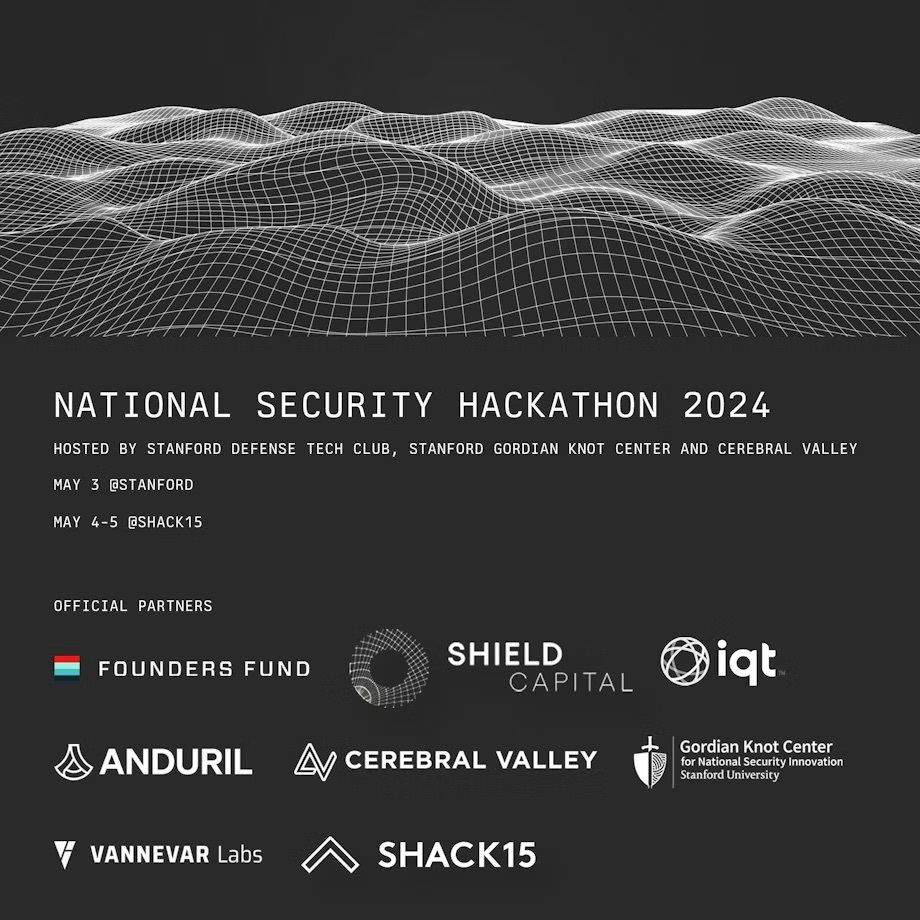
Welcome to the National Security Hackathon! This event is hosted by Stanford's Defense Tech Club, Stanford Gordian Knot Center, Cerebral Valley, and Shack15.
Get started:
Please review the notion doc sent out through the partiful.
Sponsors Include:
Shield Capital (https://shieldcap.com/)
Vannevar Labs (https://www.vannevarlabs.com/)
Founders Fund (https://foundersfund.com/)
Anduril (https://www.anduril.com/)
IQT (https://www.iqt.org/)
Skyfi (https://www.skyfi.com/)
Primer (https://primer.ai/)
Radiant (https://radiantai.com/)
Dedrone (https://www.dedrone.com/)
Requirements
For this hackathon, we’ve curated four problem themes directly from the US Military, industry partners, and government officials. Each team must complete their project within one of these four guiding problems.
- Theme 1: Next Generation Intelligence Analysis
- Recommended Resources:
- SkyFi Satellite Imagery
- Umbra SAR Scans
- Other OSS Real-World Imagery
- Radiant LLM Inference
- Data visualization tools
- Example Projects (not limited to these):
- Develop semantic search and analysis methods for satellite-specific imagery.
- Integrate military imagery with language models to automate analysis, enhance reporting, and expedite alerting.
- Create methods to detect poisoning or tampering with the outputs of computer vision models.
- Implement techniques for detecting SOS/HELP signals in satellite imagery.
- Enhance or improve Kepler or Deck imagery software.
- Identify unusual drone flight patterns, such as drug drops, using a dataset of regular drone flights.
- Apply machine learning to enhance a network of cameras and sensors (including radar, acoustic, visible optical, thermal, and passive RF) to actively search the sky for drones.
- Identify falsified records or altered data that may throw off intelligence reporting summaries
- Disambiguate an entity detected by multiple different sensor modalities (ex: if you capture an EO and SAR shot of an object, can you determine if they are the same object)
- Detect automatic identification system (AIS) spoofing (ex: falsified positional, speed, navigational information)
- Recommended Resources:
- Theme 2: Digital Drone Resilience and Operation
- Recommended Resources:
- Dedrone flight data and collisions data
- Simulated hardware environment
- Example projects (not limited to these):
- Develop a method to detect and track drone locations in GPS-denied environments using machine learning to identify coordinates from aerial videos.
- Create a system where users input a list of approved SKUs for different drone parts and frames, and the system checks availability and pricing across various websites.
- Build a battlefield visualization platform that integrates and visually communicates data from multiple domains (e.g., ADSB, AIS, satellite imagery, video feeds, network topologies) in an intuitive and extensible manner.
- Develop a collision prevention algorithm for drones and aircraft, focusing on the rapid computation of intersections between 3D ellipsoids and cylinders, which are standard zones for triggering alerts when aircraft approach each other. Courtesy of Dedrone, speak to them for more information.
- Design a novel intra-swarm communication system for swarms of small uncrewed aerial systems (sUAS) or ground vehicles (sUGV) that does not rely on RF energy, exploring alternatives like lasers, LEDs, audible signals, or specific flight movements.
- Develop a system that enables users of real time ISR and other data assets to rapidly source historical information of key entities (EX: while flying a drone, rapidly pull up images of a particular building from the past 48 hours or quickly identify an aircraft in front of you based off geolocated AIS data)
- In scenarios where small UAVs collaboratively track a moving target, what minimal information must be transmitted between UAVs to maintain effective tracking without overloading the network?
- Recommended Resources:
- Theme 3: Computational Logistics and Reporting
- Recommended Resources:
- Primer and Vannevar Social Media Logs
- Radiant LLM Inference
- OSS Information on Worldwide Logistics
- Example Projects (not limited to these):
- Design a program to scan for and analyze events potentially disrupting global supply chains, assessing the scale of impact.
- Develop a program to monitor the internet for disaster or attack reports, evaluate the authenticity of these events, and predict the number of people affected.
- Create an API-based, customizable open source threat intelligence brief aggregating data from sources like CrowdStrike, Mandiant, Recorded Future, Virus Total, and Microsoft, providing a daily one-page summary of the cyber threat landscape.
- Develop methods to adapt operational military systems to address specific threats.
- Implement a summarizer for Situation Reports (SITREPs) that uses graph-based intelligence reporting to link references to people, events, and organizations.
- Build a system where users input a list of SKUs for drone parts, and it checks availability and pricing across various websites, facilitating cost-effective drone construction in wartime scenarios.
- Analyze foreign social media and news to identify top topic hierarchies, narratives, and entities with strong sentiment.
- How can telemetry, metrics, and logs from multi-vehicle systems be effectively communicated to system operators for real-time and post-operation analysis and debugging, especially when coordinating tasks like multiple UAVs searching for a target?
- Recommended Resources:
- Theme 4: AI-Enhanced Telemetry and Sensing
- Recommended Resources:
- Radiant LLM Inference
- Open Source Sensor Data
- Example Projects (not limited to these):
- Utilize natural language data analysis and code execution techniques to analyze sensor data.
- Employ a Large Language Model (LLM) to translate sensor data standards described in Interface Control Documents (ICDs) into a schema compatible with the EUROCONTROL Surveillance Information Exchange (ASTERIX) standard for computational decoding.
- Develop a system for generating reports from raw sensor data on a rolling time schedule (e.g., every 5 minutes, 15 minutes, 1 hour, 1 day), with built-in anomaly detection to trigger alerts when anomalies are detected.
- Can extensible systems be developed to visually and spatially present large amounts of heterogeneous data sources (like ADSB, AIS, satellite imagery, video feeds, and network topologies) in intuitive ways to battlefield operators?
- Develop a path planning algorithm for an autonomous ground vehicle that calculates an optimal route from point A to point B using open-source map data, considering either or both points could exist on-road or off-road). The solution should prioritize safety, efficiency, and adaptability to diverse terrains.
- Recommended Resources:









Prizes
1st Place
$3000 cash
2nd Place
$2000 cash
3rd Place
$1000 cash
Devpost Achievements
Submitting to this hackathon could earn you:
Judges

Raj Shah
Shield Capital
Gokul Subramanian
Anduril
A.J. Bertone
IQT
Scott Philips
Vannevar Labs
Stu Wagner
USAF
Johnathan
SOCOM
Nand Mulchandani
CIA
Jim Teysom
Skyfi
John Bohannon
Primer
Nitish Kulkarni
Radiant
Bryce Mitchell
Stanford Defense Tech
Chris Kay
Stanford Defense Tech
Ritwik Gupta
DIU
Nick Ashworth
Defense Digital Service
Scarlett Swerdlow
DISA
Jeffrey Wright
SOCPAC
Glenn Parham
Defense Digital Service
Andrew Cote
Andrew Cote
Judging Criteria
-
Impact
What is the project’s long-term potential for success, growth and impact? -
Technical implementation
How well has the team implemented the idea? -
Creativity
Is the project’s concept innovative and unique? -
Pitches
How effectively does the team present their project?
Questions? Email the hackathon manager
Tell your friends
This site is protected by reCAPTCHA and the Google Privacy Policy and Terms of Service apply.
